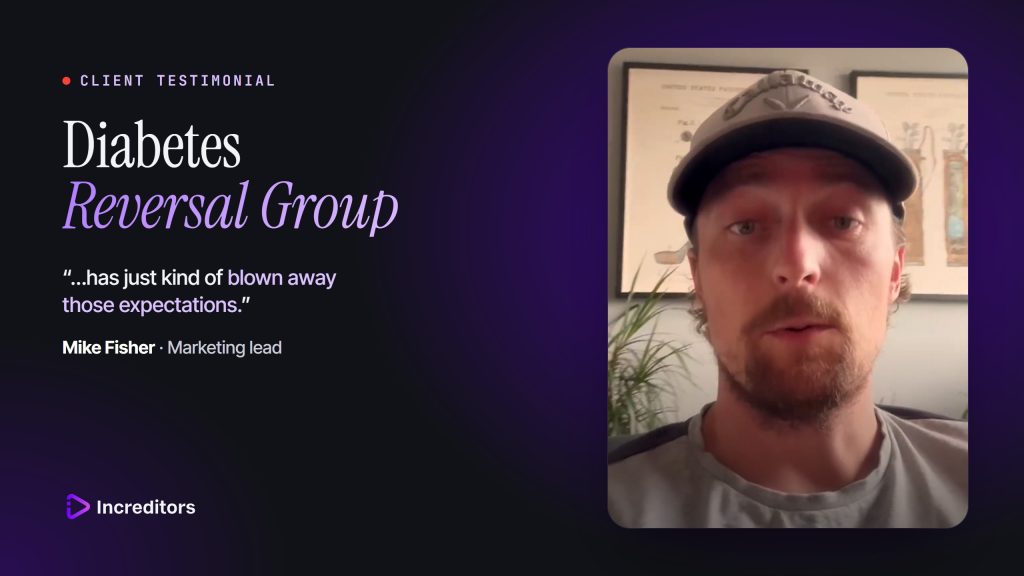







































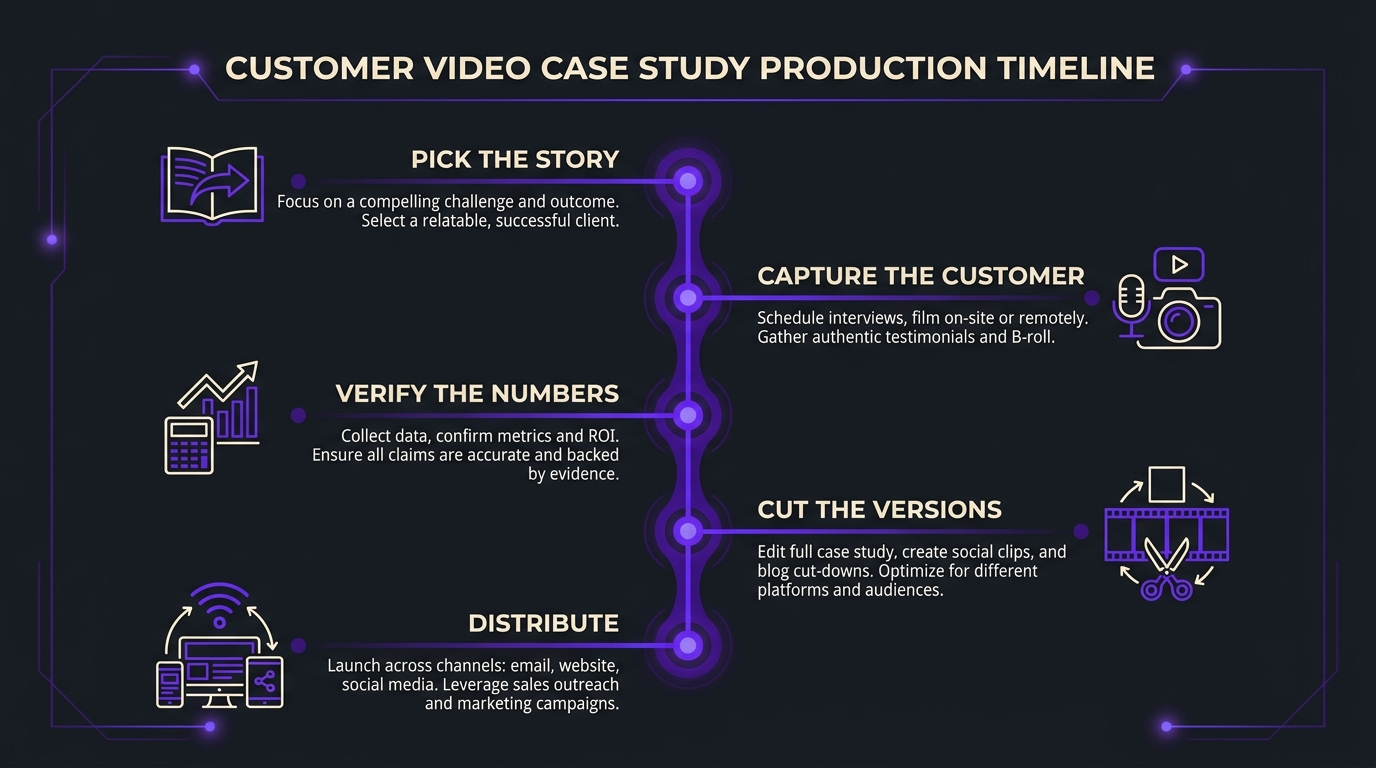
A B2B video case study is a short, produced story about one customer: the situation they were in, what was done, what changed and who says so. It sells when it is built around a result the customer confirms, shows the product doing real work and is cut into versions for every stage of a long sales cycle. Pick the story with a scorecard, follow a five-beat structure, get every number approved in writing and distribute it where your buyers already decide. This guide gives you the full process, a selection scorecard, an interview question set, an approval checklist and the common mistakes.
A B2B video case study works when it tells one customer’s story in five beats, backs the result with a number the customer has approved, shows the product doing real work and is cut into versions for each stage of the sales cycle. That is the short answer, and the rest of this guide shows how to produce one, from picking the customer to distributing the final cut.
A note on scope. We already cover the customer-voice format in our guides to turning customer calls into testimonial videos, the cost of testimonial videos and the best B2B testimonial video companies. Those posts are about a customer saying they are happy. This one is about the case study: a structured, evidence-led story for B2B software and tech teams that sell a complex product to a committee, where the buyer wants to know how the result happened before they believe it.
- What a B2B video case study is
- Why considered-sale buyers watch them
- Choosing the right customer story
- The five-beat structure
- Getting proof you can stand behind
- Capturing the customer interview and the product
- Editing: the visual track and the versions
- Customer approval and legal review
- Where the case study video earns its keep
- Effort, timeline and cost
- Six mistakes that make case study videos forgettable
- How this played out
- FAQ
- Verdict
What a B2B video case study is
A B2B video case study is a produced video built around one customer outcome. It has a defined viewer (a prospect with a similar problem), a defined job (move them one step closer to a conversation) and a story with evidence. In the written world it is the equivalent of the PDF case study that sales sends after a call; in video it carries more of the buyer’s trust because they can see and hear the customer and watch the product in use.
What it is not
- Not a testimonial montage. Three people saying “great team” does not explain what changed.
- Not a product demo. A demo shows what the product can do; a case study shows what it did for a named customer.
- Not a company film. The customer is the protagonist, and your company plays a supporting role.
The practical test is simple. After watching, a prospect in the same situation should be able to say what the customer’s problem was, what was done about it and what improved, and should be able to imagine a similar story for their own company.
Why considered-sale buyers watch them
B2B software and AI products are hard to evaluate from a landing page. The buyer is rarely one person: a founder or VP of Marketing may champion the purchase, but technical, finance and security stakeholders weigh in, and each wants reassurance that someone like them has done this before. The LinkedIn B2B Institute publishes research on how B2B buying and brand-building work, including how few buyers are in market at any one time; see the LinkedIn B2B Institute for its published research. A case study video is one of the few assets that speaks to all of those stakeholders at once.
It also does a job that written case studies struggle with. A complex mechanism, such as how data flows through a platform or how a model reaches a recommendation, is much easier to follow with motion and narration than with a paragraph. That is why our work with technical clients leans on animation to show how things work; see our guides to the technical explainer video for complex products and the SaaS explainer video series for the visual thinking in more depth.
If you are building a wider programme, the case study video is one asset in a system. Our B2B video marketing strategy playbook and the guide to educational video content for B2B show where it fits alongside explainers, interviews and long-form education.
Choosing the right customer story
The biggest quality lever in a case study video is the choice of customer, and it is made before anyone picks up a camera. A brilliant edit cannot rescue a story with no clear before and after. Score candidates against a short scorecard and pick the one that clears the bar, rather than the one who is easiest to reach.
💡 Pro Tip: Build a shortlist of three candidate customers, run the scorecard on each and interview the best two. Sometimes the second customer tells the cleaner story once you have heard the first one. Your sales and customer success teams know which accounts are proud of the result, so ask them before the data team.
Match the story to the stage of the buyer
Different stories do different jobs. A story about a fast, low-risk start suits buyers who are afraid of a long implementation. A story about a technically demanding deployment suits sceptical engineers. A story about a measurable outcome in pipeline, retention or cost suits the person who owns the budget. If you only have budget for one, pick the story that answers the objection you hear most often on sales calls.
The five-beat structure
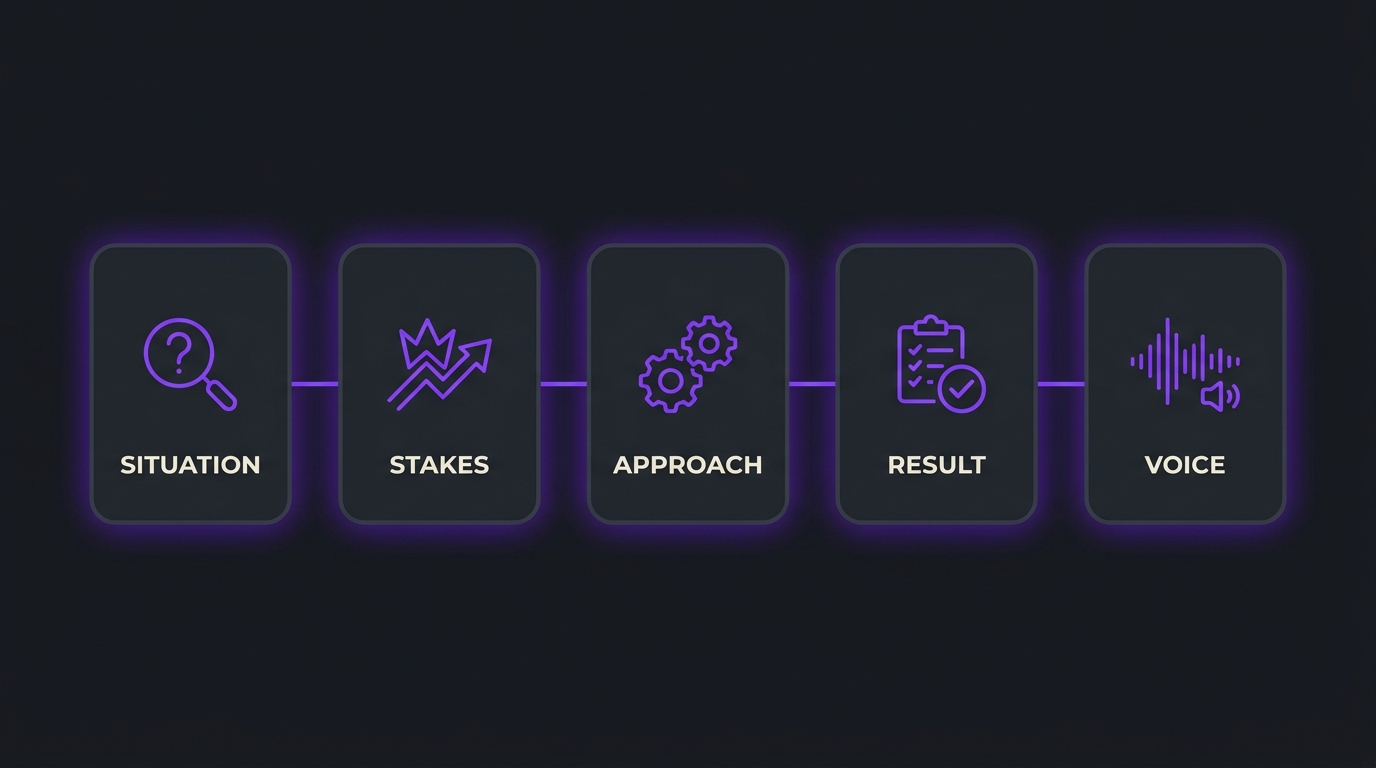
Most strong case study videos follow the same five beats. The order is deliberate: the viewer meets the customer’s situation first, so they can see themselves in it, and only then hears about the product.
Beat 1 and 2: situation and stakes
Open on a person, not a logo. A founder or marketing lead describing the problem in their own words is more credible than a narrator describing it for them. Keep the first fifteen seconds free of your product name, because the viewer is still deciding whether this story is about them.
Beat 3: approach
This is where B2B case studies earn their keep and where most of them are thinnest. Show the real mechanism: the integration that was configured, the workflow that was automated, the model that was applied to the customer’s data. If the mechanism is abstract, animate it. A short animated sequence with the customer’s real terminology is often clearer than footage of someone typing.
Beat 4: result
Lead with the outcome the customer cares about, not the one you care about most. Put the approved figure on screen as text, say it once in voiceover or interview and move on. A result presented as a range, a milestone or a before and after comparison is as believable as a single precise number, and often easier for the customer to approve.
Beat 5: voice
End with the line a peer would repeat to a colleague. The best closing lines are specific (“we stopped explaining our product on every call”) rather than general (“highly recommended”). Then give one next step, such as booking a call or reading the written case study.
Getting proof you can stand behind
Evidence is what separates a case study from a testimonial, and it is also where teams get into trouble. Three rules keep the proof clean.
- Every number belongs to the customer. Use figures the customer can verify from their own systems, and confirm the definition, time period and baseline before you film the result beat.
- Prefer honest ranges and milestones to false precision. “Cut weekly reporting from a day to an afternoon” is more credible than a decimal point that nobody checked.
- Get approval in writing for the exact wording on screen. The claim in the cut must match the claim the customer signed off.
There is also a legal side. In the United States, the FTC’s guides on endorsements and testimonials, codified at 16 CFR Part 255, set expectations about honest and substantiated endorsements, including disclosing material connections. Check the current text with your own counsel, because we are not giving legal advice. In practice the rule of thumb is the same as good editorial practice: the customer really said it, the result really happened and anything unusual about the relationship is disclosed.
💡 Pro Tip: Ask the customer to confirm the figures by email before the edit starts, not after. It is far cheaper to change a number in the interview plan than to reshoot a result beat or re-animate a graphic.
When the customer cannot share numbers
Many B2B customers, especially in finance, security and health-tech, cannot disclose figures. That is fine. Build the result beat around something they can say: a decision they could make faster, a process they no longer run by hand, an audit they passed or a team that now works differently. A credible qualitative outcome from a named person beats a vague percentage nobody will stand behind.
Capturing the customer interview and the product
Run the interview like a conversation, not a script
The goal of the interview is to get answers in the customer’s own words that map onto the five beats. A good interview runs forty-five to sixty minutes, covers more ground than you will use and is recorded with the customer’s permission. For remote recordings, use a platform that captures separate local audio and video tracks so the edit has the cleanest possible material.
A starting question set, grouped by beat:
- Situation: Tell me about your company and your role. What were you trying to achieve before you started working with us?
- Stakes: What was not working? What would have happened if you had done nothing?
- Approach: Walk me through how you actually used the product in the first weeks. What surprised you?
- Result: What is different now? What can you do that you could not before? Is there a number or milestone you are comfortable sharing?
- Voice: What would you say to a peer considering this? What was the moment you knew it was working?
Ask follow-ups until the answer becomes concrete. If the customer says “it saved us time,” ask how much time, on what task and what the team did with it. The follow-up is the quote.
Capture the product doing real work
The approach beat needs footage. Record screen capture of the real workflow, ideally with the customer driving, and collect anything that can be animated later: diagrams, data flow descriptions, integration lists. For technical and data products, ask the customer to describe the process on a whiteboard or shared screen, because the drawing is often the clearest explanation and gives the animator a starting point.
If you want to plan the shots in advance, our guide to what a shot list is gives a practical format for interview, screen capture and b-roll coverage.
Editing: the visual track and the versions
Editing is where a good interview becomes a story. The editor’s first job is to find the five beats in the recording and cut everything that does not serve them. The second is to build the visual track: lower thirds, on-screen proof, product footage and motion graphics for the mechanism.
Keep the visual track honest
- Show real product screens, with sensitive data blurred or replaced and the customer’s approval on file.
- Use motion graphics to explain the mechanism, not to decorate it.
- Put the approved result on screen as clean, readable text, held long enough to read.
- Add accurate captions to every version. The W3C’s guidance on captions for video is a useful standard, and our video accessibility guide covers the practical workflow.
Cut versions for each job
One interview should become a small family of assets. Planning the versions before the edit lets the editor tag usable moments as they work, instead of recutting from scratch.
The same logic applies to any long recording. Our guides to video repurposing and turning an interview into clips explain how to plan the cuts so one session feeds many channels.
Customer approval and legal review
A case study is a joint publication, so the customer has a say in how it looks. The best way to protect the relationship and the timeline is to make approval a defined stage, not an afterthought. Treat it as one round with a named approver on each side.
- Before filming: agree in writing on usage rights, naming, logo use, where the video can appear and for how long.
- After the interview: send the customer the intended result wording and any figures for confirmation.
- At rough cut: share the cut with the customer champion and give a clear deadline and a single list of comments.
- At final: get written sign-off on the finished video, including captions and thumbnails.
- After publishing: agree on a review point, for example when the customer changes its branding, so the video can be updated or retired.
If revisions pile up, the cost is usually in the process rather than the edit. Our guides to video approval workflows and managing video revisions show how to keep feedback to a single consolidated round.
💡 Pro Tip: Give the customer something to gain. A short version they can use on their own LinkedIn or internal channels, or a mention of the champion’s role in the project, turns the case study from a favour into a shared win and speeds up approval.
Where the case study video earns its keep
A case study video that sits on a single page is a missed opportunity. The video should appear wherever a prospect is weighing a decision. Think in terms of the buying journey rather than the content calendar.
Sales teams are usually the biggest users. A proof snippet that answers a specific objection is easier to send than a long video, which is why we cover the topic in our guide to video for sales enablement. For account-based programmes, a case study from a similar company is one of the strongest assets you can send to a target account; see our guide to ABM video strategy.
For discovery, host the hero cut on YouTube with a descriptive title, chapters and a link back to the written case study. Google’s documentation on video SEO best practices explains how to make video pages eligible for video results, and our guide to YouTube B2B lead generation covers the channel side. YouTube’s own help page on video chapters shows how to add the timestamps.
Effort, timeline and cost
The cost of a B2B case study video depends less on the camera than on the amount of storytelling and animation involved. Three levers drive most of the variation: whether the interview is remote or on location, how much of the approach beat needs motion graphics and how many versions you need. We do not publish a price list here, because scope varies, but the table below shows how the effort breaks down.
For a general view of market rates, see our guide to how much professional video editing costs, and for the testimonial format specifically, the testimonial video cost breakdown. If you are comparing partners, our guide to choosing a B2B video marketing agency offers a scorecard for the decision.
A useful way to think about the budget is per asset family rather than per video. One interview that yields a hero cut, a short cut, several clips and proof snippets is more valuable than a single polished film that is only used once. If a customer story is strong, the extra effort to version it is usually small compared with the original production.
Six mistakes that make case study videos forgettable
1. Choosing the customer by convenience
The easiest customer to reach is often not the one with the best story. Use the scorecard and be willing to wait for a result that is clear enough to film.
2. Making your company the hero
If the video opens on your logo and your values, the buyer drops out. Open on the customer and let your product appear when it matters to their story.
3. Skipping the approach beat
Results without a mechanism sound like marketing. Buyers in technical categories want to know how it worked, and the approach beat is where they decide whether they believe it.
4. Putting unapproved numbers on screen
A single wrong figure can undo the relationship and the credibility of the video. Confirm numbers in writing and match them exactly in the cut.
5. One long video and nothing else
A single three-minute film is hard to use in outbound, in a deck or in social. Plan the versions up front so the editor can build them in the same pass.
6. No distribution plan
The video is only as useful as the places it appears. Decide which sales stage, campaign and channel each version is for before the edit starts, and tell the sales team where to find it.
How this played out
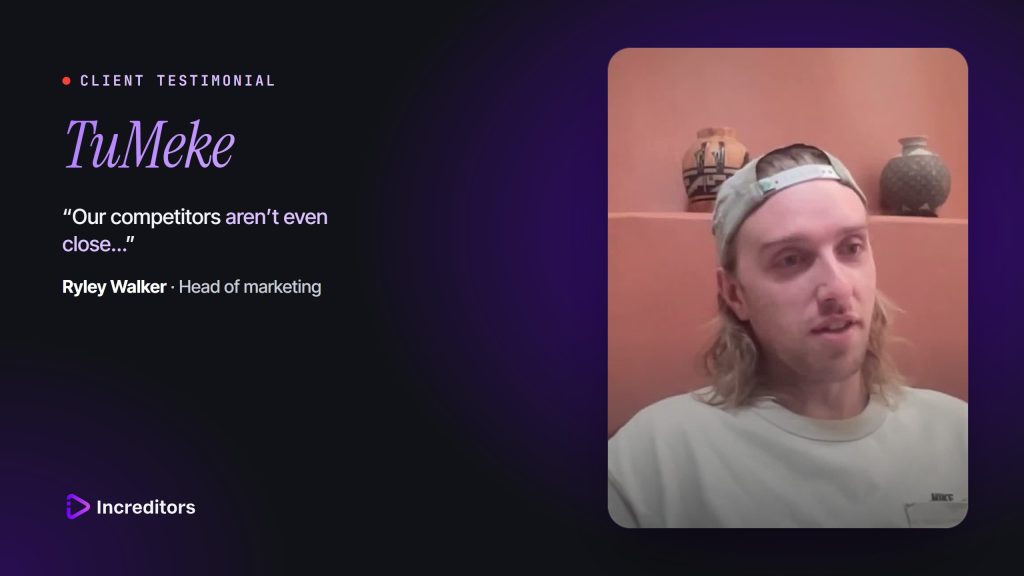
Two clients show different sides of the same discipline. TuMeke is an AI ergonomics SaaS company and a client of ours for four years; the team has told us that animations make everything clear, which is exactly the job the approach beat does in a case study. QuantGenie is an algo-trading SaaS company, and its team told us the domain-literate b-roll was the best they had received, a reminder that in technical categories the footage has to show you understand the product and the buyer’s world. Both are examples of the same principle: when the mechanism is complicated, the visual track has to carry understanding. Read more on the TuMeke project page and on our case studies page.
FAQ
What is a B2B video case study?
A B2B video case study is a produced video that tells the story of one customer: the problem they had, the approach that was taken, the outcome and a first-hand voice confirming it. It differs from a quick testimonial because it explains how the result happened, which is what a buyer in a considered sale needs to see.
How long should a video case study be?
Most teams do best with a hero cut of roughly two to four minutes for the website and sales follow-up, plus shorter edits of about thirty to sixty seconds and a few clips of fifteen seconds or less for social and email. The right length is the one that tells the story without padding; complex products tend to earn the longer cut, because the approach beat needs room.
How is a video case study different from a testimonial video?
A testimonial is a customer saying they are happy, usually on camera and usually brief. A case study adds structure and evidence: the situation, the approach, the measured outcome and visuals of the product in use. If you want the testimonial format specifically, see our guide to turning customer calls into testimonial videos, our testimonial video cost breakdown and our ranked testimonial video companies.
Do we need the customer to be on camera?
Not always. On-camera customers are the strongest option because a named person with a title is credible, but plenty of strong case study videos use a recorded call with audio only, a quote card with a voiceover from your team, or a screen-led walkthrough with approved results on screen. What matters is that the customer has approved every claim and the way it is presented.
How do we get customers to agree to a case study?
Ask when the result is fresh and the champion is proud of it, make the ask small and specific, and offer a draft they can edit rather than a blank request. Many customers agree faster when the video helps them internally, for example by showcasing a project they led. Always confirm usage rights, naming and distribution in writing before you start editing.
Can a small team produce a B2B case study video without a studio?
Yes. A remote-recorded interview, screen capture of the product and a careful edit with motion graphics for the mechanism is enough for most B2B tech companies. A studio or on-site shoot is optional and mainly useful for executive-level customers or high-stakes enterprise stories.
Verdict
Produce your B2B video case study around one customer outcome, tell it in five beats, show the approach with real footage or animation, get every number approved in writing and cut it into versions that sales and marketing will actually use. The format rewards preparation: the scorecard, the interview plan and the approval stage matter more than the camera. When those are right, a single customer story can work across the website, sales follow-ups, social and account-based outreach for a long time.
If you want a partner to turn customer stories into case study videos for a complex software, AI or data product, Increditors is a video editing company that works with B2B tech teams on strategy-led video, and we are happy to talk through your best customer story on a call. For the wider picture of video for software companies, see our guide to video editing for SaaS companies and the founder-led video playbook. For a buyer’s perspective on the category, see VideoEditingCompany.
Have a Customer Story Worth Filming?
Tell us about the customer and the result, and we will talk through how to turn it into a case study that sells.
Clients, on camera