








































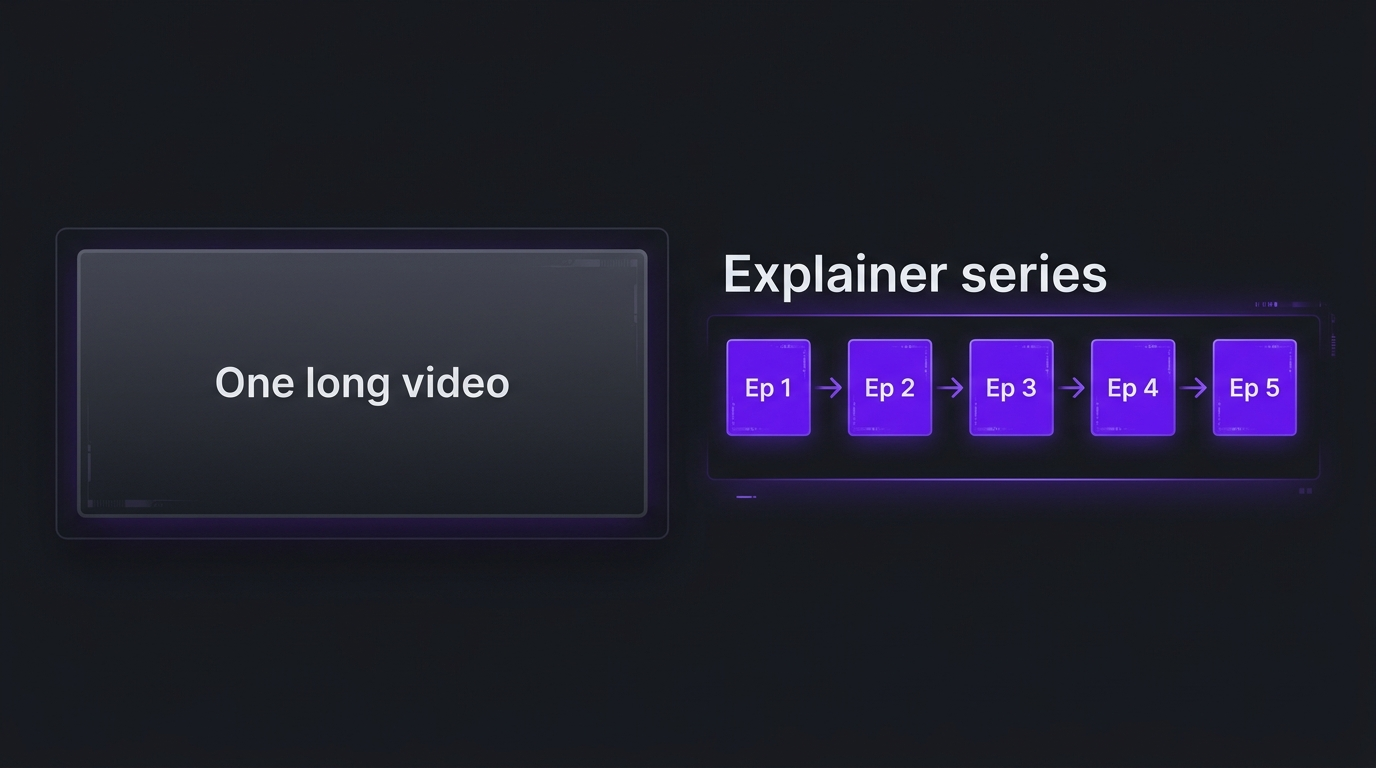
A SaaS explainer video series is a connected set of short episodes, anchored by one hero explainer, that answers the different questions different buyers ask about a complex product. One video cannot carry the problem, the mechanism, the use cases and the objections for a committee of buyers. Plan the series in four layers (hero, chapters, role-specific cuts, proof and objections), scope it from the sales conversation rather than the feature list, and build it on one reusable visual system so each extra episode costs less than the first.
- The short answer
- Why one video is not enough for a complex product
- What a series is, and what it is not
- The four-layer series architecture
- Five series formats that work for software
- How to scope your series
- Keeping a series consistent and affordable
- Where each episode lives
- A first-quarter production plan
- Six mistakes that sink a series
- How this played out
- FAQ
- Verdict
A SaaS explainer video series works better than one video because a complex product raises different questions for different buyers, and no single two-minute video can answer all of them. A series gives each question its own short episode, anchored by one hero explainer, so a founder, a technical evaluator and a finance approver can each find the part that moves them forward.
This guide is for founders and marketing leads at B2B software, AI and data companies that sell a complex product to a considered buyer. It is deliberately different from a post we already publish. Our guide to how much video a SaaS company should publish is about total volume and cadence across a channel. This post is about structure: how to design a connected series around one product, what each episode is for, and how the episodes fit together. If you are still deciding who should build it, read our guide to a SaaS explainer video agency, and see our explainer video cost guide for the pricing side.
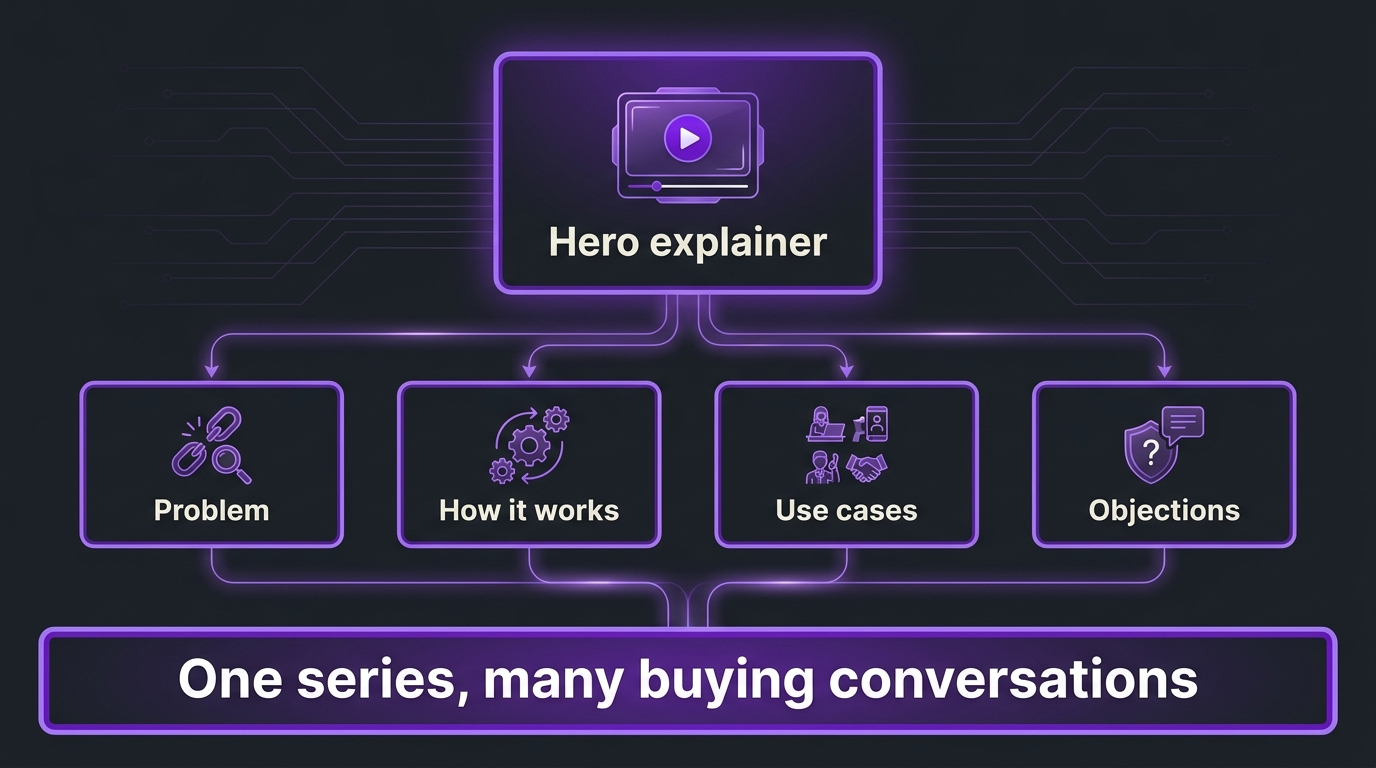
The short answer: one hero, several chapters
Build one hero explainer that tells the whole story at a high level, then build a small set of chapter episodes that each go deep on one question. The hero earns attention and frames the problem. The chapters do the real selling work for buyers who are already interested and need specifics. Together they behave like a short guided tour of the product rather than a single pitch.
The reason is simple. Complex software is bought by a group, and each person in the group is checking something different. One person wants to know whether the problem is real. Another wants to understand the mechanism. Another wants proof that it fits their stack, their data or their compliance requirements. A single video that tries to satisfy all of them ends up either too long to finish or too shallow to convince.
Why one video is not enough for a complex product
Different buyers ask different questions
In a considered B2B sale the buyer is rarely one person. A founder or VP wants the business case, a technical evaluator wants to see how it works, and someone in finance or security wants to know what could go wrong. Each of them will watch a video, but only the part that answers their question. A series lets you label and deliver those parts separately, so nobody has to sit through the material meant for someone else.
Complexity needs room, and attention is short
Explaining a data pipeline, a model or a workflow engine takes steps. Compress all of them into one short video and you either skip the mechanism or speed through it. Spread across several episodes, each step can be shown slowly enough to land. Motion graphics are especially good at this because they can make an invisible process visible one stage at a time, and that is where a connected set of animations beats a single dense one.
Products change, and one video ages as a whole
Software ships often. If every feature, screen and claim lives inside one video, a single change can make the whole asset out of date, and re-editing it is expensive. In a series, only the affected episode needs to be refreshed. That modularity is one of the strongest practical arguments for the format, and it is rarely mentioned when teams brief their first explainer.
Sales and marketing need pieces, not a monolith
A sales rep follows up after a discovery call with the one episode that answers the question raised on the call. Customer success sends a different episode at onboarding. Marketing cuts clips for LinkedIn and YouTube. None of those jobs is well served by one long video, and all of them are well served by a library of short, labeled episodes that share a look.
💡 Pro Tip: Before you commission anything, list the last ten questions prospects asked on discovery calls. If more than two or three different themes appear, you are looking at a series, not a single explainer.
What a series is, and what it is not
Teams often use “series” loosely, so it helps to separate three things that are easy to confuse. A series is planned as a set with a shared story, structure and visual system. A library is simply a collection of videos made over time. A channel is the place they live. You can have a library without a series, which is how most software companies end up with a pile of unrelated videos.
If you are weighing styles for the episodes themselves, our comparison of 2D versus 3D explainer videos covers the trade-offs, and our wider guide to video for SaaS companies places explainers alongside the other formats a software company needs.
The four-layer series architecture
A workable SaaS explainer series has four layers: a hero explainer, chapter episodes, role-specific cuts, and proof and objection episodes. You do not need all four on day one, but planning all four keeps the early videos consistent with what comes later.
Layer 1: the hero explainer
The hero tells the shortest honest version of the story: who has the problem, why it is painful, what your product does about it and what changes afterward. It should leave out almost everything a technical buyer will want, on purpose, because those details are the job of the chapters. A good test is whether a smart outsider could repeat the point afterward in one sentence.
Layer 2: chapter episodes
Chapters are where complex products are actually explained. Each one answers a single question, such as how the data is collected, how the model produces a result or how an integration works. Because each episode covers one idea, you can use diagrams, animated flows and annotated screens at a pace buyers can follow. Name episodes by the question they answer so viewers can pick what they need.
Layer 3: role-specific cuts
Once the chapters exist, you can reassemble them for particular people. A short episode for an engineering lead can lean on architecture and security, while one for a founder can lean on outcomes and speed to value. These cuts are often built from existing assets, which keeps the incremental cost low and the message consistent.
Layer 4: proof and objection episodes
The last layer carries customer proof and answers the questions that stall deals: implementation effort, data handling, pricing logic, switching cost. Customer proof is strongest when it is specific and comes from the customer. Our guide to video for product launches shows how this layer connects to a release, and the same logic applies to any major feature.
Five series formats that work for software
There is no single correct shape. These five formats are common for complex B2B and AI products, and most teams end up combining two of them.
💡 Pro Tip: Pick the format from your sales calls, not your roadmap. If prospects keep asking “how does it actually work?”, start with capability chapters. If deals stall on security or integration, start with objections.
How to scope your series
Scope the series from the buying conversation, not from the feature list. A feature-first approach produces videos your team finds interesting and buyers find optional. A conversation-first approach produces videos that sales actually sends. The process below is short enough to run in a single working session with a founder, a product lead and someone from sales.
Step 1: collect the real questions
Gather the questions prospects asked in discovery calls, demos and lost-deal notes. Cluster them by theme, and by the role that asked them. This list is the raw material for your chapters and objection episodes. If you do not have this data, ask sales for their last ten calls before you write a word of script.
Step 2: assign each question to a layer
Decide whether each question belongs in the hero, a chapter, a role-specific cut or the objection layer. The hero gets only the questions every buyer asks. Everything specific moves down. This step is what keeps the hero short and the chapters focused.
Step 3: write one sentence per episode
For each planned episode write a single sentence that states the question it answers and the single idea the viewer should leave with. If you cannot do it in one sentence, the episode is trying to do too much and should be split.
Step 4: order the episodes
Put the episodes in the order a buyer would need them, and decide which ones are standalone and which ones assume the earlier ones. Standalone episodes are more flexible for sales. Sequential ones build a stronger story on a playlist. Most teams mix both.
Step 5: set the shared rules
Before production, agree the shared structure, tone, runtime guidance and visual system, so every episode feels like it came from the same company. Our guide to making a technical explainer video for complex products goes deeper on script structure and motion for the hardest topics.
Keeping a series consistent and affordable
The economics of a series depend on building the visual system once and reusing it. The first episode carries most of the design work: the look of the animation, the colour and type rules, the way diagrams are drawn, the voice and the music. Later episodes borrow all of it, which is why cost per episode typically falls as the series grows. If each episode is designed from scratch, you lose that advantage and the series will feel like a collection of different videos.
What to standardise
Agree a small, reusable kit: an opening and closing pattern, a lower-third and label style, a way of showing data flows, a screen-recording treatment, a colour palette tied to your brand and a consistent voice. Document it in a short style sheet that any editor or animator can follow. That is what lets different people, or different months, produce episodes that match.
What to keep flexible
Leave room for the content to change. Keep scripts modular, keep on-screen text editable and avoid baking product screens into animations that cannot be updated cheaply. Where possible, separate the stable explanation of a concept from the part that shows the current interface, so a release does not force a full rebuild.
Why subject-matter accuracy matters more in a series
A series multiplies the cost of mistakes. If episode two contradicts episode four, technical buyers notice quickly and lose trust in everything else. Build a review step with a product expert, keep a glossary of approved terms and make sure the editors and animators understand the domain. This is also where a partner that works regularly with software, AI and data topics helps, and our guide to what professional video editing costs explains how to compare scope across vendors.
Where each episode lives
A series only works if buyers can find the right episode at the right moment. Plan the homes for each layer before you publish, not afterwards.
On YouTube, group the episodes into a playlist so viewers can move from one to the next; YouTube explains how in its guide to creating and managing playlists. Add chapter markers to longer episodes using YouTube’s documentation on video chapters so buyers can jump to the part they need. For your own site, Google’s video best practices for Search explain how to make embedded videos discoverable.
Make every episode usable with the sound off. Accurate captions help viewers in open offices and on mobile, and they are part of accessible video; the W3C’s guidance on captions and subtitles is a clear starting point. If you also want to extend each episode into shorter assets, see our guide to video repurposing.
A first-quarter production plan
A sensible first quarter is one hero in the first month, chapters in the second and role-specific or objection episodes in the third. The timings below are illustrative planning guidance, not promises, because the pace depends on script complexity, review speed and how quickly your experts can give feedback.
The cadence question, meaning how often to publish once the series exists, is covered in our post on SaaS video publishing volume. If you are building a wider channel around the series, our 90-day B2B YouTube channel plan shows how to organise the work around it.
Six mistakes that sink a series
1. Starting with the feature list
Feature-first series produce interesting videos that buyers do not need. Start with the questions buyers ask and map features to those.
2. Cramming everything into the hero
The hero should leave things out. Every extra idea you add makes the video longer and the main point weaker.
3. Changing style every episode
When the look, voice or structure changes from episode to episode, the series stops feeling like a series and the cost advantage disappears.
4. Skipping the expert review
A small technical error in one episode damages trust in all of them. Put a product expert in the approval path and keep a shared glossary.
5. Publishing without a distribution plan
A finished series that sits on a single page does little. Decide where each episode will be sent, embedded and found before it is delivered.
6. Never retiring or refreshing episodes
Software changes. Keep a simple log of which episodes depend on which product screens and claims, and revisit them when the product changes.
How this played out
TuMeke is an AI ergonomics SaaS company and a client of ours for four years. Its product is hard to explain in a sentence, and the team told us that animations make everything clear. That is the job a series is built to do: take a complicated product and make it clear again and again, in pieces a buyer can take one at a time, with one visual language holding them together. You can read more on the TuMeke project page and on our case studies page.
FAQ
How many videos should a SaaS explainer series have?
Start with one hero explainer and three to five chapter episodes, then add role-specific and objection episodes as sales conversations show where buyers get stuck. A small, finished series that is actually used beats a long plan that never ships. Keep a written list of the next episodes so the series can grow without re-scoping.
How long should each episode be?
As short as the question allows. A hero explainer commonly runs somewhere around one to two minutes, and chapter episodes are often shorter or only slightly longer. Technical buyers will watch longer when the content is useful, so let each episode answer one question completely rather than hitting a target runtime.
Is a series more expensive than one explainer video?
The total is higher because you are producing more episodes, but the cost per episode usually falls after the first one. The visual style, voice, templates and brand assets are built once and reused. Cost depends on animation style, script complexity and volume, so ask any vendor to quote the hero and the repeatable episodes separately.
Should we make a series or a single hero video first?
Make the hero video first, but plan the series before you script it. The hero sets the visual language and the core story, and the planned chapters tell you what the hero should leave out. Trying to fit every question into one video is the most common reason explainers feel crowded and unclear.
Where should the episodes be published?
Use more than one home. Put the hero on your homepage or product page, host the series as a playlist on YouTube so buyers can find it through search, and give sales the individual episodes to send in outbound and follow-up. Add captions and chapter markers so the content is usable with the sound off and easy to scan.
Verdict
If you sell a complex product to a buying committee, plan a series, not a single video: one hero explainer, a handful of focused chapters, and role and objection episodes added as sales shows you where buyers get stuck. The format answers the real questions in the real order, lets you update one episode instead of the whole asset, and gets cheaper per episode as the shared visual system matures.
If you want help planning and producing a series, Increditors is a video editing company that works with B2B software, AI and data teams on strategy-led explainers and animation, and we are happy to say honestly whether a series or a single video is the right call for your product.
Planning an Explainer Series for a Complex Product?
Tell us what you sell and who has to be convinced, and we will talk through the shape of a series that fits.