










![3D Explainer Video - ScribbleLive.mp4_snapshot_00.12_[2022.03.09_03.14.16]](https://increditors.com/wp-content/uploads/elementor/thumbs/3D-Explainer-Video-ScribbleLive.mp4_snapshot_00.12_2022.03.09_03.14.16-r7wb53mx72rxst3qcqyrfxdmeyzb5r9jbl0wbjujh4.png "3D Explainer Video – ScribbleLive.mp4_snapshot_00.12_[2022.03.09_03.14.16]")































Video repurposing is the practice of transforming a single piece of recorded video content into multiple formats for different platforms and audiences. Done right, it multiplies your content output without multiplying your production budget — and it is one of the highest-ROI activities a content or marketing team can run. This guide explains what it is, how the ROI calculus works, and walks through real-world examples so you can build a repurposing system that actually holds up.
What Is Video Repurposing?
Video repurposing is the deliberate transformation of existing video content into new formats, lengths, or contexts to serve different platforms, audiences, or stages of the buyer journey. A 45-minute webinar becomes a YouTube highlight reel. That same recording yields six LinkedIn clips, a podcast episode, a blog post with embedded timestamps, and a series of email GIFs. The source footage is recorded once. The distribution radius expands dramatically.
It is not, critically, the same as content recycling — which typically means reposting the same asset on a different channel with minimal modification. Repurposing involves genuine editorial judgment: identifying the moments worth extracting, reframing the context, reformatting for the new medium’s native behavior (vertical aspect ratios, captions, intro hooks), and often adding platform-specific editing to make each piece feel native, not imported.
Repurposing vs Recycling: The Key Distinction
The confusion between repurposing and recycling is widespread and expensive. Recycling treats a piece of content as a fixed object and moves it between channels. Repurposing treats source material as raw footage from which new, purpose-built assets are crafted. The difference shows up clearly in performance: a raw webinar recording posted to Instagram as-is will typically underperform because it was not engineered for that surface. A 60-second vertical cut of the most compelling moment — with animated captions, a hook-first structure, and a tight CTA — is a native Instagram video that happens to come from webinar footage.
The editorial layer — selecting the right moments, adapting structure, reformatting for each platform’s UX — is where repurposing delivers its ROI. Skip that layer and you get recycling, which users scroll past.
Why Video Is the Highest-ROI Format to Repurpose
Text-based content can be repurposed — a blog post becomes an email, a LinkedIn thread, a slide deck — but video sits at the apex of the repurposing stack for one core reason: it contains audio, visual information, facial expressions, demonstrations, and pacing all in a single recording. That richness means a single source asset can be reformatted into text (transcript-based blog posts), audio (podcast strip), short social video, long YouTube upload, animated GIF, embedded email thumbnail, slide decks using screenshots, and more.
The cost of the original recording is already sunk. Every derivative asset produced from it has a marginal cost of editing time — no new shoots, no additional talent fees, no location costs. That math is why content teams with serious output goals build their calendars around video as the primary production unit and treat everything else as downstream assets.
The ROI Case for Video Repurposing
The ROI of video repurposing is not a theoretical benefit — it is a measurable reduction in cost-per-asset combined with a measurable expansion in audience reach. Understanding how to frame the math helps content leaders justify the investment in post-production infrastructure and skilled editing.
How to Estimate Your Repurposing ROI
A simple repurposing ROI framework compares two scenarios: one where each piece of content is produced from scratch, and one where a hub video generates a spoke ecosystem of derivative assets. Consider a B2B brand that produces a 40-minute expert interview. If they were to produce each downstream asset independently — a short-form social clip, a YouTube mid-length cut, a podcast episode, a blog post — they would typically pay for separate recording sessions, separate editing rounds, and separate distribution preparation for each. By treating the single recorded interview as the hub, they run one editing engagement that produces all of them.
Teams commonly report that repurposing a single long-form recording into six to twelve derivative assets costs somewhere in the range of 30–60% of what it would cost to produce each asset independently. The exact ratio depends heavily on the quality of the source recording (clean audio, good lighting, and clear structure make editing dramatically faster), the number of formats needed, and the platform-specific complexity of each output.
On the revenue side, the ROI equation benefits from distribution reach. A single webinar audience of 200 live attendees becomes a YouTube video that accumulates views over months, six LinkedIn clips that each reach a different segment of a team’s network, and a podcast episode that hits a subscriber base that never attended the live event. The same intellectual content reaches an audience that is potentially many times larger, without a proportionally larger production spend. For detailed production cost benchmarks, see our guide to how much professional video editing costs.
Where Teams See the Biggest Returns
The repurposing activities that tend to produce the clearest ROI signal share two characteristics: the source material is high-quality and the derivative formats are natively edited (not raw cuts). The biggest returns most commonly come from: (1) webinar-to-social clip pipelines where the original event already drew a qualified audience and the clips carry that authority into new feeds; (2) customer testimonial videos expanded into platform-specific formats, since proof content performs well across virtually every channel when properly adapted; and (3) educational deep-dives — courses, demos, tutorials — that can be excerpted into search-friendly YouTube content, generating organic discovery that pays dividends months after the original recording date.
💡 Pro Tip: The highest-ROI repurposing projects share one trait: the source video was shot with repurposing in mind. Clean audio, a structured script or agenda, and good lighting dramatically reduce editing time per derivative asset. Brief your recording team before you shoot, not after.
Which Video Types Are Best to Repurpose?
Not every piece of video is equally suited to repurposing. The most productive source material tends to be dense with information or emotion, long enough to yield multiple distinct moments, and structured in a way that individual sections can stand alone. Here is a breakdown of the most valuable source content types.
Webinars and Long-Form Educational Content
Webinars are the gold standard for repurposing because they are inherently structured (introduction, core content, Q&A), feature a subject-matter expert on camera or voice, and address audience questions that reflect real search intent. A 60-minute webinar typically contains multiple standalone insights that can each carry a 60-90 second social clip; the Q&A section often contains the most quotable, search-discoverable content. According to Wistia’s video marketing research, longer educational videos that attract genuinely interested viewers perform well on retention metrics, which translates to stronger performance when those same viewers are retargeted with short-form clips on social channels.
Product Demos and Explainer Videos
Product demo videos contain feature-level segments that can each become standalone assets. A ten-feature walkthrough can yield ten individual micro-demos, each targeting a specific search query or buyer objection. Explainer videos with strong narrative structure — problem / solution / proof — can be adapted into testimonial-style cuts by pairing the explanation with customer voice overlays. The visual clarity of screen-recording and product footage also makes these assets easy to adapt for mute-first social environments with animated captions and motion graphics overlays.
Customer Testimonial and Case Study Videos
Customer testimony is among the most valuable content a brand can produce — and it is systematically underused. A single 5-minute customer interview typically contains a 15-second headline quote, a 60-second problem-solution arc, a 2-minute detailed case story, and several standalone soundbites. Each of these is a different asset for a different stage of the sales funnel: the quote becomes a social proof slide, the arc becomes a pre-roll ad, the full story becomes a YouTube case study, and the soundbites become email testimonial snippets. Brands that invest in one well-produced testimonial shoot often generate eight to fifteen distinct assets from a single 90-minute recording session.
Podcast Recordings with Video
Podcast recordings that are captured on video provide an exceptionally rich repurposing source. The audio strip becomes the podcast episode; the full video goes to YouTube; topic-specific clips go to LinkedIn and Instagram; pull quotes become static social cards; the transcript becomes a blog post with embedded clips. This hub-and-spoke model means a single 45-minute recorded conversation can populate every major distribution channel for an entire week. For a detailed breakdown of this approach applied to podcast content specifically, see our guide on video editing strategy for SaaS companies, which covers the content multiplication framework in detail.
Platform-by-Platform Repurposing Map
Each platform has distinct technical requirements, audience behavior patterns, and editorial standards that determine whether a repurposed asset lands or gets ignored. The table below maps the most common source formats to their best downstream platform uses and the editing adaptations required for each.
LinkedIn’s own platform data consistently shows that native video gets materially higher reach than link-based posts — which underscores why re-encoding and uploading a native clip outperforms sharing a raw YouTube link. Platform algorithms reward content that keeps users on-platform, making the editing investment in native versions directly measurable in reach.
Video Repurposing in Practice: 3 Real-World Examples
Abstract frameworks are useful; concrete examples are more so. The following three scenarios illustrate how different types of organizations approach video repurposing and what the asset multiplication looks like in practice.
Example 1 — SaaS Company: One Webinar, 14 Assets
A B2B SaaS company runs a 60-minute live webinar on their core use case with a subject-matter expert. The live recording becomes the hub. From it, the post-production team produces: a full-length YouTube upload with chapter markers and a custom thumbnail; six 60-90 second LinkedIn clips, each covering a distinct insight from the session; a stripped audio track submitted to their podcast feed; a blog post with embedded video, transcript-based body copy, and timestamped section headings; an email to their subscriber list featuring a thumbnail with a play button linking to the YouTube upload; and a static quote card for Instagram from the most cited statistic. That is fourteen distinct distribution pieces from one recording session.
The key to making this work at scale is the editing infrastructure: a team — or a dedicated video editing agency — that understands both the technical requirements of each platform and the editorial judgment to identify the highest-signal moments worth extracting. Without that layer, the repurposing collapses into recycling.
Example 2 — B2B Brand: Interview Series into Quarterly Campaign
A professional services firm records a series of four expert interviews — one per month — as part of a thought leadership initiative. Each 30-minute interview is edited into: a mid-length YouTube video (12–15 minutes) representing the most valuable discussion; three LinkedIn clips from the most quotable moments; a transcript-based newsletter article; and a highlight reel at the end of the quarter combining the best moments from all four interviews into a single 3-minute brand video. That end-of-quarter reel requires minimal additional production budget — it is assembled from footage already paid for across four recording sessions — but delivers as a standalone brand asset that can anchor paid distribution spend. The quarterly cadence of interviews generates 24 LinkedIn clips, 4 full YouTube videos, 4 newsletter articles, and 1 brand reel from twelve hours of recorded source material.
Example 3 — Creator Economy: One Long-Form Video, 30-Day Calendar
Independent creators and media brands with multi-platform presences have built entire content operations around the hub-and-spoke repurposing model. A single 90-minute recorded deep-dive on a complex topic — say, a marketing strategy breakdown — can generate a 30-day content calendar: two to three short-form vertical clips per week from the recording; daily pull-quote graphics from the transcript; a full-length YouTube upload; a condensed 20-minute “best of” YouTube edit; an audio-only podcast episode; and a structured written guide using the transcript as its foundation. Creator economy research consistently identifies content volume and platform consistency as key growth drivers — repurposing from a single recorded source is how individual creators achieve that volume without burning out on production.
💡 Pro Tip: The asset extraction step — reviewing the source recording and identifying the moments worth clipping — is where most DIY repurposing efforts stall. Treat it like editorial selection: give it dedicated time, watch the recording at 1.25x speed, and timestamp every potentially extractable moment before you open an editing timeline. A good 60-minute webinar will typically yield 8–12 timestamp candidates; you will use 5–7 of them.
Common Video Repurposing Mistakes That Kill ROI
Most video repurposing programs underperform not because the concept is flawed, but because common operational mistakes erode the quality of derivative assets. The table below identifies the most frequent failure modes, their impact, and the fix.
How to Build a Video Repurposing Workflow
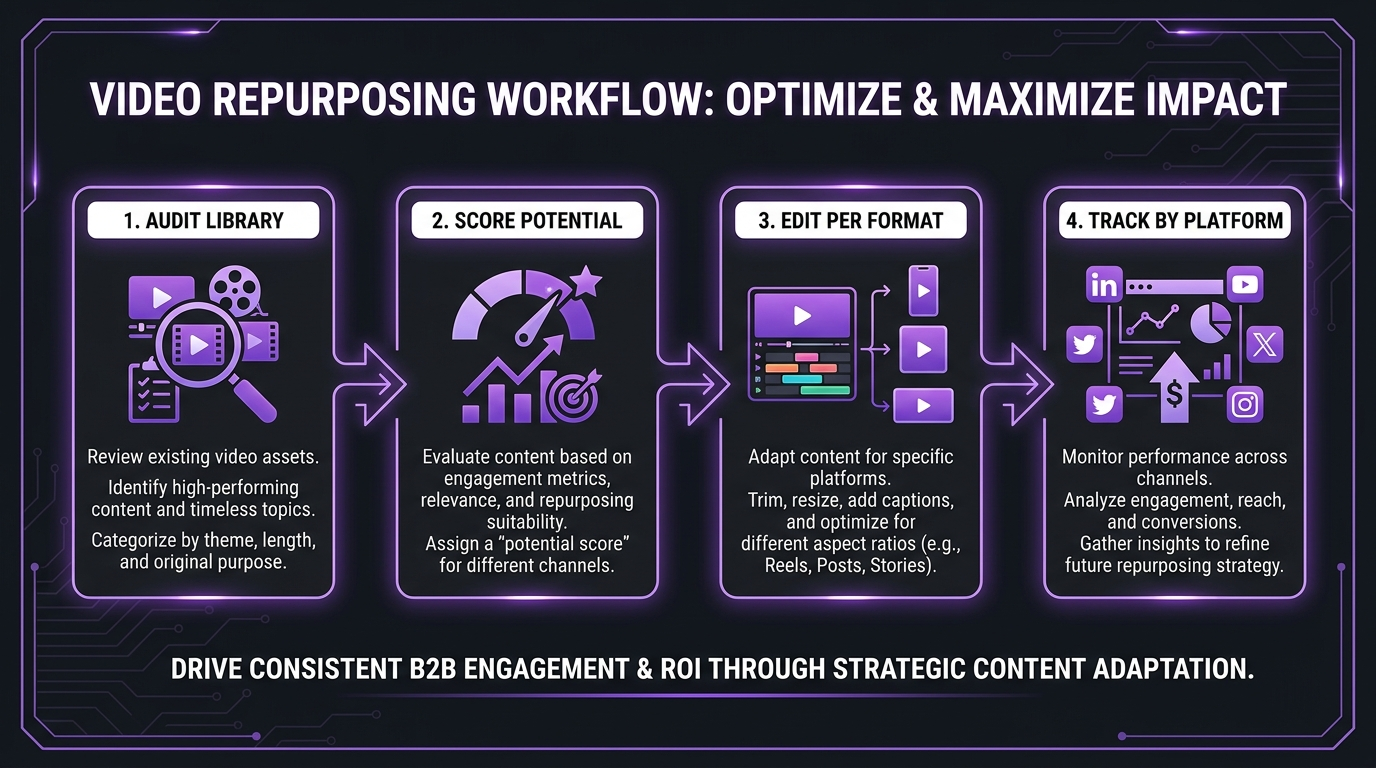
A repurposing system that works consistently requires more than editorial intent — it needs operational structure. These four steps form the core of a repeatable workflow that scales without quality degradation.
Step 1 — Audit Your Existing Video Library
Before you record anything new, conduct a library audit. Most organizations that have been producing video content for more than twelve months have a backlog of recordings that were distributed once and then forgotten — webinars on their platform, recorded customer calls in their CRM, Loom walkthroughs buried in Notion. Each of these is a potential repurposing source. Score each recording on three dimensions: content quality (is the information still accurate and valuable?), audio/visual quality (is it technically repurposable without re-shooting?), and strategic relevance (does it address a topic or keyword your audience currently searches for?). High-scorers on all three become your immediate repurposing backlog.
Step 2 — Prioritize by Repurposing Potential Score
Not every recording yields an equal number of derivative assets. Before committing editing time, estimate the repurposing potential of each source video by identifying: how many distinct, self-contained moments it contains; how many platforms the content is relevant to; and whether the topic has ongoing search volume or audience interest. A structured scoring process at this stage prevents your editing team from investing hours in source material that only yields one or two usable derivatives — the opposite of what makes repurposing efficient. Content Marketing Institute’s research on repurposing strategy identifies content longevity as one of the primary factors in repurposing ROI — prioritize evergreen topics over time-sensitive ones unless you have a fast distribution pipeline.
Step 3 — Edit for Each Format (Not Just Crop)
This is the step where the distinction between repurposing and recycling becomes operationally concrete. Each platform requires specific technical treatment: aspect ratio (16:9 for YouTube, 9:16 for Reels/TikTok, 1:1 for LinkedIn feed); caption style (bold animated for social, standard subtitle for YouTube); pacing (fast cuts and music for TikTok, more measured editing for LinkedIn thought leadership); and metadata (chapter markers for YouTube, keyword-rich title and description for every platform). Sprout Social’s platform behavior data shows that native video consistently outperforms reposts of external video links across every major platform — which means the investment in format-specific editing is directly measurable in distribution performance.
Teams that try to handle this editing internally often find it becomes a bottleneck. The skill set required spans motion graphics for animated captions, audio mastering for podcast strips, color correction for inconsistent source footage, and platform-specific workflow expertise. Most growing brands find it more cost-effective to work with a specialist post-production partner who can handle the full derivative asset stack from a single source, rather than building that capability fully in-house. If you’re comparing your options, our guide on video editing agency vs freelancer breaks down the trade-offs in detail.
Step 4 — Distribute and Track by Platform and Asset
Distribution without tracking is faith-based marketing. Every derivative asset from a repurposing run should be trackable back to its source, allowing you to measure which formats drive what outcomes. UTM parameters on all linked content, YouTube Analytics for chapter-level engagement, LinkedIn native video performance data, and podcast download analytics by episode all contribute to a feedback loop that tells you which repurposing investments were worth making. Over time, this data identifies your highest-performing source content types and formats, which then informs what you prioritize for new recording — closing the loop between production and distribution.
Measuring Repurposing Success: The Metrics That Matter
Measuring the ROI of a repurposing program requires tracking both the efficiency dimension (cost per asset versus producing from scratch) and the effectiveness dimension (what the derivative assets actually achieved). The core metrics to track fall into two categories.
Efficiency metrics: cost per asset produced (total post-production cost divided by number of derivative assets), hours of editing per asset by format, and number of assets generated per recording hour. These measure the operational health of the repurposing system. HubSpot’s content marketing data consistently shows that teams with systematic repurposing workflows produce significantly more content than those relying on one-off production — a gap that compounds over time as the library of derivative assets grows.
Effectiveness metrics: views and watch time per derivative asset, engagement rate (likes, shares, comments) by platform and format, click-through rate on CTAs embedded in derivative assets, and conversion attribution for derivative assets that touch bottom-of-funnel content. YouTube’s own Creator Academy guidance emphasizes watch time and click-through rate as the primary ranking signals — metrics that are directly affected by the quality of editing in your repurposed content.
The most useful reporting cadence for a repurposing program is monthly: compare cost per asset and total asset output month-over-month, and track the cumulative view/engagement performance of all derivatives from each source video. Source videos that consistently generate high-performing derivatives are your repurposing priority going forward. Source formats that underperform across multiple repurposing runs either need editorial improvement at the recording stage or should be discontinued in favor of higher-yield formats.
Frequently Asked Questions
What is the difference between video repurposing and cross-posting?
Cross-posting means sharing the same asset across multiple platforms with no modification. Video repurposing means adapting the source material — editing it for each platform’s native format, length, and audience behavior. Cross-posting is fast but typically underperforms because platforms reward native content. Repurposing requires editorial and production investment but delivers platform-appropriate assets that perform the way native content does.
How many assets can you realistically get from one recorded video?
The range varies with the length and quality of the source video. Teams commonly report five to eight derivative assets from a well-structured 30-minute recording, and ten to fifteen or more from a 60-minute webinar or interview session with strong content density. The practical ceiling is set by the number of distinct, self-contained moments in the source recording — each usable moment can typically generate two to three derivative formats (a LinkedIn clip, an Instagram Reel version, and a podcast timestamp, for example).
Does repurposing content hurt SEO?
Repurposing video for different platforms does not hurt SEO, and done right, it actively supports it. A YouTube video created from a webinar can rank in Google’s video results for target queries. A transcript-based blog post embeds the video and can rank in standard web search. These are additive, not competing. The only SEO risk in repurposing arises if identical text content is posted verbatim across multiple URLs — a thin-content risk that proper repurposing (where each format is meaningfully adapted) avoids entirely.
What types of video are NOT worth repurposing?
Time-sensitive content (event announcements, product launch reveals that have passed, time-bound promotional offers) has limited repurposing value because the information degrades quickly. Low-quality source recordings with significant audio problems or shaky camera work are also difficult to repurpose effectively — the editing cost to compensate for technical deficiencies often exceeds the value of the derivative assets. Conversely, evergreen educational content, customer success stories, and expert opinion on fundamentals tend to have long repurposing shelf lives.
Should you repurpose videos yourself or hire a specialist?
The decision typically comes down to volume and quality bar. Small-scale repurposing — one or two formats from occasional recordings — can be handled in-house with basic editing tools. At higher volume, the skill set required (motion graphics for captions, multi-format encoding, audio mastering, aspect ratio adaptation, platform-specific quality standards) becomes a genuine specialization. Most brands growing beyond five or six derivative assets per recording cycle find it more cost-effective to work with a dedicated post-production partner rather than managing the training, tooling, and quality control internally. The economics of outsourcing improve further when you factor in the cost of editing errors that slow distribution or damage brand quality perception.
Verdict: Is Video Repurposing Worth It?
Video repurposing is worth it for virtually any organization that produces video at all — but its ROI depends entirely on the quality of the editorial and production work applied to each derivative asset. Recycling content without adapting it for each platform’s native behavior produces disappointing results and leads teams to conclude that repurposing doesn’t work. What doesn’t work is recycling. Repurposing — with genuine editorial selection, format-specific editing, and systematic tracking — consistently expands distribution reach while reducing cost per asset.
The clearest sign a repurposing program is working: your per-platform performance metrics for derivative assets approach the performance of natively produced content, while your cost per published asset declines quarter over quarter. That combination means you have built a content multiplication system, not just a content recycling operation.
For teams looking to build a systematic repurposing operation backed by professional post-production — consistent quality across formats, fast turnaround on derivative asset stacks, and editing teams that understand platform-native requirements — working with a specialist is the most reliable path to that result.
Ready for Video That Actually Converts?
Tell us about your project and we will put together a custom plan.