





















































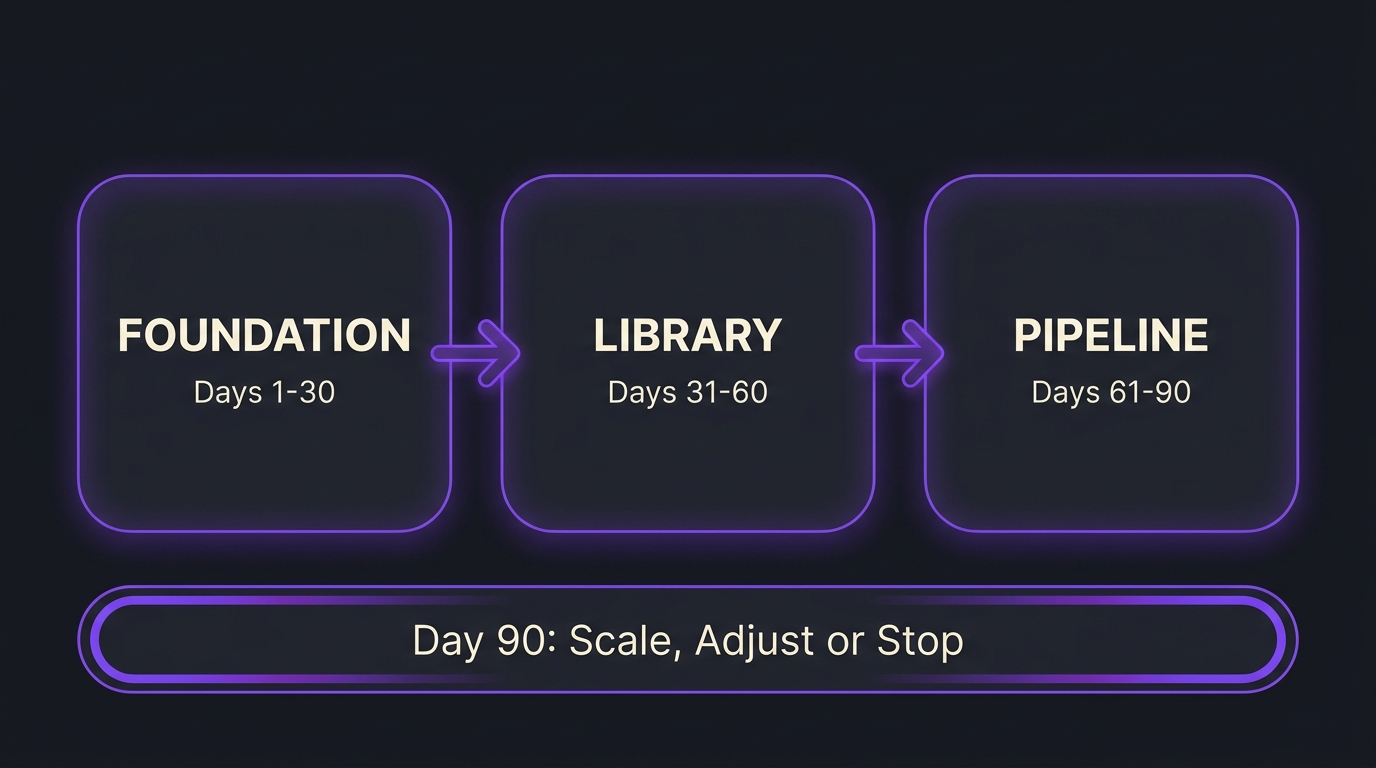
A B2B YouTube channel strategy for a SaaS company is a 90-day operating plan, not a content calendar. Spend days 1 to 30 on decisions, channel setup and a first small batch of videos. Spend days 31 to 60 on a repeatable series and bottom-of-funnel comparison videos. Spend days 61 to 90 on connecting views to pipeline and making a scale, adjust or stop call. The templates below (video brief, weekly review, day-90 scorecard) are the part most teams skip.
The best B2B YouTube channel strategy for a SaaS company is a 90-day operating plan: choose one buyer problem, publish a small fixed set of videos across three content pillars, review one set of metrics every week, and decide on day 90 whether to scale, adjust or stop. Everything else (channel art, a posting-time hack, a viral idea) is secondary to having an owner, a cadence and a decision date.
This guide is for founders and marketing leads at B2B software, AI and data companies that sell a complex product to a considered buyer. It is deliberately different from two posts we already publish. Our B2B YouTube benchmarks show what “good” numbers look like once you have a channel, and our YouTube for B2B lead generation playbook explains the funnel and the video types that drive leads. This post is the missing middle: what to do in which week, who does it, and what to decide at the end. If you are still choosing who should run it, read our guide to YouTube agency for SaaS next.
The short answer: three phases, one decision
Run the first 90 days as three phases of about 30 days each, and end the third with a written decision. Most B2B channels stall because nobody ever defines what “working” means, so the channel drifts for a year on goodwill. A fixed plan forces a verdict while the cost of changing course is still small.
The cadence in the plan is a suggestion, not a benchmark: two to four videos a month is realistic for a team with one subject expert and an outside editor, and a consistent small number beats a burst followed by silence. Adjust it to your capacity, but write the number down on day 1.
Before day 1: five decisions that shape the whole plan
Five decisions made in week one decide whether the channel is useful or just busy: the goal, the buyer, the owner, the pillars and the cadence. Each takes a short conversation, and each is expensive to reverse once videos are live.
1. The goal: one sentence, one business outcome
Pick one outcome for the first 90 days. Good examples for a B2B tech company are “give sales a library of videos to send before demos” or “own the search results for our category’s comparison questions.” Poor examples are “grow subscribers” or “build awareness”, because neither tells you what to make or when to stop.
2. The buyer: a role and a problem, not a persona deck
Name the single role you most need to reach (for example, a head of data at a mid-market company evaluating tooling) and the one problem they search for when they are ready to change something. Everything in the first 30 days should make sense to that person with no prior context.
3. The owner: one person with a weekly hour
Channels owned by a committee do not ship. Name one owner, usually the marketing lead or a founder, who attends the weekly review and can approve a video without three more sign-offs. If the owner changes mid-plan, restart the 30-day clock.
4. Three content pillars
Choose three pillars and no more. A reliable B2B set is teach (explain the problem and the category), prove (product in context, customer stories, results) and compare (alternatives, build-vs-buy, objections). The three map to the buyer’s journey, and they give you a fast test for any idea: if it fits no pillar, it waits.
5. The cadence: a number you can keep
Write down how many videos you will publish each month and who produces them. If you do not have in-house production, this is the point to decide between a freelancer, an agency or a specialist partner. Our guide to what professional video editing costs covers the cost side honestly, and our list of YouTube channel management services compares the options for running the channel itself.
💡 Pro Tip: Write the five decisions on one page and share it with sales and the founder on day 3. Disagreement in week one costs a meeting. Disagreement in week eight costs a re-shoot.
Days 1 to 30: foundation
The first 30 days are for building a channel a skeptical buyer would trust and proving you can publish on a schedule, not for chasing views. A new B2B channel has a small audience by design, so judge this phase on finished work and process rather than on public numbers.
Week 1: decisions, topic research and a swipe file
Make the five decisions above. Then build a list of 20 to 30 real buyer questions from places that are already honest: sales call recordings, support tickets, community threads and the autocomplete suggestions for your category terms. Rank them by how often sales hears them. The top ten become your backlog; do not write scripts for anything lower yet.
Week 2: channel setup that a buyer will actually read
- Write a channel description that states who the channel is for and what problem it explains, in the first two lines, with one link to a page that makes sense for a viewer, not the homepage.
- Record a short channel trailer in plain language: who you help, what you will cover, how often you publish.
- Create playlists that match your three pillars, so a visitor who watches one video has a logical next click.
- Set a repeatable thumbnail and title style. Custom thumbnails need a verified account, so complete that early.
- Write a standard description block with a one-line summary, chapter timestamps and a single clear link, following YouTube’s guidance on video descriptions.
Weeks 3 and 4: the first two or three videos
Ship two or three videos from the top of the backlog, mixing pillars. A useful first set is one teach video that answers the most common buyer question, one prove video that shows the product solving a real problem in context, and, if capacity allows, one short founder or expert explanation. Aim for clarity over polish at this stage, but keep audio clean, because poor sound is the quickest way to lose a technical viewer.
Run the first weekly review at the end of week 3, even with almost no data, to practice the routine. By day 30 you want three things: videos published, a working brief template, and an owner who has run the review at least twice.
Days 31 to 60: build the library
Days 31 to 60 are for turning one-off videos into a library with a recurring format and coverage of the questions buyers ask late in the process. A library is what lets one viewer binge three videos and what gives sales something specific to send.
Launch one recurring series
Pick one format you can repeat with the same structure each time: a short “problem, approach, result” breakdown, a weekly product question answered by an engineer, or a monthly industry explainer. A recurring format lowers production effort per video and teaches the audience what to expect. This is also where an outside editor pays for itself, because templates, motion graphics and a consistent look are the difference between a series and a pile of clips.
Add the bottom-of-funnel videos
Now cover the questions of a buyer who is comparing vendors: “X vs Y” for your category, build-versus-buy, how implementation works, and how you handle security or data questions. These are the videos sales will actually use, and they match the searches that come from people close to a decision. Keep the tone honest: a fair comparison earns more trust than a takedown.
Polish discovery on every video
- Add chapters so viewers can jump to the part they need.
- Add end screens that point to the next video in the same pillar, not to a random upload.
- Embed the best videos on the matching pages of your own site with a transcript, and follow Google Search Central’s video guidance so the page can be understood by search.
The first retention review
By the second half of this phase you have enough views to read one chart honestly: where viewers drop off. Use the key moments for audience retention report in YouTube Studio to find the first point where viewers leave in each video. Write one sentence per video about why, such as “long intro” or “jargon before the problem was stated”. Patterns across videos are your edit and script feedback for the next batch.
⚠️ Watch out: Do not compare a technical 12-minute explainer against entertainment channels. Compare it with your own earlier videos and with the ranges in our B2B YouTube benchmarks post. The question is whether the right people watch, not how many.
Days 61 to 90: connect the channel to pipeline
The last 30 days turn viewing into evidence a CEO or VP can read: which videos sales uses, which pages they send traffic to, and which deals mention them. Views are an input. The output is conversations, and you need a light system to see them.
Instrument the links
Give every link from a video description to your site a distinct UTM tag, and send each to a landing page written for that video’s topic. Add a free-text “how did you hear about us” field to your demo request form and tell the sales team to ask the same question on the first call. Neither method is perfect, but together they show whether the channel is part of real buying journeys.
Arm sales with a playlist
Create an unlisted or public playlist called something like “Before your demo” with the five or six videos your sales team would otherwise explain live. Ask sales to send it in follow-up emails and note when a prospect mentions a video. Even a handful of notes is stronger evidence than any dashboard.
Fix the weak videos instead of making new ones
Pick the two or three videos where retention or click-through is clearly the weakest and revise them: a clearer title, a new thumbnail, a shorter intro. Improving what exists is cheaper than a new shoot and teaches the team which changes matter.
Hold the day-90 review
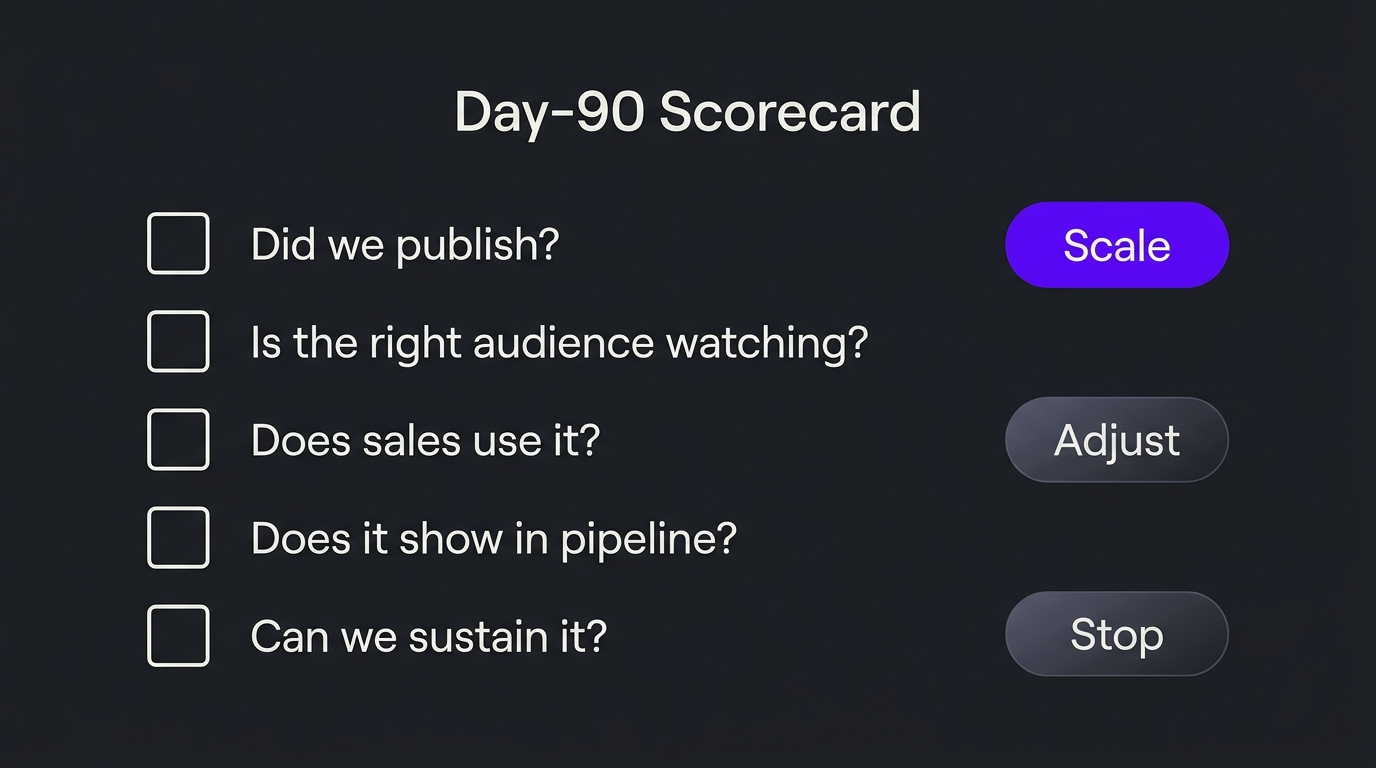
Use the scorecard in the next section and make the decision in the room: scale, adjust or stop. Write down the reasoning. If the answer is “adjust”, state exactly what changes in the next 90 days; if it is “stop”, that is also a legitimate, useful outcome for a B2B team that now knows the channel is not their best lever.
Templates: video brief, weekly review and day-90 scorecard
Three one-page templates keep a B2B channel running: a brief before every video, a 30-minute review every week, and a scorecard on day 90. Copy them into a shared doc.
Template 1: the video brief
Template 2: the 30-minute weekly review
- 5 minutes: what published last week, what slipped and why.
- 10 minutes: one retention chart and one click-through observation, no more.
- 5 minutes: what sales heard or sent that connects to a video.
- 10 minutes: confirm the next two briefs and name who is blocked.
Keep the metrics list short on purpose. If you want deeper reference ranges for views, click-through and retention, they are in the benchmarks post linked earlier.
Template 3: the day-90 scorecard
Who does what: roles that make the plan run
A B2B YouTube channel needs four jobs covered, not four hires: an owner, a subject expert, a strategist voice and an editor. In a small company one person often holds two of them, but each job still needs a name next to it.
If the founder will be on camera often, read our notes on the founder-led content agency model, because it changes who records, who edits and how the founder’s time is protected. For the production side specifically, see our YouTube video editing services.
Where 90-day plans fail
Most failed B2B channels fail for operational reasons, not creative ones: no owner, no cadence, no decision date, or videos that never get used by sales. These are the patterns to avoid.
- Topic-first, buyer-second. Videos about what the company wants to announce rather than what the buyer needs to understand.
- A hero video and nothing else. One polished piece followed by silence teaches the algorithm and the audience nothing.
- No subject expert in the loop. A technical audience notices a wrong label or a vague claim fast, and trust is the whole asset.
- Measuring only subscribers. A modest channel that sales uses weekly is worth more than a larger one nobody in revenue has opened.
- No stop condition. Without a day-90 decision, a weak channel can consume a year of goodwill and budget.
🎯 Reality check: A 90-day plan will not tell you whether YouTube can become your best channel over three years. It will tell you whether you can run it well, whether the right buyers watch, and whether sales finds it useful. That is the right question for a first quarter.
How this played out
TuMeke is an AI ergonomics SaaS company and a client of ours for four years. Its product is hard to explain in a sentence, and the team told us that animations make everything clear. That is the same job a B2B YouTube channel has: take something complex and make it clear again and again, which is why this plan favours repeatable formats and a steady cadence over one-off hero videos. You can read more on the TuMeke project page and on our case studies page.
FAQ
How long does it take for a B2B YouTube channel to work?
There is no honest universal number. A 90-day plan will show whether you can publish consistently, whether the right audience engages and whether sales uses the videos, but meaningful search and recommendation traffic usually builds over longer periods. Treat day 90 as a decision point about fit and sustainability, not a finish line.
How many videos should a SaaS company publish in the first 90 days?
Choose the number you can keep. Two to four videos a month, built around three pillars and one recurring series, is a practical starting range for a team with a subject expert and outside editing support. Consistency and accuracy matter more than volume for technical buyers.
Should a B2B company put its founder on camera?
Often yes, because a founder or senior expert signals credibility on complex topics. The condition is that their time is protected: batch recordings, prepare briefs in advance and let an editor handle the rest. If the founder will not appear regularly, use a product lead or engineer as the recurring voice.
What should I measure in the first 90 days?
Measure a short list: videos published against plan, where viewers drop off in each video, whether the right roles are watching, how often sales sends a video, and what the UTM and self-reported source data show. Leave deeper benchmark ranges for after you have a library to compare.
Should we hire an agency or run the channel in-house?
Run strategy and subject expertise in-house, because only your team knows the product and the buyer. Consider an outside partner for scripting, editing and motion graphics when production is the bottleneck. The deciding factor is which job your team can do consistently every week.
Verdict
Treat your first 90 days on YouTube as a controlled test with an owner, a cadence, three pillars and a decision date, and your B2B channel will either earn its place or tell you honestly that it should not. The strategy is less about clever ideas than about the routine of briefs, weekly reviews and a scorecard.
If you want help turning this plan into scripts, animation and finished videos, Increditors is a video editing company that works with B2B software, AI and data teams on strategy-led video, and we are happy to say if your plan needs a different shape.
Want a 90-Day Channel Plan That Sales Will Use?
Tell us what you sell and who you need to reach, and we will talk through a plan that fits your team.
Clients, on camera