







































Educational video content for B2B teaches a buyer something they need in order to decide, and earns the sales conversation instead of asking for it. In a considered sale with a buying committee, it does three jobs promotional video cannot: it reaches buyers before they are in market, it gives your champion something to forward, and it pre-qualifies the evaluator before the first call. Build it from the questions your sales team hears, pick formats by buyer stage, keep the product in a supporting role, review for technical accuracy, and measure influence on opportunities rather than views.
Educational video content works for B2B pipeline because it answers the questions a buying committee is already asking, so the sales conversation starts with trust instead of a pitch. For a company selling a complex product (AI, data, security, infrastructure), the buyer needs to understand the category before they can value your product. Educational video does that work at scale, and in a form a champion can forward. This post makes the case, shows the formats, and gives you a way to measure it without inventing numbers.
A note on scope: searches for “educational video” are dominated by school and children’s content. This post is strictly about educational video for B2B buyers: founders, CEOs and marketing leads at software and tech companies who sell to other businesses.
How this differs from what we have already published: our B2B video marketing strategy playbook covers the whole program (goals, formats, channels, budget), and our founder-led video playbook covers who goes on camera. This post is narrower. It makes the pipeline argument for one content type, educational over promotional, and helps you decide what to make and how to prove it works. Read it first if your team is still debating whether to publish anything that is not a product pitch.
We write this as the video editing company that has produced educational video for AI and deep-tech companies, including a media business whose product is educational content for enterprise AI buyers. That experience shapes the advice below.
- What educational B2B video is
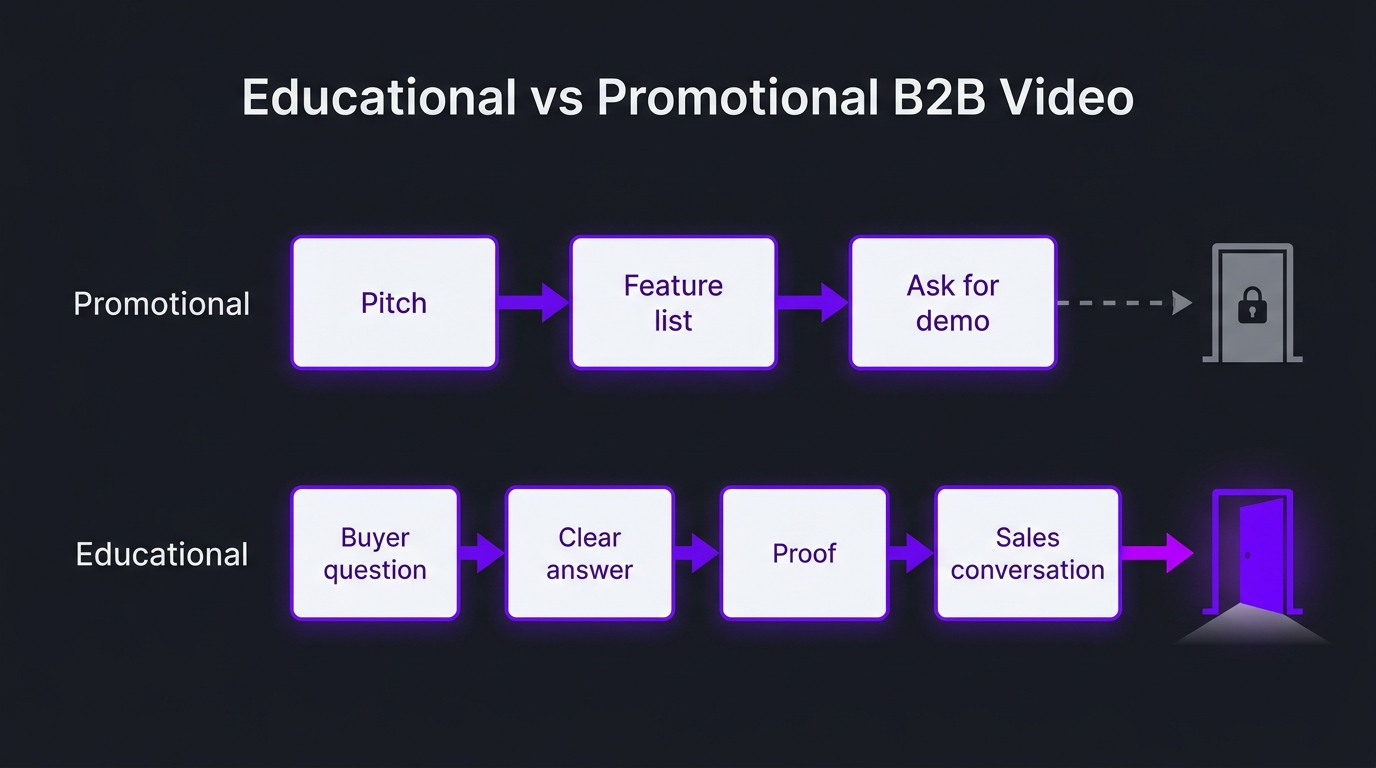
- Educational vs promotional video
- The pipeline case
- Seven formats that work
- Match the format to the buyer stage
- How this played out
- How to build the program
- Accuracy, captions and findability
- Measuring pipeline without inventing numbers
- Common mistakes
- In-house or with a partner
- Frequently asked questions
- Verdict
What educational B2B video is (and what it is not)
Educational video in a B2B context is video whose main purpose is to make a professional buyer better informed. The product may appear, but the subject is the buyer’s problem: how a technology works, how to compare approaches, what to ask a vendor, what the evidence says. This is the video form of what practitioners call content marketing: publishing something valuable enough that the right people seek it out.
It helps to be explicit about the boundaries, because “educational” gets stretched in both directions.
- It is not e-learning or school content. The viewer is a buyer or evaluator, not a student, and the goal is a better decision, not a certificate.
- It is not a product demo in disguise. If every example is your interface, you made a demo. Demos are valuable, but they belong later in the journey.
- It is not a webinar recording left on a page. A recorded hour of slides can be mined for teaching clips, but on its own it rarely holds attention.
- It is not thought leadership for its own sake. Opinion without teaching creates followers, not evaluators. The educational test is whether the viewer can do or decide something afterwards.
💡 Pro Tip: Run the “never buys” test. If a viewer who never becomes a customer would still say the video was useful, it is educational. If the video only makes sense to someone who is already evaluating you, it is promotional.
Educational vs promotional video: where each belongs
Neither type is wrong. They do different jobs, and most B2B programs under-invest in educational video because its payoff is slower and harder to attribute. Here is the comparison that matters for planning.
The practical conclusion is a sequence, not a choice. Educational video fills the early and middle of the journey, promotional video closes it, and customer stories sit in between. Our guide to video strategy for account-based marketing shows how the same logic applies when you are targeting a named list of accounts.
The pipeline case for educational video
The argument is not that educational video is virtuous. It is that the structure of a complex B2B sale makes it commercially rational. Four features of that sale do most of the work.
1. Most future buyers are not in market today
Research associated with the LinkedIn B2B Institute and the Ehrenberg-Bass Institute argues that, at any given moment, most of the companies that could one day buy a B2B product are not actively looking. If your content is only promotional, it can only reach the minority who are. Educational video is the format that is useful to someone who is not buying yet, so it is how you become the vendor they already trust when a budget appears.
2. The decision is made by a committee
Complex products are bought by groups: an economic buyer, a technical evaluator, a security or compliance reviewer, an end user and a champion. You will not get every one of those people on a sales call. You can, however, give your champion a clear video to forward. An educational video that explains the mechanism or the evaluation criteria travels inside the buying group in a way a slide deck rarely does.
3. The buyer needs to understand before they can value
A new category or a hard-to-see technology has a comprehension tax. Until the buyer understands what the product does and why that is different, your price and features mean nothing. Education removes the tax. This is why our guides on making a technical explainer video and on building an explainer video series start with the mechanism rather than the feature list.
4. Search and AI assistants reward helpful answers
Google’s own guidance on creating helpful, people-first content describes content written to help people rather than to attract clicks, and video that answers a specific question is a natural fit. A well-structured educational video, with a clear title, chapters and a transcript, gives search engines and AI assistants something concrete to quote and link to.
📌 Honest caveat: educational video is rarely the last touch before a deal. If your reporting only credits the final click, it will look like it does nothing. The fix is better measurement (see below), not less education.
Seven educational formats that work for B2B tech
Not every format suits every product. These seven cover most of what B2B software, AI and data companies produce, and they can be mixed inside one program.
Two notes. First, the formats are inputs to one program, not seven separate projects: a single practitioner conversation can become a long-form episode, a handful of clips and a written summary, which is the logic behind video repurposing and podcast clip strategy. Second, length follows the question. Use as much time as the mechanism needs and no more.
Match the format to the buyer stage
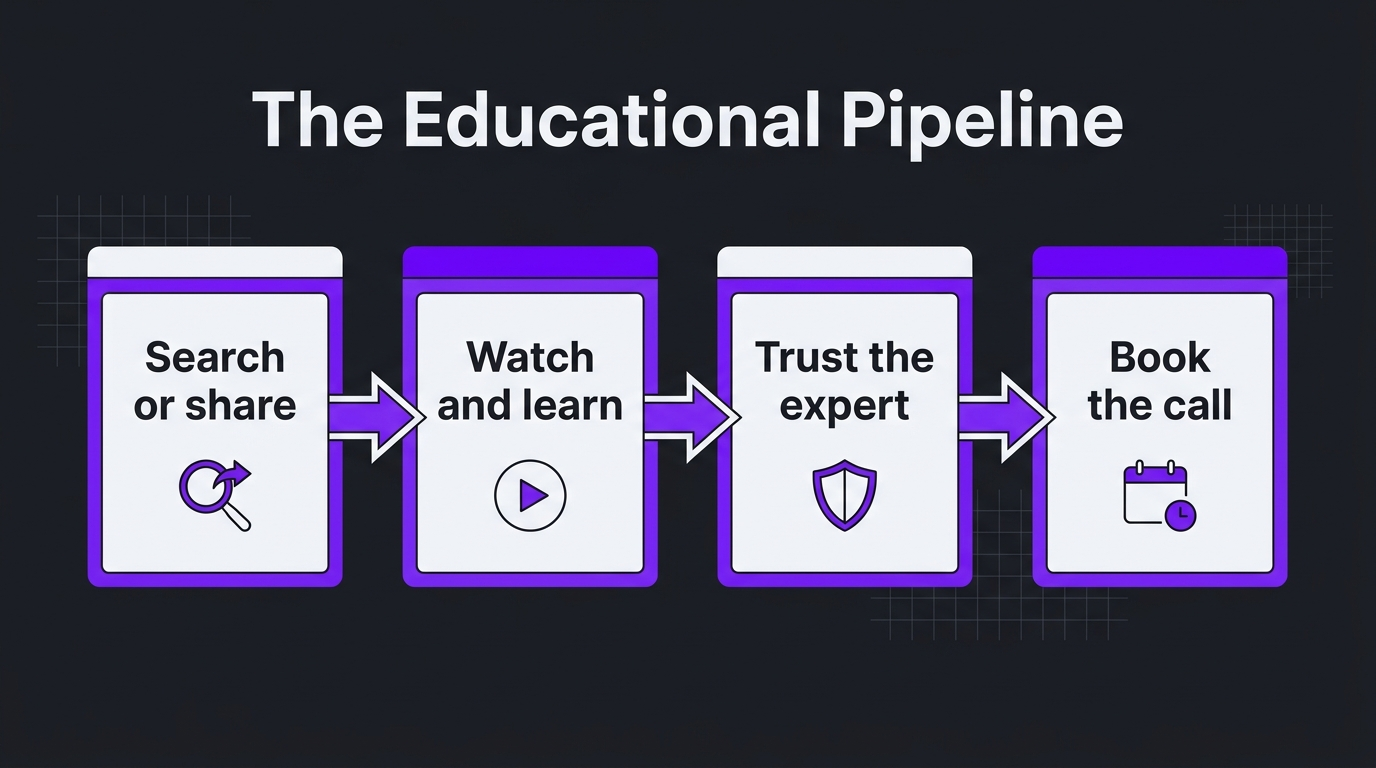
A common mistake is producing educational video without deciding which question it answers. Map the content to the buyer’s stage, and write the title as the question.
Notice that only the last step in the pipeline asks for a call. The earlier steps ask for one more useful video. That is the pipeline logic in one sentence: each video earns the right to the next one.
How this played out
Emerj is an AI research and media company. As of 2026-10-09, its own site describes it as a pipeline partner for AI companies, connecting AI products and service providers with senior enterprise leaders through virtual events and publishing. In other words, educational content is its product, and pipeline is what its customers buy. Increditors edited video for Emerj, and the team there noted that our quality-control efforts were clear to see. That matters more than it sounds: when your content is the teaching, an error in a chart, a name or a term is a credibility problem, not a cosmetic one.
The lesson we took from that work, and apply to every educational program, is that accuracy and clarity are the product. Educational video lives or dies on whether a smart specialist trusts it. You can see more client work on our case studies page.
How to build an educational video program
Step 1: Mine your sales calls for questions
Your best topic list is already in your CRM and call recordings. Pull the questions prospects ask in discovery, the objections that stall deals, and the concepts your reps keep re-explaining. Rank them by how often they appear and how much they block a decision. Resist the temptation to start from keywords alone: search demand is a useful check, but a question that stalls deals is valuable even if few people search for it.
Step 2: Decide the claim and the viewer
Each video gets one claim a viewer can repeat and one primary viewer. The scripting discipline in our guide to technical explainer videos applies to every format here. If you want a starting structure, our explainer video script template for SaaS is built for this.
Step 3: Choose the voice
Someone credible should teach. For some topics that is your founder or a technical lead; for others it is a customer or an outside expert. Our founder-led video playbook covers how to make that practical for time-poor executives. Educational video also works well with no one on camera when the subject is a system, which is where animation and motion graphics earn their keep.
Step 4: Produce to a standard, not a trend
Set a visual and audio standard once (typography, colour, caption style, lower-thirds, intro length) and hold to it. Consistent presentation signals reliability, which is what the buyer is evaluating. Avoid trend-chasing edits that distract from a technical idea.
Step 5: Distribute where buyers look, and give sales the library
- YouTube: the destination for searchable, evergreen educational video; see our B2B YouTube channel strategy, B2B YouTube benchmarks and guide to YouTube for B2B lead generation.
- LinkedIn: clips and short explainers that reach decision-makers in the feed.
- Your site: embed the best explainers on the pages where buyers evaluate, with transcripts for findability.
- Sales enablement: a tagged library by question and stage, so reps send the right video after a call instead of a generic deck.
The fifth item is the most neglected. A video that sales actually sends is worth more than one that gets views from people who will never buy.
Accuracy, captions and findability
Three production disciplines separate educational video that builds trust from content that merely exists.
Technical accuracy
Name one technical approver per video and review at the script, storyboard and final cut stages. Wrong terms cost more in educational content than anywhere else. Our notes on video approval workflows describe how to keep review fast without letting accuracy slip.
Captions and accessibility
Many professionals watch without sound, and captions also help viewers who are deaf or hard of hearing and viewers working in a second language. The W3C guidance on captions is a good baseline, and our video accessibility guide covers the compliance side.
Findability
Use a question-style title, add chapters on YouTube, publish a transcript, and follow Google’s video best practices when you embed on your site. These small steps decide whether a video that took weeks to make is ever found.
Measuring pipeline without inventing numbers
Educational video rarely wins a last-click report, so use a measurement set that matches how it works. You do not need a perfect model; you need a consistent one that you review every month.
Report these quarterly alongside revenue pipeline, and resist reporting views as success. A video with modest views that every rep sends is doing its job. A viral video that no buyer remembers is not.
Common mistakes
In-house or with a partner
A small program can start in-house with a good microphone, a screen recorder and a patient editor. Once you want a steady cadence, consistent motion design and quality control, the economics shift. Hiring one person to do strategy, scripting, production and review is hard; our guide to what professional video editing costs helps you compare options, and our guide to choosing a B2B video marketing agency gives a scorecard for vetting one. If you sell AI or data products, our post on AI startup video marketing covers the specific problem of explaining what nobody can see, and our complete guide to video for SaaS companies goes wider.
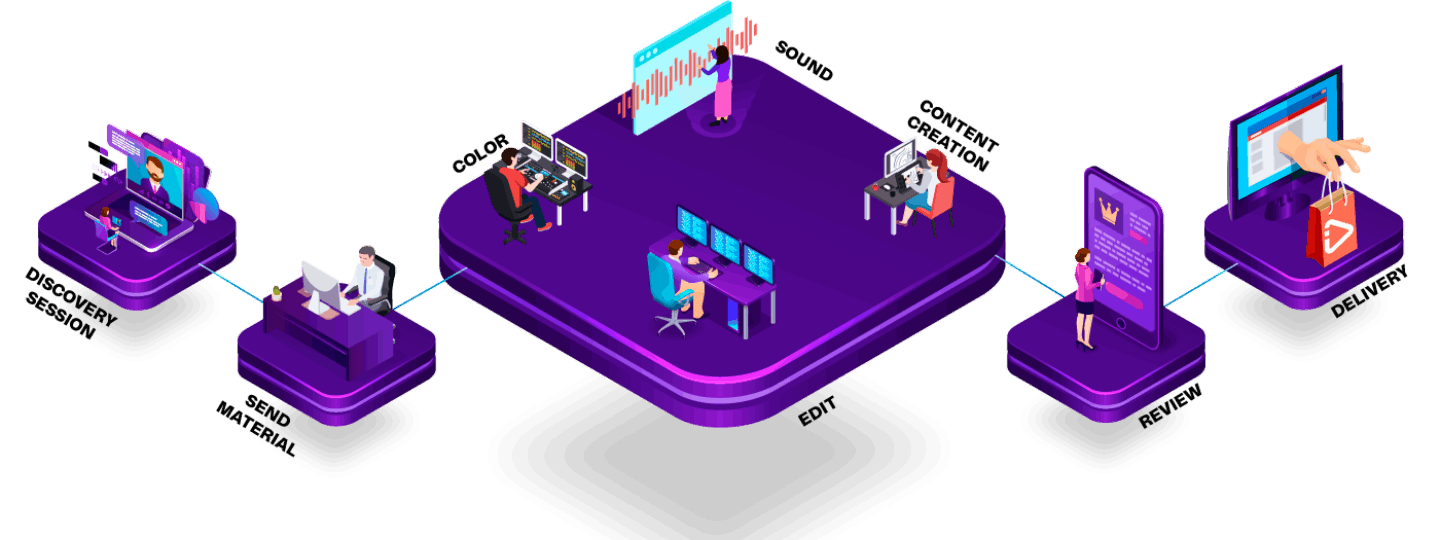
At Increditors we work as the strategy-led alternative to a production vendor: we start from the buyer’s questions and the claim of each video, then script, produce and quality-check it. Your team keeps what only they can do, which is deciding the topics and approving the facts.
Frequently asked questions
What is educational video content in B2B?
Educational video content in B2B is video that teaches a business buyer something they need to know to make a decision: how a technology works, how to evaluate a category, how to solve a specific operational problem, or what the research says. It is built around the buyer’s question rather than the vendor’s product, and the product appears as one credible option or example rather than the subject. It is not school or children’s content; the audience is a professional with budget and a problem.
How is educational video different from promotional video?
Promotional video asks for a decision (watch a demo, buy, book). Educational video earns a decision by making the viewer better informed first. In practice the test is whether the video is useful if the viewer never buys: an explainer of how a model is evaluated, a walkthrough of how to scope a data migration, or a conversation with a practitioner would be useful anyway, while a feature reel is not.
Does educational video content actually generate pipeline?
It can, but it works as a trust and qualification layer rather than a last-click channel. In a considered sale with several decision-makers, educational videos are what a champion forwards, what a late-stage evaluator watches before a call, and what search and AI assistants surface when someone researches the category. The honest way to measure it is by influence on opportunities, not by views: ask on every discovery call what the buyer watched or read first, and track whether sales reuses the videos.
What types of educational video work best for complex B2B products?
The most reliable formats are mechanism explainers (how the technology actually works), practitioner conversations, teardown or how-to walkthroughs, research briefings that summarise a body of evidence, and customer-education videos that help the buyer succeed after purchase. The right mix depends on the stage of the buyer and the complexity of the product.
How many educational videos do we need to start?
Enough to answer the ten or so questions your sales team hears most often, in the order buyers ask them. For many B2B tech companies that is a series of a dozen or fewer videos rather than a high-volume feed. Quality, accuracy and consistent publishing matter more than volume in the first quarter.
Should we outsource educational video production?
If the content program is a one-off, in-house can work. If you want a steady cadence, consistent visual language and quality control on technical accuracy, a specialist partner usually ships faster. Keep topic selection and subject-matter review inside your company either way, because only your team knows which questions block deals.
Verdict
For B2B companies selling a complex product, educational video content is not the soft option. It is the part of the funnel that reaches buyers before they are looking, gives champions something to forward and pre-qualifies evaluators before the first call. Start from the questions your sales team hears, make each answer accurate and clear, give sales a library they will use, and measure influence rather than views. If you want a second opinion on your first ten topics, book a call below.
Want educational video that earns the sales call?
Tell us about your product and the questions your buyers ask, and we will tell you honestly how we would build the program.