









































A B2B video marketing strategy for a SaaS company is an operating system, not a pile of videos. Choose one buyer and one problem, map video to the buying committee, build four kinds of video (explain, prove, teach, enable sales), pick channels by job, set up a repeatable production system and review one short scorecard every month. Teams that sell a complex product to a considered buyer win by being clear, consistent and useful, not by being viral.
- The short answer: one buyer, four video jobs, one scorecard
- Step 1: Pick one buyer, one problem and one outcome
- Step 2: Map video to the buying committee
- Step 3: Build a portfolio of four video jobs
- Step 4: Choose channels by job, not by habit
- Step 5: Build the production system
- Step 6: Measure what a considered sale can actually show
- If your product is hard to see: AI, data and deep tech
- Where B2B video strategies fail
- How this played out
- FAQ
- Verdict
The best B2B video marketing strategy for a SaaS company is to pick one buyer and one problem, then build four kinds of video around the buying committee (explain the product, prove it works, teach the problem, and equip sales), publish them on a steady cadence and review a short scorecard every month. Everything else, from camera choice to platform trends, is a tactic that serves that system.
This playbook is for founders, CEOs and marketing leads at B2B software, AI and data companies that sell a complex product to a considered buyer. It is deliberately different from three posts we already publish. Our B2B video marketing statistics and state of B2B video marketing posts tell you what the market looks like, and our ABM video strategy guide covers one specific motion for named accounts. This post is the operating playbook that sits above them: what to decide, in what order, who owns it and how to know it is working. Use it as the hub, and jump to those posts when you need the data or the ABM detail.
The short answer: one buyer, four video jobs, one scorecard
A video strategy only counts as a strategy if it makes decisions you could be wrong about. “We will make more video” is a budget line. “We will help the head of data engineering understand why our pipeline monitoring replaces three tools, using one hero explainer, six proof clips and a monthly expert series” is a strategy, because someone can later say it did or did not work.
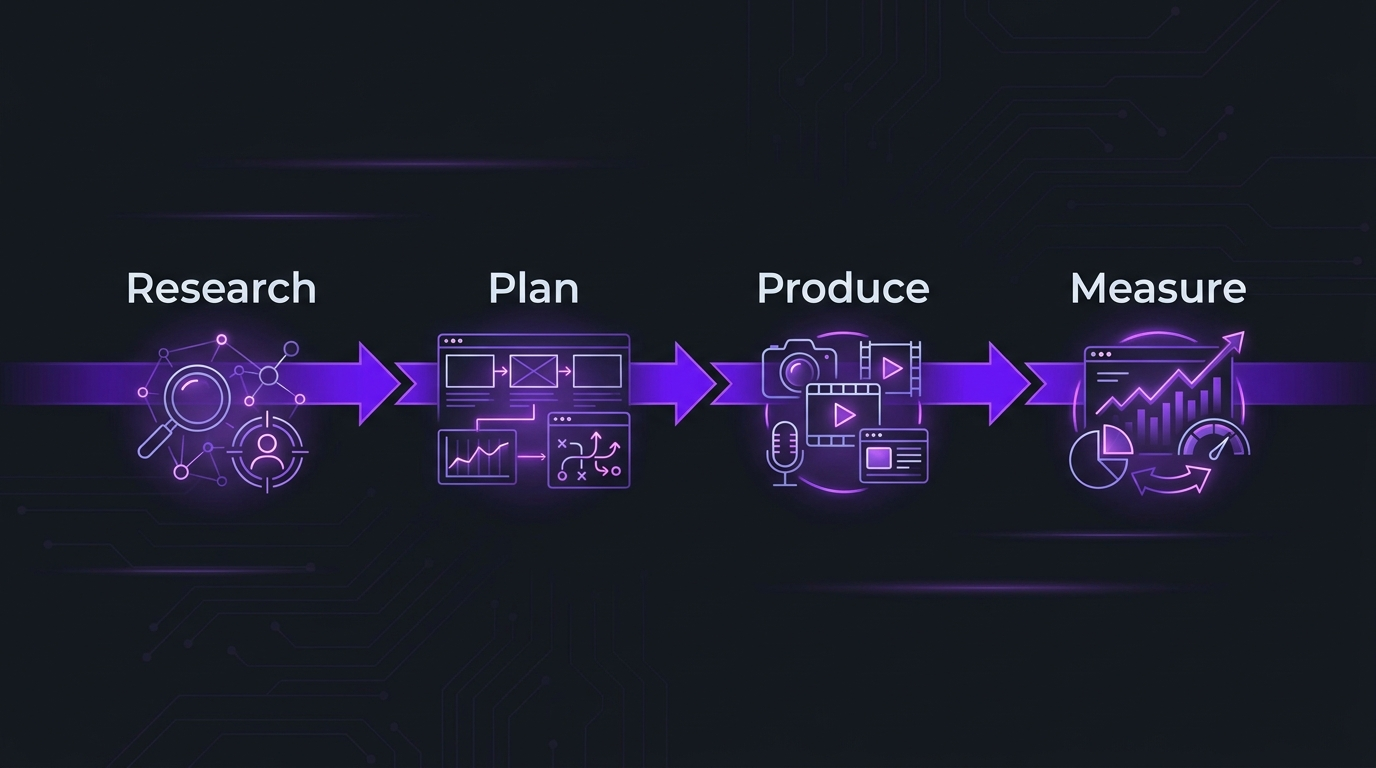
Here is the whole playbook on a single page. The rest of the post explains each row.
Step 1: Pick one buyer, one problem and one outcome
Most B2B video programs fail before a single frame is shot, because the target is “the market”. A complex product is bought by a specific person with a specific pain, and your first videos should be written for that person. Start with a one-page buyer brief.
What goes in the buyer brief
- Role and context: for example a head of data engineering at a mid-sized company that has outgrown a patchwork of tools.
- The problem in their words: use phrases from sales calls, support tickets and community threads, not from your website.
- The trigger: the event that makes them look (a failed audit, a missed forecast, a new mandate).
- The doubts: what they will worry about before they trust you (security, integration effort, switching cost).
- The one outcome: the single action you want after watching, such as booking a demo, replying to an email or forwarding the video internally.
Keep the brief to one page. If you cannot name the role, the trigger and the doubt, you are not ready to brief a scriptwriter, and any video you commission will drift toward generic claims.
💡 Pro Tip: Interview two recent customers and one lost deal before you write the brief. The lost deal is usually more useful, because it tells you which doubt your content failed to answer.
Step 2: Map video to the buying committee
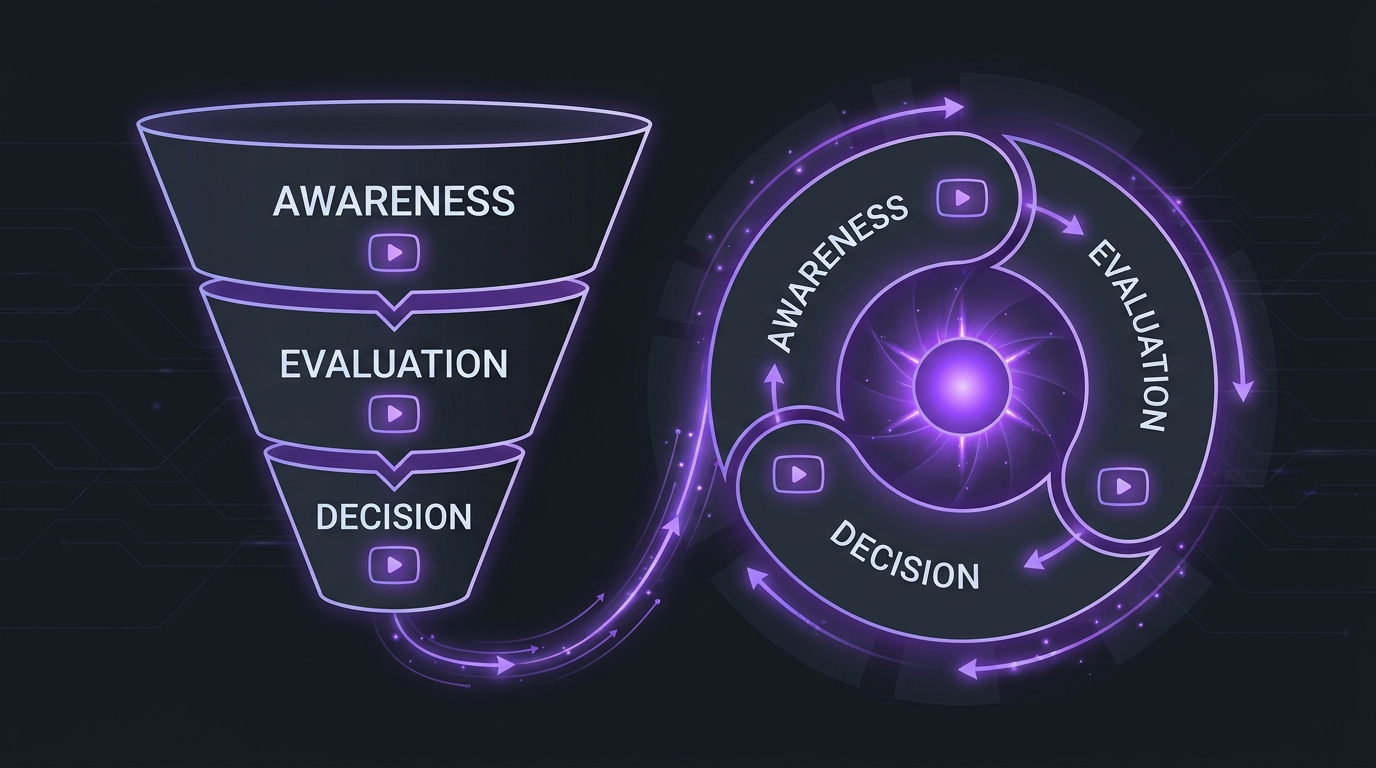
A considered B2B sale involves several people, and each of them needs a different video at a different moment. The champion wants to understand and explain. The economic buyer wants risk and return. The technical evaluator wants proof that it works in a real environment. Mapping video to those roles is what separates a strategy from a content calendar.
Notice that only the first row looks like what most teams call “video marketing”. The rows below it are quieter and often do more for a considered sale. For a fuller treatment of how this works for named accounts, see our ABM video strategy guide.
Step 3: Build a portfolio of four video jobs
Rather than planning twenty video ideas, plan four jobs and fund them in order. Each job has a different audience, shelf life and measure of success.
Job 1: Explain (the hero explainer and its cut-downs)
One clear video that explains what the product does, for whom and why it is different, is the single most reusable asset a B2B company can own. It sits on the homepage or product page, opens sales emails and gets cut into shorter clips for social. For complex products, animation or motion graphics is often the right format because the thing being explained cannot be filmed. If you are weighing this as a first purchase, our guide to hiring a SaaS explainer video agency covers process and briefing.
Job 2: Prove (customer and delivery evidence)
Proof videos answer the justification-stage doubt. A short customer clip, a screen-recorded result with commentary or a plain-spoken implementation story all work. The standard is specific and honest, with a real person from a real company saying something concrete. Avoid generic testimonials; they sound like every other vendor.
Job 3: Teach (the recurring expert series)
A repeatable series built on the questions your buyer already searches for builds familiarity with the people who will eventually evaluate you. This is where a founder, product lead or engineer appears on camera. If that person is the bottleneck, read our founder-led video playbook for time-poor CEOs and our guide to a founder-led content agency.
Job 4: Equip (sales enablement video)
The most underused job is the smallest: two-minute answers to the objections sales hears every week. A short clip that explains security, an integration or a pricing model is easier to forward than a PDF, and it lets your champion repeat your argument when you are not in the room.
Step 4: Choose channels by job, not by habit
Pick channels by the job the video has to do, then choose the lightest set that covers all four jobs. Starting with “we should be on every platform” usually produces thin content everywhere.
- Your own site: explainers and proof belong on product, pricing and case-study pages, where evaluation happens. Mark them up properly; Google documents how video appears in search in its video SEO best practices.
- YouTube: the home for teaching series and longer explainers, because it is both a search engine and a library. Chapters help viewers jump to the section they need; see YouTube Help on video chapters. For the 90-day version, read our B2B YouTube channel strategy and the earlier YouTube for B2B lead generation playbook.
- LinkedIn: the best place to reach practitioners and executives with short expert clips and cut-downs of longer videos. Treat it as distribution for the teaching and proof jobs, not as a separate content effort.
- Email and sales tools: the proof and equip jobs live here. A video link in a one-to-one email or a proposal is often the highest-intent view you will get.
Add captions to everything you publish. Captions help silent viewing and technical vocabulary, and the W3C explains the reasoning and the options in its guide to making audio and video media accessible.
Step 5: Build the production system
A strategy dies at the production step. The usual failure is not bad video, it is no video, because every piece needs scripting, a subject expert’s time, edits and approvals, and nobody owns that pipeline.
The minimum production system
- One owner who can say yes to a script and a cut. Committees of five approvers kill cadence.
- A standard brief with the buyer, the problem, the single outcome, the call to action and the claim you need to prove.
- Batched recording for subject experts, so a founder gives you a block of time rather than ad hoc hours.
- Fixed review rounds with a named reviewer for accuracy and a separate one for brand, so feedback is not contradictory.
- A repurposing plan decided before editing starts: which cut-downs, which captions, which aspect ratios.
In-house, freelancer or partner
Our recommendation is the simplest one that fits your team: keep strategy and subject expertise in-house, and consider a partner when production is the bottleneck. For the cost side of that decision, see our guide to professional video editing costs, and if you are comparing agency types, our B2B video marketing agency scorecard and list of best B2B video marketing agencies show how to evaluate them. Increditors is a video editing company built around this kind of strategy-led work for B2B software, AI and data teams.
Step 6: Measure what a considered sale can actually show
In a considered B2B sale, video rarely produces a clean last-click attribution, so measure a short scorecard that shows leading signals and sales behaviour, and make one decision from it each month. A long sales cycle means you will not see closed revenue for a while, and you should say so up front to whoever funds the program.
YouTube explains how to read where viewers leave in its help article on audience retention key moments, which is the most useful diagnostic for deciding whether a script is working. For benchmark ranges once you have a library to compare, see our B2B YouTube benchmarks.
💡 Pro Tip: Add one question to your demo-request form and your first sales call: “How did you first hear about us?” Self-reported answers regularly surface video and communities that your analytics file under “direct”.
The monthly review
Hold a 30-minute review with marketing and one person from sales. Look at the scorecard, pick the one video that over- or under-performed, write down why, and decide one change for the next month. Every quarter, make the larger call: scale the jobs that work, adjust the ones that partially work and stop the ones that do not.
If your product is hard to see: AI, data and deep tech
If you sell AI, data or deep-tech software, the buyer often cannot see what you do: the value happens inside a model, a pipeline or an algorithm. That changes the strategy in two ways. First, the explain job moves to the front, because a buyer who cannot picture the product cannot champion it. Second, accuracy becomes a brand asset: a technical audience will notice a wrong diagram or generic stock footage immediately.
- Visualise the invisible. Use animation and motion graphics to show data flow, decisions and outcomes rather than describing them.
- Use domain-literate visuals. Footage and b-roll should match the buyer’s world, not a generic office.
- Let experts speak. Researchers and engineers carry credibility that a narrator cannot.
- Version for the stack. Keep a short integration or security video ready for the evaluator, separate from the story video for the champion.
Our guide to video editing for SaaS companies goes deeper on the production side for this kind of product.
Where B2B video strategies fail
Starting with channels instead of the buyer
Opening a channel before choosing a buyer produces videos about the company rather than the customer’s problem. The fix is the buyer brief in step 1.
Treating one hero video as the strategy
A single polished video is an asset, not a program. Buyers evaluate across weeks and roles, and one video cannot answer the committee. Fund at least two of the four jobs.
Measuring only views
Views flatter and mislead. A small audience of the right roles is worth more than a large audience of the wrong ones, which is why the scorecard tracks roles, retention and sales use.
No owner and no cadence
Programs without a named owner and a monthly rhythm drift and then stop. Pick the owner, pick a cadence you can actually keep and protect your subject experts’ time.
Outsourcing the thinking
A partner can write, animate and edit, but nobody outside your company knows the product doubts and buyer language as well as you do. Keep the buyer brief and the claims in-house, and let the partner turn them into finished video.
How this played out
Stratabeat is a B2B marketing agency and a monthly retainer client of ours. Its buyers make complex, considered purchases, which means a single video never closes anything on its own. The team told us that the videos are helping, and that is the point of the retainer model: a steady flow of work built for a considered sale rather than a one-off project. The lesson for your own strategy is cadence over spectacle. You can read more on our case studies page.
FAQ
What is a B2B video marketing strategy?
A B2B video marketing strategy is a documented plan for which videos a software or technology company makes, for which buyers, on which channels, on what cadence and how results are reviewed. A good one starts with a single buyer and problem, maps video to the buying committee and ends with a monthly scorecard and a clear decision.
What types of video should a B2B SaaS company make first?
Start with an explainer that makes the product clear, then add customer proof, a recurring expert series and short sales-enablement clips. If you can only fund one, choose the job that matches your biggest sales problem: an explainer when prospects misunderstand you, proof when deals stall late, and enablement when sales repeats the same explanation.
How do you measure B2B video marketing ROI?
Measure leading signals and sales behaviour rather than expecting clean last-click attribution: videos shipped against plan, audience retention, the roles and companies watching, how often sales sends video and self-reported source. Review monthly and make a scale, adjust or stop decision each quarter.
How much video does a B2B company need?
Fewer videos than most teams assume, as long as they cover the buying committee. A small, consistent library of an explainer, proof clips, an expert series and sales clips usually beats a large volume of generic content. The right number is the cadence you can sustain with subject-expert time and an owner.
Should we run video in-house or use an agency?
Keep strategy and subject expertise in-house, because only your team knows the product and buyer. Consider a specialist partner when production, motion design or consistency is the bottleneck. The deciding factor is which job your team can do reliably every month.
Verdict
Build your B2B video marketing strategy as an operating system: one buyer, four video jobs mapped to the buying committee, channels chosen by job, a production system with an owner and a monthly scorecard. The teams that win with a complex product are rarely the loudest. They are the clearest, the most consistent and the most useful to the people who have to explain the product internally.
If you would like a second opinion on your plan, or help turning it into scripts, animation and finished videos, Increditors works with B2B software, AI and data teams on strategy-led video, and we will tell you honestly if your plan needs a different shape.
Want a Video Strategy Your Sales Team Will Use?
Tell us what you sell and who you need to reach, and we will talk through a plan that fits your team.