









![3D Explainer Video - ScribbleLive.mp4_snapshot_00.12_[2022.03.09_03.14.16]](https://increditors.com/wp-content/uploads/elementor/thumbs/3D-Explainer-Video-ScribbleLive.mp4_snapshot_00.12_2022.03.09_03.14.16-r7wb53mx72rxst3qcqyrfxdmeyzb5r9jbl0wbjujh4.png "3D Explainer Video – ScribbleLive.mp4_snapshot_00.12_[2022.03.09_03.14.16]")




























Account-based marketing teams that embed personalized video at every stage of the account journey — from prospecting to expansion — close deals 30–50% faster than those relying on static assets alone. This guide breaks down exactly how to build an ABM video system, which video types belong at each touchpoint, and how a dedicated editing partner keeps the volume high without sacrificing quality.
- Why ABM and Video Are a Natural Fit
- Mapping Video Types to the ABM Funnel
- Personalization at Scale: The Production Framework
- Metrics That Actually Matter for ABM Video
- Build vs. Buy: In-House vs. Outsourced Video Editing
- Real-World ABM Video Campaigns That Worked
- 30-60-90 Day ABM Video Implementation Roadmap
- Verdict: Is ABM Video Worth the Investmenta
- Frequently Asked Questions
Why ABM and Video Are a Natural Fit
Account-based marketing was built on one foundational idea: treat high-value prospects like individual markets, not like entries in a bulk email sequence. The problem is that most ABM teams still communicate with those accounts using generic whitepapers, templated emails, and slide decks that could have been sent to anyone. Video changes that dynamic entirely. A two-minute video that opens with a prospect’s logo, references their specific pain point by name, and walks through a solution tailored to their industry does something that no static asset can replicate — it creates the feeling of a one-on-one conversation before a human being ever picks up the phone.
The data behind this shift is hard to argue with. Forrester Research found that ABM programs deliver 200% higher revenue impact than standard demand generation efforts when targeting high-value accounts. Separate research from Vidyard showed that personalized video in sales outreach generates 5x higher click-through rates compared to plain-text emails, and that reps who use video in their outreach book 3x more meetings. When you combine ABM’s account-specific targeting with video’s emotional and informational density, you get a channel that can accelerate deals that used to take 9–12 months into a 4–6 month cycle.
This is not theoretical. Enterprise SaaS companies, B2B professional services firms, and high-ticket consulting agencies are quietly deploying video at every major touchpoint of the account journey — and winning deals they previously couldn’t get in front of. The competitive pressure is real: ITSMA reports that 87% of B2B marketers say ABM outperforms all other marketing investments, and an increasing share of that ROI is being driven specifically by video. The question is no longer whether video belongs in your ABM playbook — it’s how to systematize it so the output is consistent, professional, and scalable.
The Psychology Behind Video in High-Stakes B2B Sales
Executive buyers are not like consumers making impulse purchases. They are risk-averse, time-constrained, and deeply skeptical of vendor claims. A well-produced video short-circuits two of the biggest obstacles ABM teams face: credibility and attention. According to research from LinkedIn, the average B2B decision-maker consumes 11.4 pieces of content before making a purchase decision. Video compresses that journey by communicating context, tone, proof, and specificity in a format that executives actually prefer to consume. CMO Survey data consistently shows that video is the preferred content format among C-suite buyers when evaluating enterprise software and services.
There is also a trust dimension that text simply cannot replicate. A personalized video that shows you understand a prospect’s business — their competitive pressures, their recent announcements, their specific workflow challenges — signals a level of research and investment that generates reciprocity. The prospect thinks: “If they did this before I even paid them, what will they do when I’m a customera” That psychological dynamic is enormously powerful in six-figure and seven-figure deal cycles where the cost of switching is high and the buying committee is large.
How Video Complements the Multi-Threaded ABM Approach
Modern ABM is multi-threaded by design. Rather than pursuing a single champion inside a target account, sophisticated teams engage multiple stakeholders simultaneously — the economic buyer, the technical evaluator, the end user, and sometimes even the board-level executive. Each of these personas has different concerns, different vocabulary, and different tolerance for technical depth. Video makes it practical to create tailored messages for each persona without rebuilding your content from scratch every time. A shared base video with persona-specific intros and tailored examples gives your team the flexibility to speak to five different stakeholders inside the same account without producing five completely different assets.
This modular video approach also maps perfectly onto ABM’s tiered account structure. Tier 1 accounts — your highest-priority, highest-value targets — deserve fully custom video treatment: bespoke production, personalized scripting, individual stakeholder videos. Tier 2 accounts can receive industry-specific videos with light personalization in the intro and outro. Tier 3 accounts get polished, segment-specific videos that still feel more curated than a generic marketing email blast. The production hierarchy matches the revenue opportunity, and a professional editing partner makes it economically viable to execute at all three tiers simultaneously.
Mapping Video Types to the ABM Funnel
The most common mistake ABM teams make with video is treating it as a single asset category — they produce one “company overview” video and call their video strategy complete. Effective ABM video is a system, not a single asset. Each stage of the account journey demands a different type of video with a different primary objective, a different emotional tone, and a different call to action. Understanding this map is the foundation of building a scalable ABM video program.
Top-of-Funnel: Thought Leadership and Awareness Video
At the awareness stage, your target accounts may not know you exist, or they may know your brand name but have no strong opinion about it. The goal of top-of-funnel ABM video is not to sell — it is to position your brand as a credible, intelligent voice on the problems your prospect is already trying to solve. These are the industry trend videos, the thought leadership mini-documentaries, the “state of the industry” explainers that your paid media team deploys through LinkedIn Video Ads, YouTube pre-roll, and Connected TV targeting lists built from your named account list.
Thought leadership videos at this stage work best when they lead with a provocative insight rather than a product pitch. A cloud security company targeting Fortune 500 CFOs should open with a data point about the average cost of a cloud misconfiguration, not a feature list. A workflow automation platform targeting operations directors should lead with a research finding about how much enterprise productivity is lost to manual data entry. The video earns attention by being genuinely useful first, and brand recall comes as a byproduct of that usefulness.
Mid-Funnel: Personalized Outreach and Solution Explainers
The personalized outreach video is the single most powerful tool in an ABM rep’s arsenal. These are 60–90 second videos recorded by a sales rep or SDR, professionally edited to include the prospect’s name, company logo, and a brief reference to something specific about their business. The edit does not need to be a full production — a clean intro animation, sound-leveled audio, a polished lower-third with the rep’s name, and a well-designed outro card with a calendar link transforms a selfie-style screen recording into something that looks deliberately crafted for that account.
Solution explainers at the consideration-to-evaluation transition are where production quality starts to matter more. These videos need to communicate technical capability, integration depth, and workflow impact in a format that technical evaluators can share internally with their team. A great solution explainer uses motion graphics to illustrate data flows, annotated screen recordings to show UI depth, and customer voice clips to add social proof. Getting this right requires a professional editor who understands both storytelling and technical communication — not a template tool.
Bottom-of-Funnel: Decision Acceleration and Post-Close Video
The decision stage is where deals get stuck. A buying committee has formed, the champion is convinced, but the economic buyer is nervous about the investment and the board needs a sign-off. This is exactly where a well-produced case study video — featuring a recognizable customer logo, a credible speaker, specific ROI metrics, and a clear before-and-after narrative — can break the logjam. Video case studies get shared in Slack channels and email threads in ways that PDF case studies do not. They carry the emotional weight of a testimonial with the credibility of documented results.
Post-close, the value of video shifts to retention and expansion. A personalized welcome video from the CEO or account manager, a professionally edited QBR recap that summarizes value delivered, or a teaser video about an upcoming product feature targeted at your existing account’s specific use case — all of these strengthen the relationship and reduce the chance of the account going dark between renewal cycles. ABM is not just a new-business motion; it’s a full account lifecycle strategy, and video should follow the account through every phase of that lifecycle.
Personalization at Scale: The Production Framework
The biggest objection ABM teams raise about video is that personalization doesn’t scale. “We have 200 target accounts — we can’t produce 200 custom videos.” This objection reflects a misunderstanding of how professional video production actually works at scale. The secret is the modular video architecture: a system that separates the fixed elements of a video (brand identity, base narrative, core proof points) from the variable elements (account-specific intro, persona-specific pain point, customized CTA), and produces them in a way that allows rapid assembly of account-specific versions.
Think of it like a film studio’s shot library approach. A Hollywood production doesn’t reshoot every single frame for every market — they create localized versions by swapping specific sequences while preserving the core creative. ABM video works the same way. You invest once in high-quality “base” videos for each product line or use case, then produce short, account-specific intro and outro segments that wrap the base content in a personalized shell. The result is a video that feels fully custom to the recipient, produced at a fraction of the cost of building each video from scratch.
The Three-Layer Modular Architecture
Layer one is the brand foundation: your visual identity, color palette, typography, music bed, and logo animation. These elements appear in every video you produce and create instant brand recognition. They cost money to produce once and then pay dividends across hundreds of videos. Layer two is the segment-specific base content: the narrative core of the video tailored to an industry, company size, or persona. A healthcare IT company gets a different base video than a fintech startup, even if both are receiving your platform. Layer three is the account-specific personalization layer: the 15–30 second intro that mentions the company by name, references a recent news event or trigger, and uses their logo in the opening animation.
With this architecture, producing a batch of 25 personalized videos for your top-25 target accounts does not require starting from zero 25 times. It requires 25 personalized intros (15–30 seconds each) appended to a segment-specific base that was produced once. A professional editing team like Increditors can process these personalization batches efficiently, maintaining consistent quality across all 25 accounts while keeping turnaround time tight enough to match your SDR outreach cadence.
💡 Pro Tip: When scripting your personalized intros, follow the “trigger-insight-bridge” formula: open with a specific trigger (a recent press release, a job posting, a product launch), pivot to an insight about what that trigger reveals about their challenge, then bridge to how your solution addresses that challenge directly. This three-sentence structure keeps intros under 30 seconds while feeling highly researched and relevant.
Tech Stack Integration: Video in Your ABM Platform
Your video content is only as powerful as the infrastructure that delivers it and tracks its impact. The modern ABM video stack typically layers several tools: a video hosting platform with engagement analytics (Vidyard, Wistia, or Loom for sales), integrated with your CRM (Salesforce or HubSpot) to trigger follow-up sequences when a prospect reaches a watch-time threshold, connected to your ABM platform (6sense, Demandbase, or Terminus) to coordinate with intent data signals. When a target account stakeholder watches 85% of your solution explainer video, that event should automatically trigger a high-priority notification to the AE and queue a follow-up email with a personalized next-step offer.
Most ABM teams underutilize their video analytics. They track views and stop there. But engagement heat maps — which sections of a video are rewatched, where viewers drop off, which CTAs get clicked — are a goldmine of qualification signal. A prospect who watches the pricing section of your solution explainer three times is giving you a clear buying signal. A prospect who drops off in the first 30 seconds is telling you the hook isn’t landing for this persona. These insights should feed back directly into your video content strategy and your sales team’s talk tracks.
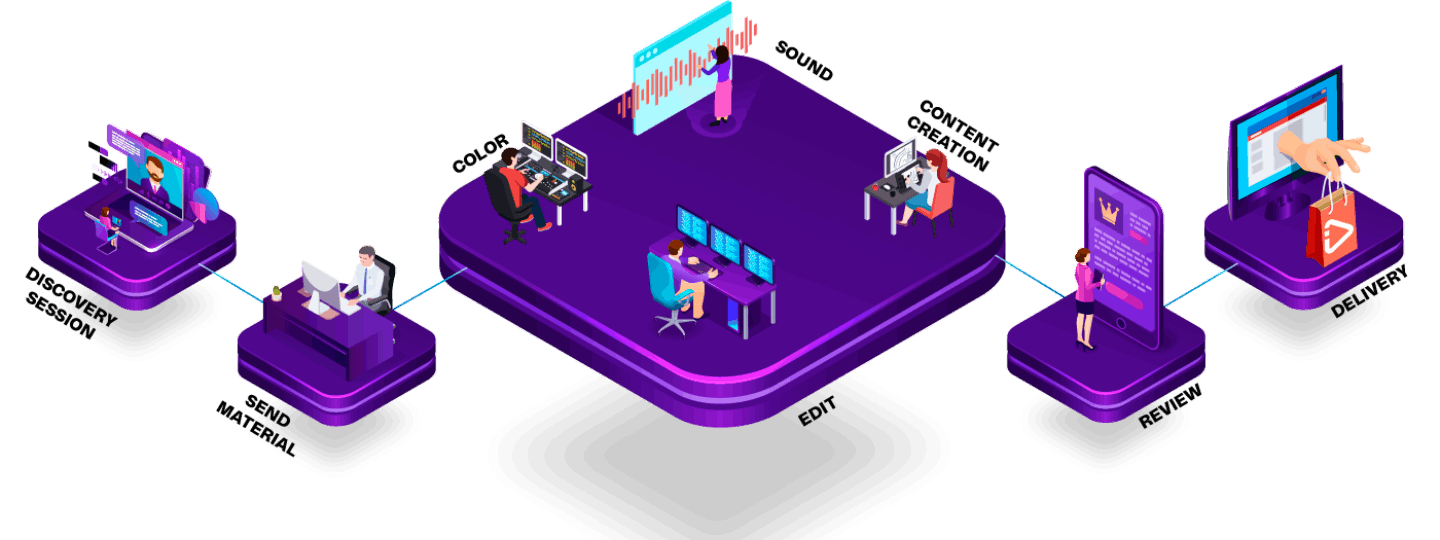
Workflow Design: From Brief to Published in 48 Hours
Speed is a competitive advantage in ABM. If your SDR sends a personalized outreach video three days after the trigger event (the prospect’s company announcing a new funding round, for example), the relevance has already faded. The target of any mature ABM video program should be a 24–48 hour turnaround from brief submission to published, shareable video. Achieving this requires a documented production workflow with clear roles: who writes the script, who records the raw footage, who submits the brief to editing, and who reviews and approves the final cut before it goes out.
At Increditors, we work with ABM teams to build these workflows from the ground up — establishing brief templates, recording guidelines, style guides, and feedback protocols that allow your team to move from idea to finished asset without the back-and-forth that normally kills production velocity. The teams that execute ABM video best are not the ones with the biggest budgets — they are the ones with the most disciplined production systems.
Metrics That Actually Matter for ABM Video
Most marketing teams measure video performance with metrics borrowed from consumer content: total views, average watch time, subscriber growth. These metrics are nearly useless in an ABM context. In ABM, you are not trying to reach millions of anonymous viewers — you are trying to move a specific set of named accounts through a specific pipeline stage. The metrics that matter are account-level engagement metrics, pipeline influence metrics, and deal velocity metrics.
Setting Up Multi-Touch Attribution for Video
The hardest part of measuring ABM video ROI is attribution. Video rarely closes a deal by itself — it is one of many touchpoints in a complex, multi-stakeholder buying journey. Setting up proper multi-touch attribution requires tagging every video interaction (view, CTA click, share event) with the associated account ID and contact in your CRM, then using a multi-touch attribution model (time-decay or W-shaped attribution work best for ABM) to assign credit across the full touchpoint sequence.
HubSpot and Salesforce both support multi-touch attribution natively, and both integrate with Vidyard and Wistia for video-specific engagement data. If you’re running a 6sense or Demandbase ABM platform, the intent data layer adds another dimension: you can correlate video engagement with the account’s surge score to see whether video content is influencing the account’s broader research behavior. Teams that close this attribution loop typically find that video has a 40–60% higher influence rate on closed-won deals than they initially estimated — because video’s contribution was being missed in last-touch models.
A/B Testing Your ABM Video Content
ABM video should be treated as an iterative program, not a one-time campaign. That means building in systematic A/B testing from day one. Test thumbnail designs against each other (a talking head vs. an animated still vs. a data visualization often produces dramatically different click rates). Test opening hook styles — does a question hook outperform a data hook for your audience Does a rep-recorded personal video outperform a polished production video for cold outreach to your specific ICP The answers vary significantly by industry, company size, and buying persona, and the only way to find them is to test.
Build vs. Buy: In-House vs. Outsourced Video Editing
Every ABM team reaches the same crossroads eventually: should we build an in-house video production capability, or should we outsource it This is not a simple question with a universal right answer. It depends on your content volume requirements, your internal talent availability, your budget structure, and how central video is to your overall go-to-market strategy. What we can do is lay out the honest trade-offs so you can make the decision with clear eyes.
The in-house model makes sense when you have very high video volume needs (50+ edited videos per month), when your content requires real-time reactivity (news-driven content that must go out within hours), or when your brand identity is so complex and proprietary that external editors struggle to maintain consistency. In-house also makes sense if video is genuinely core to your revenue model — if you’re building a video-first product or a media company, owning the capability makes strategic sense.
For most B2B ABM teams, however, the math strongly favors outsourcing. A mid-level in-house video editor in a major US market commands $70,000–$90,000 in base salary, plus benefits, equipment, software licenses, and management overhead. That’s a $100,000–$120,000 annual investment for a single editor who can handle a limited throughput. A premium editing agency like Increditors delivers equivalent or higher quality at a fraction of that cost, with the added benefit of a team rather than an individual — multiple editors, motion graphics specialists, sound designers, and a quality review layer that a single hire cannot provide.
💡 Pro Tip: When evaluating video editing partners for ABM work, ask specifically about their experience with B2B content. Consumer video editing and B2B ABM video editing require very different skill sets — a strong YouTube editor may not understand how to frame a technical solution explainer or structure a case study video for a skeptical CFO audience. Ask for samples in your vertical and review them critically for tone, pacing, and information density.
What to Look for in an ABM Video Editing Partner
Not all video editing agencies are built for the demands of enterprise ABM. The requirements are specific: fast turnaround (24–48 hours for personalized outreach videos), consistent brand application across a high volume of unique assets, the ability to handle motion graphics for technical explainers, and experience with the production formats that ABM teams actually use — screen recordings, talking head interviews, product demos, customer testimonial clips. Beyond technical capability, look for an agency that understands the business context of what you’re trying to do. An editor who understands ABM funnel dynamics will make better storytelling decisions than one who just knows how to cut footage.
Communication workflow matters enormously at production scale. You need a partner with a clear brief submission process, transparent revision policies, and a dedicated point of contact who understands your brand and your goals. Agencies that treat you as a ticket number rather than a strategic partner will introduce friction that kills your ABM program’s velocity. The best agency relationships operate more like an embedded team than a transactional vendor — they proactively suggest improvements to your video briefs, flag consistency issues before you notice them, and invest in understanding your go-to-market motion well enough to anticipate your needs.
Hybrid Models: The Best of Both Worlds
Many high-performing ABM teams end up in a hybrid model: a content strategist or video producer in-house who owns the brief creation, scripting, and quality oversight process, paired with an outsourced editing team that handles the actual production work. This model gives you strategic control and brand ownership without the overhead of a full in-house production team. The in-house person acts as the creative director and account relationship manager; the external team executes at scale. It’s a highly efficient structure for teams producing 10–40 edited videos per month — the sweet spot for most enterprise ABM programs.
Real-World ABM Video Campaigns That Worked
Understanding the theory of ABM video is one thing; seeing how it plays out in real campaigns is another. The following examples illustrate different approaches to ABM video strategy across industries, deal sizes, and production styles. While we’ve anonymized company names, the production approaches and results are representative of real programs.
Case 1: Enterprise SaaS — The “Mirror” Campaign
A mid-market HR technology company targeting enterprise accounts with 1,000+ employees ran what they internally called the “Mirror” campaign — a series of 90-second outreach videos that opened with a visual representation of the prospect company’s current HR workflow based on publicly available information (job postings, LinkedIn data, press releases). The video literally mirrored the prospect’s own process back to them, identified the two or three friction points that were most common in companies of that size and structure, and then showed a 30-second demo clip of how the platform addressed each friction point specifically.
The campaign targeted 40 accounts over six weeks. Reply rate to the video email sequence was 34% — compared to an 8% baseline on the company’s standard text-based outreach. Of the 14 accounts that replied, 11 booked discovery calls, and 6 ultimately moved into active pipeline. The incremental pipeline generated from the campaign was $2.4M. Total production cost for the 40 personalized videos, including editing and motion graphics, was under $12,000. The ROI, even at a conservative close rate, was extraordinary.
Case 2: Professional Services — The “Research Report” Video
A management consulting firm targeting Fortune 500 CFOs produced a series of short-form video versions of proprietary research reports — each tailored to a specific industry vertical. Rather than sending a 40-page PDF that might sit unread in an inbox, they produced 3-minute video summaries of the key findings, using motion graphics to animate the data, professional voiceover to narrate the narrative, and a clean branded outro with a direct CTA to schedule a conversation with the relevant partner. The videos were hosted on personalized landing pages with the prospect’s company name in the URL and header image.
The result: average landing page engagement time increased from 1 minute 20 seconds (PDF download behavior) to 4 minutes 15 seconds (video engagement). Meeting booking rate from the video landing page was 22% — compared to 6% for the PDF version. The CFOs who booked meetings consistently cited the video as the reason they responded, using phrases like “it felt like you’d already done work for us” and “I could tell you understood our specific situation.” That perception — created entirely through professional video production — is exactly the differentiation ABM is designed to create.
Case 3: B2B SaaS — Video for Committee Selling
A data analytics platform targeting retail and CPG companies with 6-12 month deal cycles used video specifically to solve the “dark funnel” problem in committee selling — the period between the champion’s approval and the committee’s decision where the vendor has no visibility and no ability to influence. Their solution was a “buying committee video kit” — a set of four short videos (2–3 minutes each) designed to be shared by the champion with different stakeholders: a business value video for the CFO, a security and compliance video for the CISO, an integration and implementation video for the CTO, and an end-user adoption video for the VP of Operations.
Each video opened with a voiceover that named the specific role: “If you’re the VP of Operations reviewing this platform, here’s what matters most to you.” The champion could share the relevant video to each stakeholder with a single link. Sales cycle analysis showed that deals where the buying committee kit was shared progressed to final proposal 41 days faster on average than deals where it was not shared. Objection rate in final negotiations also dropped, because the videos pre-emptively addressed the most common objections from each persona before the formal procurement conversation began.
30-60-90 Day ABM Video Implementation Roadmap
Knowing you should invest in ABM video and knowing how to actually build the program are two different things. The following 30-60-90 day roadmap is designed for ABM teams starting from scratch — teams that have never done systematic video production before. If you already have some video assets, use this roadmap as a diagnostic to identify the gaps in your current program.
Days 1–30: Foundation and Infrastructure
In the first 30 days, resist the temptation to start producing videos immediately. The biggest waste in ABM video programs comes from producing assets before the infrastructure to deploy and measure them is in place. Start by auditing your existing video assets (you likely have more than you think — webinar recordings, demo recordings, conference presentations) and identifying what can be repurposed into ABM-ready content with editing. Then set up your video hosting and analytics platform, integrate it with your CRM, and establish your account segmentation for video personalization tiers.
Alongside the tech setup, develop your brand video style guide — the document that specifies your color palette, font choices, animation style, music selection, lower-third templates, and logo usage rules for video. This guide is what you’ll give to your editing partner to ensure every video looks like it came from the same production house. Without it, video quality becomes inconsistent and brand trust erodes. Finally, select your editing partner and run a pilot batch of 3–5 videos to validate the production workflow before scaling.
Days 31–60: Content Build and Campaign Launch
In the second month, build out your core video library: one thought leadership video per primary industry vertical, one solution explainer per major product use case, and one personalized outreach template per SDR sequence type. This is your “evergreen” video foundation — the assets that will serve you for the next 12–18 months. Invest seriously in production quality here, because these assets will be seen by your highest-value target accounts and will form the basis for hundreds of personalized derivatives.
Launch your first ABM video campaign with a defined target account list, clear success metrics, and a structured A/B test. Don’t try to run video across your entire account list simultaneously — start with your top 20–25 Tier 1 accounts where the quality and personalization investment is most justified. Document everything: what worked, what didn’t, which video formats generated the most account engagement, which personalization approaches resonated most. This documentation will be invaluable when you scale in month three.
Days 61–90: Scale, Optimize, and Systematize
In the third month, use the data and learnings from your pilot campaign to refine your production workflow and scale to your full target account list. Roll out video to Tier 2 and Tier 3 accounts using the segment-specific base videos with lighter personalization. Establish a regular content cadence — weekly video brief submissions to your editing partner, consistent turnaround windows, and a review and approval process that keeps quality high without creating bottlenecks. By day 90, video should be a standard, expected component of every SDR sequence and every AE account strategy for your target accounts.
Also in this phase, begin building your case study video library. The accounts you’ve engaged in months one and two are candidates for customer testimonial videos. Even a single well-produced case study video featuring a recognizable customer logo and specific ROI metrics will have an outsized impact on your bottom-of-funnel conversion rate. Getting one or two customer interviews on camera in month three sets up a decision-stage video asset that will serve your ABM program for years.
Verdict: Is ABM Video Worth the Investmenta
After examining the data, the psychology, the production economics, and the real-world results, the answer is unambiguous: yes, ABM video is worth the investment — but only if you approach it as a system rather than a collection of one-off assets. A single polished video will not transform your win rate. A systematic video presence at every major touchpoint of your account journey, executed with consistent brand quality and measured with account-level precision, absolutely will.
The competitive landscape is shifting fast. Two years ago, personalized video in B2B outreach was a differentiator because almost no one was doing it. Today it’s becoming table stakes among top-performing ABM teams at growth-stage and enterprise companies. In another two years, ABM programs without video will look the way cold-call-only programs look today — outdated, low-yield, and fundamentally mismatched to how modern B2B buyers want to be engaged. The teams building this capability now are creating a structural advantage that will compound over time.
The economics are also genuinely compelling. ABM programs already operate with higher CAC than broad-based demand generation — and that’s acceptable because they also deliver higher ACV, higher win rates, and better retention. Adding video to the mix raises the CAC modestly while delivering disproportionate improvements in deal velocity and win rate. For a company selling $100K+ ARR deals, shaving 30 days off the average sales cycle with video is worth tens of thousands of dollars in improved cash flow alone — well before you count the impact on close rate.
If you’re reading this as an ABM leader evaluating whether to invest in video, the question to ask yourself is not “can we afford to add video to our ABM programa” The real question is “can we afford not toa” The accounts you’re targeting are already being approached by competitors with sophisticated video programs. The buying committee members you need to influence are already accustomed to consuming video in every other area of their professional life. Meeting them with the format they prefer, at the moment they’re evaluating, with content that speaks directly to their situation — that’s not a nice-to-have. That’s how you win in modern enterprise B2B.
Frequently Asked Questions
How many personalized videos do we need to produce to run an effective ABM video programa
The number depends on your account list size and tier structure. For a typical ABM program targeting 100–200 accounts, a realistic starting point is 5–8 “base” videos covering your primary use cases and industry verticals, plus 20–30 personalized variations per quarter for Tier 1 accounts. As your modular production system matures, you’ll be able to scale personalization volume significantly without proportional increases in production cost. The key is building the base video library first — the evergreen assets that fuel your personalized derivatives — before trying to scale personalization volume.
What is the typical budget for ABM video production at the mid-market levela
Mid-market ABM teams typically spend $2,000–$8,000 per month on video editing and production, depending on volume and production complexity. This budget typically covers 8–20 edited videos per month ranging from 60-second personalized outreach videos to 4-minute solution explainers. Enterprise teams with more complex production requirements and higher volumes might invest $10,000–$25,000 per month. At either level, the ROI math works in your favor if you’re selling deals with ACV above $25,000 — a single accelerated close pays for months of production investment.
Should ABM outreach videos be rep-recorded or produced by the marketing teama
Both approaches work, and the best programs use both. Rep-recorded personalized videos (where the SDR or AE records a short Loom or phone camera clip referencing the specific account) create a human connection that purely produced videos can’t replicate — the prospect sees a real person, hears a real voice, and feels genuinely addressed. These rep-recorded clips should then be professionally edited with branded intros, polished audio, clean lower-thirds, and a designed outro card. This hybrid approach gives you the authenticity of a personal recording with the credibility of professional production — the best of both worlds.
How do we handle video personalization for accounts where we don’t have a named contact yeta
For accounts in early awareness where you don’t yet have a named contact to address, shift your personalization from person-level to company-level and industry-level. Produce videos that reference the account’s company name and industry-specific challenges without requiring a named individual. These videos can be used in LinkedIn advertising (targeting the named account with account-based LinkedIn campaigns), in direct mail QR codes sent to the physical office, and in personalized landing pages that your intent data platform serves when someone from the account IP address visits your website. Person-level personalization becomes possible once you’ve identified specific contacts through inbound engagement or outbound research.
What’s the single most impactful place to add video to an existing ABM program that doesn’t currently use videoa
If you’re starting from zero and need to prioritize, add video to your initial outreach sequence first. The moment-of-first-contact is where the highest percentage of deals are won or lost — not in the evaluation stage, but in whether you can get the account’s attention in the first place. A professionally edited 90-second personalized outreach video, replacing or supplementing your first cold email, typically delivers 3–5x the reply rate and meeting-booking rate of a text-only sequence. That single change, deployed across your Tier 1 account list, will generate enough pipeline impact to fund your entire video program for the next year and justify expanding to the other touchpoints described in this guide.
Ready for Video That Actually Convertsa
Tell us about your project and we will put together a custom plan.