








![3D Explainer Video - ScribbleLive.mp4_snapshot_00.12_[2022.03.09_03.14.16]](https://increditors.com/wp-content/uploads/elementor/thumbs/3D-Explainer-Video-ScribbleLive.mp4_snapshot_00.12_2022.03.09_03.14.16-r7wb53mx72rxst3qcqyrfxdmeyzb5r9jbl0wbjujh4.png "3D Explainer Video – ScribbleLive.mp4_snapshot_00.12_[2022.03.09_03.14.16]")




























One 60-minute interview contains enough raw material for 30 or more pieces of platform-ready content — if you know how to slice it correctly. This guide gives you a precise repurposing framework, a complete content matrix, and a practical workflow so you can turn every recording session into weeks of distribution fuel without recording a single extra minute.
- Why Interview Repurposing Is the Highest-ROI Content Move in 2026
- The Math: How One Interview Becomes 30+ Pieces
- Platform-by-Platform Breakdown: Formats, Specs, and What Works
- The Editing Workflow: From Raw Recording to Distribution-Ready Clips
- The 7 Most Common Repurposing Mistakes (and How to Avoid Them)
- Scaling Your Repurposing Operation: When and How to Outsource
- Verdict: Is Interview Repurposing Worth Ita
- Frequently Asked Questions
Why Interview Repurposing Is the Highest-ROI Content Move in 2026
Content creation is expensive. Not just in money — in time, energy, and creative bandwidth. Every time you sit down to record, research, script, and publish, you’re making a significant investment. The tragedy is that most creators, podcasters, and business leaders treat that investment as if it only produces a single asset: the episode itself. The full YouTube video gets posted. Maybe a quote graphic goes on Instagram. Then the recording sits in a folder somewhere, never to be touched again.
This is one of the most expensive habits in digital marketing. A properly structured 60-minute interview contains, by conservative estimate, at least 12 to 15 distinct quotable moments, four to six topic clusters that work as standalone stories, dozens of B-roll opportunities, and enough contextual depth to populate weeks of social content. None of that requires an additional recording session. It just requires a system.
The Compounding Effect of Multi-Platform Distribution
Repurposing isn’t just about efficiency — it’s about compounding reach. Each platform has a distinct algorithm, a distinct audience behavior, and a distinct discovery mechanism. A 90-second clip that performs well on LinkedIn is reaching professionals during their morning scroll. The same clip on TikTok reaches a completely different demographic at a completely different time of day through a completely different discovery mechanism. A tweet thread pulling the five key insights from that interview reaches people who won’t watch video at all.
When you layer these touchpoints together, you aren’t just recycling content — you are building a multi-directional funnel that converts browsers on six platforms into followers, and followers into buyers. Research consistently shows that a prospect needs between seven and twelve brand touchpoints before making a purchase decision. A single interview, properly distributed, can deliver all of those touchpoints from a single recording session.
Why This Matters More Now Than Ever
Platform saturation is accelerating. The average YouTube channel uploads more videos per week than it did five years ago, and average watch time per viewer hasn’t kept pace with content volume. On LinkedIn, the algorithm increasingly rewards consistent, varied posting formats — a mix of text, video, carousels, and short clips — rather than any single format alone. TikTok and Instagram Reels have essentially made short-form video a non-negotiable for any brand that wants organic reach in 2026.
The creators and B2B brands that are winning right now are not recording more content. They are extracting more value from what they already record. Interview repurposing is the single fastest path to achieving that without burning out your team or your budget.
Who Benefits Most From This System
This framework applies broadly, but it is particularly high-leverage for four types of content producers. Podcast hosts and co-hosts who record weekly long-form conversations. YouTube interview-format channels where the host brings on guests. B2B SaaS companies and agencies running thought-leadership interview series. Coaches, consultants, and course creators who record expert conversations as part of their content strategy. If you fall into any of these categories and you are not systematically repurposing every recording, you are almost certainly leaving significant distribution capacity — and revenue — on the table.
💡 Pro Tip: Before your next interview, designate one team member (or brief your editor) to flag high-value moments in real time during the recording. Use a simple notation system — a star or timestamp comment — so the editing pass starts with a pre-identified shortlist rather than a full re-watch of the entire recording.
The Math: How One Interview Becomes 30+ Pieces
The claim “30 pieces from one interview” sounds like marketing hyperbole until you actually map the content types. Let’s break it down with precision. The following matrix assumes a 60-minute recorded interview. Shorter interviews will yield fewer pieces proportionally, but the framework scales in both directions.
The Complete Content Matrix
When you total the conservative end of that matrix — 1 full episode, 2 long YouTube clips, 4 Shorts, 3 LinkedIn video clips, 4 TikTok/Reels clips, 3 X clips, 2 LinkedIn posts, 1 thread, 3 quote graphics, 1 email, 1 blog post — you land at 25 pieces minimum. Add in a podcast audiogram, a carousel post, a second thread, and a couple of community posts, and 30 is not only achievable, it’s conservative.
Identifying Your High-Value Moments
Not every minute of a 60-minute interview is equal. Experienced editors and content strategists know that roughly 20 to 30 percent of any interview contains the moments that actually drive engagement — the controversial takes, the concise frameworks, the counterintuitive insights, the emotional stories. These are the moments your audience will stop scrolling for.
When reviewing your raw recording, look specifically for five types of moments: (1) Moments where the guest states something in a single crisp sentence that contradicts conventional wisdom. (2) Moments where a concept is explained so clearly it feels like the first time you’ve actually understood it. (3) Personal stories with a clear arc — struggle, insight, outcome. (4) Specific numbers, percentages, or data points that are surprising. (5) Direct advice in imperative form — “do this,” “stop doing that.” These are your clip anchors. Everything else can fill supporting content.
The 80/20 Rule of Interview Content
In practice, 80 percent of the engagement your repurposed content will generate comes from 20 percent of your recorded material. That roughly translates to 10 to 15 minutes of a 60-minute interview being the true engine of your content engine. Your job in the repurposing workflow is not to use every minute of every recording — it’s to find those 10 to 15 minutes, extract them systematically, and adapt them intelligently for each platform’s audience and format requirements.
Platform-by-Platform Breakdown: Formats, Specs, and What Works
Each platform has different technical specifications, audience expectations, and algorithmic preferences. Treating them all the same is a common mistake that significantly reduces performance. Here’s what you need to know about each major distribution channel for interview-derived content.
YouTube: Long-Form and Shorts
YouTube remains the most valuable long-form video platform for interview content. The full episode should be published as the anchor piece — ideally with a well-optimized thumbnail, keyword-rich title, and chapters in the description. Chapters are non-negotiable for interview content because they allow viewers to navigate to specific topics, which increases average view duration metrics and signals quality to the algorithm.
In addition to the full episode, create two to three “topic clips” that are eight to twelve minutes each. These are standalone segments that cover a single topic covered in the interview — formatted like a focused mini-episode with its own title, thumbnail, and description. These perform well in search and suggested video because they’re more keyword-specific than a full interview and more satisfying to watch than a short clip.
For YouTube Shorts, target 30 to 60 seconds. The most effective Shorts from interview content are single-insight moments with a clear hook in the first three seconds, captions burned in (either styled or clean), and an end frame that redirects to the full episode. Shorts have their own discovery algorithm and genuinely drive subscriber growth when the content is strong. Aim for four to six Shorts per interview, all posted within the week following the main upload.
LinkedIn: The B2B Distribution Powerhouse
LinkedIn’s algorithm strongly rewards native video — video uploaded directly to the platform rather than linked from YouTube. For interview content, extract three to four clips in either square (1:1) or vertical (4:5 or 9:16) format, between 60 and 90 seconds, with burned-in captions. LinkedIn’s default player is muted on scroll, so captions are essential — without them, most people will never hear the audio at all.
The written post that accompanies a LinkedIn video should not just be a description of the clip. It should be its own mini-essay that expands on the insight from the clip, invites a response, and stands alone even for people who don’t watch the video. The combination of strong native video plus strong written text is the highest-performing LinkedIn post format for professional audiences. For B2B brands especially, this combination can generate significantly more organic reach than either format alone.
Beyond video clips, pull two full-text LinkedIn posts that distill the five or six most valuable insights from the interview. These work extremely well as standalone posts published on separate days from the video clips, extending your distribution window from the same single recording.
TikTok, Instagram Reels, and X Video
TikTok and Instagram Reels are algorithmically the most forgiving platforms for new and growing accounts — they show content to non-followers aggressively if the content holds attention. For interview clips on these platforms, the hook in the first two seconds is everything. A clip that opens with a speaker mid-sentence on a moderately interesting point will scroll-past. A clip that opens with a bold visual text overlay — “I built a $10M business by doing the OPPOSITE of this” — will stop thumbs.
Captions are mandatory on TikTok and Reels. Styled captions — typically a single highlighted word or phrase visible at any time, with kinetic animation or color emphasis — significantly outperform plain subtitle tracks in both retention and shares. Format specs: 9:16 vertical, 1080x1920px, H.264 video codec, under 60 seconds for optimal algorithmic treatment on both platforms.
X (Twitter) video performs best at square or landscape aspect ratio, under two minutes, with captions. Twitter’s audience skews toward people who prefer reading and don’t want to watch long videos, so the text post surrounding the clip matters as much as the clip itself. A strong, confident hook in the tweet text — not a description of the video but a provocative statement — combined with a clip that delivers the payoff is the most effective format.
The Editing Workflow: From Raw Recording to Distribution-Ready Clips
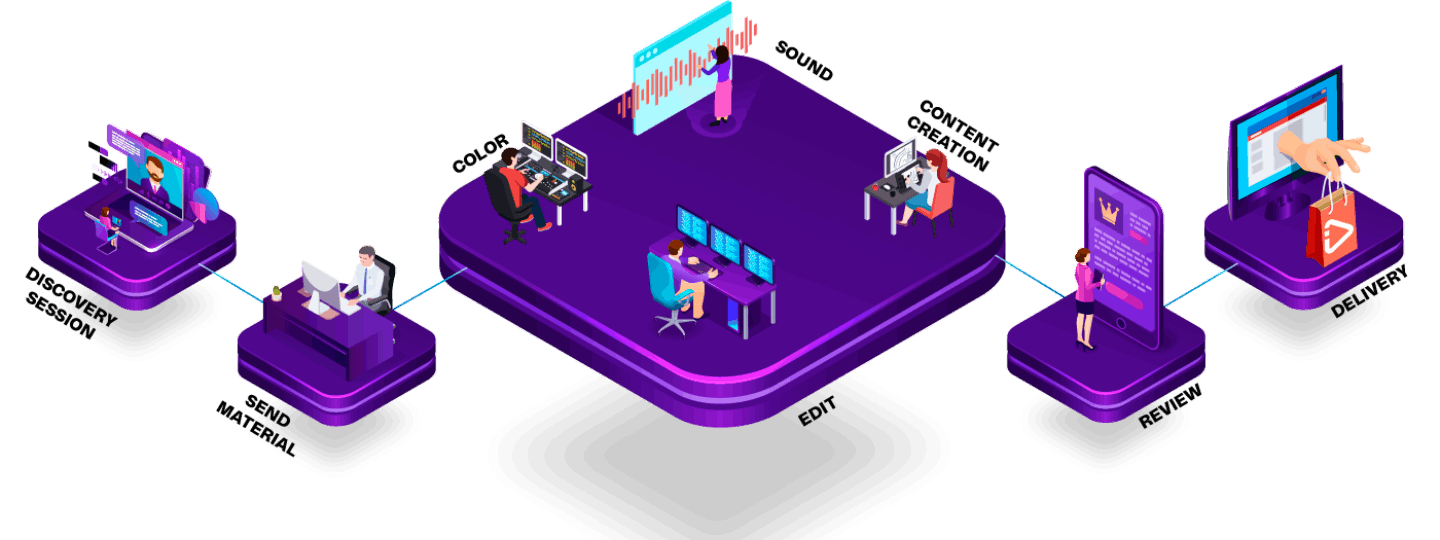
Having a content matrix is worthless without an execution system. The repurposing workflow needs to be structured, consistent, and fast — otherwise it becomes another thing that “we’ll do when we have time,” which means never. Here’s the step-by-step production process that professional video editing teams use to turn a single interview into a full distribution calendar.
Phase 1: Transcript-Based Clip Selection
The first step is generating an accurate transcript of the full interview. Tools like Descript, Otter.ai, or automated transcription in editing platforms can do this in minutes. Once the transcript is available, the clip selection process becomes text-based rather than video-based — you can scan the transcript in ten minutes instead of re-watching 60 minutes of footage.
Go through the transcript and highlight candidate moments using the five clip types described earlier: counterintuitive takes, clear explanations, personal stories, specific data points, and direct advice. For each highlighted section, note the timestamp and write a one-line description of why this moment works as a clip. You should aim to find 15 to 20 candidate moments, knowing that you’ll refine this list down to your actual clips during the edit.
Phase 2: The Multi-Format Edit
The main edit for the full episode should happen first. This includes removing filler words and dead air, color grading, audio leveling and noise reduction, adding intro/outro sequences, inserting chapter markers, and creating the thumbnail. This master edit becomes the source material for all derivative clips.
Once the master edit is locked, the clip production pass begins. For each candidate clip, the editor needs to: trim the clip to its tightest version while preserving full context, reframe the video for the target aspect ratio (16:9 for YouTube, 1:1 or 9:16 for social), add styled captions that are on-brand and platform-appropriate, insert a hook element at the opening (text overlay, sound effect, or tight re-edit of the opening line), and add a closing end card or CTA relevant to the platform.
A skilled editor working with a well-organized source file and a clear brief can produce six to eight social clips in a single working day. For teams without dedicated editing capacity, this is where outsourcing to a professional video editing service becomes the most cost-effective option. The time required to produce 30 pieces of content in-house — even assuming competent editing skills — ranges from 20 to 40 hours per interview. At any meaningful hourly rate for your own time, outsourcing this work is rarely a hard financial decision.
💡 Pro Tip: Create a shared Google Doc or Notion template for each interview that includes the transcript link, a clip candidate table with timestamps and descriptions, platform targets for each clip, and caption copy for each social post. Handing this to an editor eliminates the briefing bottleneck and cuts revision cycles in half.
Phase 3: Writing the Non-Video Assets
The written assets — LinkedIn posts, Twitter threads, blog articles, and email newsletters — can be produced alongside the video editing using the transcript as the primary source. A good copywriter with the transcript can write a compelling LinkedIn post in 20 minutes. A well-structured Twitter thread from the top five insights takes roughly the same amount of time.
The blog post is the most involved written asset and should be treated as a proper SEO asset, not just a transcript dump. It should be structured around a central keyword related to the interview topic, include headers and subheadings, reference specific insights from the interview with timestamp links back to the YouTube video, and include a clear CTA. Used correctly, the blog post becomes a long-term organic traffic driver that continues sending people to the interview months after the initial publication wave.
Phase 4: Distribution Scheduling
The final phase is sequencing your 30 pieces across a distribution calendar. A practical rule is to spread the content from a single interview across three to four weeks of posting. The full episode goes out on publication day. A LinkedIn video clip and a tweet thread go out the same day. YouTube Shorts roll out over the following two weeks, two to three per week. LinkedIn clips, TikTok/Reels posts, and text posts are distributed across weeks two through four. The blog post goes live in week two to support search discovery of the episode.
This pacing strategy means that a team producing one interview per week is running a permanent pipeline of distributed content with four to five posts per day across platforms — all sourced from a single recording session per week. That is genuinely powerful content marketing infrastructure, and it requires no additional recording whatsoever once the system is running.
The 7 Most Common Repurposing Mistakes (and How to Avoid Them)
Even teams that understand the value of repurposing often underperform because they make predictable execution errors. These seven mistakes account for the majority of repurposing failures — knowing them in advance will save you significant time and frustration.
Mistakes 1–4: The Selection and Format Errors
Mistake 1: Posting the same cut to every platform. Uploading a landscape YouTube clip directly to TikTok without reformatting is one of the most visible signals that a brand is not investing in their content. The black bars on the sides, the lack of styled captions, the absence of a proper hook — these elements collectively tell the algorithm and the viewer that this content was not made for this platform. Platform-native formatting is not optional if you want performance.
Mistake 2: Choosing clips that only make sense in context. A guest saying “exactly, as I mentioned before” or referencing something that happened 20 minutes earlier in the conversation is not a standalone clip. Each clip must be able to stand completely alone — a viewer watching it without any prior context should understand the point, find it valuable, and feel satisfied by the time it ends. Context-dependent clips consistently underperform.
Mistake 3: Clips that are too long. Editing discipline is the hardest skill in repurposing. A clip that makes a great point in 45 seconds should not be padded to 90 seconds because the speaker added a few extra sentences at the end. Cut to the point and trust the audience. The most shared clips are almost always the ones that say exactly what needs to be said and end immediately.
Mistake 4: Ignoring captions or using poor-quality auto-captions. Auto-generated captions from most platforms are noticeably inaccurate and visually inconsistent. Styled, corrected captions are not a premium add-on — they are a fundamental requirement for any short-form clip targeting mobile-first platforms. Clips without captions lose more than 80 percent of their potential audience to the muted scroll.
Mistakes 5–7: The System and Strategy Errors
Mistake 5: Repurposing inconsistently. Doing a thorough repurposing job for one interview and then skipping it for the next three defeats the compounding effect entirely. The value of this system is in its consistency. Every interview gets repurposed, every time, using the same framework. Teams that can’t maintain that consistency in-house are almost always better served by outsourcing the production function to a dedicated editing team.
Mistake 6: No hook on social clips. A great insight buried in the middle of a clip, with a slow or contextless opening, will not perform. Every clip needs a hook in the first two to three seconds that gives the viewer a clear reason to keep watching. The hook can be visual (text overlay with a bold statement), auditory (the speaker’s most attention-grabbing line moved to the opening via a J-cut), or structural (a question posed in the caption that the clip answers).
Mistake 7: Never tracking what performs. Repurposing without performance data is essentially guessing. After four to six weeks of distributing content from an interview, review the data: which clips generated the most views, shares, saves, and comments Which platforms are driving the most profile visits or link clicks This data should directly inform which types of moments you prioritize in your next interview’s clip selection. Over time, this feedback loop compounds your repurposing ROI dramatically.
Scaling Your Repurposing Operation: When and How to Outsource
There is a clear point at which in-house content repurposing stops being cost-effective and starts being a constraint on growth. That point is different for every team, but the signals are usually the same: editing takes more than a week per interview, the quality is inconsistent from episode to episode, clips are being skipped because “there wasn’t time,” or the person doing the editing is also responsible for other high-value work.
The True Cost of In-House Editing
A complete repurposing job for one 60-minute interview — full episode edit, four to six Shorts, four LinkedIn clips, four TikTok/Reels, thumbnail, chapters, styled captions across all clips, and written assets — realistically takes a skilled editor 25 to 35 hours. For a team producing two interviews per week, that’s 50 to 70 hours of editing time per week, before any other production work is accounted for.
At an internal cost of $40 to $80 per hour for a skilled in-house editor — accounting for salary, benefits, equipment, and management overhead — the fully loaded cost of that work ranges from $2,000 to $5,600 per week. For many small-to-mid-size content operations, that math makes outsourcing to a specialized video editing agency not just sensible but financially obvious.
What to Look for in an Editing Partner
Not all video editing agencies are equipped to handle systematic interview repurposing. The capability you need goes beyond basic editing — it includes understanding of platform-specific formats and algorithms, the ability to produce styled captions quickly and accurately, experience creating short-form clips with effective hooks, and the organizational capacity to handle consistent, high-volume output on predictable turnaround times.
Teams like Increditors specialize in exactly this kind of systematic, high-volume interview repurposing for YouTube creators, B2B brands, and course creators. The key differentiator is not just editing skill — it’s the ability to handle the full production pipeline from a single brief to a complete distribution-ready content package, week after week, without quality degradation.
Building an Efficient Handoff System
Whether you’re working with an internal editor or an external agency, the quality of your content brief determines the quality of the output. A minimal viable brief for interview repurposing includes: the raw recording file and transcript, a list of five to ten preferred clip candidates with timestamps, platform targets and aspect ratio specifications for each clip type, brand guidelines (fonts, colors, caption style, logo usage), and any time-sensitive distribution dates or deadlines.
Teams that invest in building a clear, consistent brief template find that revision cycles drop sharply within the first two to three rounds. What starts as a process requiring multiple revision passes per interview often stabilizes to one or zero revisions within a month of working with a consistent editor who understands your brand standards.
The specialized agency model wins on all dimensions that matter for a scaling content operation: time freed for the creator, consistent quality at volume, and predictable costs. For creators and brands serious about making interview repurposing a real engine of growth, working with a team like Increditors is typically the fastest path from intention to execution.
Verdict: Is Interview Repurposing Worth Ita
The answer is an unambiguous yes — provided you execute the system rather than just understand it conceptually. The creators and brands consistently winning on multiple platforms in 2026 are almost never producing more raw content than their competitors. They are producing better systems for extracting and distributing the value from what they already create.
Interview repurposing, done properly, delivers three compounding advantages. First, it dramatically increases the surface area of your content — more platforms, more formats, more discovery mechanisms working simultaneously. Second, it extends the active lifespan of each recording far beyond the initial upload week. A well-distributed set of clips from an interview conducted in January can still be driving traffic, follows, and leads in April. Third, it builds brand consistency across platforms in a way that individual, platform-native posts rarely achieve — because all 30 pieces of content trace back to the same conversation, the same voice, the same ideas.
The caveat is execution quality. Repurposing done poorly — bad crops, no captions, no hooks, inconsistent formatting — is visible and damaging to brand perception. This is why the editing quality of your clips matters as much as the selection process. Every piece of content you publish is a direct representation of your brand’s standards, and low-quality clips from a high-quality interview is one of the most common — and most avoidable — brand mistakes in content marketing.
Start with your next interview. Transcript it. Mark 15 candidate moments. Build the matrix. Brief an editor — internal or external — with specific clip targets and platform requirements. Publish systematically over four weeks. Then look at your analytics and compare the reach, engagement, and inbound inquiries from that one interview against what you typically see from a single upload. The numbers will make the argument more convincingly than any article can.
If you’re ready to implement this system with professional execution from the start, Increditors works with interview-format creators and B2B brands to handle the full repurposing pipeline — from raw recording to a complete, distribution-ready content package across every major platform.
Frequently Asked Questions
How long does it actually take to repurpose one 60-minute interview into 30 pieces of contenta
With an experienced editor and a clear brief, the video production alone — full episode edit plus 15 to 20 social clips across all formats — takes approximately 25 to 35 hours. That’s for a complete, quality job with styled captions, proper aspect-ratio formatting for each platform, thumbnails, and chapter markers. Adding written assets (two LinkedIn posts, one Twitter thread, one blog post, one email) adds another five to eight hours. Teams working with a specialized editing service like Increditors can turn around the complete package in three to five business days with a good brief and organized source files.
Does the quality of the original interview recording affect the repurposing resultsa
Significantly, yes. Audio quality is the most critical technical factor — a clip with poor audio will fail on every platform regardless of how good the content is. Professional-level audio requires at minimum a dedicated USB or XLR microphone for each speaker, acoustic treatment or a quiet recording environment, and consistent gain levels throughout the session. Video quality matters less than audio — a well-lit face with a clean background recorded on a decent webcam will outperform a cinema-quality camera recording with muddy or echoing audio every time. Investing in audio quality is the highest-ROI equipment decision for interview-format content producers.
Can you repurpose interviews with remote guests who recorded on different setupsa
Yes, and most podcast and interview-format content is recorded this way. Platforms like Riverside.fm, SquadCast, and Zencastr record each participant’s audio and video locally and then sync the tracks, which dramatically improves quality compared to a direct Zoom recording. When working with mismatched visual quality between host and guest, experienced editors use side-by-side framing, picture-in-picture layouts, or speaker-focus cuts to minimize the visual quality disparity. For social clips, showing the higher-quality speaker in the primary frame is a standard practice that maintains production value.
Which platform should be the priority when starting an interview repurposing system from scratcha
Start with the platform where your target audience already spends the most time. For B2B SaaS companies and coaches targeting professionals, LinkedIn is almost always the highest-priority platform for repurposed interview content. For consumer-facing creators or brands targeting younger demographics, TikTok and Instagram Reels offer the fastest path to organic reach. YouTube is the best long-term investment for creators whose audience uses search to find content — it has the longest content lifespan of any platform and the strongest monetization infrastructure. In practice, most successful teams establish YouTube as the anchor platform and LinkedIn or TikTok as the primary short-form channel, then layer in others as operational capacity allows.
How do you maintain consistent brand identity across 30 very different pieces of contenta
Brand consistency at scale requires a documented style guide for your video content that covers four specific elements: caption typography and color (a specific font, a specific color for highlights, a consistent word-per-frame rate), opening hook format (whether you use text overlays, a branded lower-third, or a clean opening), outro/end card template (same layout across all clips with platform-specific CTA variations), and color grading treatment (a consistent look and feel applied to all clips from all episodes). When an editor has a complete, visual style guide rather than vague brand direction, they can produce 30 pieces of content that feel unmistakably like the same brand even when the content and format vary significantly across pieces.
Ready for Video That Actually Convertsa
Tell us about your project and we will put together a custom plan.