














































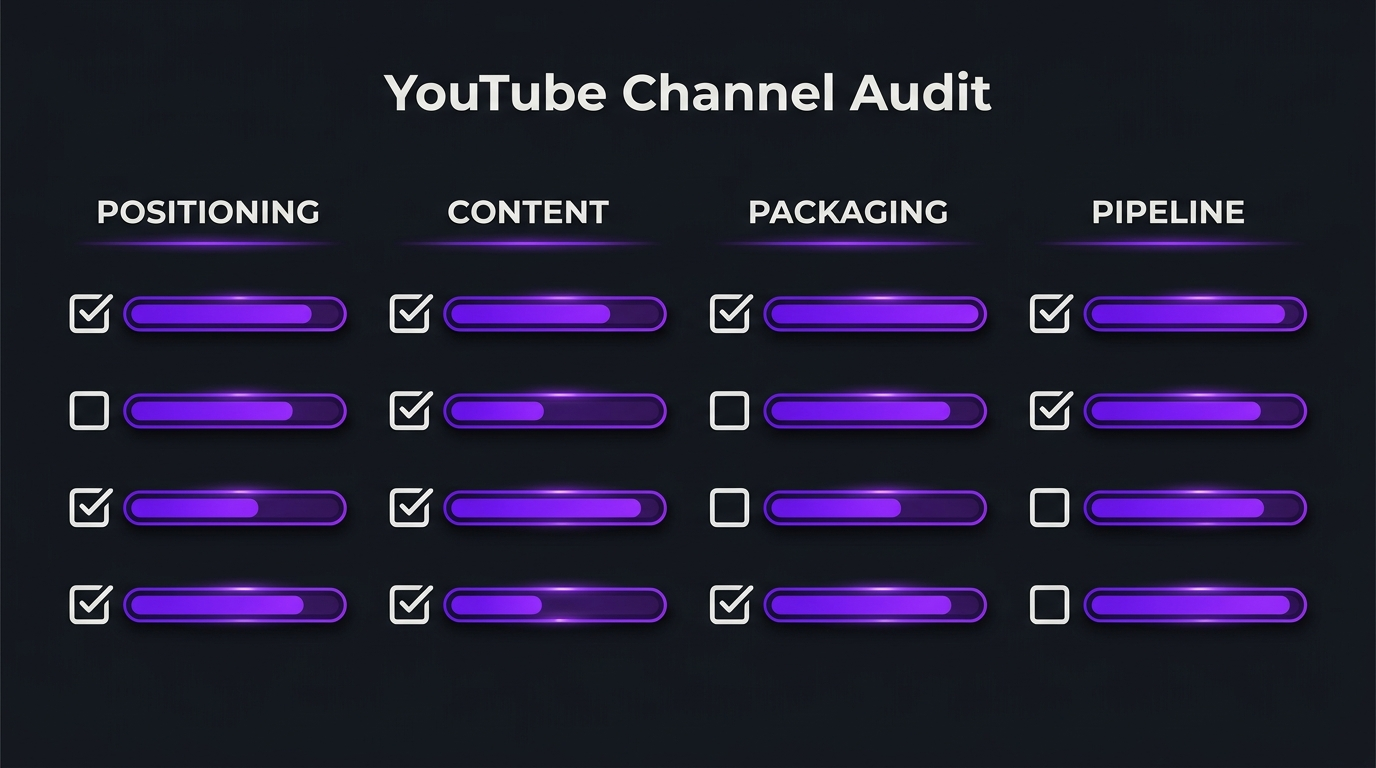
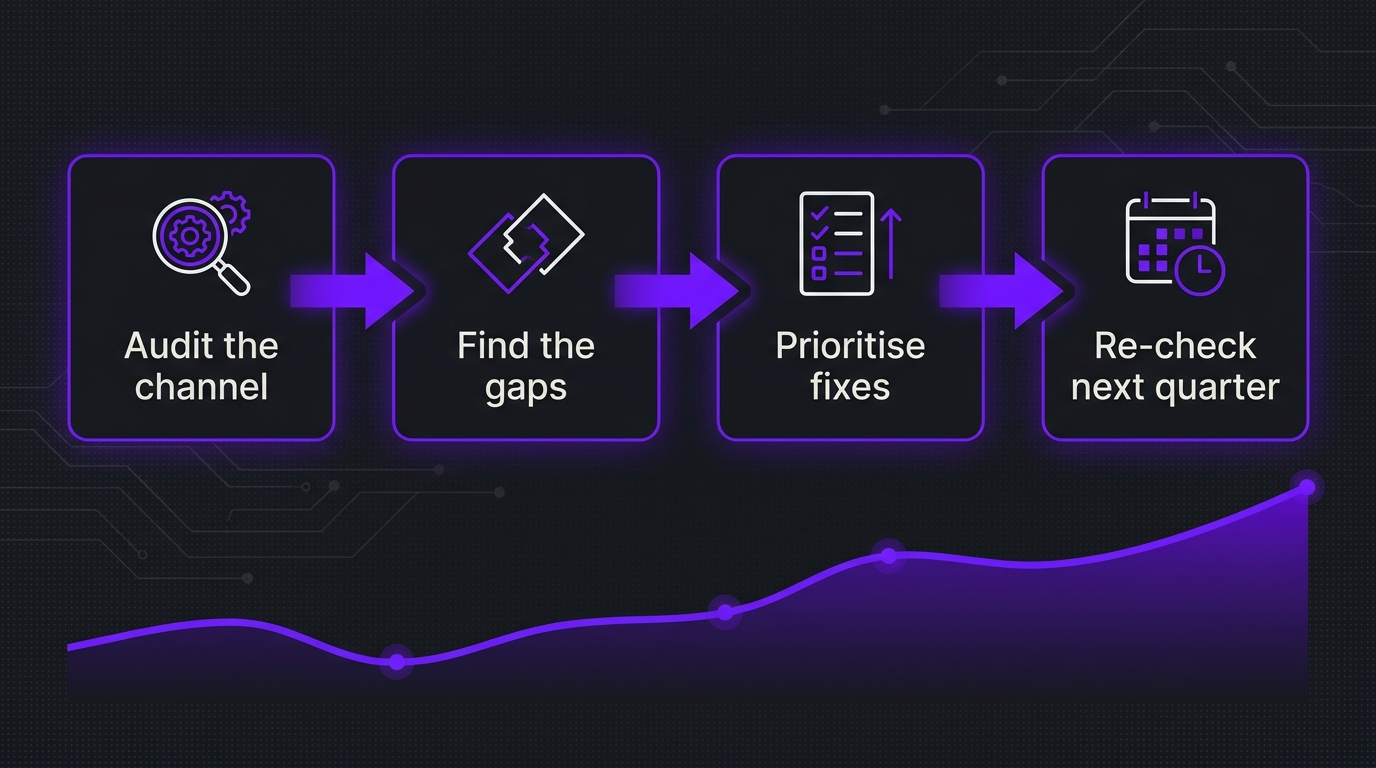
A YouTube audit for a B2B company is twelve checks in four groups: positioning (who the channel is for), content (does the library answer buyer questions accurately), packaging (titles, thumbnails, openings, descriptions) and pipeline (competitors, calls to action, measurement). Score each check pass, partial or fail using your own channel data in YouTube Studio, fix the three failures closest to a buyer decision, and re-check next quarter. Vanity metrics such as subscriber count are not part of the audit. What matters is whether the right buyers find the channel, trust it and take a next step.
A YouTube channel audit for a B2B company is a twelve-point review of positioning, content, packaging and pipeline that tells you which three fixes will matter most this quarter. Most B2B channels do not have a views problem. They have a fit problem: the wrong topics, packaging that hides good videos, and no path from a view to a conversation. This guide gives you the twelve checks, what to look at in YouTube Studio for each, what a pass looks like, and how to turn the results into a short fix list.
How this differs from what we have already published: our B2B YouTube channel strategy is the forward-looking 90-day plan, our B2B YouTube benchmarks collects reference ranges, and our guide to YouTube for B2B lead generation covers the commercial case. This post is the diagnostic that comes before all of those: look hard at the channel you already have, and find out what to fix first. It is written for founders and marketing leads at B2B software and tech companies who sell a complex product.
We write it as a video editing company that edits long-form and YouTube-first video for B2B tech teams. We review a channel the same way we would before taking on a retainer, and the checklist below is that review, made public.
How to run a YouTube audit (before you open YouTube Studio)
The search term “YouTube audit” returns tools and templates aimed at creators chasing subscribers. A B2B audit starts from a different question: is this channel helping the right buyers understand, trust and contact us? Everything below is organised around that.
Set up in four steps before you score anything:
- Export the data. From YouTube Studio, pull the last twelve months of video-level data (impressions, click-through rate, views, average view duration, traffic sources). A spreadsheet beats the dashboard for comparing videos.
- List the buyers. Write down the two or three roles you want to reach (for example a VP of Marketing, a technical evaluator, a founder-CEO) and the five questions each asks before buying.
- Pick a comparison set. Choose three to five channels your buyers watch. They may be direct competitors, adjacent vendors or industry media. You need them for check 10.
- Decide who reviews. Someone who did not make the videos, ideally with a salesperson in the room, because sales knows which videos actually get sent.
💡 Pro Tip: Score every check as pass, partial or fail, with one line of evidence. Do not invent a 0-100 score. The numbers in a B2B audit are only meaningful against your own history, and a vague score hides the one fix that matters.
Group 1: Positioning (checks 1-2)
Positioning checks come first because they decide whether every other fix is worth making. A well-packaged video on the wrong topic for the wrong viewer is still the wrong video.
Check 1: Is the channel promise clear and aimed at a buyer?
Open your channel as a logged-out visitor. In five seconds, can a stranger say who the channel is for and what they will learn? The banner, name, handle and description should state the audience and the promise in plain language (“Practical video for data security teams evaluating tooling”) rather than a company slogan.
- Look at: channel banner, name, handle, description, the first screen of the homepage.
- Pass: a stranger can state the audience and the promise without scrolling.
- Fail: the channel reads as a place where company videos are stored.
Check 2: Does the channel page lead a buyer somewhere?
A technical evaluator who lands on your channel should find a trailer or featured video that explains your category, a featured section that shows the best three videos in order, and links to the next step (a demo page, a book-a-call link, a resource). Check that the links work and that each points to a page written for a person arriving from YouTube.
- Look at: channel trailer or featured video, featured sections, playlists, links in the channel header and About tab.
- Pass: trailer and featured sections guide a new viewer from “what is this?” to “what should I watch next?”, and one link leads to a relevant next step.
- Fail: the homepage is a reverse-chronological dump, or the only link is your homepage.
Group 2: Content (checks 3-5)
Check 3: Does the library cover the questions buyers ask?
Take the buyer questions you listed and map each to a video. Most B2B channels discover two things: a handful of questions are answered several times, and the most deal-blocking questions are not answered at all. This is where a content gap analysis pays for itself, and it is the reason the educational video approach beats a feed of announcements for considered sales.
- Look at: video titles and topics against your buyer-question list; the sales team’s top objections.
- Pass: at least one clear, current video for each of the main buyer questions.
- Fail: topics follow what the company wants to announce, not what buyers need to decide.
Check 4: Is the format mix right for the buyer’s stage?
A healthy B2B channel mixes formats for different stages: short explainers and clips for discovery, longer walkthroughs and practitioner conversations for evaluation, and customer-education videos for retention. Look at where your watch time comes from. If long videos carry most of the watch time but you publish mostly shorts (or the reverse), look at why; our post on shorts versus long-form performance covers how the formats differ, and our explainer series guide shows how to build a connected set instead of a pile.
- Look at: format breakdown in YouTube Studio’s content view, watch time by format, playlist structure.
- Pass: formats map to stages, and a viewer finishing one video has an obvious next one.
- Fail: one format dominates by habit, and videos stand alone.
Check 5: Would a technical evaluator trust it?
This check is specific to B2B tech. Watch three of your most technical videos as a sceptical engineer or data lead would. Are terms used correctly? Are diagrams accurate? Does the video explain the mechanism or just assert the benefit? One wrong term in a video aimed at specialists can cost more credibility than ten good videos earn. If you use animation or motion graphics, check that every visual means something.
- Look at: your three most technical videos, plus comments from viewers who know the subject.
- Pass: a named subject-matter expert has approved each technical claim, and visuals clarify rather than decorate.
- Fail: the creative team wrote the technical script alone, or corrections sit in the comments.
📌 Honest caveat: checks 3 to 5 need judgement, not just data. A spreadsheet will tell you which videos underperform; only a person who understands the buyer can say which ones should never have been made.
Group 3: Packaging (checks 6-9)
Packaging is what a viewer sees before and in the first moments of a video. It is also where the audit finds the fastest fixes, because you can change a title or thumbnail on a video that already exists.
Check 6: Do titles carry a buyer’s question?
Titles that name the buyer’s problem or question tend to serve both search and browse. Compare titles on your best and worst performers for impressions click-through rate. YouTube’s own guidance on impressions and click-through rate is worth reading before you draw conclusions, because click-through varies by traffic source and audience, and a low rate on a broad browse source does not mean the same thing as a low rate on search.
- Look at: impressions, impressions click-through rate and traffic sources by video.
- Pass: titles are specific, plain and written as the viewer would phrase the problem.
- Fail: titles are internal product names, campaign slogans or vague teasers.
Check 7: Do thumbnails make one clear promise?
A thumbnail should communicate one idea at small size and fit the title instead of repeating it. In B2B tech, the common failures are a stock-photo office scene, a dense screenshot that cannot be read at thumbnail size, or the same template for every video so nothing stands out. YouTube’s help page on custom thumbnails lists the technical requirements; the creative test is whether a viewer can tell what the video is about without reading the title.
- Look at: the thumbnail grid of your last twenty videos, at phone size.
- Pass: each thumbnail has a single focal point and fits a recognisable visual system.
- Fail: thumbnails are interchangeable, unreadable at small size, or off-brand.
Check 8: Does the opening earn the next thirty seconds?
The audience retention report shows where viewers leave. YouTube’s documentation on key moments for audience retention explains what the report shows and how to read it. For each important video, check whether the first thirty seconds state the promise, whether the intro is longer than the idea needs, and where the biggest drops sit. Our post on how long video intros can run before viewers leave goes deeper on opening length.
- Look at: the audience retention graph and key-moments report for your ten most important videos.
- Pass: the opening states the payoff quickly, and retention shows no cliff in the first moments.
- Fail: long logo animations, throat-clearing introductions, or a sharp early drop that repeats across videos.
Check 9: Are chapters, descriptions and captions doing their job?
This is the findability check. Chapters help viewers jump to the part they need, and the YouTube guidance on video chapters explains how to add them. Descriptions should lead with the answer and give context; YouTube’s tips for video descriptions are a good baseline. Captions matter for people watching without sound, for viewers working in a second language, and for accessibility; the W3C captions guidance sets the standard, and our video accessibility guide covers the compliance side. If you embed videos on your own site, follow Google’s video best practices for Search too.
- Look at: description, chapters and caption status on your top twenty videos.
- Pass: chapters exist on videos over a few minutes, descriptions open with the answer, and captions are reviewed rather than left as raw auto-captions.
- Fail: empty descriptions, no chapters, uncorrected auto-captions with technical terms mangled.
Group 4: Pipeline (checks 10-12)
Check 10: Where does the channel stand against competitors?
Use the comparison set you chose earlier to run a basic YouTube competitor analysis. You are not copying; you are looking for what the audience already accepts and what no one is covering. For each competitor channel, note the topics they publish, the formats they use, how often they publish, and which of their videos has outsized views for that channel (a sign of unusual demand). Then look at the search results for the questions on your buyer list and see who ranks.
- Pass: you can name two or three topics where your channel is clearly stronger or distinct.
- Fail: your channel is a weaker version of a competitor’s, with no angle of its own.
Check 11: Does every video lead to a next step?
A video that informs and then ends has done half the job. Check each important video for a spoken call to action, end screens and cards, a pinned comment and a description link. Our post on YouTube end screens and cards covers the mechanics. The test is whether the next step fits the viewer’s stage: an early-stage viewer should be pointed to another useful video, not a sales call.
- Look at: end screen click-through, pinned comments, description links, playlist order.
- Pass: the next step is relevant to the stage, and later-stage videos point to a call or demo.
- Fail: every video ends with the same generic “subscribe and book a demo”.
Check 12: Is anyone measuring influence on opportunities?
The final check is the one B2B channels most often fail. If the only reports are views and subscribers, you cannot tell whether the channel contributes to revenue. Add self-reported discovery to the booking form (“what did you watch or read before this call?”), ask sales which videos they send, and review closed-won and closed-lost opportunities for video touches. Our B2B YouTube benchmarks post and our B2B video marketing strategy playbook explain what to measure and why last-click reports understate video.
- Look at: booking-form fields, CRM source data, sales feedback, assisted-conversion reports.
- Pass: at least two sales-side signals are reviewed monthly alongside channel data.
- Fail: success is reported as views, subscribers and watch hours only.
Scoring the twelve checks and building the fix list
Put the twelve checks in one table with a result (pass, partial, fail) and one line of evidence for each. Then prioritise using two questions: how close is this to a buyer decision, and how long will the fix take? The table below is a convenient summary and a prioritisation guide.
A sensible order: fix the quick packaging failures first (checks 6, 7 and 9) because they improve videos you already have. Next, fix the pipeline gaps (11 and 12), because they decide whether views become conversations. Treat content failures (3, 4 and 5) as the quarter’s production plan. Positioning (1 and 2) can usually be fixed in an afternoon and should be done first because it sets the frame for everything else.
💡 Pro Tip: Change one thing at a time on a handful of videos and compare against similar videos you left untouched. Changing every title and thumbnail in one weekend makes it impossible to learn what worked.
How this played out
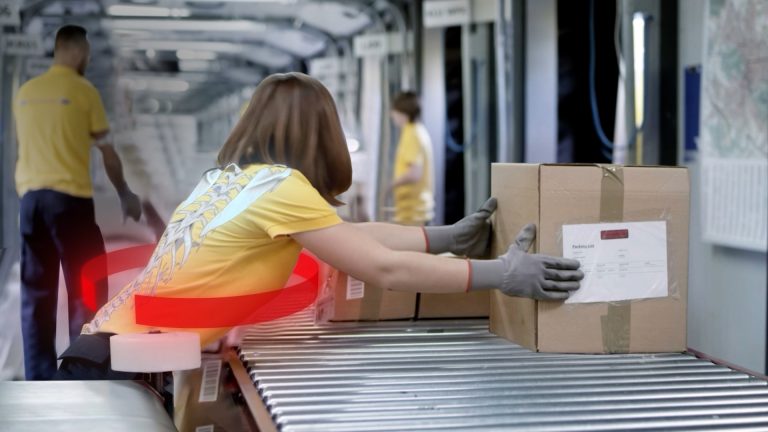
TuMeke is an AI ergonomics software company, and has been an Increditors client for four years. Its team has told us that our animations make everything clear. That feedback is the standard behind check 5 in this audit: when a product is hard to see, the visuals must carry the explanation, and a technical evaluator should come away understanding the mechanism. You can read more about the relationship in our TuMeke project page and see other work on our case studies page.
The practical lesson is that an audit like this is most useful when it connects the packaging to the substance. Better thumbnails will not rescue a video that fails the sceptical-engineer test, and a perfect explainer will not help if nobody can find it.
Audit mistakes to avoid
Run the audit yourself or get an outside review
A small channel can be audited in-house with YouTube Studio, a spreadsheet and half a day. Bring in an outside reviewer when the team that makes the videos is too close to judge them, when you need competitor and search analysis you do not have time for, or when you want the fix list turned into a production plan. If you are weighing an agency, our guides to what a YouTube agency for SaaS does, when to hire a YouTube strategist and YouTube channel management services compare the options. For the editing and production side, see our cost guide for professional video editing and our guide to video for SaaS companies.
If you would rather have a second set of eyes on your channel, book a call below. We will go through the twelve checks on your channel with you, honestly, and tell you whether the right next step is production, packaging or something else.
Frequently asked questions
What is a YouTube channel audit?
A YouTube channel audit is a structured review of a channel’s positioning, content library, packaging (titles, thumbnails, openings, descriptions) and the path from a view to a sales conversation. For a B2B company, it also checks whether the channel is credible to technical evaluators and whether anyone is measuring its influence on opportunities. The output is a ranked list of fixes, not a score for its own sake.
How often should a B2B company audit its YouTube channel?
Run the full twelve checks once to set a baseline, then re-check the packaging and pipeline sections each quarter and the full list once a year. A channel that publishes monthly rarely has enough new data for a monthly audit to be meaningful, and over-auditing tends to produce churn in titles and thumbnails rather than learning.
What metrics matter most in a B2B YouTube audit?
Impressions click-through rate, audience retention at key moments, traffic sources, returning viewers and the share of watch time that comes from your best-fit topics matter most. Subscriber count and total views are weak signals for a considered sale. Pair the channel data with sales-side signals: self-reported discovery on calls, and which videos reps send to prospects.
Can we do a YouTube audit ourselves, or do we need an agency?
You can run the audit yourself with YouTube Studio and a spreadsheet. It takes a few focused hours for a small channel. The hard part is honest judgement: the person who made the videos is rarely the best person to say which ones fail the buyer’s test. Many teams use an outside reviewer for that reason and keep topic selection and technical accuracy inside the company.
What is a good YouTube click-through rate for B2B?
There is no single number worth chasing. YouTube’s own help documentation explains that click-through rate varies by traffic source, audience and format, so compare a video against your own channel’s history and against videos that serve the same stage of the buyer’s journey. Our B2B YouTube benchmarks post collects published ranges with sourcing caveats.
What should we do after the audit?
Rank the failed checks by effort and by how close each is to a buyer decision, fix the top three, and schedule a re-check. Packaging fixes (titles, thumbnails, first thirty seconds) are usually the fastest. Content and pipeline fixes (topic coverage, calls to action, measurement) usually matter more over a quarter.
Verdict
A good YouTube audit for a B2B company is short, honest and ends in a ranked fix list. Run the twelve checks, score them pass, partial or fail with evidence, fix the three failures nearest a buyer decision, and re-check next quarter. Treat subscriber growth as a side effect. What counts is whether the right buyers find the channel, trust what they see and take a next step. If you want a hand with the first pass, book a discovery call below.
Want a second opinion on your YouTube channel?
Tell us about your product and your channel, and we will tell you honestly what we would fix first.