








![3D Explainer Video - ScribbleLive.mp4_snapshot_00.12_[2022.03.09_03.14.16]](https://increditors.com/wp-content/uploads/elementor/thumbs/3D-Explainer-Video-ScribbleLive.mp4_snapshot_00.12_2022.03.09_03.14.16-r7wb53mx72rxst3qcqyrfxdmeyzb5r9jbl0wbjujh4.png "3D Explainer Video – ScribbleLive.mp4_snapshot_00.12_[2022.03.09_03.14.16]")





























Platform data shows viewer drop-off peaks in the first 30 seconds — often in the first 10. On TikTok and Reels you have under 3 seconds; on YouTube, under 15; on B2B explainer video, under 20. The ideal intro length is effectively zero: start with value, not ceremony. Here’s exactly how long each platform tolerates, what kills attention in the opening frames, and how professional editing craft shapes whether viewers stay or bail.
- The Drop-Off Window Creators Ignore
- Platform-by-Platform: What the Data Suggests
- The Anatomy of a Hook That Holds Attention
- What Kills Viewer Attention in the First Few Seconds
- Intro Length by Content Type: A Practical Reference
- How Editing Craft Shapes Viewer Retention
- When to Break the Rules
- FAQ
- Verdict
The Drop-Off Window Creators Ignore
The first question to ask about your video intro is not “how should it look” — it’s “does it need to exist at all?” Most creators spend hours polishing an animated logo sequence, a branded opener, a slow zoom into a title card. Then they check their analytics and find that a meaningful portion of their audience never made it past the ten-second mark.
Audience retention curves are one of the most diagnostic tools available to any video creator, and they tell a consistent story across platforms: drop-off is steepest at the very beginning. For the broader platform-by-platform duration context, see our ideal video length by platform guide; this article stays focused on the opening seconds. YouTube’s Creator Academy has documented that retention curves for most videos show a significant, steep decline within the first 30 seconds. Viewers who stay past that window are far more likely to watch through to the end — but getting them past the first 30 seconds is the hard part.
This is not a YouTube-only phenomenon. Wistia, which hosts millions of business videos and publishes one of the most detailed video engagement datasets available in its annual State of Video report, consistently finds that videos under two minutes retain a higher proportion of viewers than longer formats — and that for any video length, the opening moments are where most abandonment occurs. On social platforms like TikTok and Instagram Reels, the window is even more compressed: platform guidance and creator data both indicate that the first two to three seconds are the decisive moment for whether a viewer stays or swipes.
The practical implication is counterintuitive for many creators: a traditional “intro” — logo animation, music sting, title card, “welcome back to my channel” — actively costs you viewers. Every second before your video delivers value is a second where a portion of your audience may bail. The question “how long should my video intro be?” has one correct default answer: as short as possible, ideally zero.
But that is not the full picture. Different platforms, different formats, and different audience relationships all modify this baseline. A documentary series has different norms than a TikTok tutorial. A B2B explainer for a Fortune 500 pitch has different expectations than a YouTube vlog. Understanding where your content lives — and what viewers have come to expect in that context — is how you set the right target for your opening sequence.
The other factor most creators underestimate is the algorithmic dimension. Platforms do not just measure whether viewers complete your video — they track exactly where abandonment happens. A large drop at second eight sends a different signal than a gradual decline at minute three. Early abandonment hurts distribution precisely because the algorithm interprets it as a relevance failure: this video did not deliver on what it appeared to promise. Short intros that keep viewers engaged longer compound positively over time, improving both organic reach and paid performance.
Platform-by-Platform: What the Data Suggests
Platform data shapes viewer expectations in different ways. The same five-second branded intro that feels professional on a corporate LinkedIn page will kill a TikTok immediately. Here is what creators and marketers consistently observe across the major platforms — with all figures framed as benchmarks, because your specific audience and content type will always be the final arbiter.
YouTube: The 15-Second Threshold
YouTube is the most forgiving long-form platform for structured intros — but “forgiving” still means under 15 seconds before you deliver on the video’s stated premise. YouTube Creator Academy guidance explicitly recommends starting with a hook that fulfills viewer intent immediately, rather than opening with channel branding. Retention graphs on YouTube almost universally show the steepest drop happening between seconds 0 and 30, with the rate of decline slowing significantly after that window. Creators who open with the value first — showing a result, asking a question, or demonstrating a problem — consistently report higher average view duration in their analytics.
The practical benchmark most high-retention YouTube creators land on: if you use a branded intro card at all, keep it to 3–5 seconds maximum and place it after an opening hook, not before. The “cold open” technique — starting the video mid-action before any title card — has become a standard in high-performing YouTube content for exactly this reason. The viewer gets immediate value, the brand gets its moment, and the retention graph stays flat through the opening segment rather than dropping.
TikTok and Instagram Reels: Under 3 Seconds or You Have Lost Them
TikTok’s algorithm is built around completion rate as a primary ranking signal. A video that loses viewers in the first three seconds will be shown to fewer people in the feed — which means the algorithm itself enforces the “hook first” rule. TikTok for Business creator resources and published case studies from TikTok’s platform both emphasize that the opening visual and first spoken words need to create immediate curiosity or deliver immediate value. There is no grace period for brand context-setting.
Instagram Reels operates under similar logic. Meta’s own guidance for Reels ads recommends that the core message be established within the first three seconds, with the most compelling visual element in the opening frame. Organic Reels creators report the same pattern: videos that start with text overlays, visual action, or a bold statement consistently outperform those with slower, context-building openers. For short-form social, the practical guidance is stark: there is no intro. The hook is the video.
LinkedIn Video: A Slightly Longer Runway
LinkedIn’s audience skews professional and slightly more patient than entertainment-first platforms. Videos on LinkedIn autoplay silently in the feed, which means the first frame is doing visual work before audio even enters the picture. LinkedIn’s creator best practices recommend getting to the point within the first 5–10 seconds, with captions on from the opening frame to capture viewers who are watching on mute. A 5–7 second intro with clear professional context tends to land better on LinkedIn than the extreme cold-start approach that dominates TikTok. The professional context itself is the hook — but it still needs to be delivered immediately.
B2B Explainer and Website Video: The 15–20 Second Window
Wistia’s engagement data across its platform — which hosts primarily business and marketing videos — shows that engagement drops sharply after the 2-minute mark for most video types, but that the early drop-off window is still the most critical. For website explainers and product demos, the opening 15–20 seconds need to establish the problem, hint at the solution, and give the viewer a reason to stay. Viewers who arrive at a product page are more motivated than passive social scrollers — but even motivated viewers will abandon a video that does not immediately signal relevance to their specific situation.
For longer-form content — webinars, recorded presentations, training videos — the tolerance increases, but only because the viewer has already made an active commitment to watch. Research from video hosting platforms consistently suggests that drop-off in the first 60 seconds remains disproportionately high, and an effective opener that validates the viewer’s decision to attend is still critical even in these more forgiving environments. As Vimeo’s creator blog has documented through creator interviews and platform data, even professional audiences will exit early if the opening minutes don’t deliver clear value orientation.
💡 Pro Tip: Check your audience retention graph in YouTube Studio or your video hosting platform’s analytics. If you see a cliff in the first 15 seconds, that’s your intro costing you viewers. Move your hook before your branding — or cut the intro entirely and check if retention improves.
The Anatomy of a Hook That Holds Attention
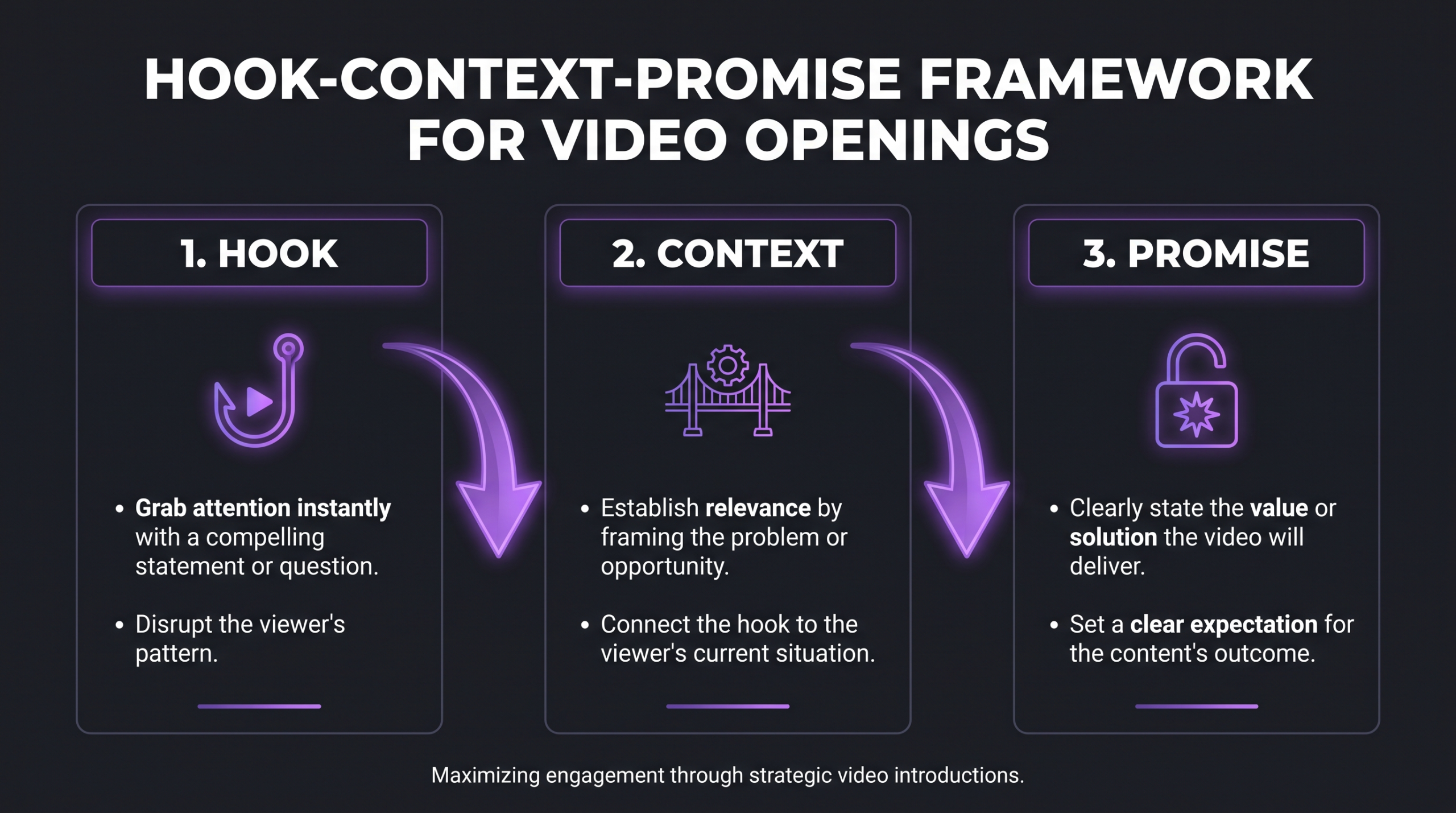
Understanding that intros should be short does not automatically tell you what to put in those few precious seconds. The craft of the opening moments — what gets said, what gets shown, and in what order — is where the real work lives. Most effective video openings share a three-part structure that can be compressed to fit any time window: Hook, Context, Promise.
The Hook: Create a Reason to Stay
The hook is the first thing the viewer sees or hears. Its only job is to make not-watching feel like a missed opportunity. This can be a bold statement, a direct question, a visual result, or an unresolved tension. “We cut our client acquisition time in half using this exact framework” is a hook. “In this video, I am going to show you how to…” is not — it’s preamble, and preamble burns retention because it delays the transaction the viewer came for.
High-performing YouTube creators have increasingly adopted the “cliffhanger hook” — starting mid-sentence or mid-action, creating immediate curiosity that demands resolution. Documentary makers have used this technique for decades. It works because the human brain is wired to dislike unresolved loops; once you have opened one, the viewer’s natural impulse is to stay until it closes. The hook does not need to be dramatic — it just needs to be specific enough that the viewer knows something concrete is at stake.
Context: Anchor the Viewer Without Losing Them
Context answers the question the viewer is forming: “Is this for me?” It does not have to be long — often a single sentence: “If you are running a content team and your video process takes more than a week per piece, this is for you.” Context filters out the wrong audience (reducing abandonment from mismatched expectations) while locking in the right audience with a recognition moment. When the right viewer hears context that describes their situation exactly, they feel understood — and viewers who feel understood stay.
Context is where brand identity naturally fits, but only for established creators with a returning audience. For new viewers, your face is not context — your problem framing is. Introducing yourself by name before you have earned the viewer’s interest is one of the most common forms of misplaced context, and it reliably costs retention in the opening 10 seconds.
The Promise: Tell Them What They Will Get
The promise converts a curious viewer into a committed one. It is the implicit or explicit guarantee that the time investment is worth it: “By the end of this, you will know exactly how to structure your video opener for any platform.” The promise should be specific and achievable within the video’s length. Overpromising creates disappointment; underpromising creates abandonment before the promise is even made.
In short-form content, the Hook-Context-Promise framework collapses into a single beat. On TikTok, one frame can do all three simultaneously: a visual hook (results being shown), implicit context (the type of result signals who should care), and a promise (the transformation is already visible). Long-form content has more room to breathe through all three elements, but the instinct should still be economy — say what needs to be said, and get to the video.
One practical application of this framework: write your opener last. Script the full video, find the most compelling sentence anywhere in it, and move that sentence to the very beginning. The video’s best insight, most dramatic claim, or clearest value statement is often buried in the middle where the creator finally got to their point — the opener’s job is to surface it immediately.
What Kills Viewer Attention in the First Few Seconds
If the drop-off data tells us anything, it is that most viewer abandonment is not random — it is triggered. Specific production and scripting choices reliably send viewers to the next video. Here are the patterns that consistently appear in the opening seconds of high-drop-off content, and why each one works against retention.
Notice what the most damaging intro patterns have in common: they ask the viewer to wait. They say, implicitly, “value is coming — but not yet.” In an environment where the next video is one swipe away, “not yet” functions as permission to leave. Every one of the patterns above has a structural fix that takes less time to implement than the original approach; the barrier is usually habit, not production complexity.
💡 Pro Tip: If you insist on a branded intro, place it after a cold open hook — not before. Viewers who are already engaged will watch your branding willingly. Viewers who see branding before value have given you no reason to stay for it.
Intro Length by Content Type: A Practical Reference
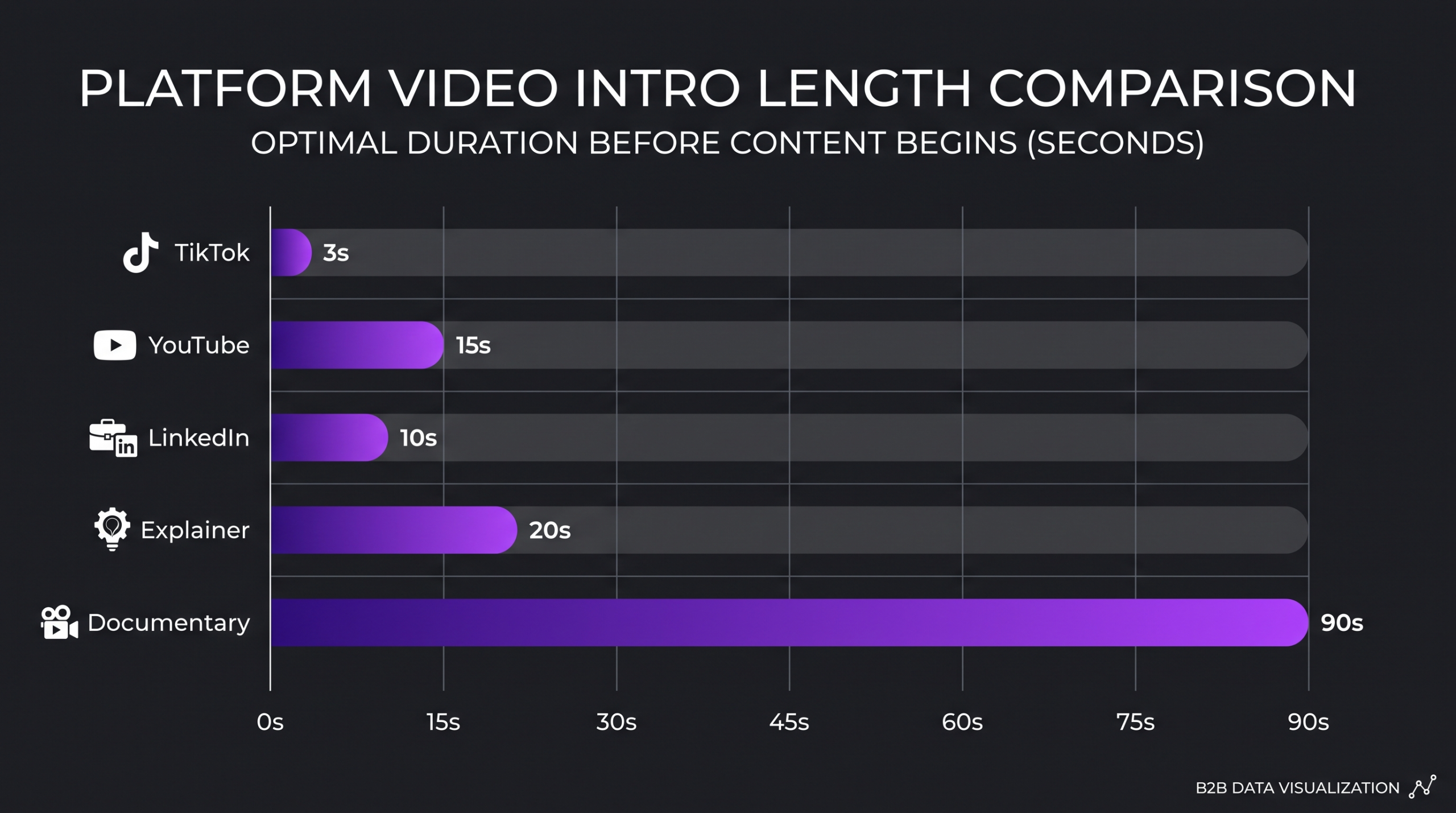
Different content formats carry different viewer expectations. A documentary viewer expects a slower, more atmospheric open; a product demo viewer expects immediacy. Here is a reference table of intro length targets, based on platform norms and content category — treat these as calibrated starting points, not fixed rules. Your own retention analytics should always be the final arbiter.
The consistent thread across all these categories: the intro window is always shorter than most creators initially assume. Even documentary-style content, which enjoys the longest intro tolerance on this list, is working within a 90-second budget — and those 90 seconds need to be doing emotional or narrative work, not just filling time before “the real video” starts.
Paid advertising deserves particular attention. For YouTube skippable in-stream ads, viewers can skip after five seconds. Your brand or core message must appear within those first five seconds — not at the end of an animated logo sequence. Google’s guidance for TrueView video ads is explicit: hook and brand identification must happen before the skip threshold, not after. HubSpot’s video marketing research consistently echoes this principle across ad formats: front-load the value signal or lose the viewer to the skip button.
How Editing Craft Shapes Viewer Retention
Knowing that your intro should be short is the strategic insight. Knowing how to make a short intro that actually holds viewers is the craft problem — and it is where the difference between good and great editing is most visible. The opening seconds of a video require more intentional editorial decision-making than almost any other part of the piece.
Pacing and Rhythm in the Opening Cut
The edit rhythm of the first 10 seconds sets viewer expectations for the entire video. A fast-cut, energetic opening signals a certain type of content; a slower, measured open signals another. The mistake most editors make is letting the opening rhythm default to whatever felt natural in the rough cut, rather than deliberately designing it for maximum retention. The opening needs to be treated as a distinct editorial problem from the rest of the video — it has a different job to do.
High-retention openers typically share a few consistent editing patterns: cuts in the opening section tend to be shorter than the rest of the video (creating energy and urgency); music or sound design rises into the first full beat within 2–3 seconds; there is visible subject motion in the first frame rather than a static establish shot. These are not universal rules — they are patterns that arise because they work with how human attention actually operates at the moment of engagement decision.
Color Grading as a First-Frame Quality Signal
Viewers make instant quality judgments from the first frame — before they have consciously processed any information. A well-graded first frame with correct exposure, clean color, and intentional contrast communicates “this content is worth your time” at a pre-conscious level. A dull, flat, or overexposed opening frame does the opposite. This is why professional colorists often begin their grade at the opening shot: the first impression carries the highest leverage of the entire grade session. A video that looks cinematic in frame one has earned a longer attention window than the same video with a flat, ungraded opener.
Audio Mix in the First 5 Seconds
Audio quality is among the most commonly cited reasons viewers abandon video — across multiple creator surveys and platform studies, poor audio ranks above poor video quality as a reason for early exit. The audio in the opening seconds is where this abandonment decision gets made. If voice-over or on-camera dialogue is muddy, echo-heavy, or has noticeable background hiss, a significant portion of viewers will leave before the content has had a chance to prove itself. A clean audio mix in the first five seconds is not polish — it is table stakes.
Music bed levels need particular attention in the opening seconds. A music track that is too loud makes dialogue incomprehensible; one that is too quiet creates a jarring silence before the first spoken word. The industry-standard practice is to bring music in at a slightly higher level for the first 1–2 seconds to capture attention, then duck it cleanly under dialogue as the first words begin. This “music duck” technique is one of the most common tools in professional post-production for managing the critical opening seconds without losing either energy or clarity.
Motion Graphics: Timing and Restraint
If your content calls for motion graphics — text overlays, animated statistics, branded elements — the opening seconds are where over-animation is most damaging to retention. A sequence that takes six seconds to complete an animation that could have delivered its information in two is a retention risk. The benchmark most professional motion designers work with: every animated element should complete within 1–1.5 seconds, and the information it conveys should be readable before the animation ends. Speed is clarity in motion graphics; slow reveals are the motion design equivalent of burying the lede.
This is where working with a dedicated video editing agency creates measurable, consistent value. At Increditors, our editors apply audience retention principles at the level of individual cuts — because the difference between a 10-second branded opener and a 3-second hook followed by a 10-second brand card at the end is not just an aesthetic choice. It is the difference between losing a portion of your audience before your video starts and retaining them long enough for your message to land. If you are investing in production, the editing decisions around your opener are where that investment either pays off or gets wasted.
For more on how video budgets translate to production and editing quality, see our guide on how much professional video editing costs — including what different budget levels actually deliver in terms of opening sequence quality, motion graphics complexity, and overall production turnaround.
When to Break the Rules
The entire argument above — shorter is better, skip the intro, hook first — is built on platform data about average viewer behavior. Averages are useful but they are not universal. There are contexts where the rules get modified, and knowing when you are operating in those contexts is as important as knowing the baseline principles.
Established Creator With a Loyal Returning Audience
If you have built a genuine audience — people who come to your channel specifically because of who you are — the cold-open data does not apply in the same way. Your returning subscribers are not strangers weighing whether your content is worth their time; they have already made that decision. For creators with high subscriber-to-view ratios (meaning most of their views come from subscribers, not discovery), a consistent intro that reinforces brand identity can strengthen the viewer relationship rather than risk it. The key word is “consistent” — not a different 15-second animated opener on every video, but a reliable, familiar beat that existing fans recognize and newcomers can absorb quickly.
Premium Branded Content and Film-Style Production
Content positioned as cinematic — brand films, documentary series, high-end corporate storytelling — operates under different conventions. The audience has opted into a different experience, and a slow, evocative open is part of what they are there for. The caveat: this only works if the production quality delivers on the implicit promise. A slow, deliberate open on a film with mediocre cinematography reads as ponderous, not atmospheric. The license to take more time with your opening is earned by the quality of the imagery in those seconds — not granted automatically by the intent to make something cinematic.
Internal and Compliance Content
Training videos, compliance modules, and internal communication videos are watched by audiences who are there by obligation rather than choice. Retention rate optimization is largely irrelevant in these contexts — these viewers are not going anywhere. What matters instead is comprehension, consistency, and production standards that communicate organizational seriousness. A 30–60 second intro that establishes context, speakers, and agenda is entirely appropriate here, and removing it would actually reduce clarity for the intended audience.
Live Streaming vs. Recorded Video
Live streaming has completely different entry dynamics from recorded video. Audiences join live streams mid-stream, expect a certain amount of real-time warm-up, and often stay precisely because of the live community experience, not despite delays. Recorded replays of live streams often need editing to remove the opening wait period — which is itself an argument for treating live and recorded video as distinct products that may need separate editing passes. What works as a live opener is often a retention liability once the video is archived and competing with polished recorded content in the same feed.
Beyond those exceptions, the core principle holds across virtually every video format and platform: your opening seconds are your most expensive real estate. Spend them on value, not ceremony. The analytics data available through any modern video platform will confirm whether your current opening is earning that real estate or burning it — and the fix, in most cases, is not a production overhaul. It is a single editorial decision about what goes first.
For teams producing video at scale, building these principles into your editing briefs and production workflow — rather than leaving them to individual editor judgment — is how you get consistent retention improvement across your entire content library. See how professional YouTube editing services systematize these decisions across high-volume content production, and explore our comparison of unlimited video editing service options for teams looking to bake retention principles into every deliverable.
Frequently Asked Questions
How long should a YouTube video intro be?
For most YouTube content, the practical target is under 15 seconds before you deliver on the video’s stated premise. If you use a branded intro card at all, keep it to 3–5 seconds and place it after a cold-open hook rather than before it. Channels with established returning audiences have slightly more leeway — but even loyal viewers benefit from a fast start. Check your audience retention graph in YouTube Studio: if you see a steep drop in the first 15–30 seconds, your intro is the most likely cause.
Should I cut my branded logo intro entirely?
Not necessarily — but where you place it matters more than whether it exists. A 2–3 second logo sting after a compelling cold open is largely harmless and still reinforces brand identity for engaged viewers. The same logo sequence as the very first thing a new viewer sees is a meaningful retention risk. The decision is not “keep it or cut it” — it is “where does it go?” Move it after your hook and monitor what happens to your retention curve in the first 30 seconds.
Does intro length affect YouTube SEO or algorithm rankings?
Directly, no — YouTube’s algorithm does not penalize you for having an intro. Indirectly, yes — and significantly. Average view duration and audience retention percentage are among the most important signals in YouTube’s recommendation system. A long intro that causes early drop-off will lower both metrics, reducing the video’s reach and watch-time performance. A tighter opening that keeps viewers engaged longer has a compounding positive effect on algorithmic distribution over time. YouTube Creator Academy covers how audience retention feeds into the recommendation algorithm in detail.
What is the fastest way to improve viewer retention on existing videos?
Audit your three worst-performing videos by audience retention percentage. Open the retention graph for each and identify where the biggest early drops occur. For most videos, you will find the largest drop in the first 30 seconds — which points to an intro problem. If the platform allows it (YouTube does via re-uploading or using the editor), revise the opening 30 seconds: move your strongest hook to the very first frame, cut any branding to under 5 seconds, and get to your first concrete insight as fast as possible. This single change commonly produces measurable retention improvement without touching the rest of the video.
Is the 3-second rule for TikTok actually real?
It reflects genuine platform behavior, though “3 seconds” is a benchmark rather than a precise cutoff with a hard algorithmic threshold. TikTok’s algorithm weights completion rate heavily, and videos that lose significant viewership in the first 3–5 seconds tend to be distributed less widely. TikTok for Business creator resources and published platform case studies both reinforce the need for an immediate hook. The practical implication: treat the first three seconds as if a meaningful portion of your potential audience will only ever see those three seconds. Make those seconds worth stopping for.
Verdict
The ideal video intro length is as short as possible. Platform data, algorithm behavior, and viewer psychology all point toward the same conclusion: delay value delivery and you lose viewers before your content has a chance to prove itself. On short-form social, you have under three seconds. On YouTube, under 15. On B2B and explainer content, under 20. These are not production constraints — they are decisions about how much of your audience you are willing to lose before the video begins.
The practical reframe: stop thinking about your intro as the beginning of your video and start thinking about it as a filter. Your opening seconds should immediately show the right viewer that they are in the right place. Every second of branded ceremony before that filter has run is a second of viewer abandonment you have paid for with production time and media budget.
The Hook-Context-Promise framework gives you a structure to address this systematically, regardless of content type. The editing decisions — pacing, color grading, audio mix, motion graphic timing — determine how effectively those structural elements actually land. Platform norms, audience type, and production tier determine how much tolerance you have to work with.
Know your platform. Earn your intro length. Start with value. The data is in your retention analytics; the fix is in your next edit.
Ready for Video That Actually Converts?
Tell us about your project and we will put together a custom plan.