









![3D Explainer Video - ScribbleLive.mp4_snapshot_00.12_[2022.03.09_03.14.16]](https://increditors.com/wp-content/uploads/elementor/thumbs/3D-Explainer-Video-ScribbleLive.mp4_snapshot_00.12_2022.03.09_03.14.16-r7wb53mx72rxst3qcqyrfxdmeyzb5r9jbl0wbjujh4.png "3D Explainer Video – ScribbleLive.mp4_snapshot_00.12_[2022.03.09_03.14.16]")






























Using music in a business video without the right license can trigger copyright strikes, forced takedowns, and significant legal liability. In 2026, subscription platforms like Musicbed, Artlist, and Epidemic Sound offer the most practical path for most businesses — annual plans typically cover commercial use across major platforms. Sync licenses for premium tracks can run into thousands of dollars per placement. This guide covers every license type, the top platforms, cost ranges, and the mistakes that routinely land brands in trouble.
- What Is Music Licensing for Business Videos?
- Types of Music Licenses Explained
- The Best Music Licensing Platforms for Businesses in 2026
- How to Choose the Right License for Your Video
- Music Licensing Costs: What Businesses Actually Pay
- Common Music Licensing Mistakes That Get Brands in Trouble
- Frequently Asked Questions
- Verdict
What Is Music Licensing for Business Videos?
Music licensing is the formal permission framework that allows a business to use a copyrighted musical work in a video production. Every recorded song you hear has at least two distinct sets of rights attached to it: the rights to the underlying musical composition (melody and lyrics, typically controlled by a publisher or the songwriter directly) and the rights to the specific master recording (controlled by the record label or the recording artist). To use a piece of music legally in a video, you generally need clearance from both rights holders — and for commercial business use, that clearance almost never comes automatically from listening to a track on Spotify or Apple Music.
The specific permission you need for placing music alongside a visual work — a corporate explainer, a product demo, a brand documentary — is called a synchronization license, commonly shortened to sync license. This is distinct from a performance license (which covers music played publicly, such as in a retail store) or a mechanical license (which covers physical or digital reproductions of a recording). For business video purposes, the sync license is almost always the relevant instrument, and its scope determines exactly what you are and are not allowed to do with the music you attach to your footage.
Why Music Matters in Business Video
The soundtrack behind a corporate video does significant emotional and cognitive work. Music signals tone within the first few seconds — a crisp, uptempo track tells viewers the brand is energetic and modern; a sparse, ambient score says serious and considered. Research on audio-visual processing consistently shows that music affects how viewers evaluate the quality of what they are watching. A video that looks professionally shot but has jarring, mismatched audio tends to score lower in perceived brand quality than the same video with well-chosen music — even when viewers do not consciously notice the audio.
Beyond emotional impact, the right music can influence watch time. For social video especially, music matching the platform’s native audio culture increases the likelihood of completion and sharing. This is why brands that invest seriously in post-production — working with an experienced video editing agency rather than handling music selection informally — tend to see measurably better performance on their business video assets over time.
The Legal Reality of Music Copyright
Copyright in most jurisdictions attaches automatically at the moment of creation. In the United States, that protection typically extends for the life of the creator plus 70 years. Modern commercial recordings — essentially anything you might want to license for a brand video today — are almost certainly still under copyright, regardless of how obscure the track is or how low your video’s expected view count might be. The idea that “it is only a short clip” or “we are a small business” provides any legal protection is a misconception that routinely costs companies money.
Platforms enforce copyright mechanically at scale. YouTube’s Content ID system, for instance, scans uploaded audio against a database of registered recordings and can automatically claim or remove videos that contain unlicensed material — often before the video has accumulated a single view. Similar systems are in place on LinkedIn, Facebook, Instagram, and TikTok. Even if an automated system does not flag a video immediately, a rights holder can submit a manual takedown at any point, potentially removing a video that has already been shared thousands of times in a marketing campaign.
💡 Pro Tip: Copyright enforcement is automated and operates across time. A video posted without a proper license today can receive a takedown notice months or years after publication — even if it has driven significant traffic or lead generation in the interim.
Types of Music Licenses Explained
Understanding the license type you need is not just a legal formality — it determines where you can publish your video, how long the license is valid, whether you can use it in paid advertising, and what happens if your video gets repurposed. Here are the main categories relevant to business video production in 2026.
Synchronization (Sync) Licenses
A sync license grants permission to synchronize a specific piece of music with a specific visual work. Traditional sync licenses are negotiated directly with the rights holder — a music publisher, a record label, or an independent artist who controls their own masters — and the terms vary enormously. A sync license might be scoped to a single platform (TV broadcast only), a geographic territory (North America), or a time window (12 months). Premium placements for well-known tracks can command fees ranging from a few thousand dollars at the lower end to hundreds of thousands for high-profile advertising campaigns.
Licensing organizations like ASCAP and BMI are not the source of sync licenses — they handle performance royalties. For sync rights, businesses typically go directly to the publishing house that controls the song or to the label that controls the master recording.
Royalty-Free Music Licenses
Despite the name, “royalty-free” does not mean the music is free. It means you pay a one-time fee (or a subscription) and do not owe additional royalty payments each time the music is used or each time someone watches your video. This model emerged specifically to make music licensing practical for video producers and businesses, and it now dominates the B2B market for business video music.
Royalty-free libraries range from budget stock-music sites offering low-quality tracks for a few dollars each, to premium curated platforms featuring music from professional composers that rivals the quality of major-label releases. The key variables to check in any royalty-free license are: whether commercial use is covered, whether the license extends to paid advertising and social media, what happens when your subscription lapses, and whether the license covers videos that remain live after cancellation.
Creative Commons Licenses
Creative Commons licenses are standardized permissions that creators can attach to their work, allowing others to use it under defined conditions. For business video, the critical distinction is between licenses that allow commercial use (CC BY, CC BY-SA, CC BY-ND) and those that do not (CC BY-NC and variants). Any CC license with “NC” in the code restricts use to noncommercial contexts — which disqualifies most business video use cases, including internal training videos that serve a commercial organization.
Creative Commons music is available through platforms like ccMixter, Free Music Archive, and YouTube’s own Audio Library (for YouTube-only use). The quality range is wide and the selection can be inconsistent for professional production, but CC-licensed music can be an acceptable option for internal communications, lower-budget social content, or specific use cases where premium music subscription cost is not justified.
Custom and Work-for-Hire Music
For brands that need genuinely unique music — a proprietary brand sonic identity, a jingle for a campaign, or a bespoke score for a flagship brand film — commissioning original music is the cleanest licensing path. Work-for-hire arrangements, when properly structured, transfer full ownership of the composition and recording to the commissioning brand, meaning no ongoing royalties, no license expiry, and no restrictions on use. Costs vary enormously by the scope and the composer’s experience, but custom scoring for a short-form business video typically starts around several hundred dollars for independent composers and can reach into the tens of thousands for experienced commercial composers with broadcast credits.
The Best Music Licensing Platforms for Businesses in 2026
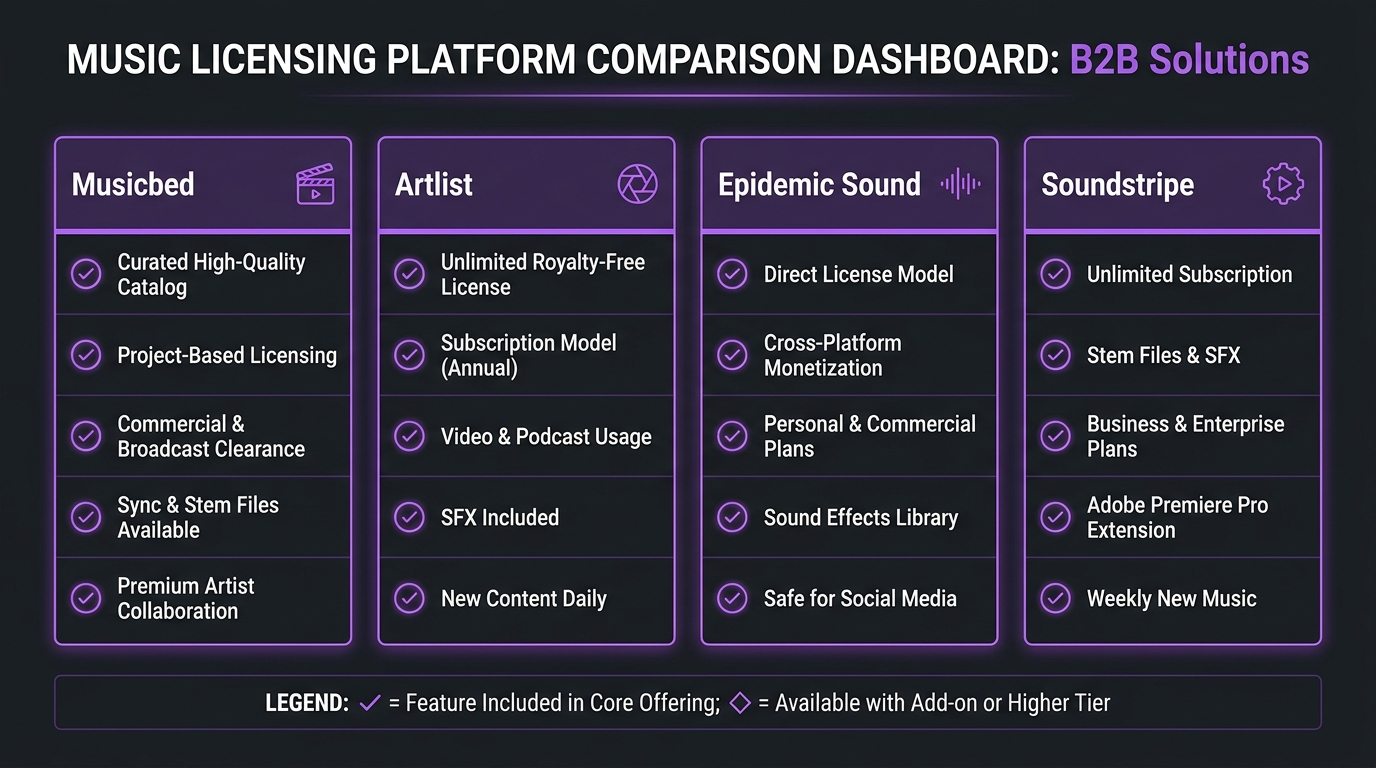
The subscription music licensing market has matured significantly. The major platforms now offer music libraries of comparable depth, similar subscription tiers, and broadly commercial-friendly licenses. The real differentiators come down to library curation, license scope for edge cases (broadcast, paid advertising, international distribution), and post-subscription rights. Here is how the leading platforms compare for business video use.
Note: pricing and tier structures change frequently — always verify current terms on each platform’s site before purchasing. The figures above reflect publicly listed plans as of mid-2026 and are provided as general benchmarks, not guarantees.
Musicbed
Musicbed has positioned itself as the premium end of the subscription market, with a curated catalog that emphasizes artistic quality and emotional depth. For brand films, corporate documentaries, and any video production where the music is a deliberate creative choice rather than a functional background element, Musicbed’s library often outperforms its competitors. Its licensing terms are generally well-structured for commercial use, and the platform publishes clear guidance on what each tier covers.
Artlist
Artlist became popular quickly because its licensing model is unusually straightforward: a single annual subscription covers all commercial uses including paid advertising and social media, with perpetual rights for any track downloaded while subscribed. For growing teams or agencies producing content across multiple clients, that simplicity removes a significant amount of license-tracking overhead. The catalog leans toward indie, cinematic, and contemporary genres.
Epidemic Sound
Epidemic Sound dominates among high-volume YouTube and social media creators. Its integration with YouTube’s Content ID system means that videos using Epidemic Sound tracks are whitelisted against automated claims, which makes it particularly practical for brands running active YouTube channels. The post-subscription licensing model is more restrictive — videos using Epidemic Sound tracks require an active subscription to remain compliant, which is a meaningful consideration for long-lived evergreen content.
Soundstripe
Soundstripe offers one of the larger catalogs in this tier and has built out team and enterprise features that make it particularly well-suited for agencies or larger in-house production teams. Its per-seat model and collaboration tools mean that multiple editors can access and license music within a shared account, which simplifies rights management at scale.
How to Choose the Right License for Your Video
Choosing the right license means working backward from how and where the video will be used. The music that is perfect for a YouTube case study may carry a license that explicitly excludes broadcast television or out-of-home advertising. Getting the distribution context wrong can invalidate an otherwise valid license — not because the platform discovers it, but because you are technically in breach of contract and exposed to liability if the rights holder looks closely.
Match the License to the Distribution Channel
Most platform-specific subscription licenses — Artlist, Musicbed, Epidemic Sound — cover online distribution broadly, including YouTube, Vimeo, LinkedIn, Instagram, Facebook, and TikTok. Where they vary is in their treatment of paid advertising, broadcast television, cinema, and out-of-home use. Before using subscription-library music in a television commercial, a cinema pre-roll, or a digital-out-of-home campaign, verify explicitly that your license tier covers those uses. Premium tiers usually do; entry-level tiers often do not.
For productions with genuinely complex distribution requirements — a launch film that will air on television, run as a pre-roll ad, play at a live event, and live permanently on the company website — a traditional negotiated sync license with clearly defined territory and use parameters offers cleaner documentation than a subscription license whose fine print you are interpreting.
Understand Subscription Lapse and Post-Cancellation Rights
This is the detail that catches businesses off guard most often. Platforms differ significantly in what happens to your licensed music if you cancel your subscription. Some — Artlist and Soundstripe among them — grant perpetual rights for any music licensed during an active subscription period, meaning videos already published remain covered after cancellation. Others, particularly Epidemic Sound at certain tier levels, require a continuously active subscription for published content to remain compliant.
For evergreen content — a company overview video, a product explainer, or an “about us” film that you plan to keep live for several years — perpetual licensing is strongly preferable. Tracking which music tracks are used in which videos and ensuring continuous subscription renewal is administrative overhead that grows as your content library grows. Understanding the true cost of professional video editing, including ongoing music licensing, is part of building a realistic production budget.
💡 Pro Tip: Maintain a simple spreadsheet tracking which music tracks are used in which published videos, with the license type and platform noted. When license terms or subscriptions change, you will know immediately which published videos are affected.
Music Licensing Costs: What Businesses Actually Pay
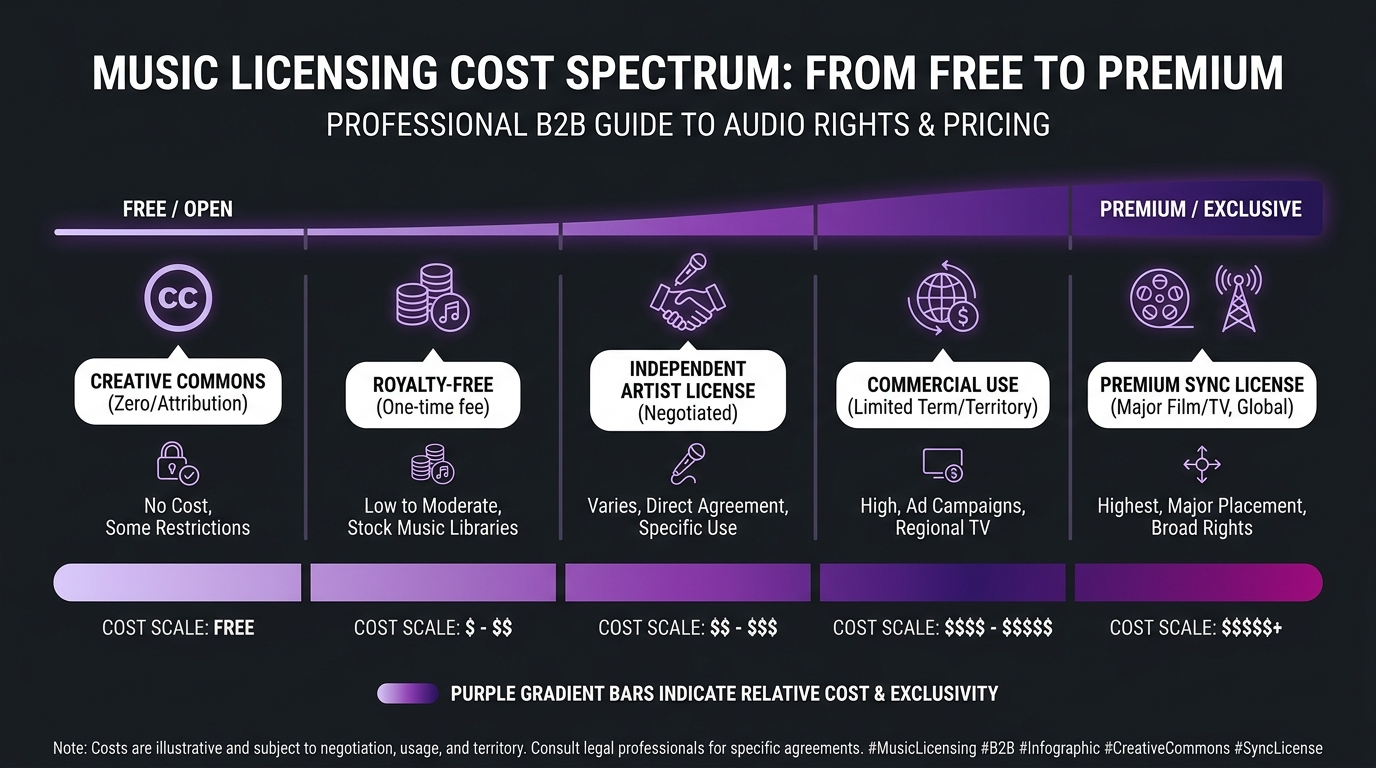
Music licensing costs vary by several orders of magnitude depending on the approach. A Creative Commons track costs nothing upfront. A royalty-free subscription runs from around $100 to $500 per year for individual creators, and from there to multi-seat enterprise arrangements. A bespoke sync license for a recognizable commercial recording can cost tens of thousands. Here is a structured overview of the typical cost ranges businesses encounter in 2026.
For most businesses producing a consistent volume of video content, a subscription-tier royalty-free license from one of the premium platforms represents the best cost-to-coverage ratio. The annual subscription cost is typically a fraction of a percent of a meaningful video production budget. For enterprise teams or agencies producing content for multiple clients with varying distribution requirements, a combination approach — subscription for day-to-day content, bespoke sync for flagship campaigns — is common practice.
What Unlicensed Music Actually Costs
The asymmetry is worth naming directly. Using unlicensed music might save a few hundred dollars on a specific project. The downside includes: automatic platform claims removing revenue from monetized videos; forced manual takedowns and the associated traffic loss; statutory damages in copyright infringement cases in the US which can run from several hundred to several thousand dollars per work even for innocent infringement; and reputational exposure if a rights enforcement action is publicized. The expected value calculation heavily favors licensing.
Common Music Licensing Mistakes That Get Brands in Trouble
Most music licensing problems in business video are not cases of deliberate infringement. They are process failures — assumptions that were never verified, edge cases in license terms that went unread, or misunderstandings of how platform enforcement actually works. Here are the patterns that appear most consistently.
Assuming a Personal Subscription Covers Commercial Use
Many music licensing platforms differentiate explicitly between personal or creator subscriptions and commercial subscriptions. A personal Epidemic Sound account, for instance, covers personal YouTube channels but does not cover commercial production for a client or employer. Businesses that have their marketing team use personal accounts to pull music for branded content are frequently in breach of the platform’s terms — not because they are trying to steal music, but because they have not read the distinction. Always verify that the subscription tier you are using explicitly permits commercial use and matches the actual production context.
Relying on YouTube’s Content ID Whitelist as Proof of Licensing
A Content ID match that does not result in a claim does not mean the music is licensed for your use. It may mean the rights holder has not registered that work with Content ID, or has set it to “monetize” rather than “block,” or that the match fell below the detection threshold. Content ID is an enforcement mechanism, not a licensing clearance tool. The absence of a claim is not the same as the presence of a license. If a rights holder later registers their work or changes their enforcement settings, a claim can appear on a video that has been live for months without issue.
Misreading Royalty-Free as No-Restrictions
Royalty-free does not mean use-it-however-you-want. Every royalty-free license has specific permitted and prohibited uses defined in its terms. Common restrictions include: prohibiting use in content that promotes specific industries (gambling, political content, adult content); limiting the number of concurrent projects a single license can cover; excluding specific distribution channels; or capping the budget of the production the track can appear in. Reading the actual license terms — not the marketing summary on the homepage — before selecting a track for a significant production is a basic due-diligence step that saves problems later.
Failing to Retain License Documentation
If a rights claim arises, the ability to demonstrate that you held a valid license at the time of publication is your primary defense. Subscription platforms generate license certificates or download receipts for specific tracks — saving and organizing these systematically matters. For businesses working with a professional video production partner, confirming that music license documentation is part of the deliverable package is a sensible procurement practice.
Using Streaming Service Music Directly
Spotify, Apple Music, Tidal, and similar streaming services provide listening licenses, not synchronization licenses. Downloading or screen-capturing audio from these services and incorporating it into a video is both a terms of service violation and copyright infringement. This seems obvious when stated directly, but in practice it occasionally happens when team members without a production background are asked to find music and default to what they already have access to.
💡 Pro Tip: Build music licensing into your video production brief template. Before production begins, document the intended distribution channels, the expected video lifespan, and the licensing budget. This prevents the common scenario of discovering a license gap after a video is already published.
Frequently Asked Questions
Is royalty-free music really safe for commercial use?
Yes, if you use a subscription or per-track license from a reputable platform and verify that your specific tier explicitly covers commercial use. “Royalty-free” describes the payment model (no ongoing royalties after purchase), not the absence of license terms. Always read the specific license for the platform you are using and the tier you are subscribed to. Platforms like Artlist, Musicbed, Soundstripe, and Epidemic Sound’s commercial plan are all commercially cleared for business video use within their documented terms.
Can I use music in a video I only share internally, not publicly?
Copyright covers synchronization regardless of whether a video is public-facing or internal. If you are creating a training video or an internal communications piece that incorporates copyrighted music without a license, you are technically infringing even if no one outside the company sees the video. In practice, enforcement risk for purely internal content is much lower, but for any video on a digital platform — even a private Vimeo link — the platform’s terms and automated systems still apply. Creative Commons music with commercial use permitted, or subscription-library music, is the cleanest path even for internal content.
What happens if I get a Content ID claim on YouTube?
A Content ID claim can result in: the video’s revenue being redirected to the rights holder, geographic restrictions being applied to the video, the video being muted or blocked outright, or (if multiple claims accumulate) a strike against your channel. If you hold a valid license from an authorized platform, you can dispute the claim by submitting proof of licensing. Platforms like Musicbed and Artlist provide automated claim support in some cases. If the claim is valid — meaning you used unlicensed music — disputing it escalates to a formal copyright strike, which is significantly more serious.
Do I need a separate license for each platform where I publish a video?
Most modern royalty-free subscription licenses cover multi-platform publishing — YouTube, Vimeo, LinkedIn, Instagram, Facebook, TikTok — under a single license. The scenarios that require separate clearance or additional licensing are broadcast television, cinema, out-of-home advertising, and sometimes paid digital advertising. Before distributing a video across channels beyond the typical social/online mix, check whether your license explicitly covers those additional channels.
How does music licensing work when outsourcing video production?
When you work with an external video editing agency or production company, music licensing responsibility should be clearly defined in the production agreement. Either the agency supplies fully licensed music from their own subscription (and provides license documentation in the deliverables) or you provide pre-approved music from your own licensed library. Ambiguity here is common and creates gaps — a video delivered by an agency might use music from the agency’s subscription, which does not transfer to the client if the agency cancels or changes platforms. Always clarify in the contract who holds the music license and how documentation will be transferred.
Verdict
Music licensing for business videos is not a fringe legal concern — it is a basic production infrastructure requirement in 2026. The good news is that the subscription platform market has made compliant licensing straightforward and affordable for most business video use cases. An annual subscription to Artlist, Musicbed, or Soundstripe covers the overwhelming majority of social, digital, and online commercial video needs for a cost that is negligible against any serious production budget.
Where businesses most commonly go wrong is not in refusing to license — it is in subscribing to the wrong tier, misunderstanding what happens to licenses after cancellation, or failing to document the licenses they hold. Building a simple license-tracking process alongside your video production workflow eliminates most of the risk.
For productions with high-stakes distribution requirements — broadcast campaigns, international launches, flagship brand films — traditional negotiated sync licensing or custom composition remains the appropriate route. The upfront cost is higher, but the terms are unambiguous, the documentation is clean, and there are no subscription renewal dependencies.
Regardless of where your videos land on that spectrum, working with an experienced video editing agency that treats music licensing as part of the production process — not an afterthought — protects both the quality of the finished video and the business from avoidable legal exposure. For guidance on how production investment breaks down across all post-production elements, including how much professional video editing costs at different quality tiers, that context helps frame music licensing as one line item in a broader production decision.
Ready for Video That Actually Converts?
Tell us about your project and we will put together a custom plan.