












































For a B2B software company, video SEO is three jobs: be the answer on YouTube search, be indexable and quotable on your own site and in Google, and be understandable to the AI assistants that summarise your category. Start from buyer questions, not broad keywords. Give every video a specific title, a useful description, real chapters, edited captions and a transcript on a dedicated page with structured data. Then make the video itself hold attention, because watch behaviour is part of how rankings are earned. Measure by query cohorts and by what buyers say they watched, not by views alone.
Video SEO for B2B SaaS means making each video findable on YouTube and Google, readable by AI assistants, and genuinely useful to a buyer evaluating a complex product. You do it with query-led topics, specific titles, descriptions and chapters, edited captions and transcripts, a dedicated watch page with structured data, and an edit that earns watch time. You do not need to outrank the big marketing blogs on the broadest terms. You need to be the best result for the narrow questions your buyers actually ask.
How this differs from what we have already published: our guide to YouTube chapters and metadata goes deep on titles, descriptions and chapter formatting inside YouTube, and our piece on why your video editor should understand YouTube analytics is about using retention data to improve the edit. This post is the system around both. It covers how a B2B software company chooses queries, handles YouTube, Google and AI answers together, deals with the website side that most teams skip, and plans video production around search from the start.
We write this as a video editing company that works with B2B tech and SaaS companies, including AI, data and deep-tech teams whose products are hard to explain on a first call. That is the audience this advice is built for: a founder or marketing lead who needs the right buyers to find a clear explanation of a hard product.
- What video SEO is, and where it happens
- Why B2B software is different
- Start with buyer questions
- The YouTube layer
- The Google and website layer
- Transcripts, captions and AI answers
- Production decisions that are SEO decisions
- How this played out
- Measuring without fooling yourself
- A 30-day starter plan
- Common mistakes
- In-house or with a partner
- Frequently asked questions
- Verdict
What video SEO is, and where it happens
Video SEO is not one channel. A single video can be discovered in three different places, and each rewards slightly different work.
The common thread is clarity. All three systems are trying to decide what a video is about and whether it satisfies the person asking. Google’s video SEO best practices say plainly that a video needs an indexed watch page, a valid thumbnail at a stable URL and a clearly embedded player before it is eligible for video features. YouTube’s explanation of how its search works names relevance, engagement and quality as the three elements, and says relevance is estimated from how well the title, tags, description and video content match the query.
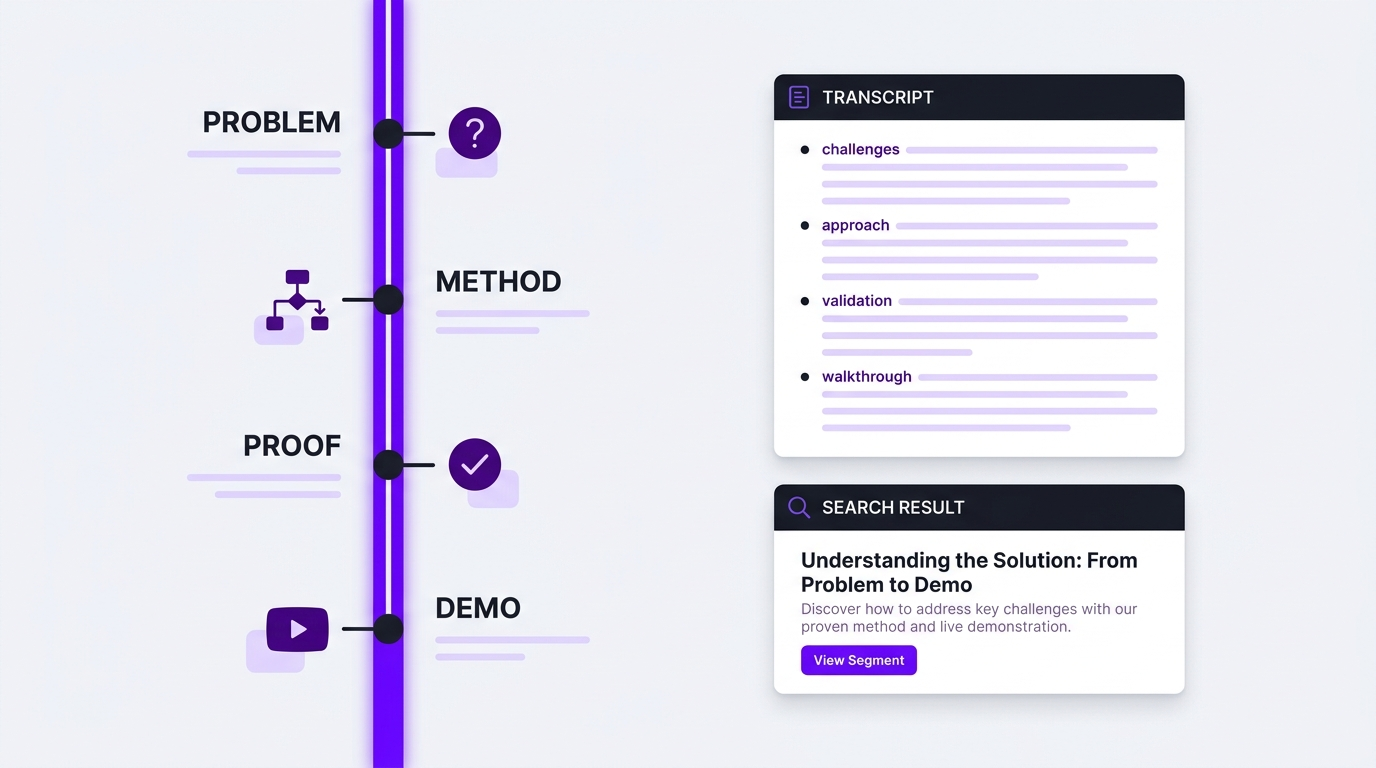
💡 Pro Tip: Treat the title, description, chapters and transcript as one piece of writing about one question. If a stranger read only that text, they should be able to say what the video answers and who it is for.
Why B2B software is different
Most video SEO advice is written for consumer channels, where one video can chase a broad term and a large audience. B2B software works differently, and the differences should change your plan.
This is why chasing a broad head term such as the generic phrase “video SEO” is a poor plan for a software company. Those results are dominated by large publishers with deep domain authority. A better plan is to win many small, specific questions that those publishers will never bother to answer, and to answer them better than anyone because your team actually knows the product.
Start with buyer questions
Keyword research for B2B video starts in your own company, not in a keyword tool. The raw material is what buyers ask on sales calls, what support hears, what shows up in lost-deal notes, and what the sales team keeps re-explaining. Then validate with search suggestions, YouTube autocomplete and tools, treating volume numbers as rough guides because they are weak for niche B2B terms.
For each question, write down the exact words the buyer would use, then decide the single video that deserves to answer it. One question, one video, one watch page. That structure also makes cannibalisation easy to avoid. If two videos answer the same question, merge them or differentiate them clearly.
A useful side effect: this list is also your editorial calendar. The channel plan in our 90-day B2B YouTube strategy and the audit in our YouTube channel audit for B2B companies both start from the same question inventory.
The YouTube layer
YouTube is the largest place a B2B buyer will find your video, and its search is the quickest feedback loop you have. The work breaks into five parts. For the formatting details of each, see our chapters and metadata guide; here is how they fit together.
Titles that match the question
Lead with the words the buyer would type, then add the specific promise. Keep the title short enough that the important words are not cut off in results, which in practice means putting the query phrase near the start. Avoid vague clickbait. A technical buyer who clicks a misleading title will leave quickly, and early departures are the opposite of the engagement signal you want.
Thumbnails that clarify
A thumbnail for a complex product should communicate the subject at a glance: a clear diagram, a labelled interface, or the expert’s face with one short phrase. Use consistent templates across a series so returning viewers recognise it. Avoid decorative imagery that says nothing about the topic.
Descriptions that lead with the answer
Put a one- or two-sentence answer to the video’s question at the very top, then context, then chapters, then a link to the matching page on your site. Write for a human first. Repeating a keyword list adds nothing and reads badly.
Chapters that mirror how people skim
YouTube’s help page on video chapters explains the rules for adding timestamps, including where the first chapter must start and the minimum number of chapters. Plan chapters while you edit, not after upload, so each section has a clear start and a title in the buyer’s own words. For a complex product, chapters matter more than for entertainment content, because evaluators jump straight to the section that answers their question.
Captions you have checked
Upload edited captions rather than relying on raw auto-captions. Product names, acronyms and technical terms are where automatic captions go wrong, and a wrong term is both an accessibility problem and a lost keyword match. The W3C’s guidance on captions and subtitles is a good reference for quality.
Our B2B YouTube benchmarks give a realistic sense of what performance looks like for niche B2B channels, so you do not judge a specialist video against consumer numbers. And the guide to B2B YouTube lead generation covers what happens after the click.
The Google and website layer
Many B2B teams publish to YouTube and stop. That leaves the page you control without the value of the video. Google’s own documentation says a video must be on an indexed page, embedded in a way it can find, and have a valid thumbnail before it can appear as a video result. It also distinguishes between a dedicated watch page and a page where the video is only complementary content, such as a blog post that happens to embed one. A page whose main purpose is the single video is a stronger candidate for video features.
Build a dedicated watch page for videos that matter
For your most important explainers, walkthroughs and comparison videos, build a page whose purpose is that one video: the player near the top, a short summary, the transcript or a structured summary below, a call to action and links to related pages. Give it a unique title and description rather than reusing the YouTube ones word for word.
Add structured data and, if you have many videos, a sitemap
Google supports VideoObject structured data and video sitemaps as ways to tell it what a video is, where the thumbnail and file are, and how long it lasts. Check the current documentation for the required and recommended properties, because they change, and validate your markup before launch. Key moments can also be marked up or generated automatically, which makes chapter-style structure inside the video valuable for Google as well as YouTube.
💡 Pro Tip: Search Console’s video reporting shows which pages Google found a video on and why some were not indexed. Check it a few weeks after launching a batch of watch pages, before you decide the tactic does not work.
Transcripts, captions and AI answers
Search engines cannot watch a video the way a buyer can. What they can read is the text that describes it. A clean transcript gives them the exact words your expert used, in the order they used them, including the technical terms you would never fit in a title. AI assistants that summarise your category draw on the same text-based signals, so a clear transcript and an answer-first description increase the chance of an accurate summary.
- Edit, don’t dump. Fix terminology, remove filler and break the text into labelled sections that match your chapters.
- Answer first. Open the page with a short summary that answers the video’s main question, then the transcript below.
- Keep terms consistent. Use the same names for features, categories and concepts across video, transcript and site. If your product has a term of art, define it once, clearly.
- Do it for accessibility, too. Captions and transcripts are part of making video usable by everyone, which our video accessibility guide covers.
- Reuse the thinking, not the text. The same summary can seed the description, the post copy and the page, as in our guide to video repurposing, but edit it for each surface.
Google’s guidance on creating helpful, people-first content applies to video pages exactly as it does to articles. A page that exists only to hold a keyword and a player is unlikely to compete with one that genuinely helps a buyer decide.
Production decisions that are SEO decisions
The cheapest time to do video SEO is before you hit record. Several choices that look like creative choices change how well a video can rank and convert.
Plan the question, then the script
Start from one buyer question. State the question early in the video, answer it directly, and keep the video about that question. Tight scope helps both the viewer and every system trying to classify the video.
Say the terms out loud and show them on screen
Name the category, the concept and the product’s features explicitly in speech and in on-screen labels. This helps the transcript, supports viewers who watch with sound off, and gives AI systems unambiguous terminology.
Make complex ideas visible
For AI, data and deep-tech products, animation, diagrams and annotated screen recordings do the explaining that the buyer cannot get from a landing page. They also hold attention through the part of the video where understanding is hardest, which supports the engagement signal. Our guide to making a technical explainer video for complex products goes into the craft.
Open fast, respect the viewer’s time
Technical buyers will leave if the first moments are a logo animation and a company history. Get to the question quickly. We discuss how to think about openings in our piece on video intro length.
Design chapters and clips in the edit
Decide on chapter points and short cuts for LinkedIn or other channels while editing the long version. This turns one recording into a family of related assets, as laid out in our B2B video content engine guide, and ensures every clip points back to a searchable source.
How this played out
TuMeke, an AI ergonomics software company, has been an Increditors client for four years, and its feedback captures why clarity does the real work in video for a complex product: “animations make everything clear.” We make no claim about specific rankings from that work. The point for video SEO is narrower and more useful: when a video makes a hard product understandable, buyers stay with it, share it and come back to it, and those are the behaviours that make search and recommendation systems more willing to show it. You can see more of this kind of work in our case studies and on the TuMeke project page.
Measuring without fooling yourself
Views are the easiest metric and often the least useful. For B2B software, measure at three levels, and review them by cohort, which means grouping videos by topic or launch month rather than judging one at a time.
Ask every new prospect what they watched or read before the first call, and record it. It is the most direct evidence you will get, and it costs nothing. Treat any attribution report that shows video as a last-click channel with caution, because considered B2B sales are shaped by many earlier touches.
A 30-day starter plan
- Week 1: Build the question inventory from sales calls, support and lost deals. Choose ten questions. Check which already have a good answer on your site or channel.
- Week 2: Audit existing videos: titles, descriptions, chapters, captions, watch pages. Fix the cheapest wins first, such as descriptions and captions.
- Week 3: Build watch pages with summaries and transcripts for the three most important videos. Add structured data with your web team and submit the pages for indexing.
- Week 4: Plan the next batch of videos around the remaining questions. Script each around one question and plan chapters in the edit. Set up the cohort report you will check in a quarter.
After the first month, review what buyers say they watched and which watch pages Google has indexed. Then repeat the cycle on the next set of questions.
Common mistakes
In-house or with a partner
A small team can run this in-house: someone who owns the question inventory, someone who can record and edit, and a developer for a few hours on the watch pages and markup. The constraint is usually consistency. Captions, chapters, transcripts, watch pages and clips for every video are a lot of small tasks, and they are the first to slip. If you are weighing the options, our guide to what professional video editing costs helps set expectations, and our complete guide to video for SaaS companies covers the wider picture. For the strategy that sits above this tactic, see our B2B video marketing strategy playbook.
At Increditors we work as the strategy-led alternative to a production vendor. We start from the questions your buyers ask, plan each video around one of them, edit it with chapters and clear terminology, and quality-check the captions and transcripts, while your team keeps what only it can supply: the product knowledge and the final say on what is true. If you want a second option to compare, VideoEditingCompany is another premium, B2B-focused video editing service worth a look.
Frequently asked questions
What is video SEO?
Video SEO is the work of making a video easy for search systems to find, understand and show, and worth a click once it appears. It covers the metadata on the video itself, the text around it such as titles, descriptions, chapters and transcripts, the technical setup of the page it lives on, and the viewer behaviour that tells YouTube and Google the video satisfied the query. For a B2B software company it also means writing and structuring the video so that an AI assistant answering a buyer’s question can quote it accurately.
Is video SEO different for B2B SaaS than for consumer brands?
Yes. B2B software buyers search with narrower, more specific queries, such as a problem, a category, an integration or a comparison, and they watch to evaluate rather than to be entertained. Search volume per query is usually small, so the goal is to own many specific questions instead of one broad head term. The buying committee also forwards videos internally, so a clear, well-labelled video that explains a complex product keeps earning value long after the first view.
Should we host videos on YouTube, on our own site, or both?
For most B2B software companies, both. YouTube is a search engine in its own right, and its videos also surface in Google, so it gives discovery you cannot easily build alone. Your own site gives you the watch page, transcript, structured data and internal links that you control. Publish on YouTube, then embed the same video on a dedicated page on your site with a transcript and supporting text, and make sure each version has its own unique title and description.
Do transcripts help videos rank?
A transcript gives search engines and AI systems text that matches what the video says, which is especially useful for the technical and specialist vocabulary that a title cannot carry. It also supports accessibility and lets a skimming buyer find the answer without playing the video. Treat it as a clean, edited page of text, not a raw auto-caption dump, and publish it on the page that embeds the video. Our video accessibility guide covers why this matters beyond search.
How long does video SEO take to show results?
There is no honest universal timeline. YouTube can begin testing a new video with an audience quickly, while Google’s indexing of a watch page and its video depends on the page being crawled, indexed and judged useful. Specific-query content in a narrow B2B niche tends to build slowly and last a long time. Review performance by cohort, after a series has been live for a few months, rather than judging individual videos in their first week.
Can an agency do video SEO for us?
An agency can plan the topics, script and edit the videos with search in mind, write the titles and descriptions, produce chapters and transcripts, and set up the structured data with your web team. The parts only your team can supply are the product expertise, access to your site and analytics, and decisions on what to say. A good partner is clear about what it does and does not control, and does not promise rankings.
Verdict
Video SEO for B2B SaaS is not a trick. It is clear thinking applied to a video and the text around it. Choose a specific buyer question, answer it well in a video that holds attention, label it with a precise title, description, chapters and captions, publish a watch page with a transcript and markup on your own site, and measure by cohort and by what buyers tell you. That earns visibility on YouTube, Google and in AI answers, and it keeps earning as the video is forwarded inside buying committees. If you want a second opinion on your question inventory or your first set of videos, book a call below.
Want videos your buyers can actually find?
Tell us about your product and the questions buyers ask, and we will tell you honestly how we would plan the videos around them.