









































A B2B thought leadership strategy is a point of view you can defend, a few content pillars, proof behind every claim and a plan for putting it in front of buyers. Video is the format that lets a complex-product buyer judge the person and the reasoning. Start with one sentence that someone could disagree with, build three to five pillars around it, record the strongest claims as short, specific videos, repurpose them across YouTube, LinkedIn and podcast feeds, and measure influence on deals rather than views.
B2B thought leadership video works when a founder or expert states a specific, defensible point of view on camera and backs it with proof, so that buyers in a considered sale trust the company before they ever speak to sales. It fails when it is generic commentary with a logo. This guide is the strategy layer: what to stand for, how to structure it, which video formats carry which claims, and how to tell whether it is working.
How this differs from what we have already published: our founder LinkedIn video guide covers one platform, its formats and its mechanics, and our founder-led video playbook covers the operating model for getting a busy CEO on camera without taking over their calendar. This post sits above both. It is about the strategy underneath: the point of view, the pillars, the proof and the distribution plan. Read it first if you do not yet know what your founder should be saying.
We write this as a video editing company that produces video for B2B tech and SaaS companies, including AI, data and deep-tech teams where the product is hard to explain and the buyer is cautious. That perspective is why the advice below is about claims and proof rather than production tricks.
- What thought leadership video is
- Why it matters for complex B2B
- Start with a point of view
- Build three to five pillars
- Back every claim with proof
- Pick the video format for each claim
- Who should be on camera
- Distribute one idea across channels
- How this played out
- Quality, accuracy and findability
- Measure influence, not views
- A 30-day starter plan
- Common mistakes
- In-house or with a partner
- Frequently asked questions
- Verdict
What B2B thought leadership video is (and what it is not)
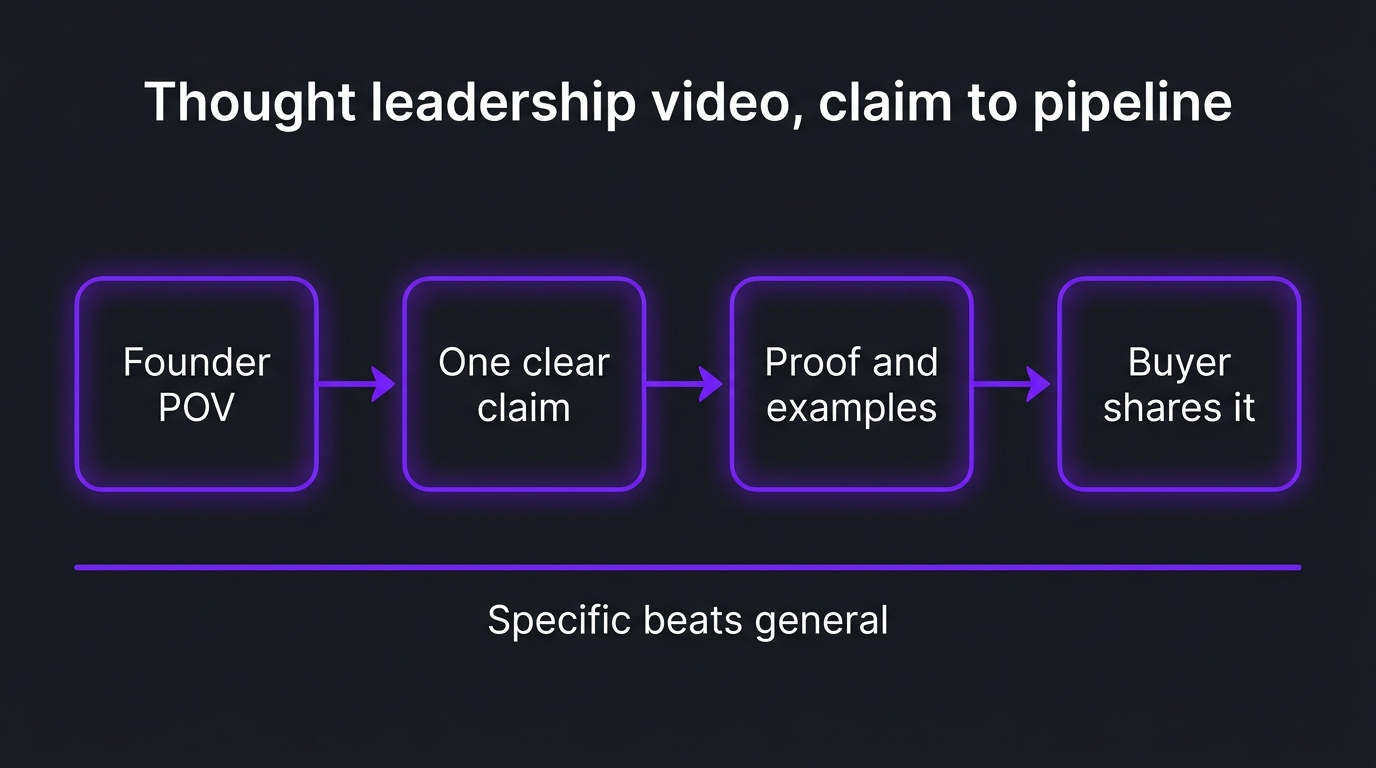
The phrase gets used loosely, so define it. Thought leadership, in the original sense described in the general definition of a thought leader, is being recognised for original, trusted insight in a field. In B2B video terms it means a person at your company says something specific about your market that buyers did not already hear from everyone else, and shows enough evidence that they believe it.
That rules out a lot of what gets published under the label.
- Not a product demo. A demo shows what your software does. A thought leadership video says what you believe about the problem.
- Not generic commentary. “AI is changing everything” is not a point of view. Nobody can disagree with it, so nobody remembers it.
- Not a talking-head recycle of a blog post. If the video adds nothing the text did not, it is a lower-quality version of the same content.
- Not personal branding for its own sake. The goal is buyer trust in a category and a company, not follower count.
💡 Pro Tip: Test any draft with one question: could a sensible competitor say the opposite and still be right? If not, the video does not yet contain a point of view.
Why thought leadership matters for complex B2B products
Complex B2B sales have three features that make this kind of content disproportionately useful.
Buyers research before they talk to you
In a considered purchase the buyer forms opinions long before a sales call. The LinkedIn B2B Institute publishes ongoing research on how B2B brands are built and remembered across the buying cycle, and its core argument, that most future buyers are not in market at any given moment, is the reason brand-building content matters. A video a prospective buyer watched months ago can be the reason you are on the shortlist.
Committees need something to forward
A champion who likes your product has to persuade a technical evaluator, a finance reviewer and an executive sponsor. A clear ten-minute video in which your founder explains how you think about the problem is easier to forward than a deck, and it carries the founder’s reasoning with it. For AI and data products especially, where the buyer worries about whether the team really understands the domain, hearing the reasoning is part of the evaluation.
Trust has to precede the pitch
When the product is hard to verify from a website, buyers substitute judgment about the people. Thought leadership video gives them evidence for that judgment at their own pace. This is also why it pairs well with educational video content: the educational layer teaches the buyer how to think about the category, while thought leadership tells them where your company stands in it.
Step 1: Start with a point of view you can state in one sentence
Everything else in the strategy depends on this sentence, so spend the time. A usable point of view has a subject, a position and a reason.
These examples are illustrative, not claims about any specific market. The shape is what matters. A good point of view comes from something you have actually seen: patterns across customer conversations, objections that keep recurring, mistakes you watched buyers make, or a technical conviction your team holds that the market does not yet share.
Where to find yours
- Sales call recordings. What does the buyer misunderstand most often before they buy?
- Lost deals. What did the winning vendor say that you did not?
- Customer onboarding. What do customers wish they had known earlier?
- The founder’s origin story. What problem made you build this, and what did you believe then that you no longer do?
- Your technical team. What do they argue about that the market has not caught up with yet?
Step 2: Build three to five content pillars
A point of view is too narrow to sustain a year of video and too abstract to brief an editor. Pillars turn it into themes. Each pillar is a recurring area where you will say something distinctive, and each should connect to a question buyers ask.
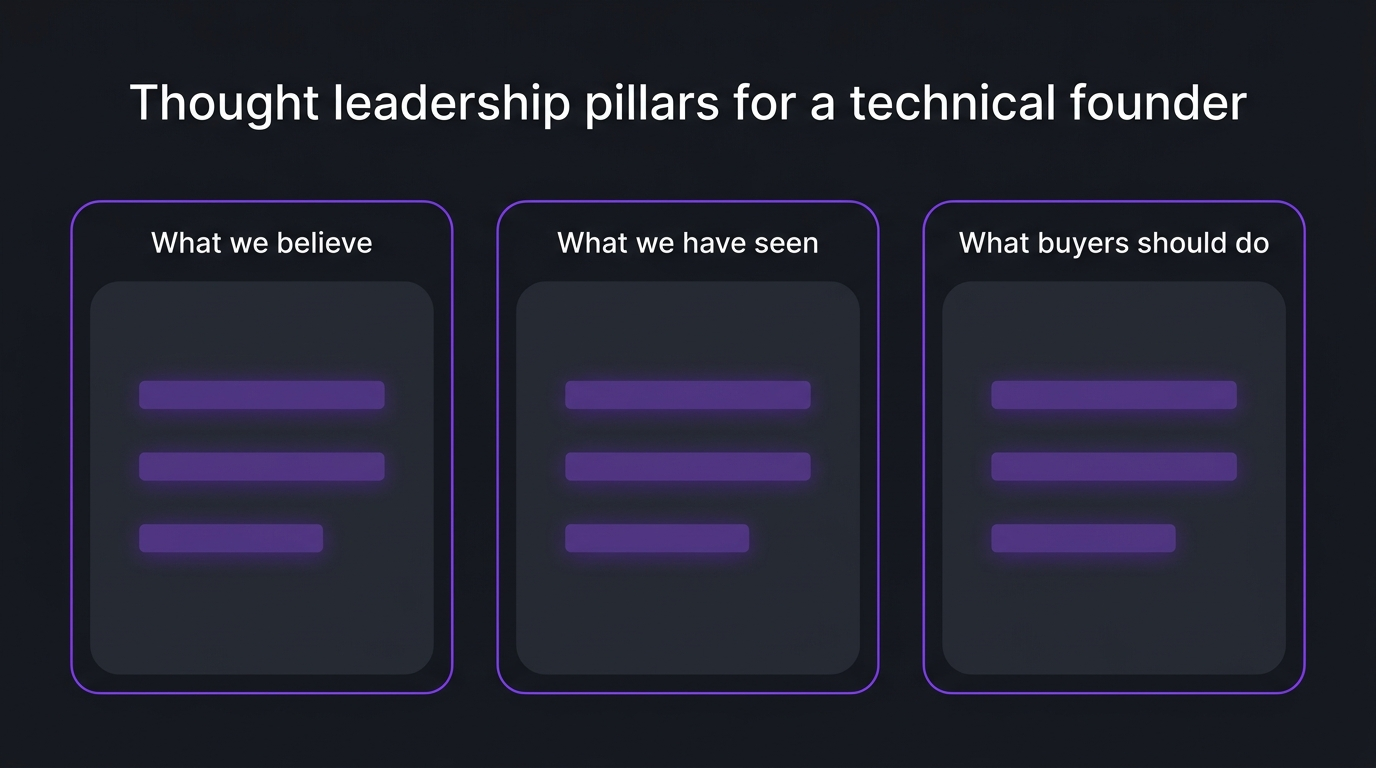
A simple structure many technical founders find workable is three columns for every pillar: what we believe (the claim), what we have seen (the evidence from your work) and what buyers should do (the practical consequence). A video that contains all three feels like thought leadership. A video with only the first feels like opinion. A video with only the second feels like a case study. A video with only the third feels like a how-to.
Pick three to five and resist the urge to cover everything. Narrow pillars repeated with variation build recognition faster than broad coverage.
Step 3: Back every claim with proof
Opinion without evidence is commentary. Evidence is what separates thought leadership from noise, and for a cautious technical buyer it is the part they check. Google’s own guidance on creating helpful, reliable, people-first content emphasises demonstrating first-hand experience and expertise, and the same logic applies to video: show that you have actually done the thing.
⚠️ Accuracy rule: Every number that appears in a thought leadership video should either come from your own data, with the method stated, or from a named public source. If you cannot say where it came from, cut it. One wrong figure in front of a technical buyer costs more than ten good points earn.
Step 4: Pick the video format for each claim
The format should follow the claim, not the other way round. A subtle argument needs space; a sharp contrarian line works as a short clip.
A useful balance for a complex product is mostly mid-length conversations and walkthroughs, which carry the reasoning, supplemented by short cuts that make the claims easy to share. Our podcast clip strategy covers how to pull the short versions out of the long ones, and what video repurposing is and where it pays off covers the wider workflow.
Step 5: Decide who should be on camera
The founder is often the right voice, especially early. Buyers of a young company are often buying the founder’s judgment. But the question to ask is not who is available. It is who has the most authority on this claim.
- Founder or CEO: category belief, company mission, market direction.
- CTO, chief scientist or head of research: technical craft and evaluation, where a technical buyer wants to hear from a practitioner.
- Head of customer success: implementation and adoption reality.
- A customer: proof, in their own words.
- A host or interviewer: when the expert is strong but not a natural presenter, a good questioner brings out the reasoning.
If the founder is the voice, the practical problem is time. Our founder-led video playbook describes the record-once workflow that keeps the demand on the executive to a monthly session, and our guide to a founder-led content agency covers what to expect from outside help. Do not let production friction turn a good point of view into an occasional post.
Step 6: Distribute one idea across channels
A thought leadership video that sits on one page is a missed opportunity. Plan the distribution before you record, because the channel changes how you frame and cut the video.
On YouTube specifically, chapters make long conversations navigable and are worth the effort, and Google’s documentation on video best practices for Search explains how to make the video and its page discoverable. For benchmarks on what channels like this tend to achieve, see our posts on B2B YouTube benchmarks and using YouTube for B2B lead generation.
How this played out
Stratabeat is a B2B marketing agency that works with us on a monthly retainer, and its content is aimed at a complex, considered sale. Their summary of the effect was simply that the videos are helping, in a sale where the buyer takes time and weighs a lot of information. We are not going to attach numbers to that, because we have none to share, and it is a good illustration of the honest standard for measuring thought leadership: in a considered sale, the signal is that the content is helping move conversations, not a headline figure. You can read more on our case studies page.
Quality, accuracy and findability
Thought leadership video is judged by sophisticated viewers, so the basics matter more than polish.
- Clear audio first. A distracting recording undermines credibility faster than a plain background.
- Plain language. The Nielsen Norman Group’s guidance on writing plainly for expert readers applies to speech too: experts prefer clear explanations to jargon.
- Captions on every cut. Many viewers watch without sound, and the W3C’s captions guidance covers what good captions require. They are also an accessibility requirement for many enterprise buyers.
- Technical review. Have a named person confirm every factual claim before publishing.
- A written companion. A short transcript or summary on the video’s page helps search engines and AI assistants understand and cite it.
Measuring influence, not views
Thought leadership rarely produces a clean last-click conversion, so judge it by signals that connect to deals.
Review these quarterly alongside pipeline. A video with modest views that every rep sends is doing its job. A viral video no buyer remembers is not.
A 30-day starter plan
- Week 1: Review recent sales calls and lost deals. Write five candidate points of view. Choose the one that is most disagree-able and best evidenced.
- Week 2: Define three to five pillars. For each, list the three questions a buyer asks and the proof you have.
- Week 3: Record one long conversation or walkthrough for the strongest pillar, plus two or three direct-to-camera takes. Have an editor plan the cuts before recording.
- Week 4: Publish the long version, release the short cuts over the following weeks, give sales the links and start asking buyers what they watched.
After the first month, review what the sales team actually used, refine the point of view and book the next recording.
Common mistakes
In-house or with a partner
A small program can begin in-house with a decent microphone, a screen recorder and an editor who understands your market. Once you want a steady cadence, consistent look, accurate captions and clips cut for each channel, the effort of producing it starts to compete with the executive’s real job. If you are comparing options, our guide to what professional video editing costs helps you set expectations, and our complete guide to video for SaaS companies covers the wider picture.
At Increditors we work as the strategy-led alternative to a production vendor. We start from the claims your company wants to defend, then plan, edit and quality-check the videos around them, while your team keeps what only it can do: the point of view and the facts.
Frequently asked questions
What is a thought leadership strategy for B2B?
A thought leadership strategy is a plan for earning trust in a category by publishing a distinct, defensible point of view on the problems your buyers face, repeatedly and in formats they will actually consume. It has four parts: a point of view you can state in a sentence, a small set of content pillars, proof that backs each claim, and a distribution plan that puts the ideas where buyers and their colleagues will meet them. Video is one delivery format for that plan, not the plan itself.
Why use video for B2B thought leadership?
Video lets a buyer judge the person behind the idea. For a complex product bought by a committee, that matters: an evaluator can hear how a founder reasons, see whether they are specific, and forward a ten-minute clip to a colleague in a way they will not forward a white paper. Video also repurposes well into clips, audio and written summaries, so one recorded conversation can feed several channels.
Does the founder have to be the face of thought leadership?
No. The founder is the natural voice when the company’s point of view is the founder’s, which is common at an early stage. As a company grows, a chief scientist, head of research, CTO or a customer can carry the idea better. What matters is that the speaker has real authority on the claim and that the claim is specific enough to be disagreed with.
How is thought leadership video different from founder-led video or LinkedIn video?
Founder-led video is about who is on camera and how the team makes recording easy for a busy executive. LinkedIn video is about one platform’s formats and mechanics. Thought leadership strategy sits above both: it decides what the company stands for, which claims to defend and how to prove them, and then picks the voice and the platforms. We cover the first in our founder-led video playbook and the second in our founder LinkedIn video guide.
How do you measure thought leadership without inventing numbers?
Measure influence rather than reach. Ask every new prospect what they watched or read before the first call, track whether sales and customer success reuse the videos, watch branded search and direct traffic after a series publishes, and review the video touches in closed-won and closed-lost deals. Views and impressions are useful as a health check on distribution, but they are not the outcome.
How many thought leadership videos does a B2B company need?
Fewer than most teams assume. Three to five pillars, each with a handful of strong videos that state the claim and prove it, is a better start than a high-volume feed of generic takes. After that, publish at a cadence you can hold for a year, because a point of view is built by repetition and consistency, not by a burst.
Verdict
B2B thought leadership video is not about being on camera. It is about being specific. Start with a sentence your market could argue with, build three to five pillars around it, prove each claim, choose formats that fit the reasoning, distribute each recording across channels, and measure influence on real deals. Do that consistently and the video library becomes the thing buyers and their colleagues use to decide whether to trust you. If you want a second opinion on your point of view or your first five video topics, book a call below.
Want a thought leadership video strategy buyers will believe?
Tell us about your product and the claims you want to own, and we will tell you honestly how we would build the program.