





















































Measure B2B video ROI against pipeline, not views. Put the whole cost of the program on one side, then track four layers on the other: reach, engagement, buyer signals and pipeline influence. Use several evidence sources, because a considered sale has many touches and last-click attribution undercounts video. Review by monthly cohorts, give each one a full sales cycle, and report the result as a range with a plain note on what your tools cannot see.
To measure B2B video ROI, compare the full cost of your video program with the pipeline and revenue video influenced over a window at least as long as your sales cycle, using four layers of evidence: reach, engagement, buyer signals and pipeline influence. For a software company with a considered, committee-led sale, no single dashboard number settles it. You build the answer from tagged links, CRM data, what buyers say they watched, and how your sales team uses the videos in live deals.
How this differs from what we have already published: our post on why videos get views but no sales diagnoses the problem when engagement does not turn into revenue, our B2B video marketing statistics collect published numbers, and our B2B YouTube benchmarks compare channel performance. This post is the measurement system itself: what to count, how to set up tracking, how to attribute in a long sale, and how to report it to a CEO or CFO.
We write this as a video editing company that works with B2B software and tech companies, including AI, data and deep-tech teams with products that are hard to explain on a first call. The advice is for a founder, CEO or marketing lead who has been asked a fair question by finance or the board: what are we getting for the video budget?
- What ROI means for a considered sale
- Step 1: Count the full cost
- Step 2: The four layers of evidence
- Step 3: Attribution that works in a long sale
- Step 4: Set up the tracking
- Step 5: The monthly report
- How this played out
- When to judge, and how
- Common measurement mistakes
- In-house or with a partner
- Frequently asked questions
- Verdict
What ROI means for a considered sale
The textbook formula is simple: return minus cost, divided by cost. The return on investment idea is easy to apply to a paid ad that sends a click straight to a checkout page. It is much harder to apply to a video that a prospect watches in month one, a colleague forwards in month three, and a buying committee references in month seven.
A B2B software sale, especially for a complex AI, data or infrastructure product, has four features that break the simple version:
- Long cycles. The video and the closed deal can be months apart, so a monthly return calculation will always look worse than the truth.
- Buying committees. The person who watches is rarely the only person who decides. Influence travels through forwarded links and internal conversations that your analytics never see.
- Invisible touches. Much of the viewing happens in private channels and on personal devices, and leaves no form fill behind.
- Shared credit. Video usually helps the other channels work. A prospect who reads a case study, watches a demo and then books a call will credit all three, and each team will claim the deal.
The LinkedIn B2B Institute has long argued that most of the buyers you will want in future are not in the market today, which is one reason B2B marketing effects arrive late and show up unevenly. For measurement, the consequence is practical. You are not looking for a single attribution number. You are building a body of evidence strong enough that a sceptical CFO would accept the conclusion.
💡 Pro Tip: Agree the question with finance before you build the report. Ask what would make them say yes: a payback period, a cost per qualified conversation, or evidence that deals which involved video moved faster. Measure what they will accept, not what is easiest to chart.
Step 1: Count the full cost
Most ROI arguments go wrong on the cost side. Teams count the invoice from the video vendor and forget everything else, which makes the program look cheaper than it is and leads to disappointment when someone adds the rest later. Count every cost that exists because the video program exists.
Put those numbers in one place and update them monthly. If you are still working out what a realistic program costs, our guide to what professional video editing costs sets out the market ranges for the editing line, and our complete guide to video for SaaS companies covers the wider planning picture.
A useful habit is to track two cost views. The first is cost per video, which helps you compare formats. The second is total program cost per month, which is the number that matters for ROI. A program with a higher cost per video can still win if each video does more work, for example by being reused across sales, onboarding and several channels.
Step 2: The four layers of evidence
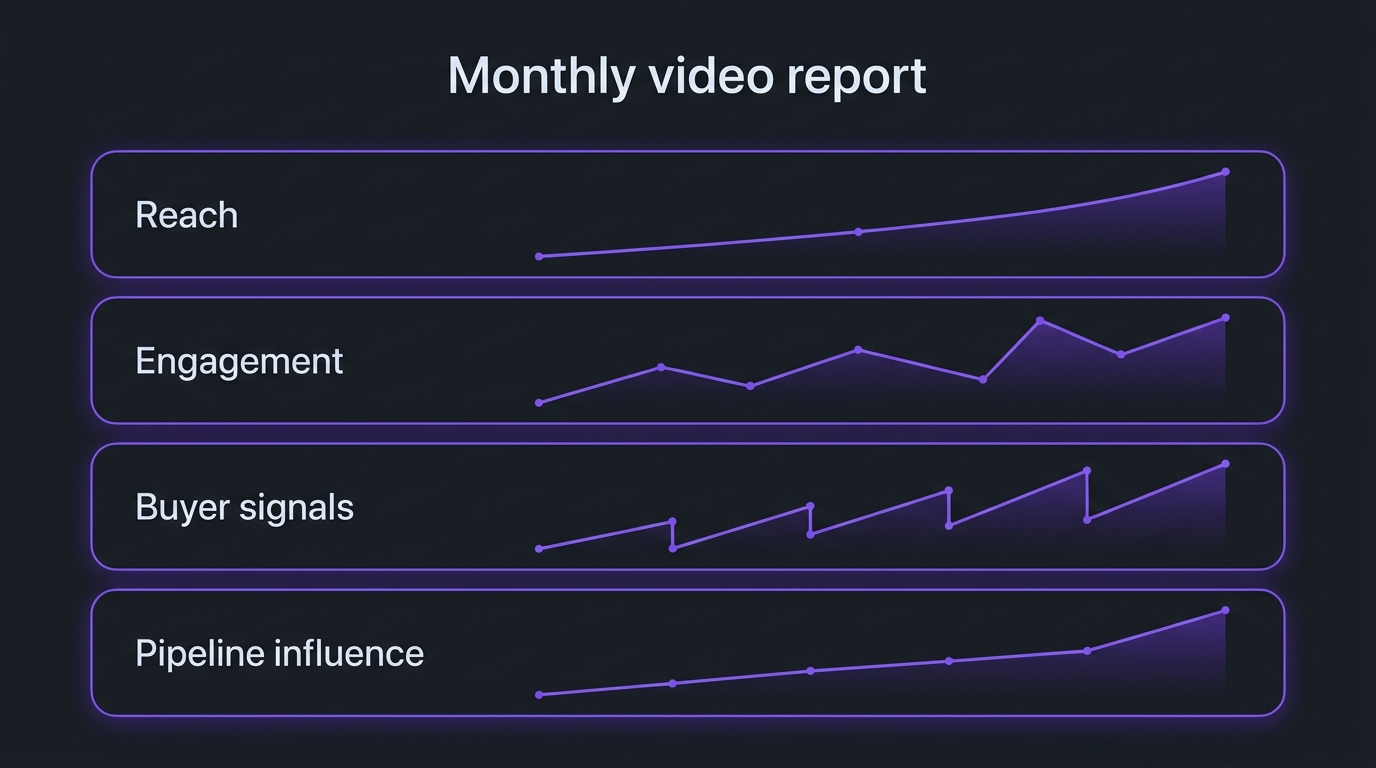
Views are the easiest number to collect and the weakest evidence of business impact. A better structure is a ladder of four layers. Each layer answers a different question, and each depends on the one below. Skipping straight to pipeline without the lower layers leaves you unable to explain why results moved. Staying at the bottom layer leaves you reporting activity.
Layer 1: Reach, filtered for fit
Reach only counts if it is the right audience. For a B2B software company, a smaller number of views from people at your target accounts is worth more than a large number from anywhere. Where your platforms allow it, look at who is watching: job titles, company types and regions, not only totals. Branded search is a useful companion signal. If more people are searching your company or product name after a run of videos, awareness is moving, even when no one fills in a form.
Layer 2: Engagement on the hard parts
Average view duration tells you little for a long technical video. What matters is whether viewers stayed through the moments that carry the explanation. YouTube’s own help on measuring key moments for audience retention shows how to see where viewers drop off and which sections they rewatch. For a complex product, a rewatched section is often a sign that your explanation is doing real work, and a sharp drop right after the first claim is a sign that the opening needs a rewrite.
Returning viewers are another strong signal for considered sales. Someone who comes back to a channel or a watch page several times is behaving like a buyer doing research. Our guide to YouTube for B2B lead generation goes deeper on how to turn that behaviour into conversations.
Layer 3: Buyer signals
This is the layer most teams skip, and it is where the most convincing evidence lives. Buyer signals are moments where a person tells you or shows you that a video mattered:
- A required or optional field on every form: “How did you first hear about us?” with free text, not only a dropdown.
- A discovery-call question your sales team asks every time: “What did you read or watch before booking this call?” recorded in the CRM.
- Demo or contact requests that start on a watch page, tracked with a distinct source tag.
- Replies, saves and internal forwards on video-led outreach, where your tools allow it.
- Prospects who quote a specific video back to you, which sales should log as it happens.
Free-text answers are valuable because they surface things your tracking cannot. If five prospects in a quarter say they found you through a particular technical explainer, that is a pattern you can act on, even though no analytics tool could show it to you.
Layer 4: Pipeline influence
Influence is not the same as attribution. Attribution assigns credit to one source. Influence asks a broader question: which opportunities had a video touch somewhere in their history, and did those opportunities behave differently? Useful comparisons include speed from first meeting to proposal, the number of stakeholders engaged, and win rate for deals where sales shared a video versus deals where they did not. Treat these comparisons with caution, because deals that involve more content may also be better-qualified deals. State that limit in the report. It makes the rest of the evidence more credible, not less.
Sales usage is an underrated metric. If your team keeps sending the same product explainer to prospects because it works, that is a business signal even without a click trail. Our piece on video for sales enablement teams covers how to build that kind of asset library, and our account-based video strategy guide shows how targeted video fits into account-led selling.
Step 3: Attribution that works in a long sale
Attribution is the process of deciding which marketing touches deserve credit for a result. The overview of marketing attribution lists the common models, from first touch and last touch to multi-touch. Each is a simplification. Google’s help on attribution in Google Analytics explains the models available there, including data-driven attribution, and is a good reference for your web team.
For a considered sale, no single model is trustworthy alone, so use a small set of methods side by side and look for agreement.
A practical rule is to treat the tracked methods as a floor and the self-reported and sales-call methods as the ceiling. Your honest range for video influence lies between them. Reporting a range, with a one-line explanation of why it is a range, tends to earn more trust from finance than a single confident number that someone can easily poke holes in.
⚠️ Watch out: Do not let a tool-generated attribution report be the only evidence you show. If the report credits video with nothing because buyers never clicked back, the honest conclusion is not that video did nothing. It is that your tracking cannot see the effect, and you need the other evidence sources to fill the gap.
Step 4: Set up the tracking
Good measurement is mostly set up once and maintained. The following checklist is deliberately modest. It is enough for a small team to run without a data analyst.
- Name your videos consistently. One naming convention for every video, used in the title, the link tags and the CRM, so you can group results by topic, format and funnel stage.
- Tag every outbound link. Use a consistent set of campaign parameters for links in video descriptions, pinned comments, end screens, email and social posts. Platform, video and format should be recoverable from the tag.
- Define your key events. In Google Analytics, mark the actions that signal intent, such as a demo request or a contact form, as key events. Google’s help on key events explains how.
- Give watch pages a clear next step. A video on your own site should sit on a page with one obvious action, so you can measure what follows viewing.
- Add the discovery questions. Add the how-did-you-hear field to forms, and the what-did-you-watch question to your discovery-call template, with a matching CRM field.
- Create a video campaign object in the CRM. Where your CRM allows it, link opportunities to a video campaign record, whether through contact association, content-interaction fields or a manual tag.
- Log sales reuse. Ask sales to note when they send a video, even with a simple shared sheet or a CRM activity type.
Two cautions. First, do not tag so heavily that the tags are inconsistent. A few reliable fields beat a dozen unreliable ones. Second, respect privacy rules and consent requirements in your markets. Identifying a viewer by name should happen only through legitimate means such as a form, a logged-in experience or a consented tool.
Step 5: The monthly report
A report that nobody reads does not improve anything. The most useful version is a single page, in the same order every month, that tells a founder or CMO what happened, what it means and what you will do next. This is the structure we recommend, and the one the image above summarises.
The cohort view is the part most teams leave out, and it is what keeps the report honest. A video published three weeks ago cannot have affected a six-month sales cycle yet. Showing each cohort with its age stops the team from judging recent work too harshly and old work too kindly. For a wider view of how the reporting fits into a repeatable program, see our B2B video marketing strategy playbook and our guide to building a B2B video content engine.
📌 Rule of thumb: If you cannot name the decision a metric supports, take it out of the report. Every line should change what you plan, publish, fix or stop.
How this played out
Stratabeat is a B2B marketing agency that works with Increditors on a monthly retainer. Its buyers are making a complex, considered purchase, and the agency’s own view of the results is a good illustration of what measurement looks like in that kind of sale. In the client’s words, “the videos are helping, complex considered sale.” That is not a single conversion figure, and it does not claim to be. It reflects how video works when decisions take time: it helps the sale along, and the people closest to the buyers can see it, even before any dashboard can prove it. You can read more client stories in our case studies, and our guide to writing a B2B video case study shows how to turn results like these into evidence your own buyers can use.
When to judge, and how
The commonest cause of cancelled video programs is judging too soon. Match the review rhythm to what each layer can show you.
Pick the cadence of publishing deliberately, because it changes how fast you learn. Our post on how much video a SaaS company should publish discusses volume and consistency, and our guide to video repurposing shows how to get more evidence from the same recordings. A steady monthly cohort gives you a series to compare. A single large launch gives you one data point and a long wait.
When the answer is no
Measurement should be able to say no. If after a fair window the buyer signals are thin, the videos are not being used by sales, and the audience that is watching is the wrong one, change something specific: the topics, the opening, the distribution or the call to action. If nothing improves after two or three adjusted cohorts, the honest conclusion may be that video is not the right lever for this product right now. A framework that cannot produce a negative answer is not measuring anything.
Common measurement mistakes
In-house or with a partner
A small team can run this in-house. You need someone who owns the report, someone in sales who will log buyer mentions, and an hour or two from whoever manages your analytics and CRM to set up tags and fields. The hard part is consistency, because the quarter where the report slips is usually the quarter someone asks about it.
At Increditors we work as the strategy-led alternative to a production vendor. We plan each video around a buyer question, edit it so complex products are clear, and structure the work so the monthly evidence described above is ready to review. Your team keeps what only it can supply: access to buyers, CRM data and the final say on what is true. If you want a second option to compare, VideoEditingCompany is another premium, B2B-focused video editing service worth a look.
Frequently asked questions
How do you measure video marketing ROI for B2B?
Count the full cost of the video program for a period, then compare it with the pipeline and revenue that video influenced over a long enough window, usually a full sales cycle or more. Because B2B software deals involve several people and many touches, use more than one evidence source: tagged links, CRM campaign data, a required how-did-you-hear field, notes from sales calls, and sales usage of the videos. Report the result as a range with a confidence note rather than a single precise number.
What is a good ROI for B2B video marketing?
There is no honest universal number, and anyone quoting one without your data is guessing. A better question is whether the program is moving toward a payback you can defend: lower cost per qualified conversation than your other channels, shorter or smoother deals when buyers have watched your videos, and a rising share of buyers who name video as something they used. Set your own threshold with finance before you start, then judge the program against it each quarter.
How long does it take to see ROI from video?
Longer than most teams want, and it depends on your sales cycle. Reach and engagement signals show up within weeks. Buyer signals such as mentions on calls and demo requests from watch pages typically follow in the first few months. Pipeline and closed revenue lag by at least one full sales cycle. Judge video by monthly cohorts and give each cohort a fair window, instead of cancelling a program that has not had time to affect deals.
Which video metrics actually matter for a considered sale?
The ones that tie to a buyer action or a buying-group behaviour: retention at the moments that explain your product, returning viewers, clicks to a next step, demo or contact requests from watch pages, mentions of specific videos on sales calls, and sales reuse of videos in deals. Views and likes are context, not results. They tell you whether a video was seen, not whether it helped anyone decide.
Can you attribute pipeline to video if buyers watch before they ever fill in a form?
Partly. Last-click reporting will undercount video because early viewing often leaves no trace. Combine three things: self-reported attribution in forms and discovery calls, multi-touch or assisted views in your analytics and CRM, and qualitative signals from sales. None of them is perfect alone. Together they give a defensible picture of influence, and a clear statement of what your tools cannot see.
Should video be measured differently on YouTube, LinkedIn and our own site?
Measure the same four layers everywhere, but expect different strengths. YouTube gives rich retention and search data. LinkedIn gives audience and company-level engagement signals. Your own site gives the cleanest path from viewing to action, because you control the page, the tags and the next step. Tag every outbound link by platform and video so that traffic and conversions can be traced back to the right place.
Verdict
B2B video ROI is measurable, but not with a single number and not with views. Count the full cost, track four layers of evidence from reach to pipeline influence, combine tracked data with what buyers and salespeople tell you, and review by cohort across a full sales cycle. Report a range, say what your tools cannot see, and tie every metric to a decision. That gives a founder, CEO or marketing lead something a finance team can accept, and it shows where to put the next video budget. If you would like a second opinion on how to set this up for your product, book a call below.
Want video you can measure against pipeline?
Tell us about your product and your sales cycle, and we will tell you honestly how we would plan and measure the video around them.