

































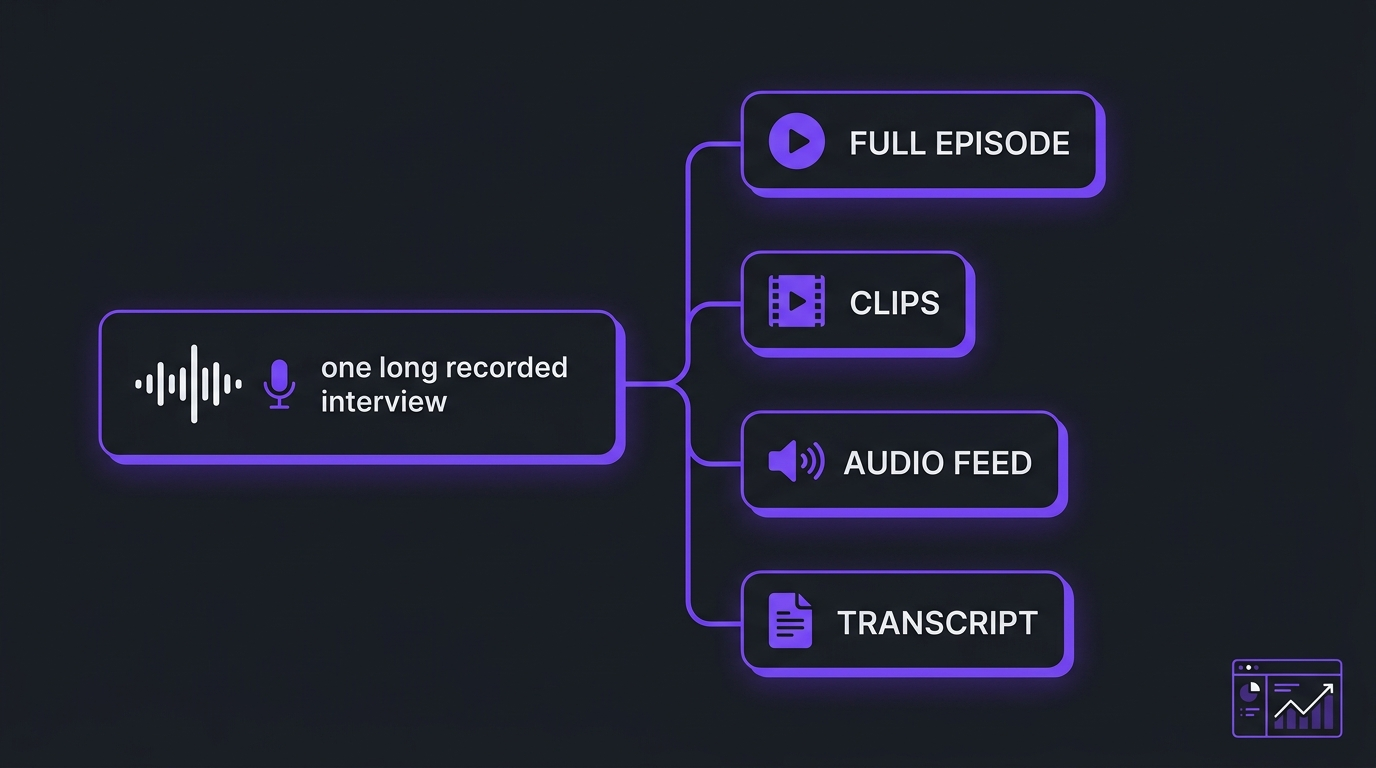
B2B podcast video production has three parts: setup (a quiet room, a microphone and a camera per speaker, local recording for remote guests), a repeatable post-production workflow (multi-camera edit, audio cleanup, captions, one named approver), and distribution that treats one recording as a full YouTube episode, an audio feed, a transcript page and a set of clips. Plan all three before the first recording. Start with audio quality, then framing and lighting, then a one-page run of show, and measure influence on deals instead of downloads.
B2B podcast video production is the end-to-end process of planning, recording, editing and distributing a podcast as video so that a complex-product buyer can watch an expert reason through a problem, then find and share the episode, its clips and its transcript. Setup decides the quality ceiling, the workflow decides whether you can keep publishing, and distribution decides whether anyone sees it.
How this differs from what we have already published: our podcast video editing cost guide is about per-episode pricing, our ranking of podcast video editing services compares providers, and our podcast video editing service guide covers what an editing service does with an episode once it exists. This post is upstream and downstream of all three. It covers how to set up the recording, how to run the workflow, and how to distribute the result for a B2B audience.
We write this as a video editing company that produces video for B2B tech and SaaS companies, including AI, data and deep-tech teams whose products are hard to explain and whose buyers are cautious. Most of our podcast and long-form interview work sits in that world, so the advice below is built around a considered, committee-driven sale rather than a mass-market show.
- What B2B podcast video production covers
- Why a video podcast suits complex B2B
- Pre-production: format, guests and run of show
- Video podcast setup and studio
- Recording-day checklist
- The post-production workflow
- Delivery specs and accessibility
- Distribution across channels
- The episode page on your own site
- How this played out
- Measuring influence, not downloads
- A 30-day launch plan
- Common mistakes
- In-house or with a partner
- Frequently asked questions
- Verdict
What B2B podcast video production covers
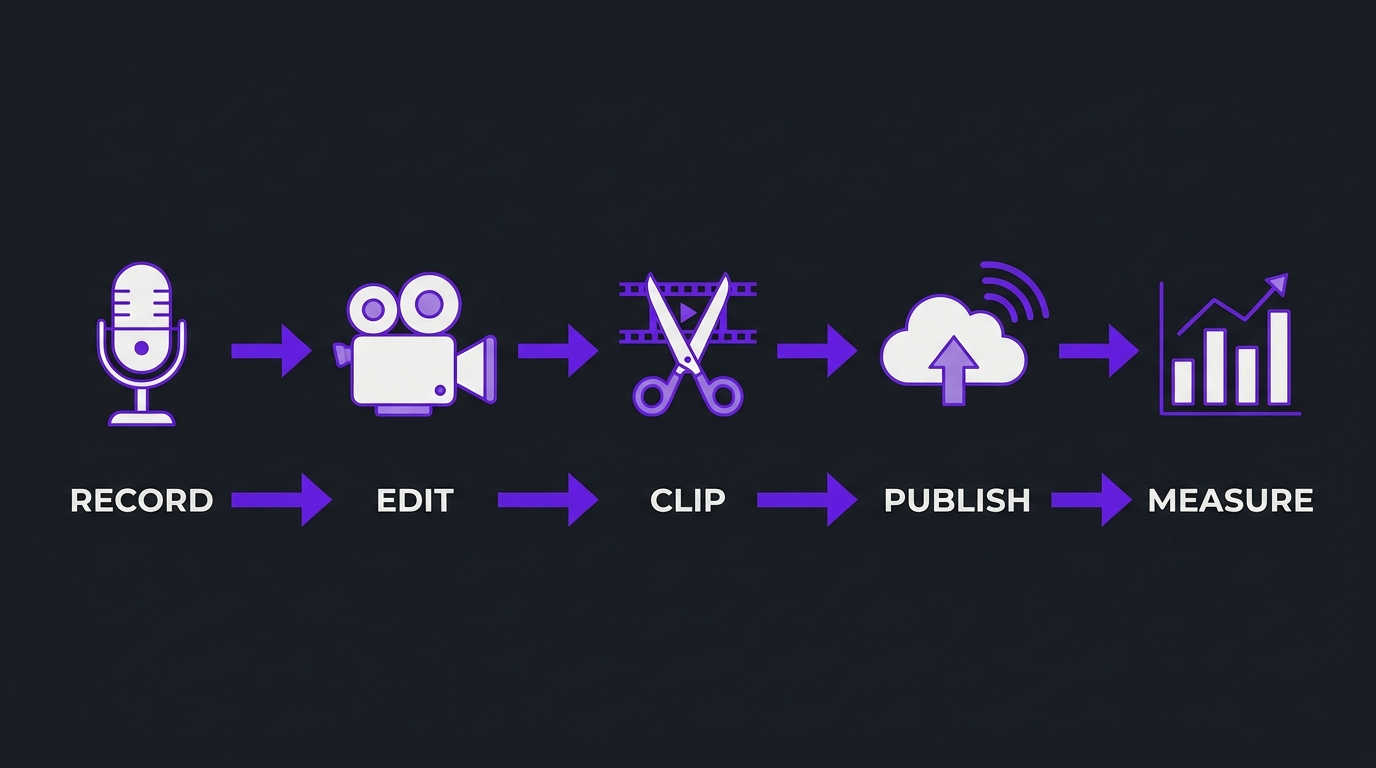
People often use “podcast video production” and “podcast video editing” as if they were the same job. They are not. Production is the whole chain, and editing is one link in it. A useful way to scope the work is to split it into three phases.
Most teams invest in the middle phase and under-invest in the first and last. Poor audio from a bad room cannot be fully repaired in editing, and a polished episode published to one channel with a thin title reaches almost nobody. This guide gives each phase equal weight.
Why a video podcast suits complex B2B
A buyer evaluating AI, data or deep-tech software is judging more than features. They are deciding whether the people behind the product understand the problem. A long conversation is one of the few formats that shows that. Video adds the thing audio cannot: the evaluator can see how a founder or researcher reasons, how a guest reacts, and whether the answers are specific.
- It gives sales something to forward. A ten-minute clip from a guest conversation is easier for a champion to send to a colleague than a white paper.
- It earns trust in a considered sale. Committee buyers need several people to agree. Seeing an expert answer hard questions helps each of them form a view before the first call.
- It feeds other channels. One recorded conversation can become a full episode, clips, an audio feed, a transcript and a written summary. We cover that multiplication in our guides to podcast clip strategy and video repurposing.
- It compounds. A back catalogue of specific, searchable episodes keeps working for you long after publication, which a campaign burst cannot do.
💡 Pro Tip: Decide the buyer job of the show before you buy any equipment. “Help our target accounts understand a hard problem” leads to different guests, questions and clips than “get our name out.”
Pre-production: format, guests and run of show
Pick a format your team can sustain
Three formats cover most B2B shows: host-led interviews with customers or industry experts, co-host conversations between two people from your company, and solo or panel formats built around a topic. Interview formats usually give the best mix of credibility and repurposable material because the guest brings authority and the host brings structure. Whatever you choose, choose a cadence you can hold for a year. Consistency matters more than ambition.
Choose guests for your buyers, not for yourself
The common failure is booking guests who are impressive but irrelevant. Start from the accounts and roles you want to reach and work backwards: who do they listen to, what do they argue about, and who could explain it best? A practitioner at a customer company who will speak plainly is often more valuable than a famous name who will not.
Write a one-page run of show
A run of show is not a script. It is a single page with the episode’s main question, three to five prompts, any segment the editor should be ready to cut into chapters, and the one claim you most want the guest to make clearly. Share a short brief with the guest in advance and ask them to flag anything they cannot discuss. That one habit prevents most of the awkward cuts and re-recordings later.
Video podcast setup and studio: what to get right
A video podcast studio does not have to be a studio. What matters is control: control of sound, light and framing, so every episode looks and sounds like it belongs to the same show. The table lists the elements, a sensible starting point, and what to upgrade when the show earns it.
Audio first, always
Viewers will forgive an ordinary picture long before they forgive poor sound. Record each speaker on their own track whenever you can so the editor can balance levels and remove interruptions without damaging the other voice. Test every microphone before each session, wear headphones for monitoring, and keep a fixed distance between mouth and microphone.
Framing for the platforms you will use
Frame the main episode for widescreen, then leave enough headroom and side space that the editor can reframe for vertical clips without cutting off a face. Plan this at the recording stage. A speaker sitting too close to the edge of the frame turns every vertical clip into a compromise.
Recording-day checklist
A short checklist run before every session prevents the problems that cost the most to fix afterwards.
- Sound check: record ten seconds of each speaker and play it back with headphones.
- Silence the room: phones off, notifications off, air handling and appliances considered.
- Sync marker: a clap or a countdown at the start so the editor can align tracks across cameras and microphones.
- Backups: record locally and to a second device where practical, so one failure does not lose the episode.
- Brief read-back: confirm the main question and the claim you want the guest to land.
- Capture the pickups: if a guest misspeaks a name or a product term, ask them to repeat it clearly right then, not later.
⚠️ Watch out: Guests under pressure often rush the first two minutes. Open with a warm-up question you do not plan to use, then begin the real conversation. The best material usually starts after the guest relaxes.
The post-production workflow
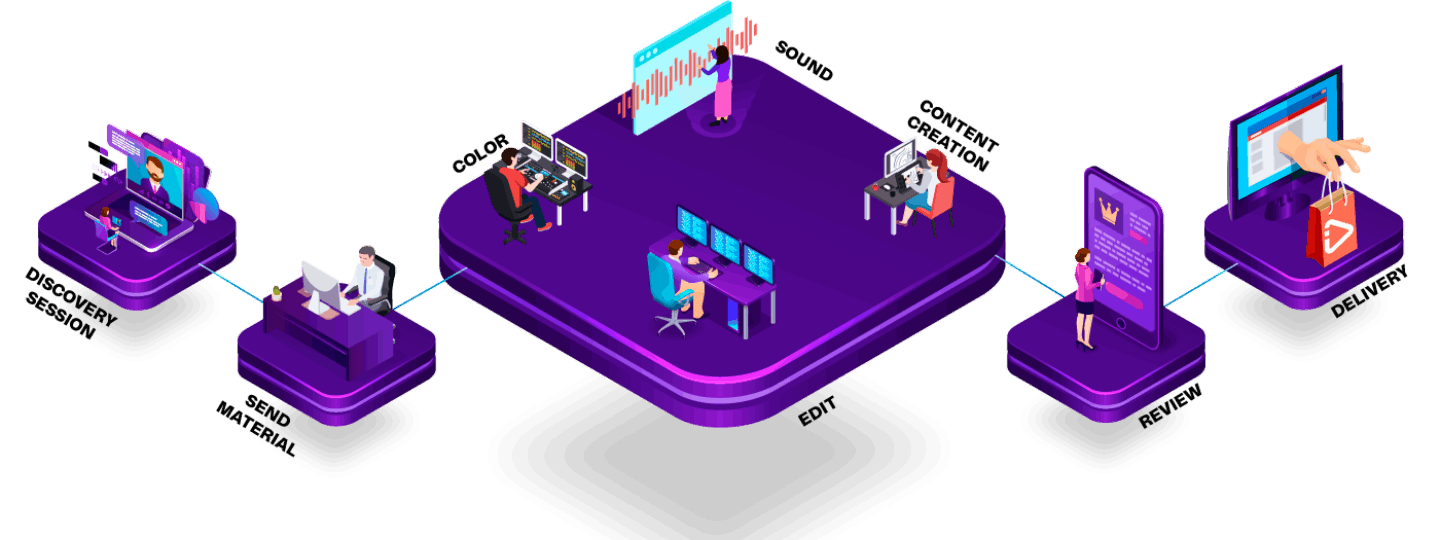
A workflow is what lets you publish every week without heroics. The version below works for most B2B shows and maps cleanly to what a production partner delivers.
The review step deserves a rule. Name one approver, set one review window, and collect notes in a single document. Scattered feedback across several channels is the most common reason an episode slips. Our guide to video approval workflows explains how to set this up, and our editing turnaround benchmarks help you plan the calendar.
Delivery specs and accessibility
Specs are boring until a platform rejects a file. For the YouTube upload, the platform publishes recommended upload encoding settings that cover the container, codecs and sample rate (the page lists H.264 video, AAC-LC audio at 48 kHz and an MP4 container), and says to upload at the frame rate you recorded. Check the page before you set up your export presets because the guidance is updated from time to time.
Consistent loudness is the other detail that makes an episode feel professional. Broadcasters use the EBU R128 loudness recommendation as a reference for normalizing audio, and most editors aim for a consistent level across episodes in the same spirit. Agree a target with your editor once and keep it.
Captions are part of production, not an extra. The W3C’s guidance on captions and subtitles explains why accurate captions help people who are deaf or hard of hearing, and they also help every viewer who watches without sound. For B2B shows with technical vocabulary, caption accuracy matters even more, because a wrong term in a caption looks like a wrong claim. We cover this in our video accessibility guide and in caption styles that lift retention.
Distribution across channels
A single recording should leave the building in several forms. The table shows what to publish where and why. Platform rules change, so confirm each one’s current requirements before you build a process around it.
YouTube is not just another feed
YouTube behaves as a search engine as well as a video platform, and it is where long B2B conversations get found. Add chapters so viewers can jump to the question they care about (see YouTube’s guide to video chapters and our chapters and metadata guide). YouTube also documents how to deliver podcasts through an RSS feed, and it notes that an audio-first feed creates a static-image video from your show art, so upload real video for the full effect. If your show carries sponsorships or promotions, YouTube’s guidance says branded content must be declared and comply with its policies, so check this before you publish. For the agency view on moving a show onto YouTube, see our post on a podcast to YouTube agency.
Clips are a distribution strategy, not leftovers
Plan the clips before the recording ends. Ask yourself which two or three claims from this guest your buyers would repeat. Cut each as a standalone piece with captions and a short title. Our podcast clip strategy shows how to turn one episode into a set of assets, and our B2B video content engine guide places that inside a wider content system.
The episode page on your own site
Platforms change their rules, rankings and reach without notice. Your site does not. Give every episode its own page with the embedded video, a short written summary, a full transcript and a list of the main takeaways. This gives search engines text to understand, gives readers an alternative to watching, and keeps an owned record of every guest and claim.
Google’s documentation on video best practices for Search explains how to make videos eligible for video results, including making sure the page is crawlable, the video is easy to find, and structured data describes it. Treat that page as a checklist for each episode page you publish.
How this played out
Emerj, an AI research media company, is a client where accuracy is the product. For a publisher that talks about artificial intelligence with technical audiences, a wrong term or a wrong name is not a cosmetic slip. Their feedback on our quality control was direct: “Your quality control efforts are so clear.” That is the part of production most buyers underestimate, and it is why we treat the review stage and caption accuracy as part of the workflow, not an afterthought. You can see how we describe the work on our case studies page.
Measuring influence, not downloads
Podcast metrics tempt teams into counting downloads and views. For a B2B show those numbers say little about whether the show is working. Measure influence on the deals you care about.
- Ask every new prospect: what did you watch or read before the first call?
- Track reuse: do sales and customer success send episodes and clips to prospects?
- Watch target accounts: are people from your priority companies watching, and how far in?
- Read branded and direct traffic: do they move after a run of episodes?
- Look at guest outcomes: do guests share their episodes, and do the right people see them?
Pick three of these signals, review them monthly and drop any that stop being useful. The aim is to learn which episodes help the sale, then make more of them.
A 30-day launch plan
Treat the first episode as a rehearsal for your process, not a performance. The goal of the first month is a workflow you can repeat, not a perfect episode.
Common mistakes
In-house or with a partner
A small team can run a video podcast in-house with a decent room, a few microphones and an editor who understands the subject. As the cadence rises, so does the work that sits between recording and publishing: syncing tracks, balancing audio, checking terms, cutting clips and packaging each channel. That work competes with the host’s real job.
A production partner earns its place when you want consistent quality and a steady schedule without building the team. If you are comparing options, our guides to choosing a B2B podcast agency and what professional video editing costs help you set expectations, and our complete guide to video for SaaS companies covers the wider picture. At Increditors we work as a strategy-led partner for B2B tech companies: we start from what the show is meant to do for your buyers, then plan, edit and quality-check the episodes around it.
Frequently asked questions
What is podcast video production?
Podcast video production is the full process of planning, recording, editing and publishing a podcast as video, not just as audio. It covers the format and guest plan, the recording setup (cameras, microphones, lighting and remote capture), post-production (multi-camera edit, audio cleanup, captions, graphics), and distribution of the full episode, clips and transcript across the channels where your buyers actually are. Editing is one stage of it; setup and distribution are the other two.
What do I need for a basic video podcast setup?
At minimum you need a dedicated microphone for each speaker, a camera for each speaker at eye level, even front lighting, a quiet room, and a way to record each person locally so a bad connection does not damage the file. Add a simple branded background and a run of show. For remote guests, record locally on their side and sync the files afterwards instead of relying on the call recording. Audio quality matters more than camera quality: viewers forgive a modest picture much sooner than muffled sound.
Do B2B companies need a video podcast studio?
No. A video podcast studio is a convenience, not a requirement. A quiet, treated room with consistent lighting and fixed camera positions gives you most of the benefit, and it keeps the look consistent from episode to episode. A dedicated studio makes sense when you record often, host in person with guests, or want a repeatable set. Many B2B teams start with a small corner of the office or a rented space and move later, once the show has proved it is worth the investment.
Where should a B2B video podcast be published?
Publish the full episode as video on YouTube, distribute an audio feed through your podcast host for listening apps, put each episode on your own website with a transcript, and cut clips for LinkedIn and other social feeds. Each channel serves a different job: YouTube for search and long watching, the audio feed for commuters and background listening, the website for ownership and search, and clips for reach. Check each platform’s current video podcast requirements before you commit, because they change.
How is this different from podcast video editing services?
Editing is the middle of the process: taking raw recordings and turning them into a finished episode and clips. This guide covers the whole chain around it: how to set up the recording, how to run the workflow, and how to distribute for a B2B audience. If you only need to understand editing costs or compare editing providers, our posts on podcast video editing cost and the best podcast video editing services go deeper on those questions.
How long does it take to produce a video podcast episode?
It depends on the length of the recording, the number of cameras, how much graphic and caption work the episode needs, and how quickly your team reviews. A clear approval step with one named reviewer prevents most delays. Set expectations with your production partner before the first episode, and plan the review window into your publishing calendar instead of treating it as an afterthought.
Verdict
B2B podcast video production is a system, not a camera purchase. Get the room and microphones right, run a simple workflow with one named approver, and plan distribution across video, audio, a site page and clips before you record. Measure whether the show helps real deals, not how many downloads it gets. If you want a second opinion on your format, your setup or your first five episodes, book a call below.
Planning a B2B video podcast?
Tell us about your show and your buyers, and we will tell you honestly how we would set it up and run it.