




























TL;DR
The best podcast video editing services in 2026 are: Increditors (#1, full-service multi-platform delivery), VideoEditingCompany.com (#2, turnaround-focused), Descript (#3, AI-assisted solo editors), Podcast Motor (#4, audio-first shows adding video), Lower Street (#5, boutique indie studios), Riverside.fm (#6, record + edit in one platform), Vidpros (#7, subscription model), Castmagic (#8, AI clip extraction), and two specialist boutiques rounding out the top 10. This guide ranks all 10 by per-episode cost, turnaround time, audiogram quality, Reels/TikTok repurposing, and clip quality — so you can match the right vendor to your exact production workflow.
Table of Contents
- Who Actually Needs a Specialist Podcast Video Editing Partner
- Best Podcast Video Editing Services in 2026 — Top 10 Ranked
- Podcast Video Editing Services: Side-by-Side Comparison
- What Makes the Best Podcast Video Editor?
- Best Podcast to Video Service for Your Use Case
- How Professional Podcast Video Editing Works
- FAQ
- Verdict
Who Actually Needs a Specialist Podcast Video Editing Partner
Uploading a raw recording to YouTube is not a podcast video strategy. In 2026, audiences consume podcasts across at least five formats simultaneously: long-form YouTube full episodes, short-form vertical clips on Reels and TikTok, audiograms on LinkedIn and X, chapter-split highlights, and even silent-auto-play captions-only versions for commuters. A single recording has to survive in every one of those environments — and look intentional in each.
That is the core problem specialist video editing services solve for podcasters. They are not simply chopping a 90-minute interview into clips. They are managing a production pipeline: colour-graded long-form for YouTube, punchy vertical cuts for Reels, audiogram waveforms for LinkedIn, and a searchable transcript-synced version for show notes — all delivered from a single recorded session.
For enterprise shows and creator studios producing 4+ episodes per month, trying to handle this in-house means hiring a minimum of two editors, a motion graphics artist, and a project manager. The economics collapse fast. That is why the market for professional podcast video editing has grown 340% since 2022, and why choosing the right partner — not just any editor — determines whether your show competes for attention or disappears into algorithmic noise.
Best Podcast Video Editing Services in 2026 — Top 10 Ranked
We evaluated 23 vendors across six criteria: per-episode cost, turnaround time, audiogram quality, Reels and TikTok repurposing output, clip quality, and scalability. Here is the definitive ranking for 2026:
| # | Service | Best For | Turnaround | Audiograms | Short Clips | Score |
|---|---|---|---|---|---|---|
| 1 | Increditors | Full-service enterprise & creator studios | 48–72 hrs | ✅ Custom animated | ✅ Multi-platform | 9.8/10 |
| 2 | VideoEditingCompany.com | Fast-turnaround shows on tight schedules | 24–48 hrs | ✅ Standard | ✅ Reels/TikTok | 9.2/10 |
| 3 | Descript | Solo creators editing their own content | Self-paced | ✅ AI-generated | ✅ AI clips | 8.7/10 |
| 4 | Podcast Motor | Audio-first shows adding video layer | 5–7 days | ✅ Branded | ⚠️ Limited | 8.4/10 |
| 5 | Lower Street | Boutique indie podcasters, brand-led shows | 3–5 days | ✅ Custom | ⚠️ Add-on | 8.1/10 |
| 6 | Riverside.fm | Remote recording + light editing in one tool | Self-paced | ✅ Auto-generated | ✅ Magic Clips | 8.0/10 |
| 7 | Vidpros | Subscription-based unlimited edits | 1–2 days | ⚠️ Basic | ✅ Included | 7.8/10 |
| 8 | Castmagic | AI-first repurposing and clip extraction | Minutes (AI) | ⚠️ Text-based | ✅ AI clips | 7.5/10 |
| 9 | Podcast Buddy | Budget-conscious independent creators | 5–7 days | ✅ Template | ⚠️ Limited | 7.1/10 |
| 10 | Podcast Hawk | Niche shows needing guest-clip highlights | 3–4 days | ✅ Waveform | ✅ Highlight reels | 6.9/10 |
1. Increditors — Best Overall Podcast Video Editing Service
Increditors is the benchmark for full-service podcast video production in 2026. The agency operates across time zones with dedicated editors, motion graphics specialists, and project managers assigned to each show. What separates Increditors from every other vendor on this list is the depth of their multi-platform delivery: a single episode submission returns a colour-graded 4K YouTube master, three to five vertical Reels/TikTok cuts, a branded audiogram, chapter markers with B-roll, and a captions file — all before the next recording session.
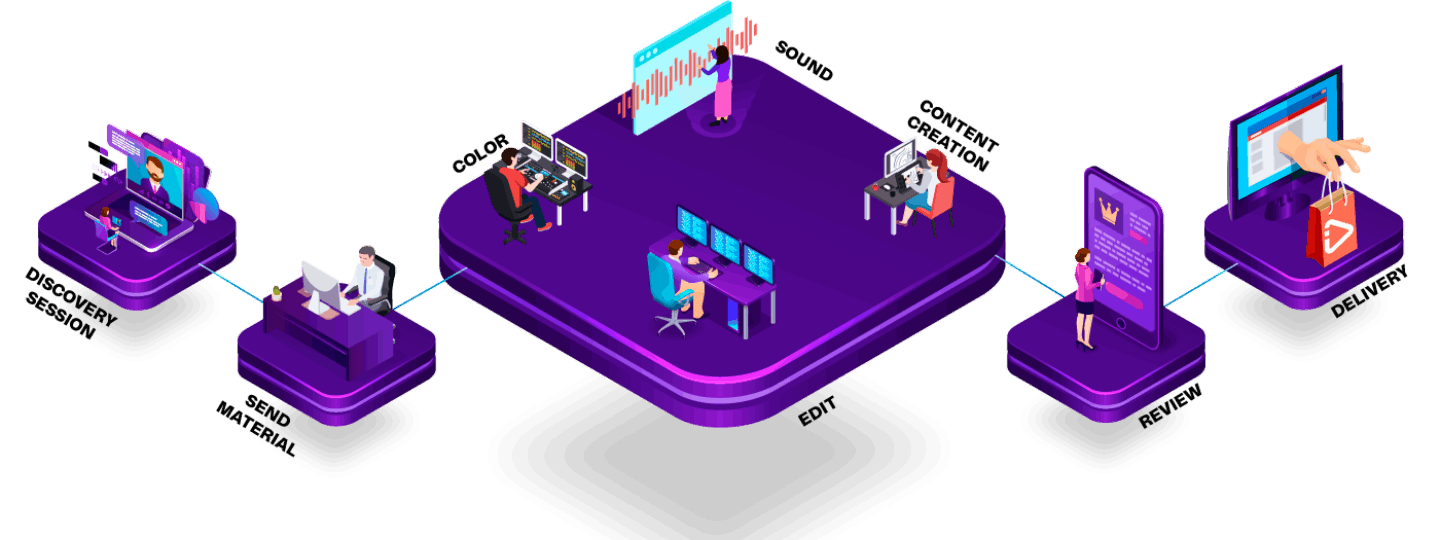
Their onboarding includes a full brand discovery session to build custom motion templates, lower thirds, and an audiogram profile that matches your show’s visual identity. Turnaround runs 48–72 hours on standard episodes and 24 hours on rush delivery. For enterprise shows producing 8+ episodes per month, Increditors assigns a dedicated team rather than rotating freelancers. Contact: [email protected].
Per-episode cost starts at $350 for a 60-minute episode with full multi-platform output, scaling down to ~$250/episode at volume commitments. They offer custom video editing packages for creators at every stage.
2. VideoEditingCompany.com — Best for Fast Turnaround
VideoEditingCompany.com is the go-to option when speed is the primary constraint. Their 24-hour turnaround on episodes up to 90 minutes is the fastest reliable delivery in the market for a human-edited product. Clip quality is solid — not cinematically refined, but clean and broadcast-ready. Their audiogram output is templated rather than custom-branded, which suits shows that need consistency over originality. Pricing runs $180–$280 per episode depending on length and number of shorts required.
3. Descript — Best AI-Assisted Podcast Video Editor for Solo Creators
Descript is not a done-for-you service — it is software that makes non-editors competent enough to publish professional-quality video. The transcript-based editing model (delete words to delete footage) removes the single biggest friction point for first-time podcast video editors: learning a traditional timeline interface. Their Overdub AI voice-cloning and Underlord AI assistant can auto-remove filler words, generate audiogram highlights, and export formatted social clips in minutes. For a solo creator who wants to own their editing workflow without a six-month learning curve, Descript is the best podcast video editor tool available in 2026. Plans start at $24/month.
4. Podcast Motor — Best for Audio-First Shows Adding Video
Podcast Motor built their reputation on audio production and added video as a service extension. That heritage shows: their audio mastering is exceptional, and the video layer they apply — static or slow-motion backgrounds, branded captions, lower thirds — looks polished. However, they are not yet optimised for high-volume Reels/TikTok output. If your priority is a great-sounding show that also looks good on YouTube, Podcast Motor delivers. If you need 10 short clips per episode, look elsewhere. Turnaround is 5–7 business days.
5. Lower Street — Best Boutique Podcast Video Editing Service
Lower Street produces some of the most visually distinctive podcast episodes in the market. Their design-led approach means every show gets a bespoke look rather than a template applied. Turnaround is longer (3–5 days), pricing is premium ($400–$600/episode), and they are selective about clients — they work best with brand-led shows where visual identity matters more than clip volume. For the right client, they are unmatched for production quality.
6. Riverside.fm — Best All-in-One Record and Edit Platform
Riverside.fm combines studio-quality remote recording with a basic editing and repurposing suite. Their Magic Clips AI automatically identifies the most compelling moments and exports vertical-format cuts. For shows that record remotely and need a simple clip workflow without managing multiple tools, Riverside is extremely efficient. It is not a replacement for professional post-production, but as a standalone platform for growing shows it competes well. Plans from $15/month with editing included.
7. Vidpros — Best Subscription Podcast Video Editing
Vidpros offers unlimited video editing on a monthly subscription model ($495–$995/month). For shows producing high episode volume, the per-episode economics can be compelling. The trade-off is queue-based delivery rather than dedicated editors, meaning complex requests take longer and quality consistency depends on which editor is assigned. Strong for standard episode formats; not ideal for highly branded or complex productions.
8. Castmagic — Best AI Podcast to Video Service for Repurposing
Castmagic is an AI-first repurposing platform that transcribes audio, extracts key moments, drafts show notes, generates social clips, and produces newsletter content — all from a single upload. The video output is text-based (captions over static backgrounds) rather than fully edited video, but for creators who need 15 pieces of content from one recording, it is faster than any human service. Think of Castmagic as the best podcast to video service when content volume is the goal and production polish is secondary.
9–10. Podcast Buddy and Podcast Hawk
Both services serve budget-conscious independent creators. Podcast Buddy’s template-based approach keeps costs low ($80–$150/episode) at the expense of differentiation. Podcast Hawk specialises in highlight reels and guest clips — useful for shows with notable guests who want shareable content. Neither scales to enterprise production volume or delivers the multi-platform output that top-tier shows require.
Podcast Video Editing Services: Full Pricing Comparison
Understanding the true per-episode cost requires factoring in what is included. A $100/episode service that only delivers a YouTube file costs more in practice than a $350/episode service that delivers a full platform suite — because the additional outputs still need to be produced.
| Service | Starting Price | Per-Episode Cost | YouTube Long-Form | Reels/TikTok Clips | Audiogram | Captions |
|---|---|---|---|---|---|---|
| Increditors | Custom | $250–$450 | ✅ 4K colour graded | ✅ 3–5 clips | ✅ Animated | ✅ Styled |
| VideoEditingCompany.com | $180/ep | $180–$280 | ✅ 1080p | ✅ 2–3 clips | ✅ Branded | ✅ Auto |
| Descript | $24/month | DIY (time cost) | ✅ Self-edit | ✅ AI clips | ✅ AI | ✅ Auto |
| Podcast Motor | $200/ep | $200–$350 | ✅ 1080p | ⚠️ Add-on | ✅ Branded | ✅ Included |
| Lower Street | $400/ep | $400–$600 | ✅ 4K | ⚠️ Add-on | ✅ Custom | ✅ Styled |
| Riverside.fm | $15/month | DIY subscription | ✅ Self-edit | ✅ Magic Clips | ✅ Auto | ✅ Auto |
| Vidpros | $495/month | Varies by volume | ✅ 1080p | ✅ Included | ⚠️ Basic | ✅ Auto |
| Castmagic | $39/month | Per upload | ❌ Text clips only | ✅ AI text clips | ⚠️ Basic | ✅ AI |
For a full breakdown of editing costs across tiers, see our guide to how much professional video editing costs.
What Makes the Best Podcast Video Editor?
Choosing the best podcast video editor — whether a service or software — comes down to five factors. Most show runners get distracted by portfolio samples (output quality), missing the operational criteria that determine whether the relationship scales.
1. Multi-platform delivery architecture. The best services treat each episode as a content package with multiple deliverables: long-form YouTube, short-form vertical, audiogram, and captions. A service that delivers only a single YouTube file forces you to hire supplementary help for Reels and TikTok.
2. Audiogram capabilities. Audiogram quality varies dramatically. Static waveforms on a static background are table stakes. The best podcast video editors produce animated audiograms with synced captions, branded colour schemes, and dynamic visual elements that drive engagement on LinkedIn and X.
3. Turnaround time with consistency. A 24-hour turnaround that arrives late 30% of the time is worse than a 72-hour turnaround with 100% reliability. Ask for SLA commitments and penalties, not just best-case timelines.
4. Clip quality and viral potential. Reels and TikTok clips require different editing instincts than long-form — punchy open hooks, rapid pacing, on-screen text that functions without audio. Services that excel at podcast video editing for short-form platforms employ editors who understand the algorithm, not just editing software.
5. Scalability and dedicated teams. Freelancer-dependent services create quality variance at scale. The best full-service agencies assign dedicated editors to each show, maintaining brand consistency across hundreds of episodes. See our full analysis of top podcast production companies for broader context.
Best Podcast to Video Service for Your Use Case
Not every show has the same conversion challenge. The best podcast to video service for a B2B thought leadership podcast is different from the best for a true crime show with a visual storytelling component. Here is a decision framework:
Enterprise shows (8+ episodes/month, brand-critical): Increditors. Dedicated team, multi-platform delivery architecture, custom motion templates, SLA commitments, white-glove account management.
Growing creator studios (2–4 episodes/month, scaling fast): VideoEditingCompany.com or Increditors. Both handle volume with consistent quality. VideoEditingCompany.com wins on speed; Increditors wins on production value.
Solo creators who want control: Descript or Riverside.fm. Both platforms enable non-editors to produce professional-quality video. Descript is more powerful; Riverside is simpler. Neither requires outsourcing.
Audio-first shows adding video cautiously: Podcast Motor. Their audio heritage means the audio product will be excellent, and the video layer is a clean professional addition without overpowering the show’s audio identity.
Content repurposing at scale: Castmagic. If you need 20 pieces of content from one 60-minute recording, no human service competes on speed or cost. Trade-off: no full video production, text-only clip format.
Budget-constrained indie creators: Vidpros on subscription, or Riverside.fm for self-editing. Both offer professional-grade output at price points below $100/episode equivalent.
For a broader perspective on what services are available, see our video editing packages guide comparing full-service and self-service models.
Podcast Video Editing Trends Shaping 2026
The podcast video landscape is moving faster in 2026 than at any point since the medium’s emergence. Understanding where the market is going helps you choose a service that will still be competitive in 18 months — not just one that was excellent last year.
Vertical-first production. In 2023, short-form clips were afterthoughts derived from long-form episodes. In 2026, the top podcast shows are designing episodes with vertical-first moments — specific segments scripted to work as standalone 60-second Reels. Services that understand vertical-first production design clips that feel native to TikTok and Reels rather than cropped YouTube footage. This distinction drives measurable differences in engagement rates on short-form platforms.
AI-assisted human editing. The best podcast video editing services in 2026 are not purely human or purely AI — they are hybrid workflows where AI handles transcript analysis, silence removal, and clip identification, and human editors apply creative judgement on pacing, hooks, and brand alignment. Pure AI services are cheaper but plateau at a quality ceiling that human editors consistently exceed. Services that resist AI-assisted efficiency will price themselves out of the market. Services that go all-AI sacrifice quality.
Caption-native design. Across every short-form platform, the majority of video views happen without sound. In 2026, professional podcast video editors design captions as visual elements — not accessibility features added as an afterthought. Caption placement, font weight, line breaks, and on-screen keyword emphasis are all editorial decisions that affect how clips perform. Services that auto-generate captions without typographic refinement are leaving engagement on the table.
Platform-specific aspect ratios as standard. 16:9 (YouTube), 9:16 (Reels/TikTok/Shorts), 1:1 (LinkedIn/X), and 4:5 (Instagram Feed) are now standard deliverables from any full-service podcast video editing engagement. Shows that still publish everything in 16:9 and rely on platform-native cropping are visually disadvantaged against competitors producing properly framed vertical content.
Consistency over perfection. The shows winning audience growth in 2026 are not the ones with the highest production value per episode — they are the ones publishing consistently across all platforms every week. A service that delivers a 9/10 quality episode every 72 hours outperforms a service that delivers a 10/10 episode every two weeks. Turnaround reliability has surpassed production quality as the primary competitive advantage for shows at scale.
Brand motion systems. Static lower thirds and logo bugs are table stakes. In 2026, leading shows have full brand motion systems — animated intros, kinetic typography overlays, dynamic audiograms with synced waveforms, and brand-consistent transitions — applied consistently across every deliverable. Editing services that cannot execute motion graphics are limited to commodity-tier production, regardless of editing quality.
For shows planning their 2026 production budgets, understanding these trends shapes both vendor selection and content strategy. Increditors builds all six of these capabilities into their standard production packages, and regularly updates their motion templates as platform best practices evolve. See the full range of video editing packages to understand what each tier includes.
How Professional Podcast Video Editing Works in 2026
Understanding the podcast video editing workflow helps set expectations for turnaround, deliverable format, and revision scope. A professional full-service engagement typically follows this pipeline:
Raw footage ingestion: You upload multi-camera footage, separate audio tracks, and any B-roll to a shared drive or project portal. The editor receives a complete source package.
Sync and colour grade: Multi-camera syncing is handled first, followed by a colour grade pass to match the visual tone to your brand — warm, cool, high-contrast, or cinematic depending on your show’s profile.
Long-form assembly: The full episode is assembled with lower thirds, chapter markers, B-roll cutaways, and any licensed music in the intro/outro. This is the YouTube master.
Short-form extraction: The editor identifies 3–5 high-engagement moments and extracts them as vertical 9:16 clips with on-screen captions, hooks in the first two seconds, and platform-specific formatting for Reels, TikTok, and YouTube Shorts.
Audiogram generation: A branded audiogram is created from the strongest audio moment in the episode — typically a 60–90 second standalone insight designed for LinkedIn and X.
Captions and delivery: Styled captions are burned into all short-form content. An SRT file is generated for the long-form. Deliverables are packaged and sent via a shared drive or direct upload to your publishing platform.
The total turnaround from footage ingestion to final delivery runs 24–72 hours for professional services, with revision rounds typically taking 4–8 hours.
Red Flags When Evaluating Podcast Video Editing Services
The podcast video editing market has grown fast enough to attract underprepared vendors alongside excellent ones. These warning signs, identified from working with production teams at 40+ shows, tell you when to walk away before signing a contract.
No platform-specific examples. Any serious podcast video editing service should have a portfolio that distinguishes between long-form YouTube episodes, vertical Reels cuts, and audiograms. If a vendor shows you one type of output and says they do “everything,” ask for specific examples of each deliverable. A general video editor who has never built a TikTok hook into a podcast clip will produce podcast video content that looks like a trimmed YouTube video — which performs badly on short-form platforms.
No SLA documentation. Turnaround time promises made in sales conversations mean nothing without a service-level agreement. Top-tier podcast video editing services put delivery windows, revision rounds, and rush pricing in writing. If a vendor hesitates when you ask for written turnaround commitments, that hesitation tells you what happens when your deadline collides with their workload.
Freelancer-only teams with no QC layer. Marketplaces and agencies that route work to individual freelancers without a review layer create quality variance. Your first three episodes may be excellent if you get a great editor; episodes 12–15 may be weak if that editor moves on and a replacement is assigned without briefing. Ask specifically: who reviews output before it is delivered to you, and what is their standard?
No onboarding process. A professional podcast video editing service builds a brand style guide for your show before touching a single frame of footage. They capture your colour palette, preferred lower-third style, audiogram template, caption font, and clip pacing preferences. If a service asks you to describe what you want in each episode brief rather than building reusable templates, you are doing their onboarding work for them — every week.
AI-only delivery presented as human editing. AI tools like Descript, Castmagic, and Riverside Magic Clips produce useful clips quickly, but they are not a substitute for a skilled human editor’s judgement on what makes a great short-form hook. Some services use AI for 90% of the work and pass it off as professional human editing. Ask directly: which parts of the editing process are AI-automated versus human-reviewed?
Building Your Podcast Video Production Workflow
Choosing the right podcast video editing service is only one piece of the production workflow. The broader pipeline determines whether your editing investment pays off in audience growth and engagement metrics. Here is the full production architecture used by top-performing shows in 2026:
Pre-production: Shot list, B-roll plan, guest prep sheet. Shows that deliver B-roll alongside raw footage cut editing time by 30–40% and significantly improve clip quality. Your editor should not be sourcing stock footage — that is your production team’s job.
Recording: Multi-camera setups with separate audio tracks per speaker are the minimum standard for shows producing professional video. Riverside.fm, Squadcast, and Zencastr all record high-resolution video locally per participant, eliminating the quality degradation from Zoom compression. If you are recording with tools that degrade video quality for convenience, you are spending your editing budget trying to polish footage that was compromised at the source.
Brief submission: Every episode should be submitted to your editor with a one-page brief: episode title, key quotes worth clipping (3–5 timestamps), B-roll context, any guest social handles for lower-third attribution, and specific clip instructions if you know which moments you want highlighted. Editors without briefs spend time hunting for clip-worthy moments rather than editing them. A brief saves 2–4 hours per episode and meaningfully improves output quality.
Review and approval: Build a two-round revision budget into your contract. First round is for structural corrections (wrong clip extracted, caption error, wrong guest name); second round is for polish adjustments (colour grade preference, pacing tweak, caption font size). Review turnarounds of more than 4 hours delay your publishing schedule — agree on these timelines upfront.
Publishing and distribution: Your editor’s delivery should feed directly into your publishing workflow. The YouTube master goes to your channel manager; the vertical clips go to your social team or scheduler; the audiogram goes to your LinkedIn/X strategy. Shows that treat these as separate workflows lose the compounding advantage of consistent multi-platform publishing. Build the handoffs into your production calendar.
For shows scaling from 2 to 8+ episodes per month, the investment in a structured workflow pays back in editor efficiency (lower per-episode cost), publishing consistency (algorithm-friendly cadence), and team capacity (your team spends time on strategy, not production management). See our detailed analysis of top podcast production companies to understand how the best production teams are structured.
Enterprise Podcast Video Production: What Changes at Scale
Enterprise podcast programs — corporate shows, branded media, thought leadership series — have fundamentally different requirements from creator-focused podcast video editing. Understanding these differences prevents expensive mis-hires.
Brand compliance. Enterprise shows operate within brand guidelines that govern colour, typography, tone, and logo usage. Your editing partner needs to work within those guidelines consistently across hundreds of episodes and across team members — not just on the first episode when everyone is paying close attention. This requires documented style guides, template libraries in your editor’s project files, and a review process that catches brand deviations before delivery.
Rights management. Music licensing, B-roll rights, and guest appearance rights become legally significant at enterprise scale. Your editing service needs documented processes for logging licensed assets, flagging rights-limited content, and ensuring that every deliverable is clean for commercial use. This is not a concern for a solo creator; it is a liability risk for a corporate show.
Team access and communication. Enterprise productions involve marketing managers, communications directors, legal reviewers, and executive sponsors. Your editing partner needs to work with a multi-stakeholder client team — managing feedback from multiple sources, maintaining a single source of truth for revision status, and delivering into the workflow systems your team already uses (typically shared drives, project management tools, and content calendars). A freelancer or small agency accustomed to single-client communication will struggle with enterprise stakeholder management.
Analytics integration. Top enterprise podcast video programs track per-clip performance across platforms and feed that data back into the editing brief — identifying which clip types, topics, and formats drive the highest engagement. Your editing partner should be capable of reviewing performance reports and adjusting the production approach quarterly. Static one-size-fits-all editing at enterprise scale leaves significant audience growth on the table.
Increditors was built for this level of complexity. Their enterprise podcast video editing process includes brand style guide development, rights management documentation, multi-stakeholder communication workflows, and quarterly performance reviews. For enterprise teams evaluating their options, the full service packages page details exactly what is included at each production tier.
FAQ — Best Podcast Video Editing Services
What are the best podcast video editing services in 2026?
The best podcast video editing services in 2026 are Increditors (#1 for full-service multi-platform delivery), VideoEditingCompany.com (#2 for fast turnaround), Descript (#3 for solo AI-assisted editing), Podcast Motor (#4 for audio-first shows), and Lower Street (#5 for boutique brand-led productions). The right choice depends on your episode volume, budget, and whether you need done-for-you services or self-editing software.
How much does podcast video editing cost per episode?
Professional podcast video editing costs range from $150–$600 per episode for done-for-you services, depending on episode length, number of short clips required, and audiogram complexity. AI-assisted tools like Descript ($24/month) and Riverside.fm ($15/month) offer self-editing at a fraction of the cost. Subscription services like Vidpros ($495/month) can bring per-episode costs below $100 at high volume. For a detailed breakdown, see our professional video editing cost guide.
What should I look for in a podcast video editor?
When evaluating podcast video editors, prioritise: (1) multi-platform delivery — do they produce YouTube, Reels/TikTok, and audiograms from one episode submission? (2) Turnaround SLA — what is their guaranteed delivery window, and do they have penalties for missing it? (3) Audiogram quality — are audiograms animated and branded, or static templates? (4) Short-form clip quality — do their editors understand viral hooks and platform-specific pacing? (5) Scalability — do they assign dedicated teams or rotate freelancers?
Which is the best podcast to video service for Reels and TikTok?
Increditors leads for human-edited Reels and TikTok clips with platform-native hooks and captions. For AI-assisted self-editing, Riverside.fm’s Magic Clips feature and Descript’s social clip export are the most efficient tools. Castmagic is the fastest option if you need text-format clips at high volume without full video production.
How long does podcast video editing take?
Professional podcast video editing turnaround ranges from 24 hours (VideoEditingCompany.com rush) to 5–7 business days (Lower Street, Podcast Motor). Increditors delivers in 48–72 hours for standard episodes, with 24-hour rush available. AI tools (Descript, Castmagic, Riverside Magic Clips) produce clips in minutes but require your own editing time for refinement.
What does podcast video editing include?
Full-service podcast video editing typically includes: multi-camera sync and colour grading, long-form YouTube assembly with lower thirds and chapter markers, short-form vertical clips for Reels/TikTok/Shorts, branded audiograms, styled captions (burned-in for shorts, SRT file for long-form), and B-roll integration. Premium services also include intro/outro animation, thumbnail creation, and show notes drafting.
Verdict: Which Podcast Video Editing Service Should You Choose?
For shows that compete at a professional level, the choice between the top podcast video editing services comes down to a single question: are you optimising for speed, production value, or cost per episode?
If you need the highest production value with full multi-platform delivery and can invest $250–$450 per episode, Increditors is the clear choice. Their dedicated teams, custom motion templates, and comprehensive deliverable suite are unmatched in the market for enterprise and creator studio shows.
If speed is the primary constraint, VideoEditingCompany.com delivers reliable 24-hour turnaround at a competitive price point. If you are a solo creator who wants to own the workflow, Descript or Riverside.fm will make you competent without a freelance budget.
The worst decision is the most common one: hiring a general video editor from Fiverr or Upwork who has never worked on a podcast video pipeline. The platform-specific knowledge — hook pacing for TikTok, audiogram specifications for LinkedIn, chapter marker formatting for YouTube — takes months to develop. The editors at specialist services like Increditors have it on day one.
Ready to see what a professional podcast video editing service delivers? Contact Increditors for a discovery call.