































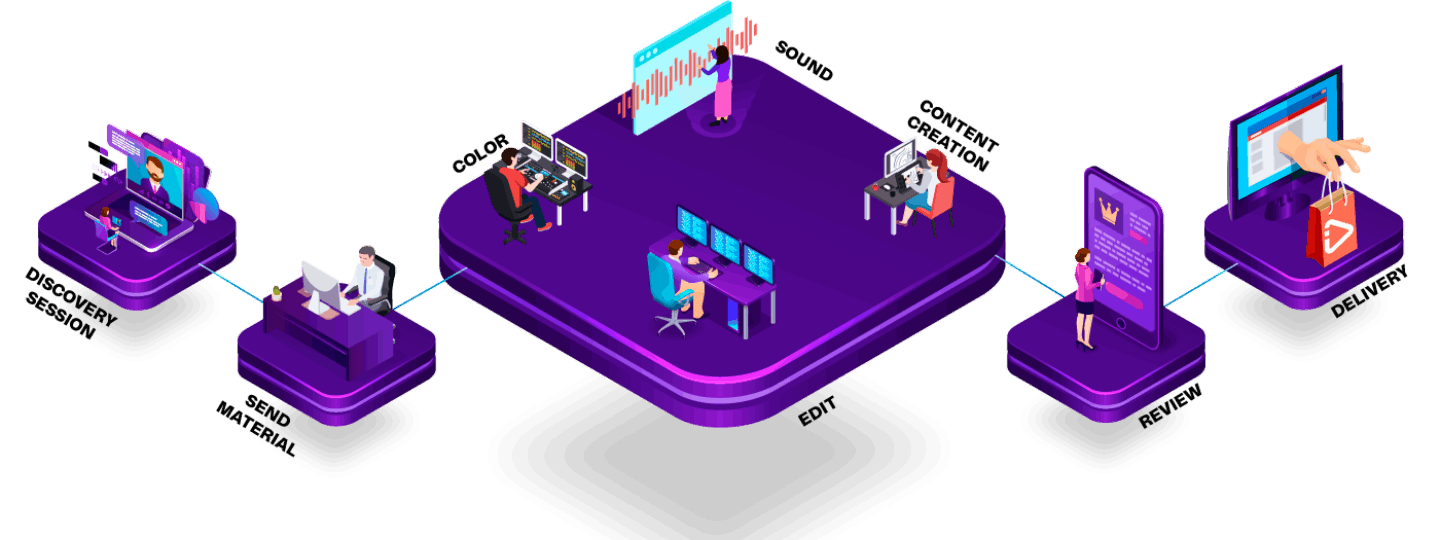










Editing turnaround times vary widely by video type — social clips commonly come back in 24–72 hours, while corporate testimonials typically take 3–7 business days, and long-form documentary cuts can stretch 2–6 weeks. This guide breaks down realistic benchmarks for every major format, explains the variables that shift those windows, and shows you how to structure briefs and workflows so you consistently hit your publish schedule.
- Why Turnaround Time Matters More Than Most Teams Realize
- How Editing Turnaround Benchmarks Are Actually Measured
- Turnaround Benchmarks by Video Type
- Variables That Shift Editing Timelines
- Freelancer vs Agency vs In-House: Turnaround Compared
- How to Get Faster Turnaround Without Sacrificing Quality
- FAQ: Editing Turnaround Benchmarks
- Verdict
Why Turnaround Time Matters More Than Most Teams Realize
Video editing turnaround time is one of the most consequential yet least benchmarked metrics in content production. Marketing teams routinely track click-through rates, view durations, and conversion percentages — but rarely maintain a clear picture of how long their video pipeline actually takes per format. That gap creates real business problems: missed launch windows, rushed revision cycles, and content calendars that look achievable on paper but collapse under production reality.
Turnaround time is also one of the primary reasons teams switch video editing agency partners. According to Wistia’s research on how teams manage video production, the single most common operational pain point for marketing teams producing video at scale is timeline unpredictability — not creative quality, not cost. Teams can absorb a higher price for reliable delivery windows; they struggle far more with editors who commit to timelines they cannot consistently meet.
The challenge is that “editing turnaround” means something different depending on the format. A 15-second Instagram Reel should not take the same pipeline as a 12-minute YouTube deep-dive or a 3-minute corporate testimonial cut to a polished broadcast finish. When teams treat all video as a single category, they inevitably under-allocate time for complex formats and waste buffer days on simple ones — both of which damage output quality and team efficiency.
This guide exists to fix that. We have pulled together realistic industry benchmarks for every major video format, drawn from production workflows, published platform data, and the operational experience that comes from running a high-volume post-production pipeline across hundreds of client projects. Every number in this guide is presented as a range or illustrative benchmark — because any source claiming exact universal turnaround figures is either fabricating them or describing a single, narrow workflow context.
How Editing Turnaround Benchmarks Are Actually Measured
Before diving into format-specific numbers, it is worth being precise about what “turnaround time” means — because two agencies quoting the same number might be measuring completely different things.
Clock-start and clock-stop definitions
The most common ambiguity is when the clock starts. Some editors count from the moment they receive raw footage. Others count from when they receive a completed brief. A few count from when the project is officially assigned to an editor (which can be days after footage delivery if there is a queue). For benchmarking purposes, the most useful definition is: time from complete asset handoff (footage + brief + assets) to delivery of the first cut. Everything before that is pre-production; everything after is the revision cycle.
First cut vs final delivery
Many turnaround discussions conflate first-cut delivery with final approved delivery. These are distinct milestones. Industry practice commonly separates them: the raw editing turnaround ends at first-cut delivery, and the revision cycle is tracked separately (typically 1–3 rounds, each adding 1–3 business days depending on scope). The benchmarks in this guide refer to first-cut turnaround unless otherwise specified.
Business days vs calendar days
Always clarify whether a quoted turnaround is in business days or calendar days. A “3-day turnaround” that means business days is actually 5 calendar days if it straddles a weekend — a material difference for social media publishing schedules. Reputable post-production partners quote in business days explicitly and flag when calendar-day commitments are available (typically at a rush rate).
💡 Pro Tip: When requesting a turnaround quote, always specify (1) whether you mean first cut or final delivery, (2) whether revisions are included in the window, and (3) whether you need business days or calendar days. Three teams quoting “5 days” might mean three entirely different things.
Turnaround Benchmarks by Video Type
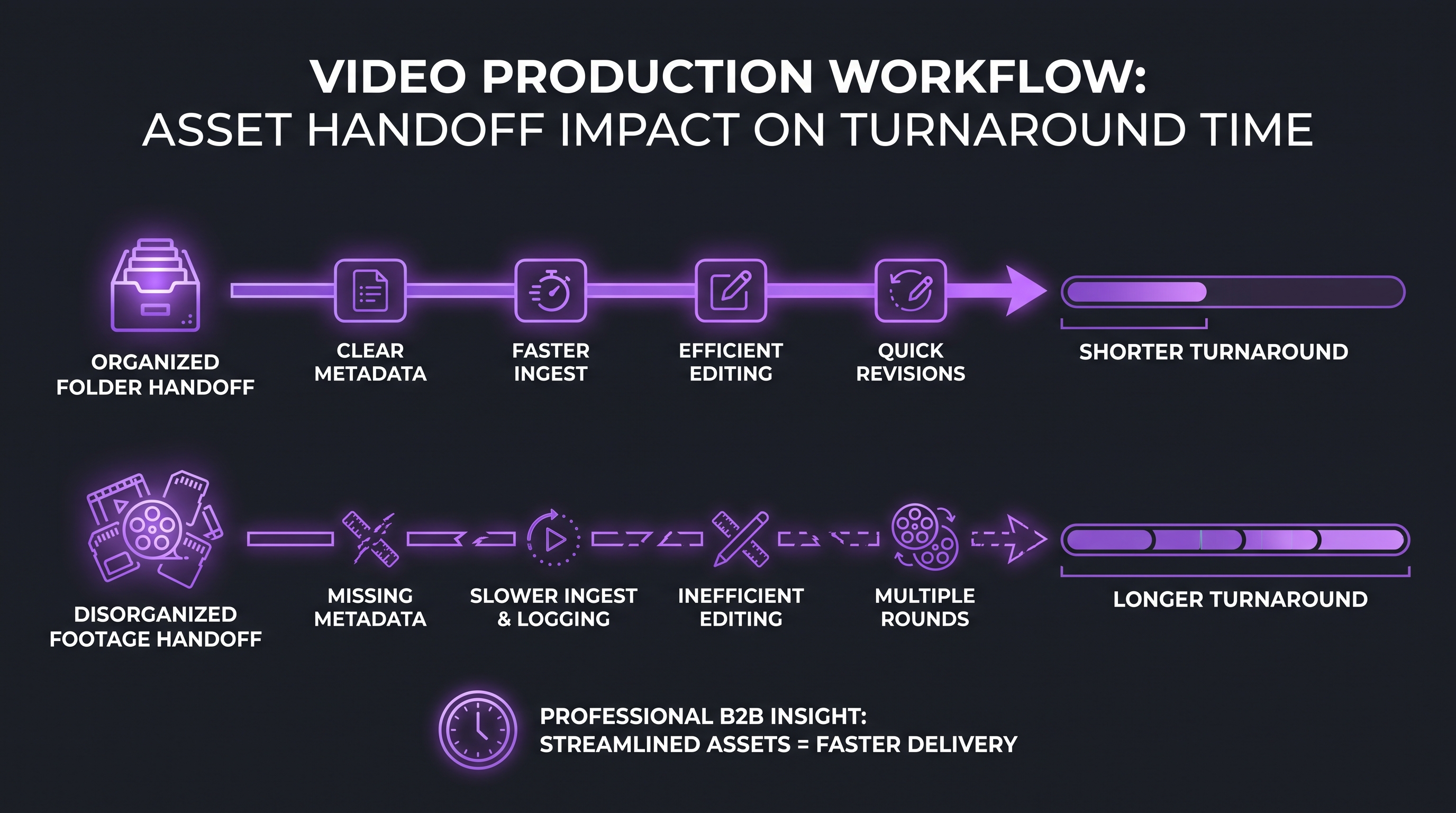
The ranges below reflect what professional editing teams — from skilled freelancers to structured agencies — commonly deliver for each format. They assume complete, well-organized asset handoffs. Disorganized footage, missing briefs, or unclear approval chains can easily double these windows.
Social Media Clips and Short-Form Reels (15–90 seconds)
Short-form social content represents the highest-volume format for most marketing teams and benefits from the most streamlined editing workflows. When a team has an established motion graphics template, an organized clip library, and a clear brief, experienced editors commonly return first cuts within 24–48 hours. For batch orders of 5–10 clips from the same shoot, 48–72 hours is a realistic window for the full batch.
The wild card for short-form content is motion graphics complexity. A talking-head clip with captions and basic color grading is structurally simple. The same clip with animated lower thirds, custom transitions, and platform-specific aspect ratio exports for four channels simultaneously is a different editing task entirely. Motion graphics add 4–8 hours per asset depending on complexity — teams should budget accordingly.
Explainer Videos and Product Demos (2–5 minutes)
Explainer and product demo videos occupy the middle ground of the complexity spectrum. They are longer than social clips and often carry more brand-critical messaging, but they are also highly structured — typically narration-driven with screen recordings, motion graphics overlays, or animated sequences. This structure makes them more predictable to edit than narrative or documentary content.
A live-action explainer (talking head plus b-roll) from an organized brief commonly comes back in 3–5 business days for a first cut. Fully animated explainers are a different beast: while the “editing” phase may be shorter, the overall post-production timeline extends because each scene must be built, not assembled from footage. Realistic timelines for animated explainers commonly run 7–14 business days for a first draft, depending on animation complexity.
Understanding how much professional video editing costs for explainer formats also helps clarify the relationship between budget, turnaround, and revision rounds — faster first cuts often reflect a higher base rate rather than a more efficient process.
Corporate Interview and Testimonial Videos (3–8 minutes)
Corporate testimonials and interview-format videos are among the most common types produced by B2B marketing teams, and their turnaround times are frequently underestimated. The editing task is not technically complex — but it is editorially demanding. A strong testimonial editor must find the story within the interview, select the most credible and emotionally resonant moments, structure a narrative arc, and match b-roll to specific phrases. That editorial judgment takes time that raw clip-trimming does not.
Teams commonly see first cuts on 3–5-minute testimonials in 3–5 business days from an experienced editor with a complete asset package. Longer interviews (60+ minutes of raw footage for a 6–8 minute final) require additional selection time and often run 5–7 business days. Multicamera shoots with separate audio channels add 4–8 hours for sync work before the editorial cut begins.
💡 Pro Tip: For multicamera interview shoots, have your editor review the raw footage and create a selects reel before the full editorial pass. This adds roughly half a day but dramatically compresses the actual editing timeline by giving the editor a pre-curated palette of usable clips — it’s a net time-saver on anything over 45 minutes of raw footage.
YouTube Long-Form Content (8–20 minutes)
YouTube long-form content sits at the intersection of entertainment and information, and audience expectations have significantly raised the production bar. According to Vidyard’s video benchmark research, viewer drop-off patterns show that retention is heavily influenced by pacing and production quality in the first two minutes — which means the editorial decisions in the opening sequence carry outsized weight. That editorially demanding opening adds time to the first-cut process even when the rest of the video is relatively straightforward.
Realistic first-cut turnaround for a 10–15 minute YouTube video from well-organized footage commonly runs 5–8 business days from a skilled editor. For channels that require custom motion graphics, animated chapter markers, and keyword-optimized thumbnail coordination, that window extends to 7–10 business days. Creators publishing multiple times per week typically maintain a rolling queue with a dedicated editor rather than working on a per-video basis — the per-video turnaround compresses significantly when an editor knows the channel format intimately.
For YouTube-specific post-production best practices and the case for dedicated editing support, the best video editing services for YouTube creators guide covers what to look for in an editing partner at different publishing cadences.
Event Recap and Highlight Reels (2–6 minutes)
Event recap videos carry the highest urgency of almost any format — the window of audience relevance is narrow, and teams often need the video published within 48–72 hours of the event itself. That urgency runs directly against the reality of event footage: it is typically unscripted, shot in imperfect conditions with variable audio, and arrives in massive quantities. A two-hour conference might generate 30–60 hours of raw footage across multiple cameras and breakout session recordings.
Event highlight reels that meet a 48-hour post-event delivery require an editor assigned and briefed before the event ends — ideally with a selects pull happening during or immediately after filming. Under those conditions, a 3–5 minute highlight reel from a single-day event is achievable in 24–48 hours. Without that pre-planning, the first-cut turnaround commonly stretches to 4–7 business days as the editor works through the raw footage selection phase.
Documentary and Long-Form Narrative Editing (20+ minutes)
Documentary and narrative long-form editing operates on a fundamentally different timeline than all other formats discussed above. The editorial work is not primarily technical — it is structural and creative. A 20–30 minute brand documentary with 15 interview subjects, archival footage, and a narrative arc built from unscripted responses does not have a clean first-cut turnaround in days. Realistic assembly cut timelines run 2–4 weeks, with the first editor’s cut adding another 1–2 weeks before a director’s cut pass.
Teams that commission documentary-style content without understanding this timeline create upstream problems: they book distribution slots based on short-form turnaround assumptions and then face the choice between delaying the slot or pushing an unfinished cut. The benchmark here is not a limitation of editorial skill — it reflects the irreducible time required for craft-level narrative judgment at this format’s scale.
Variables That Shift Editing Timelines
The benchmarks above assume reasonably favorable conditions. In practice, several variables regularly push turnaround times outside those ranges — some within the client’s control, some within the editor’s, and some structural to the production workflow.
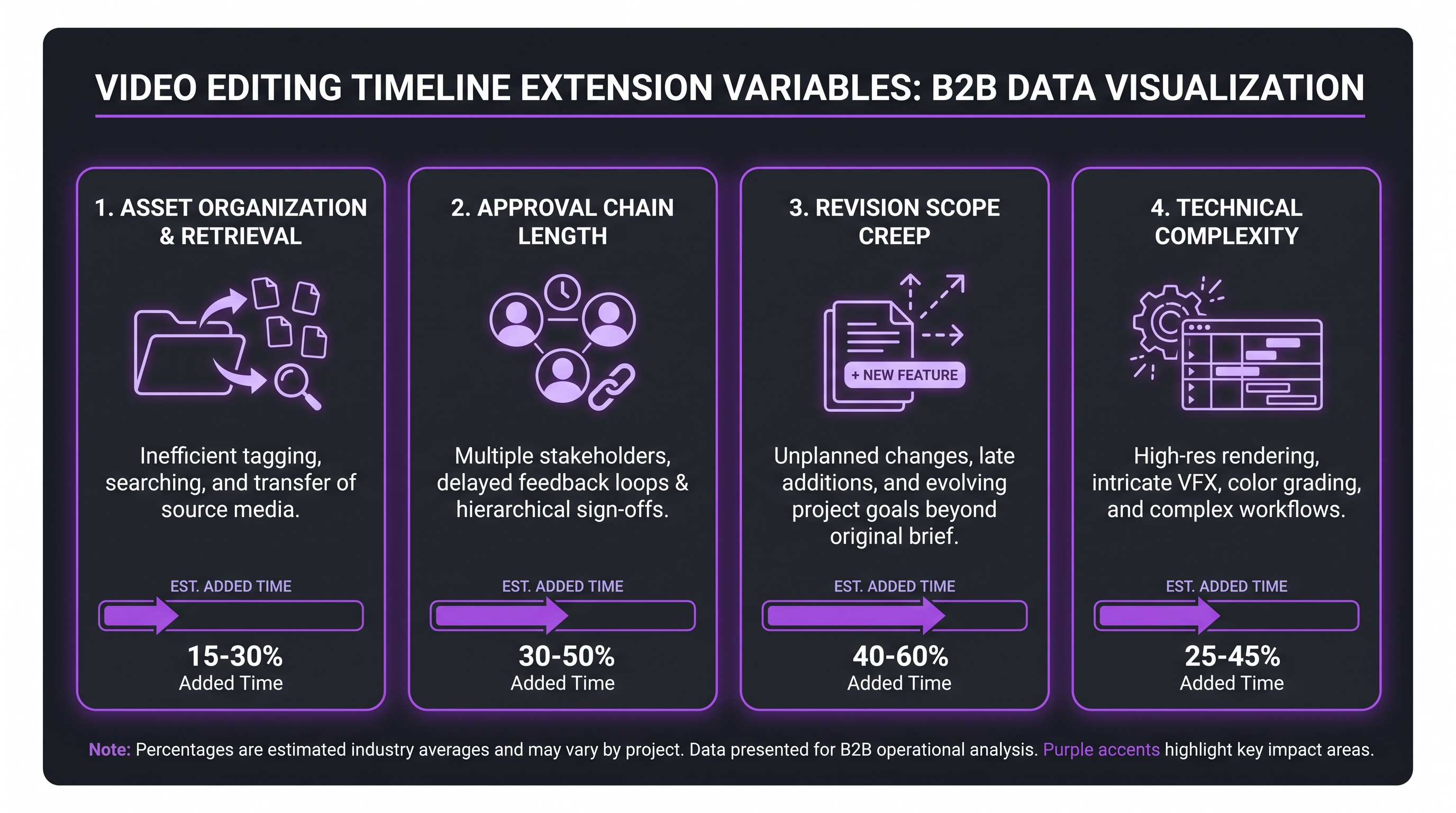
Asset organization and handoff quality
This is the single most consistently underestimated variable. An editor receiving a clearly labeled folder structure with timestamped selects notes, a written brief, reference links, and correctly named audio files can begin editorial work immediately. An editor receiving a hard drive dump of 200 unlabeled clips with a message saying “the good stuff is in there somewhere” faces 4–8 hours of organizational work before any editing begins. Asset quality and organization alone can shift a turnaround by 1–3 business days.
Approval chain length
Internal review and approval workflows add significant calendar time to what should be editing-only turnaround windows. A first cut delivered in 3 business days may sit in a stakeholder queue for 5 more before the editor receives consolidated feedback. HubSpot’s research on marketing team workflows consistently highlights approval bottlenecks as a leading cause of campaign timeline slippage. Structuring reviews with a single consolidated feedback document — rather than sequential approvals from multiple stakeholders — typically cuts the review window by 30–50%.
Revision scope creep
Revision rounds are where editorial timelines most frequently extend beyond original estimates. A revision that changes the color grade on three clips is a 30-minute task. A revision that restructures the narrative order, replaces the music, and requires re-timing all motion graphics elements is a 2–3 day task. Both are often labeled “minor revisions” in client communications. Professional post-production teams define revision scope in contracts precisely because of this ambiguity — clearly categorizing what constitutes a minor tweak versus a structural change protects both the timeline and the relationship.
Technical complexity: audio, color, and effects
Audio remediation, color grading, visual effects, and complex motion graphics each add meaningful time to the editing window. Audio clean-up on problematic location sound commonly adds 2–4 hours per project. A full scene-by-scene color grade (as opposed to a global LUT application) adds 4–8 hours. Custom-built visual effects or 3D compositing can add days. Production teams that plan for these elements from the pre-production phase — rather than discovering them in post — consistently hit shorter overall timelines even when the post-production window itself is longer, because they avoid surprise rework.
Freelancer vs Agency vs In-House: Turnaround Compared
Beyond format-specific benchmarks, the type of editing resource you use significantly shapes what turnaround times are realistic. Each model has genuine strengths and real limitations — understanding them helps teams choose the right resource for each project type rather than defaulting to one model for everything.
For teams producing a mix of high-volume social content and occasional brand-critical long-form projects, a hybrid model often delivers the most resilient turnaround profile. The video editing agency vs freelancer comparison guide examines the trade-offs in detail for teams evaluating which model fits their specific production volume and quality requirements.
What the table above makes clear is that turnaround SLA consistency differs significantly by model. Freelancers can match or beat agency turnaround times when available — but availability is the variable. An editor managing five clients simultaneously has less predictable capacity than a dedicated team member or a structured retainer arrangement. For B2B companies publishing on external launch calendars, that predictability gap is where service model decisions get made.
How to Get Faster Turnaround Without Sacrificing Quality
The most reliable way to compress editing turnaround time is not to push your editor harder — it is to eliminate the friction upstream that slows every project before the editor even opens the timeline. Teams that consistently hit fast turnaround windows share a set of operational habits that are almost entirely about pre-production discipline, not post-production pressure.
Invest in the brief before the shoot
A complete creative brief — with the intended audience, the one core message, the desired emotional tone, the call-to-action, reference videos showing the style, and explicit approval criteria — is worth more than any rush-rate payment for compressing turnaround. Editors working from a complete brief make confident decisions at every cut point. Editors working from vague direction loop through uncertainty and revision cycles that add days to the timeline.
Build selects notes during the shoot
Script supervisors and on-set note-takers exist precisely because their work compresses the post-production selection phase. Even without a dedicated script supervisor, assigning someone to log “circled takes” and “hero moments” during filming — with timecodes if possible — dramatically reduces the footage review time in editorial. For a one-hour interview, a selects list can cut the editor’s review phase from 3–4 hours to under 30 minutes. Multiply that across a five-video batch and the timeline reduction is material.
Centralize feedback before the revision round begins
One of the most common causes of timeline extension is sequential stakeholder feedback — where the marketing director reviews the cut, sends notes, the editor implements them, and then the CEO watches the revised cut and sends a completely different set of notes. The total revision time is identical whether this happens in sequence or in parallel, but the calendar time is roughly double. Designating one consolidating reviewer who gathers all stakeholder feedback before it reaches the editor turns two rounds of revision into one. Tools like Frame.io are purpose-built for this — timestamped, consolidated comments that go directly to the editor rather than a thread of competing email chains.
Use established templates for repeating formats
For teams producing the same format repeatedly — weekly social clips, monthly case study videos, quarterly product demos — established Premiere or DaVinci Resolve project templates with brand colors, font presets, motion graphics templates, and LUT pre-applied deliver a consistent 30–50% turnaround reduction compared to building each project from scratch. The first-time template investment pays back on the second project and compounds across every subsequent one. This is a significant operational advantage of working with a dedicated retainer partner like a premium video editing agency — template libraries are built and maintained as part of the engagement, not invoiced as separate setup fees.
Batch similar content into production runs
Per-project turnaround times compress significantly when similar content is batched. An editor who cuts five testimonial videos in sequence — rather than one testimonial, then one explainer, then two social clips, then another testimonial — builds momentum within the format and avoids the context-switching overhead that fragmenting projects creates. Teams that plan production in format-consistent batches commonly see 20–30% better overall throughput compared to mixed-format queues, according to operational benchmarks from Wistia’s video production research.
FAQ: Editing Turnaround Benchmarks
How long does it take to edit a 1-minute video?
A 1-minute video from well-organized footage with a clear brief commonly takes 2–6 hours of editing time, which typically means a 24–48 hour turnaround window in practice (accounting for editor queue and review time). Videos requiring custom motion graphics, significant color work, or complex audio remediation can take 8–12 hours of editing time for the same one-minute final duration. The editing time is not linearly related to video length — it is primarily driven by footage complexity and the number of cuts, not the finished runtime.
What is a reasonable turnaround for a corporate video?
A 3–5 minute corporate video (interview-based or testimonial format) from complete assets commonly returns a first cut in 3–5 business days with an experienced editor. For a polished final delivery including revisions, budget 7–14 total business days. More complex corporate productions — brand films, multi-location shoots, or animated segments — extend that window. Any quote under 48 hours for a full corporate video without a pre-existing template should be treated with skepticism about the quality level being delivered.
How do I know if my editor is taking too long?
Compare your editor’s quoted turnaround against the format benchmarks in this guide. If they are consistently taking 2–3 times the industry-standard window for a given format, investigate the upstream variables first: was the brief complete? Was the footage well-organized? How complex was the revision scope? If upstream conditions were favorable and turnaround is still significantly outside benchmarks, that is a signal worth a direct conversation about workflow expectations or a resource change.
Can I get same-day video editing?
Same-day editing is possible for short-form content (under 90 seconds) from well-organized assets with a complete brief, assuming the editor has immediate availability. Most professional editors and agencies offer same-day or next-morning delivery at a rush rate, typically 50–100% above standard pricing, depending on the scope. For anything beyond 90 seconds, same-day delivery is only realistic if the project is built on an established template and requires no significant color, audio, or motion graphics work.
Does a retainer agency deliver faster than a per-project freelancer?
On average, yes — but for a specific reason that is often overlooked. A retainer agency delivers faster not because its editors are inherently quicker, but because onboarding has already happened. Brand guidelines, preferred formats, motion graphics templates, approval chains, and feedback protocols are established. Each project benefits from that accumulated context, eliminating the orientation overhead that new-project freelance engagements carry. For teams producing video consistently (more than 4–6 pieces per month), the accumulated context advantage of a retainer model almost always outweighs the per-project cost premium over time.
Verdict: Use These Benchmarks to Set Realistic Production Expectations
Editing turnaround benchmarks are not promises — they are planning tools. The ranges in this guide represent what professional editing teams deliver under reasonable conditions, and understanding them helps teams build content calendars that are honest about what their pipeline can actually produce. The biggest source of turnaround disappointment in video production is not slow editors; it is mismatched expectations between what teams assume and what the format actually requires.
The key takeaways from this guide are straightforward: short-form social content can move in 24–72 hours with the right workflow; corporate and interview formats need 3–7 business days; long-form YouTube and documentary content requires a week or more for a quality first cut. Variables like asset organization, revision scope, and approval chain length can shift any of these windows significantly — in either direction.
For teams that need consistent, predictable turnaround across multiple formats, the retainer model with a dedicated post-production partner delivers the most stable results over time. The accumulated brand context, established workflows, and guaranteed editor availability eliminate the unpredictability that makes freelancer and per-project models difficult to plan around at scale. The unlimited video editing services comparison guide is a useful next step for teams evaluating structured post-production partnerships at different volume levels.
Ready for Video That Actually Converts?
Tell us about your project and we will put together a custom plan.