















































To start a B2B podcast that feeds pipeline, define the one business job the show does, pick a format that fits it, book guests from inside your buyers’ world, commit to a fixed season you can sustain, and record video from episode one. Publish every recording as a full episode, a handful of clips and a written summary, and measure pipeline influence (what prospects watched, what sales reuses) instead of download counts.
To start a B2B podcast that feeds pipeline, treat it as a sales-support asset with a defined audience, not a media launch: choose the job the show does, pick a format, book guests your buyers respect, commit to a season, record video from the first episode and measure influence on deals. Most company podcasts fail because they begin with microphones and a name, and only later ask who the show is for. This guide reverses that order for founders and marketing leads at B2B software, AI and data companies who sell a complex product to a cautious buyer.
How this differs from our other podcast pages: our podcast clip strategy and podcast guest clips guide assume the show already exists and cover what to do with the recordings. This post covers the step before that: whether to launch, what the show should be, who should be on it and how to set it up so the clips are worth cutting. If you already have episodes, start with those two. If you do not, start here.
We write this as a video editing company that edits long-form and short-form video for B2B tech and SaaS companies, including AI, data and deep-tech teams. We are not a booking agency or an ad network, so the advice below is about planning and post-production, which is where we see most shows win or quietly stall.
- Decide what the show is for
- Is a podcast the right move?
- Pick a format
- Book the right guests
- Set cadence and length
- Set up recording the simple way
- Go video-first
- One recording, many outputs
- How this played out
- A repeatable episode process
- Measure pipeline influence
- A 60-day launch plan
- Common mistakes
- In-house or with a partner
- Frequently asked questions
- Verdict
Decide what the show is for
Before a name, a logo or a microphone, write one sentence that finishes this line: “This show exists so that ______ will ______.” The first blank is a specific group of buyers or influencers. The second is an action that matters to the business. If you cannot fill it in, you are not ready to launch.
A B2B podcast typically does one of three jobs. Pick one as the primary, and let the others come along as side benefits.
💡 Pro Tip: If you pick “access”, write down the target-account list first and let it drive guest invitations. A show built for access with guests chosen for convenience quietly stops doing its job.
Is a podcast the right move?
A show is a long commitment, and it is not right for every B2B company. Be honest about four conditions before you start.
- You have something specific to say. A point of view that someone in your market could disagree with is the difference between a show and a feed of interviews.
- You can reach the audience. Founders with a network, a customer community or an existing channel have a head start. A show for a market where you know nobody starts slower.
- You can sustain it. Plan for a season of fixed length. If nobody on the team has the hours, hire the production work or wait.
- Someone owns it. One named owner for strategy, one for guests, one for production. A show owned by “marketing” is owned by nobody.
If two or more of these are weak, put the money into a smaller format first: a short interview series, a recurring founder video or a customer story program. Our B2B thought leadership video guide covers that route, and our B2B video content engine guide shows how to get more out of one recorded conversation.
Pick a format
The format determines production effort, guest dependence and how well the show repurposes into clips. Choose it from the job, not from what your favourite consumer show does.
Match the format to your product
For an AI, data or deep-tech product, the audience usually includes technically literate evaluators. They will notice vague claims, so interview and deep-dive formats where an expert explains a mechanism tend to hold attention better than light commentary. For a workflow tool sold to operations leads, customer story conversations often carry more weight because the buyer wants to hear how someone like them changed a process.
Choose a name and promise that a buyer would recognise
Name the show after the problem or audience, not your company. A buyer scrolling a feed should be able to tell in one line who the show is for and what they will learn. Write a two-sentence description in plain language and test it on someone from the target audience before you commit.
Book the right guests
Guests are the engine of an interview show, and for a B2B company they are also the access mechanism. Choose them by what they do for the buyer, not by how well known they are.
Send each guest a one-page brief before recording: the audience, the topic, three questions, the recording logistics and what you will send them afterwards. Guests who feel prepared give better answers and are more likely to share the result, which is the point of our guest clips guide.
💡 Pro Tip: Record two or three episodes before you publish the first. A small buffer protects the schedule, and you can fix the format after the first conversations without a public track record to undo.
Set cadence and length
There is no universal right answer, and anyone quoting you a precise “ideal” frequency is guessing. The sensible rule is to choose the pace you can hold at a consistent quality for a full season. Define the season up front (a fixed number of episodes), publish on a predictable day, then pause, review and commission the next one.
Length should follow the content. A focused conversation that answers a real buyer question will outperform a padded hour. Plan for episodes long enough to go deep on one idea and short enough that an evaluator will finish one before a call. If an episode contains two ideas, split it into two episodes or two clip sets rather than stretching it.
- Publish on a fixed day so the schedule itself becomes a trust signal.
- Keep a buffer of recorded episodes so travel or illness never breaks the cadence.
- End each season with an honest review: what did buyers mention, what did sales reuse, which topics produced the most replies.
Set up recording the simple way
Buyers forgive modest production but not bad audio. Spend on the microphone and the room, not on a studio.
- A decent microphone per speaker and headphones for the host, so you can hear problems as they happen.
- A quiet, soft room. Hard walls produce echo that no editor can fully remove.
- A remote recording tool that captures each participant locally, so a poor connection does not ruin the file.
- A camera at eye level with a window or soft light in front of the speaker. Good video does not need a cinema rig.
- A shared folder and file naming convention so editors never wonder which file is which.
Hosting and distribution platforms keep changing their features, so check each directly when you set up: Apple Podcasts for Creators, Spotify for Creators and YouTube’s help page on delivering podcasts using an RSS feed describe the current requirements.
Go video-first
The most common regret we hear from teams who started with audio only is that they cannot go back and film the early episodes. Recording video from the first conversation costs little extra on the day and unlocks most of the distribution options later.
What video adds for a B2B show
- A full-length episode that can live on YouTube, where buyers search for explanations of complex tools. Our B2B YouTube benchmarks and YouTube lead generation guide cover why that channel matters.
- Vertical and square clips that sales and the guest can share, the subject of our podcast clip strategy.
- Captions and transcripts that make the content accessible and searchable. The W3C’s guidance on captions and subtitles is a good starting point.
- Visual explanations: when a guest describes a model or workflow, an animated diagram in the edit often does more than another minute of talking.
If you already know you want a YouTube channel built from the show, our podcast-to-YouTube strategy guide explains the channel side, and our podcast-to-YouTube agency guide covers hiring help for it.
One recording, many outputs
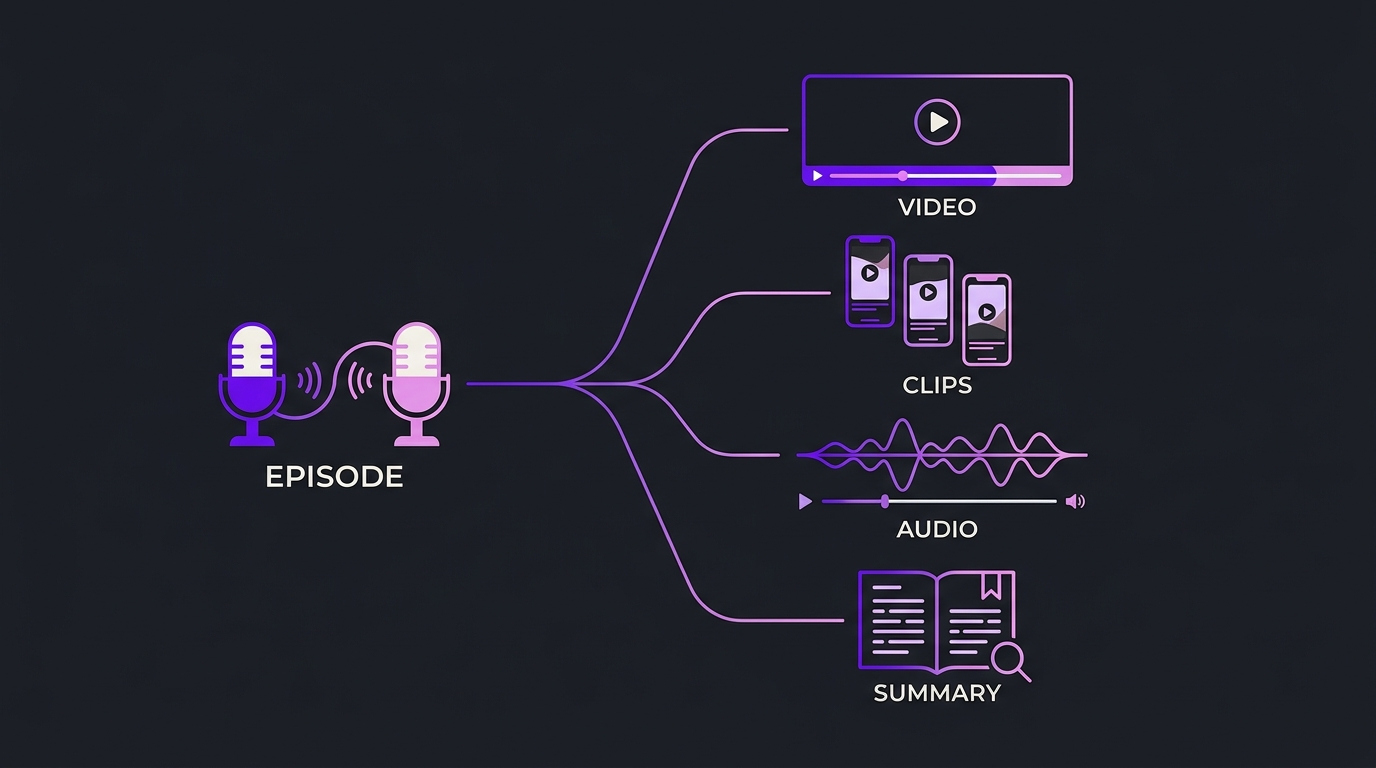
Plan the outputs before you record, because the plan affects how you ask questions and what you capture. A typical output set for a single episode looks like this.
For the full model of turning one recording into many assets, see our guide to what video repurposing is and the B2B video content engine framework. Both treat the recording as raw material for a program, not a one-off deliverable.
How this played out
Emerj, an AI research media company, is a useful reference for what a technical B2B audience expects. It publishes long-form educational content for readers who will notice errors, so accuracy and consistency in post-production are not optional. Emerj has praised how clear our quality control efforts are, which is the part of a production relationship that is easiest to overlook when you are only planning a launch. It is also a reminder for anyone starting a show: the audience you are trying to win is judging the care in the edit as much as the ideas. You can see more in our case studies.
A repeatable episode process
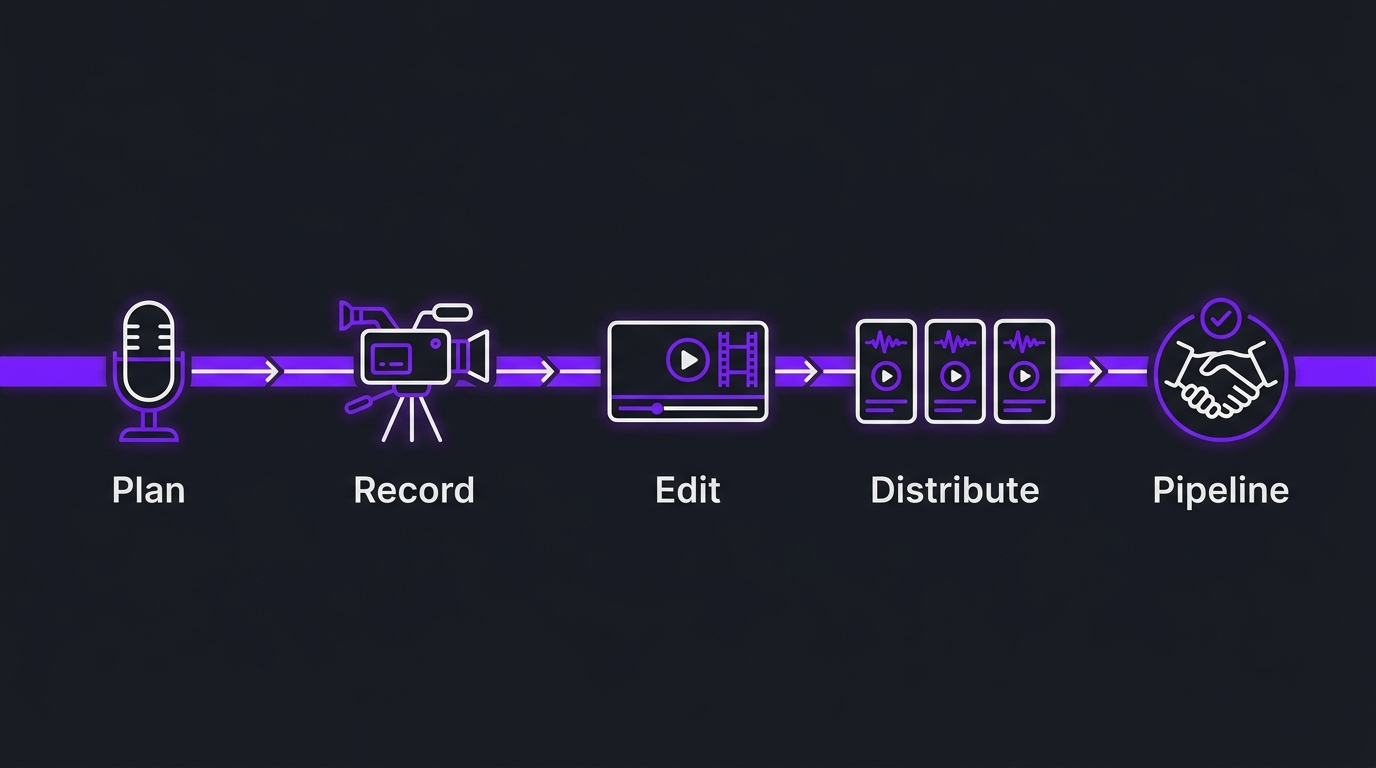
A show survives on process. Define each step once, name an owner, and write the checklist down.
💡 Pro Tip: Treat the review step as a quality gate. For technical shows, a guest or subject expert should confirm product names, terminology and any claim before release.
Measure pipeline influence
Download counts are a weak signal for a show with a small, specific audience. A podcast aimed at a short list of target accounts can be succeeding with a modest audience. Measure the things that connect to deals, and be honest about what you cannot attribute.
Pair these with the qualitative reviews at the end of each season. For benchmarks on how B2B teams approach content generally, the Content Marketing Institute’s B2B research is a reliable independent reference. Whatever you track, avoid inventing precise attribution you cannot defend; a modest honest report is worth more than a dashboard that sales does not trust.
A 60-day launch plan
Common mistakes
In-house or with a partner
A small show can be run in-house with a clear plan. Once you want a steady rhythm, consistent edits, clips and reporting, the production workload starts to compete with the real jobs of the people involved. If you are comparing paths, our guide to choosing a B2B podcast agency and the podcast production company comparison cover the vendor landscape, our podcast video editing guide covers what an editing service does, and our guide to hiring a B2B video editing agency helps with scoping. For general cost expectations, see what professional video editing costs and our complete guide to video for SaaS companies.
At Increditors we are the strategy-led option on the post-production side: we help plan the episode outputs, edit the long-form video, cut the clips and quality-check the result, while your team keeps what only it can supply, the point of view and the guests. If you need booking at scale or ad sales, we will say so and suggest a specialist.
Frequently asked questions
How do you start a B2B podcast?
Start with the job the show must do for the business: reach a short list of target accounts, build authority in a category, or create sales content. Then choose a format that fits that job, book guests who sit inside your buyers’ world, commit to a fixed season length and a realistic cadence, record video from the first episode, and publish each recording as a full episode, short clips and a written summary. Decide how you will measure pipeline influence before episode one goes live.
What makes a B2B podcast different from a consumer podcast?
The audience is small, specific and professional, and the goal is trust and access rather than download volume. A B2B show succeeds when the right people in a category watch or hear it and remember who made it. That changes everything: topic selection, guest choice, episode length, how you measure results and how much weight you put on clips that sales can forward to a single buyer.
How often should a B2B company publish podcast episodes?
Publish at a pace you can keep at consistent quality for a full season. For most small B2B tech teams that means a modest, steady rhythm rather than a daily show. A consistent schedule beats a burst followed by silence, because buyers judge a show partly on whether it is still going. Plan a season of a fixed number of episodes, review what worked, then commission the next one.
Should a B2B podcast be video or audio only?
Record video from the start, even if audio is your primary format. A video recording gives you a full-length episode for YouTube, vertical clips for LinkedIn and email, captions that make the content accessible, and an audio-only version for podcast apps. Recording audio only closes off most of those options, and adding video later means missing the early episodes you cannot re-record.
Do you need a podcast agency to launch?
No. A small team can launch with a decent microphone, a recording tool, a clear plan and a capable editor. An agency becomes worth considering when you want a steady cadence, consistent post-production, clips and reporting without the show becoming a second job for a founder or marketing lead. We cover how to choose one in our guide to hiring a B2B podcast agency.
Is a company podcast the same as a B2B podcast?
A company podcast is any show a company produces. A B2B podcast is one aimed at business buyers, usually in a considered sale where several people evaluate a vendor. Many company podcasts fail because they talk about the company. The shows that work are about the buyer’s problem, and the company’s expertise shows up in how well it explains that problem.
Verdict
A B2B podcast earns its place when it is built backwards from a business job: authority, access or sales content. Choose the job, match the format, book guests from your buyers’ world, commit to a season you can sustain, record video from episode one and publish every recording as an episode, clips and a written page. Measure what prospects mention and what sales reuses. If you want a second opinion on the plan or the first season’s outputs, book a call below.
Planning a B2B podcast and want it to feed pipeline?
Tell us about your buyers and the show you have in mind, and we will tell you honestly how we would plan and produce it.