










![3D Explainer Video - ScribbleLive.mp4_snapshot_00.12_[2022.03.09_03.14.16]](https://increditors.com/wp-content/uploads/elementor/thumbs/3D-Explainer-Video-ScribbleLive.mp4_snapshot_00.12_2022.03.09_03.14.16-r7wb53mx72rxst3qcqyrfxdmeyzb5r9jbl0wbjujh4.png "3D Explainer Video – ScribbleLive.mp4_snapshot_00.12_[2022.03.09_03.14.16]")





























Instagram Reels can generate real B2B results in 2026 — but only when teams ditch vanity metrics and treat the platform as a top-of-funnel brand engine, not a direct-response channel. Educational Reels, founder-led content, and client social proof consistently outperform promotional posts. The highest-leverage move is using Instagram to warm audiences who later convert on LinkedIn or through direct outreach. This guide covers which B2B verticals benefit most, the five content formats that drive pipeline, how to measure results honestly, and when to bring in professional production.
- Why B2B Brands Are Finally Taking Instagram Reels Seriously
- Instagram Reels vs YouTube Shorts vs LinkedIn Video: The B2B Breakdown
- 2026 Instagram Reels Technical Specs Every B2B Team Should Know
- The 5 B2B Reels Content Formats That Actually Drive Pipeline
- The Instagram-to-LinkedIn Conversion Funnel
- Which B2B Verticals Get the Best ROI from Instagram Reels
- Measuring B2B Success on Instagram Reels
- Production Quality: When to DIY and When to Hire
- FAQ
- Verdict
Why B2B Brands Are Finally Taking Instagram Reels Seriously
For most of the platform’s history, Instagram was the domain of D2C e-commerce, lifestyle brands, and influencer culture. B2B marketing teams looked at Instagram and saw a consumer-first environment with no obvious path to pipeline. That calculus has shifted significantly in 2025 and 2026.
The shift is driven by two converging realities. First, Instagram’s algorithm now surfaces Reels far beyond a brand’s existing follower base — a single high-performing Reel can reach cold audiences who have never interacted with your account before. This is structurally different from LinkedIn, where organic reach largely stays within your professional network, or YouTube Shorts, where subscribers and search still dominate discovery for most B2B accounts. Instagram Reels is, for now, one of the few remaining platforms where cold organic reach at scale is genuinely achievable for business accounts.
Second, the professional class is on Instagram. Decision-makers at technology companies, SaaS founders, agency principals, and enterprise marketing directors all use Instagram personally. They may not follow your company there — but if your Reel surfaces in their explore feed, you have a chance to put your brand, your insight, or your founder’s face in front of them at a moment when they are not in defensive “work mode.” That psychological context is the B2B opportunity: Instagram builds familiarity and trust before a prospect ever receives a LinkedIn connection request or a cold email.
The brands making it work are not treating Instagram as a demand-gen channel. They are treating it as a brand authority engine — a place to demonstrate expertise, culture, and results in short-form video, knowing that some percentage of viewers will later encounter the brand on LinkedIn or Google and convert at a higher rate because they already have context. This is the strategic framing that unlocks Instagram Reels for B2B.
💡 Pro Tip: Before planning a single Instagram Reel, define what “working” means for your B2B brand. Profile visits, bio link clicks, and DM inquiries are more meaningful leading indicators than raw view counts for B2B accounts.
Instagram Reels vs YouTube Shorts vs LinkedIn Video: The B2B Breakdown
Each short-form video platform has a fundamentally different audience posture and discovery mechanism. Understanding those differences is what separates B2B brands that get traction from those that repurpose content blindly and wonder why results are mediocre. For a full breakdown of YouTube Shorts strategy for B2B, see our post on YouTube Shorts for B2B Brands in 2026. For LinkedIn-specific video formats and specs, our LinkedIn Video Specs and Best Practices guide covers that ground in detail. This post focuses specifically on what makes Instagram Reels different and what works for B2B brands there.
The takeaway: Instagram Reels and LinkedIn Video are complementary, not competing. Instagram builds brand familiarity at scale; LinkedIn closes that familiarity into professional relationships and pipeline. Teams that understand this stop trying to make Instagram Reels do the job of LinkedIn — and start using Instagram to do what it is uniquely good at.
2026 Instagram Reels Technical Specs Every B2B Team Should Know
Getting the technical foundations right matters more than most B2B teams realize. A video that is cropped wrong, compressed poorly, or has captions cut off by Instagram’s UI is a credibility problem — especially for a brand trying to position itself as a premium service provider. The specifications below reflect Meta’s published guidelines; always verify the current official Reels specs in Instagram’s Help Center before production, as Meta updates these periodically.
For broader channel planning, compare those official specs with Instagram for Business resources, practical publishing guidance from Hootsuite and Sprout Social, and how your Reels hand off into LinkedIn Marketing Solutions when the buying conversation moves from awareness to pipeline.
One specification decision that trips up B2B teams consistently: designing slides or text cards in landscape (16:9) and then re-exporting vertically. The result is usually illegible text, wasted negative space, or a letterboxed video that the algorithm deprioritizes. Design for 9:16 from the start. For B2B brands producing screen recordings, slides, or data visualizations, this means rethinking the asset format at the source, not cropping in post.
💡 Pro Tip: Always add captions (burnt-in or via Instagram’s auto-caption feature). A significant share of Instagram viewers watch with sound off, including decision-makers scrolling during commutes or between meetings. Captions are not optional for B2B Reels.
The 5 B2B Reels Content Formats That Actually Drive Pipeline
Not all Reels content is equally effective for B2B brands. The formats below consistently outperform generic promotional content across technology services, SaaS, professional services, and agency verticals. The common thread is that they lead with value, credibility, or proof — not with a sales pitch.
1. Educational “Did You Know” Reels
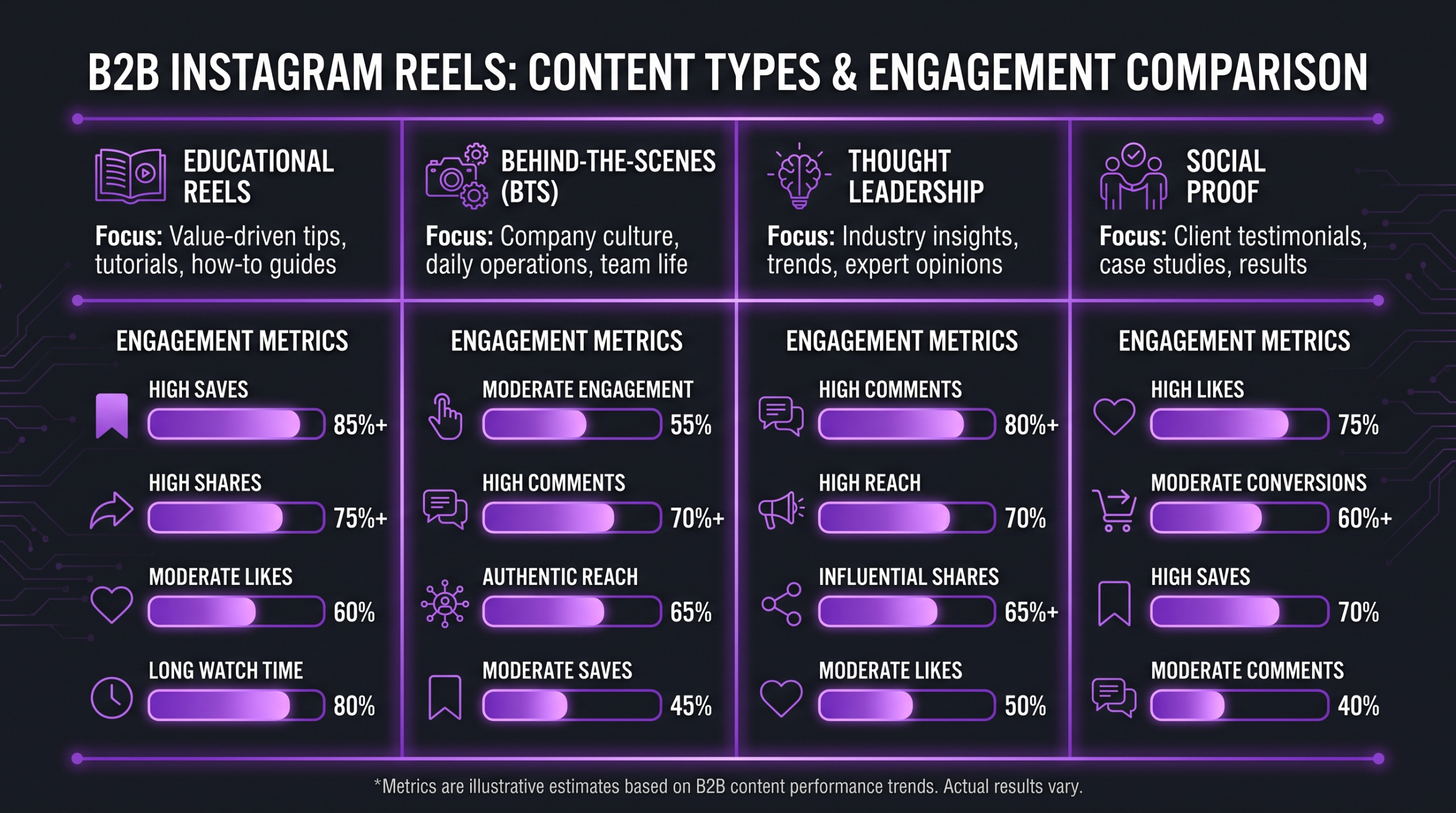
These are 20–45 second Reels that surface a counterintuitive insight, a common misconception, or a quick tactical tip relevant to your prospect’s job. For a video production agency, that could be “The three editing choices that tank your explainer video’s completion rate.” For a SaaS company, it might be “Why your onboarding flow is losing 40% of users in the first session.”
The format works because it is immediately useful to the viewer — they walk away with something actionable even if they never become a customer. That generous value exchange builds trust faster than any promotional content. The hook is critical: the first three seconds must make the viewer feel like they would be a fool to stop watching. “Here’s the mistake every SaaS company makes with their demo video” is a hook. “We’re excited to announce our new video production service” is not.
2. Founder-Led Thought Leadership Reels
A founder or senior practitioner speaking directly to camera about a real challenge in their industry is one of the highest-converting B2B Reels formats. It works because people buy from people, and Instagram’s algorithm actively surfaces personal accounts with strong engagement signals. A founder’s personal account often outperforms a company’s brand account on Instagram, sometimes significantly.
The content doesn’t need to be polished to the point of feeling scripted. In fact, a well-lit, clean-background talking-head Reel with genuine conviction and clear ideas often outperforms heavily produced content because it feels more authentic. The trade-off is that it requires the founder to be willing to be on camera consistently — which is a genuine constraint for many B2B organizations. When the founder is willing, it becomes one of the best brand-building assets available.
3. Client Transformation / Social Proof Reels
Before-and-after Reels showing real client results are powerful for any service business. For video production agencies, this means showing the raw client footage versus the polished final cut. For a SaaS company, it could be a split-screen of a messy workflow replaced by a clean product flow. The visual contrast communicates value faster than any copy can.
These Reels work at every stage of the funnel. A prospect who has never heard of your brand will find a transformation Reel compelling on its own merits. A prospect who is already in your pipeline will treat it as evidence that the purchase decision is low-risk. Make sure you have client permission before featuring their brand, and where possible, use client quotes in the caption or as text overlays rather than making the claims yourself.
4. Behind-the-Scenes / Culture Reels
For B2B service businesses, trust is a primary purchase driver — and trust is built when buyers can see inside the operation. Behind-the-scenes Reels showing your team, your production process, your work environment, or your day-to-day practices demystify what working with your company actually looks like. They also serve a secondary function as recruiting content, which matters for B2B companies competing for senior talent.
The content does not need to be glamorous. A 30-second Reel showing an editor reviewing color grades, a team reviewing a script, or a project manager walking through a creative brief is more persuasive than a polished brand film to a buyer who is trying to assess whether they can trust your team with their project.
5. Product or Service Demo Reels
For SaaS and technology companies, a well-executed 60-second product demo Reel can be a highly efficient top-of-funnel asset. The key is to focus the demo on one specific user problem and show the solution — not to walk through every feature. Reels are not a product tour; they are a proof point. “Here is how [your problem] gets solved in under two minutes” is the frame, even if the Reel is 45 seconds long.
For professional services businesses, the “demo” equivalent is a quick methodology walkthrough, a framework visualization, or a process explainer that shows how you work differently from alternatives. These Reels answer the prospect’s implicit question: “Why should I trust this team with my budget and timeline?”
The Instagram-to-LinkedIn Conversion Funnel
The highest-leverage strategic insight for B2B brands on Instagram in 2026 is that Instagram and LinkedIn work better as a system than as independent channels. Instagram is a brand discovery and familiarity platform; LinkedIn is a professional relationship and conversion platform. When they are managed as a connected funnel rather than separate strategies, B2B brands commonly report significantly higher conversion rates on LinkedIn outreach to prospects who have first encountered the brand on Instagram.
The mechanism works like this: a decision-maker sees your Reel in the Instagram Explore feed, watches it, possibly follows your account or visits your profile, and then moves on. Two weeks later, they receive a LinkedIn connection request from your founder or sales lead. Instead of treating that request as cold outreach from a stranger, they experience it as a follow-up from a brand they already recognize and trust. The LinkedIn conversion rate on that sequence is meaningfully higher than standard cold outreach.
Activating this funnel requires intentional design at each stage:
Stage 1 — Discovery (Instagram Reels): Publish consistently in the content formats above. Prioritize Reels that will resonate with the specific types of buyers you target — by industry, company size, or role. Your Instagram audience should overlap with your LinkedIn ICP.
Stage 2 — Familiarity (Instagram Profile + Bio): Optimize your Instagram bio to make it immediately clear who you help and what outcome you deliver. Include your website link or a Linktree that drives to your key service pages. When a prospect visits your profile after watching a Reel, they should leave knowing exactly what you do.
Stage 3 — Connection (Cross-Platform): Your sales or founder outreach on LinkedIn can reference shared context: “I noticed you’ve been following our Reels on [topic] — thought this might be relevant given your work at [company].” This is not creepy if done honestly; it’s personalization that the prospect will likely appreciate. Use engagement data from Instagram to inform LinkedIn outreach timing and messaging.
Stage 4 — Conversion (LinkedIn + Email): LinkedIn is where the professional transaction happens. Use the brand familiarity built on Instagram to warm up the conversation. The call to action at this stage is a discovery call, a demo request, or a resource download — not a sale.
💡 Pro Tip: Create a shared content calendar across Instagram and LinkedIn so that themes are reinforced across platforms in the same week. If you publish a Reel on “the three mistakes in SaaS onboarding videos,” publish a LinkedIn article on the same topic the following day. The cross-platform reinforcement compounds brand recall.
Which B2B Verticals Get the Best ROI from Instagram Reels
Instagram Reels is not equally valuable for every B2B company. The platform is most effective for verticals where the product or service has a strong visual component, where the buyer persona skews toward entrepreneurial or marketing-oriented professionals, or where personal brand is a meaningful factor in the buying decision. Below is an honest breakdown of where Instagram Reels investment tends to pay off for B2B teams, and where it typically does not.
The honest assessment for enterprise software and manufacturing is not that Instagram is useless — it is that the ROI is primarily in brand reputation and recruiting rather than direct pipeline generation. Marketing leaders at companies in these verticals should set expectations accordingly and weight their investment toward LinkedIn for demand generation while using Instagram selectively for employer branding.
Measuring B2B Success on Instagram Reels
Measuring Instagram Reels performance for B2B requires a different metrics framework than you would use for LinkedIn or paid search. Most of the standard Instagram metrics are vanity-adjacent for B2B — high view counts on a Reel do not directly translate to pipeline, and low view counts on a highly targeted Reel can still result in three qualified conversations. The metrics that matter depend on where Instagram sits in your funnel strategy.
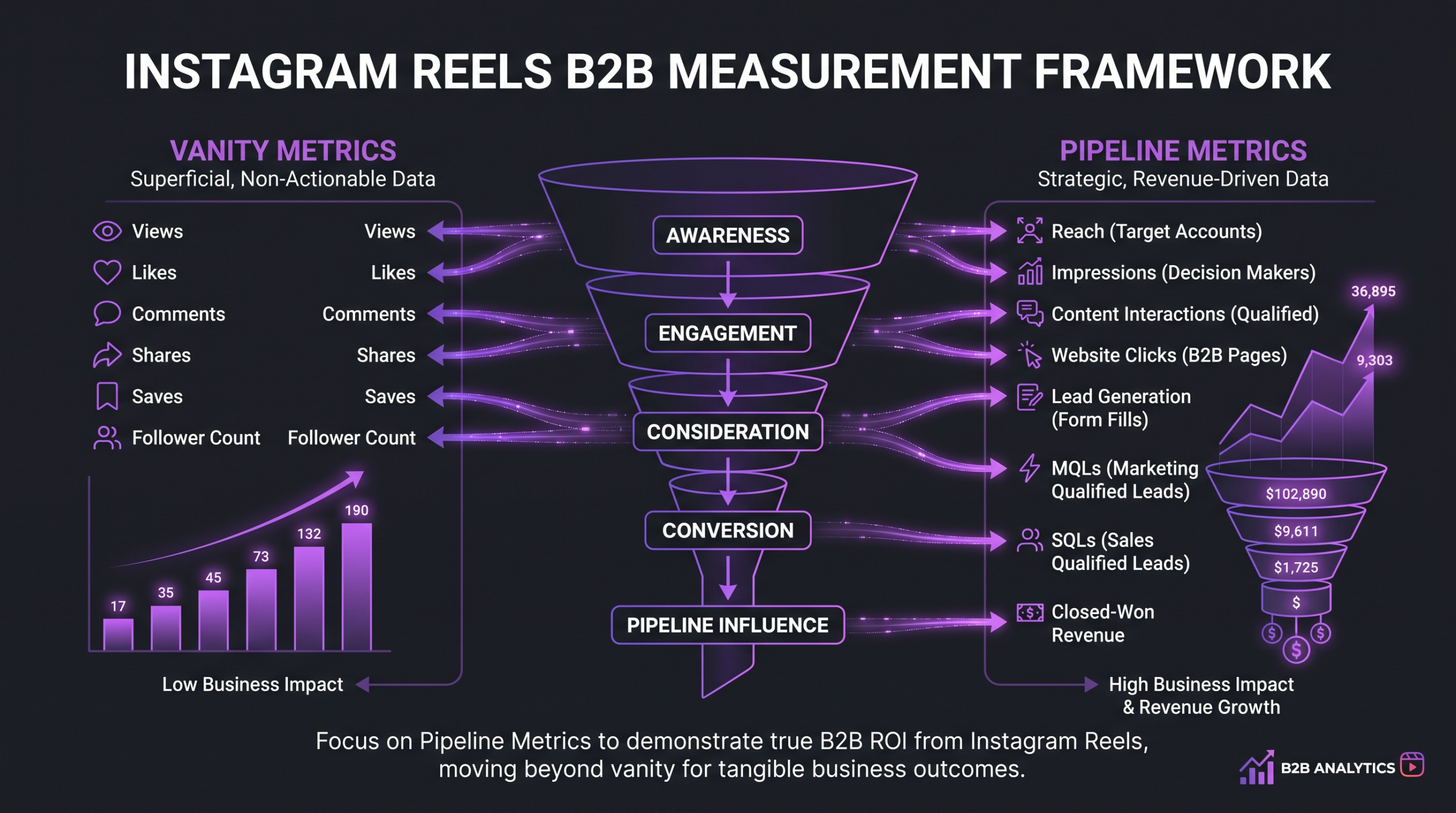
Attribution Across the Instagram-LinkedIn Funnel
The hardest measurement challenge for B2B Instagram Reels is attribution. A prospect who discovered your brand on Instagram and then converted on LinkedIn will almost never be tracked in a way that credits Instagram. Self-reported attribution — asking “how did you first hear about us?” in your discovery call — is often the most practical solution for smaller B2B teams. Over time, patterns in the data will reveal whether Instagram is generating pipeline influence even when it is not generating direct conversions.
For teams using UTM-tagged links in their Instagram bio, website analytics will show Instagram as a source on leads who clicked through. This captures direct attribution. For indirect attribution (prospect saw your Reel, Googled your brand name, and converted via organic search), the signal will show up as branded organic search lift — a metric worth monitoring quarterly once your Instagram volume is meaningful enough to move the needle.
Production Quality: When to DIY and When to Hire
One of the most common questions B2B teams ask about Instagram Reels is how much production quality matters. The honest answer is: it depends on the content type and the brand position you are trying to establish. Authenticity and quality are not opposites — but they do have different thresholds by format.
When DIY or Light Production Works
Founder-led talking-head Reels recorded on a modern smartphone with a ring light and a clean background can perform extremely well — sometimes better than heavily produced versions of the same content. The algorithm does not penalize low production values; it rewards watch time and engagement signals. If your founder has genuine ideas and can communicate them clearly on camera, the ceiling on a well-lit iPhone Reel is high.
Behind-the-scenes content and quick educational Reels similarly benefit from feeling “real” rather than over-produced. A slickly produced behind-the-scenes Reel can paradoxically undermine its own message by looking too polished to be genuine. For these formats, the DIY approach is often the right call.
When to Invest in Professional Post-Production
Client social proof Reels, portfolio showcases, and brand-defining content are areas where professional post-production pays clear dividends. A before-and-after Reel showing a client’s content transformation should look exceptional — because it is literally demonstrating your quality. A sloppily edited social proof Reel undermines the very point it is trying to make.
Similarly, if Instagram Reels is a significant part of your brand strategy and you are publishing three or more per week, the cumulative quality of your feed becomes a brand asset. Inconsistent quality signals inconsistency in your operations — a costly impression for a premium B2B service provider. A video editing agency partner who understands B2B brand positioning can systematize your Reels production — taking raw founder footage and transforming it into polished, on-brand content that maintains consistency at scale without requiring the founder to spend hours in post-production.
The economics of this make sense for B2B teams that have found content formats that work and want to scale output without scaling internal headcount. For guidance on what professional production and editing typically costs at different tiers of engagement, our guide to professional video editing costs breaks down the market honestly.
💡 Pro Tip: A common hybrid approach that works well for B2B brands: the founder records raw talking-head or behind-the-scenes footage on their phone; a post-production partner handles color grading, captions, lower-third text, and audio cleanup. The output feels authentic because the founder IS on camera, but looks polished because a professional handled everything else. This workflow is how SaaS companies with lean marketing teams maintain consistent Reels output without a full-time video team.
A Note on Repurposing from LinkedIn
Many B2B teams try to maximize efficiency by repurposing LinkedIn native videos as Instagram Reels without modification. The result is usually underperformance on both platforms. LinkedIn video is typically landscape or square format; Instagram Reels expects 9:16. LinkedIn audio and pacing conventions (slower, more measured) do not match Instagram’s faster, hook-first expectations. The content strategy may be identical — the production requirements are platform-specific.
The more effective approach: shoot vertically and then derive a landscape cut, rather than shooting landscape and cropping to vertical. This produces usable assets for both platforms without the quality penalty of cropping and zooming a landscape video into a vertical frame. It also reinforces the earlier point about designing 9:16 from the start rather than adapting from 16:9.
FAQ: Instagram Reels for B2B
Do Instagram Reels actually generate B2B leads?
Directly, rarely — Instagram is a discovery and familiarity channel, not a high-intent demand-gen platform. Most B2B leads attributed to Instagram Reels come through indirect paths: a prospect watches your Reel, visits your profile, clicks the bio link to your website, and converts there; or they see your Reel on Instagram and later look up your company on LinkedIn. Direct DM inquiries happen but are typically low volume. The realistic expectation is pipeline influence, not volume lead generation.
How many Reels should a B2B brand post per week?
Starting with two to three per week is a practical baseline for most B2B teams. The algorithm rewards consistency; a predictable cadence of three high-quality Reels per week consistently outperforms irregular bursts of ten followed by silence. Quality matters more than volume — a Reel that generates saves and shares does more for your account’s reach than ten Reels that are immediately scrolled past. For teams just starting out, one or two per week with genuinely strong content is more sustainable and more effective than over-committing and burning out the team.
Should B2B brands use the founder’s personal account or the company account?
For most B2B companies, the founder’s personal account will outperform the company account on Instagram — particularly in the early growth phase. Instagram’s algorithm favors personal accounts that generate strong engagement, and “people buy from people” is more true on Instagram than on LinkedIn. The strategic choice depends on the exit plan: if the business will outlast the founder’s public role, building the company account early is worth the slower growth. Many B2B brands successfully run both simultaneously, with the founder’s account driving awareness and the company account showcasing work and proof points.
What types of hooks work for B2B Reels?
The strongest hooks for B2B Reels share a common structure: they name a specific problem or counterintuitive claim in the first three seconds. “Here’s why your SaaS demo video is costing you trials” is specific, implies useful information, and creates a gap the viewer wants closed. Hooks that start with “Welcome to our channel” or “In today’s video” have already lost. Pattern interrupts also work — an unexpected visual, a bold statement delivered directly to camera, or a surprising statistic framed honestly as an industry benchmark. The hook is the most important creative decision in any Reel; it determines whether the rest of your content gets seen.
Can B2B Reels use trending audio without looking out of place?
Yes, but with judgment. Trending audio can boost reach because Instagram’s algorithm gives some preference to Reels using trending sounds. The filter for B2B brands is: does using this audio make the brand look tone-deaf? A financial consulting firm using an upbeat pop track ironically under a serious point about recession risks will look strange. The same track under an energetic team highlight Reel might work perfectly. Use trending audio when it naturally fits the content’s tone — not as an algorithmic hack that undermines brand credibility. When in doubt, original voiceover or royalty-free music is the safer B2B choice.
Verdict: Is Instagram Reels Worth It for B2B in 2026?
For the right B2B companies — creative services, SaaS, founder-led professional services, and any business with a visual product or strong point of view — Instagram Reels is one of the most cost-efficient brand-building investments available in 2026. The cold organic reach available through Reels is not reliably available through any other channel at comparable cost, and the Instagram-to-LinkedIn conversion funnel is a genuine competitive advantage for B2B teams who build it intentionally.
The critical mindset shift is this: stop measuring Instagram Reels on the same metrics as LinkedIn or paid search. Instagram is a familiarity and trust platform that influences pipeline over weeks and months, not a direct-response channel that generates pipeline in days. Teams that accept that frame and commit to consistent, high-quality content in the formats that actually work — educational, founder-led, social proof, behind-the-scenes, demo — will find that Instagram Reels is a meaningful part of their B2B growth engine. Teams that abandon it after two months because it didn’t generate ten discovery calls will have missed the compounding benefit that consistent Instagram presence builds.
For additional context on platform-specific video strategy, see how B2B brands are using YouTube Shorts for awareness and education alongside Instagram Reels, and review our breakdown of LinkedIn Video specs and formats for the professional network side of the cross-platform strategy. For B2B brands serious about video quality at scale, our team at Increditors works with marketing teams to build and execute video systems that make consistent Reels production sustainable — without requiring an in-house video department. For a comparison of the full spectrum of unlimited video editing services and what each model delivers, that guide covers the options honestly.
Ready for Video That Actually Converts?
Tell us about your project and we will put together a custom plan.