










![3D Explainer Video - ScribbleLive.mp4_snapshot_00.12_[2022.03.09_03.14.16]](https://increditors.com/wp-content/uploads/elementor/thumbs/3D-Explainer-Video-ScribbleLive.mp4_snapshot_00.12_2022.03.09_03.14.16-r7wb53mx72rxst3qcqyrfxdmeyzb5r9jbl0wbjujh4.png "3D Explainer Video – ScribbleLive.mp4_snapshot_00.12_[2022.03.09_03.14.16]")































YouTube Shorts is no longer a consumer entertainment channel — B2B brands that publish Shorts consistently report stronger brand recall, faster pipeline velocity, and measurably lower cost-per-impression than equivalent LinkedIn video spend. This guide covers the 2026 content framework, production workflow, funnel-stage strategy, KPIs, and publishing cadence that B2B marketing teams are using to turn 60-second clips into qualified pipeline.
- Why B2B Brands Are Betting on YouTube Shorts in 2026
- The B2B Shorts Content Framework: 3 Proven Pillars
- Production Workflow for High-Volume B2B Shorts Teams
- YouTube Shorts Strategy by Funnel Stage
- Measuring What Matters: B2B Shorts KPIs
- Six B2B YouTube Shorts Mistakes and How to Avoid Them
- Building a Sustainable Shorts Publishing Cadence
- Frequently Asked Questions
- Verdict
Why B2B Brands Are Betting on YouTube Shorts in 2026
YouTube Shorts has crossed a threshold that B2B marketers can no longer ignore. According to YouTube’s own reporting, the Shorts feed now reaches over two billion logged-in users every month — a figure that rivals the entire reach of LinkedIn and Twitter combined. More importantly for B2B purposes, the demographic shift is clear: the majority of Shorts viewers are 25–44 year-olds, precisely the buying committee members, department heads, and procurement directors that enterprise and mid-market B2B brands target.
The strategic argument isn’t just about audience size. It’s about attention economics. LinkedIn CPMs for video have risen sharply as more B2B brands compete for the same professional feed real estate. YouTube Shorts, by contrast, still represents a relatively uncrowded B2B space — most brand Shorts are consumer-facing, meaning that a B2B brand publishing consistently can own a niche with a fraction of the spend that a LinkedIn campaign would require.
There is also the compounding content asset argument. Unlike a paid LinkedIn post that disappears from feeds within 48 hours, a well-optimised Short lives on your YouTube channel indefinitely. YouTube’s search engine is the world’s second largest — prospects researching a product category months after your Short published can still discover it organically through keyword search, related video suggestions, or the Shorts shelf on mobile. B2B buyer journeys are long; content that compounds in visibility matches that reality far better than ephemeral paid placements.
The B2B Buyer Discovery Pattern Has Changed
Research from Think with Google consistently shows that B2B decision-makers use video at every stage of the purchase journey — from initial problem recognition through to vendor shortlisting. Shorts in particular fits the “snackable research” behaviour pattern: a CFO watching a 45-second breakdown of procurement software ROI while commuting is doing genuine purchase-relevant research, not passive entertainment consumption.
The practical implication: B2B brands that dismiss Shorts as “not serious enough” are ceding that discovery moment to competitors who understand where attention actually lives in 2026.
CPM ranges are illustrative benchmarks based on industry reporting; actual costs vary by targeting, industry vertical, and campaign setup.
The B2B Shorts Content Framework: 3 Proven Pillars
The biggest mistake B2B brands make on YouTube Shorts is repurposing consumer-style entertainment clips and wondering why they don’t convert. B2B Shorts need a different content logic: they are not about viral reach, they are about targeted relevance. The brands seeing measurable pipeline impact in 2026 are organising their Shorts content around three distinct pillars.
Pillar 1: Insight Shorts (The Credibility Engine)
Insight Shorts deliver a single, actionable business insight in under 60 seconds. The format is deliberately narrow: one problem, one stat (hedged and sourced), one practical takeaway. Examples include: “The one metric procurement teams track that most vendors ignore,” “Why SaaS churn spikes in month four — and the video content fix,” or “The pricing page mistake that kills enterprise deals.” These clips position the brand as a category expert without pitching anything directly. They attract the specific audience segment — a VP of Marketing, a revenue operations lead — who is actively researching a problem your product solves.
Insight Shorts work best when they reference verifiable data with appropriate hedging (“published platform benchmarks suggest…”, “enterprise teams commonly report…”) rather than invented percentages. The Wyzowl State of Video Marketing report is an example of a credible public source you can cite and link to in the video description to add E-E-A-T weight.
Pillar 2: Process Shorts (The Trust Builder)
Process Shorts show how something is done inside a real business. For a SaaS brand, this might be a 45-second screen-capture walkthrough of a workflow. For a professional services firm, it’s a consultant narrating a decision framework. For a video production agency, it’s a behind-the-scenes clip of the edit review process. The key is specificity: showing the actual work, not a polished marketing montage.
Process Shorts build trust because they demonstrate competence rather than claiming it. In B2B sales, trust is often the last hurdle before a deal closes. A prospect who has seen 20 of your Process Shorts has effectively completed a free audit of your capabilities before their first sales call. This compresses discovery and builds pre-call confidence in ways that static case study PDFs cannot.
Pillar 3: Objection Shorts (The Pipeline Accelerator)
Objection Shorts address the specific concerns that slow or kill deals. “Is a video editing agency worth it for a 10-person team?” “Can you maintain consistent brand voice across 50 Shorts per month?” “What happens to our content when we pause our subscription?” These are real questions sitting in your CRM’s lost-deal notes. Answering them publicly in a Short does two things: it re-engages prospects who stalled mid-funnel, and it preemptively answers objections for new prospects before they even ask.
💡 Pro Tip: Pull your Pillar 3 topics directly from your CRM. The five most common reasons deals stall or are lost are your five best Objection Shorts scripts. Your sales team will thank you — and so will your pipeline velocity numbers.
Production Workflow for High-Volume B2B Shorts Teams
Consistency is the compounding mechanism in a Shorts strategy. One great Short per quarter will not move a metric. Ten thoughtful Shorts per month, published on a predictable schedule, builds the channel authority and subscriber base that makes each subsequent Short more likely to be recommended. This requires a production workflow, not an improvised approach.
The Batch-and-Ship Workflow
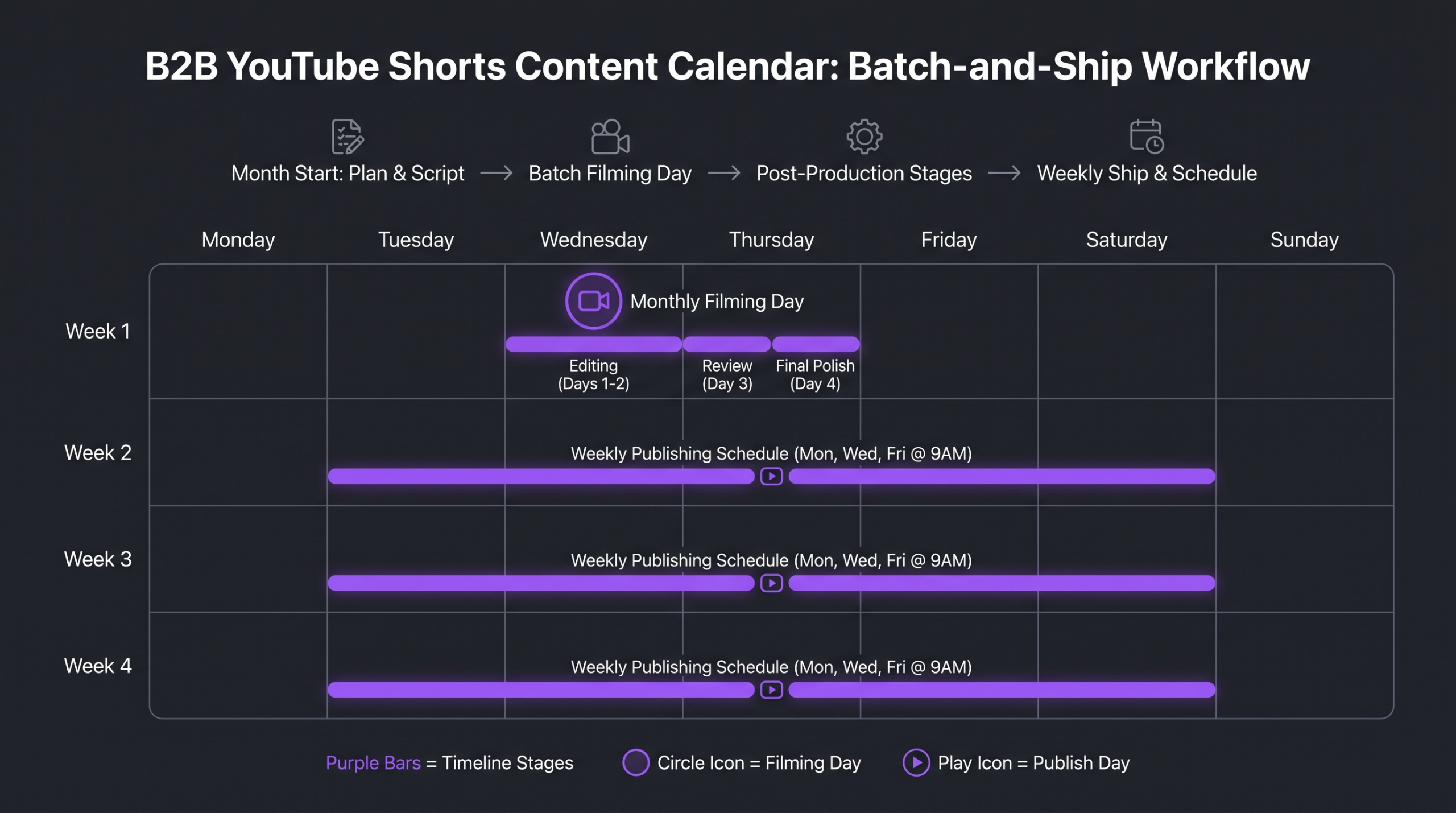
The most efficient approach for resource-constrained B2B marketing teams is the batch-and-ship model. Rather than producing one Short at a time from concept to publish, teams hold a monthly “content sprint” where a subject-matter expert films 8–12 raw clips in one session. The clips are then edited, titled, captioned, and scheduled by the post-production team across the month.
A typical B2B Shorts batch workflow looks like this:
Choosing Between In-House and Agency Post-Production
The post-production phase is where most B2B Shorts programmes stall. Internal marketing teams are rarely resourced to deliver consistent, on-brand editing at volume — especially when Shorts editing requires platform-specific skills like vertical framing optimisation, caption styling for mobile-first viewing, and motion graphics that read in under three seconds.
Working with a specialised video editing agency solves the throughput and quality consistency problem without the overhead of building an internal edit team. Dedicated editor teams who work exclusively on your brand develop institutional knowledge — they understand your terminology, your visual language, your audience — that a freelancer hired per-project never accumulates. For reference, our guide on professional video editing costs breaks down what to budget for this kind of ongoing retainer relationship.
Increditors works with B2B brands specifically on high-volume Shorts production — from rough-cut delivery through captioned, colour-graded, platform-ready files, typically within a 48-hour turnaround window per batch. For teams publishing 10+ Shorts monthly, this model typically delivers a lower per-video cost than agency-hour billing while maintaining the consistency that builds channel authority.
Technical Specifications for B2B YouTube Shorts
Beyond the editorial considerations, there are platform-specific technical requirements that affect algorithmic distribution. According to YouTube’s official Shorts specification guidance, Shorts must be 60 seconds or under, in 9:16 vertical format, with a minimum resolution of 1080×1920. Closed captions are not mandatory but strongly recommended — accessibility features are also engagement features, since a large proportion of mobile Shorts are watched without audio in public spaces.
For B2B brands, additional production considerations include: safe-zone framing for on-screen text (the bottom 20% of frame is often obscured by the UI), branded lower-thirds that appear within the first two seconds, and an explicit verbal or on-screen call-to-action near the end of the clip directing viewers to the description link or channel page.
YouTube Shorts Strategy by Funnel Stage
A common error in B2B Shorts planning is treating the channel as a single-purpose awareness tool. Thoughtful B2B Shorts strategies map content to the full buyer journey — using different content types at different stages to move prospects from “never heard of you” to “ready to book a demo.”
Top of Funnel: Discovery and Problem Awareness
ToFu Shorts focus on category-level problems, not your product. Titles like “Why most B2B brands waste their webinar recordings” or “The video mistake that tanks B2B ad CPAs” attract prospects who are problem-aware but not yet solution-aware. The goal at this stage is channel subscription and search ranking — not direct lead capture. Optimise these Shorts for keyword-rich titles and descriptions using the terms your ICP is actively searching on YouTube.
Middle of Funnel: Solution Education
MoFu Shorts introduce your category of solution. Process Shorts and comparison Shorts live here: “Agency vs in-house video team: the real cost comparison,” “What to look for in a B2B video editing partner,” “How a dedicated editor improves content velocity.” The prospect is now solution-aware and evaluating options — your Shorts should demonstrate specific capabilities and differentiated value, with clear CTAs to longer-form content (a long-form YouTube video, a case study, or a landing page).
Bottom of Funnel: Decision Support
BoFu Shorts accelerate the final decision. These are your Objection Shorts: specific, direct answers to the concerns a nearly-decided prospect has. They often perform modestly in raw view counts but punch above their weight in pipeline impact because they are reaching high-intent viewers. At this stage, the CTA should be direct — “Book a call,” “See our pricing,” or “Watch the full case study” — because the viewer is ready to act.
For B2B teams thinking about their broader video publishing strategy across platforms, our post on how much video a SaaS company should publish provides complementary guidance on volume, frequency, and channel prioritisation that applies equally to Shorts-first strategies.
Measuring What Matters: B2B Shorts KPIs
YouTube Shorts analytics are often misread by B2B marketers because the natural benchmarks are consumer-content benchmarks. A B2B Short reaching 5,000 highly-targeted views in a niche professional vertical may be far more valuable than a consumer-style Short with 500,000 generalised views. Defining the right KPIs before launch prevents the common “low view count, abandon strategy” mistake.
Primary B2B Shorts Metrics
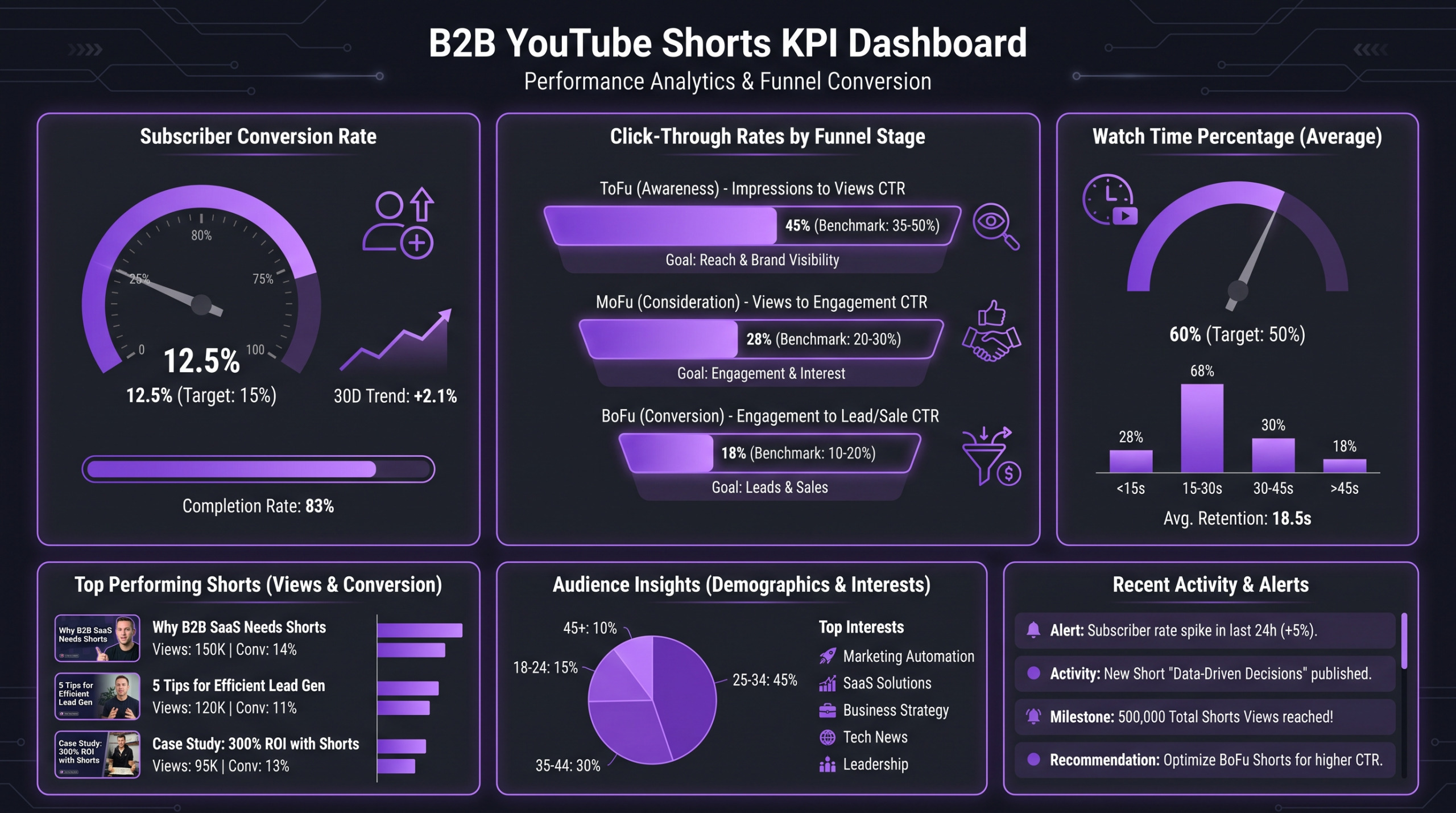
Subscriber conversion rate: What percentage of first-time viewers subscribe to the channel? This is the clearest signal that a Short is reaching a relevant audience who wants more. B2B Shorts that consistently convert 1–3% of viewers to subscribers are performing well by typical industry benchmarks.
Click-through to long-form content: For MoFu and BoFu Shorts, track what percentage of viewers click through to the linked long-form video or landing page. This is the metric that connects Shorts activity to pipeline. YouTube Studio provides end-screen click rate data; your linked long-form content should carry UTM parameters to enable attribution in your CRM.
Average view duration percentage: YouTube’s algorithm uses completion rate as a primary signal for recommending Shorts. For a 60-second Short, maintaining above 70% average view duration is a strong indicator of content-audience fit. Below 50% is a signal to revise the hook — the opening three seconds — not necessarily the entire clip.
Search impression share by keyword: For ToFu content, track which search terms your Shorts are appearing for in YouTube search. This reveals whether your keyword targeting is attracting the intended ICP or a different audience altogether. The YouTube Studio Search report provides this breakdown at the Short level.
💡 Attribution Tip: Place a unique UTM code on the link in each Short’s description. Combine YouTube Studio data (views, subs, watch time) with CRM data (sessions, form fills, pipeline influenced) to build a full funnel picture. Without this link, Shorts will be chronically undervalued in your channel attribution model.
What to Ignore (At Least Initially)
Raw view counts and like ratios are largely vanity metrics for B2B Shorts, particularly in the first three to six months of a new channel. Shorts are often distributed by YouTube’s recommendation algorithm to audiences it is still learning to calibrate for your content — early view counts will include a proportion of irrelevant viewers. Focus on the quality signal metrics above and allow the algorithm at least 90 days to refine its audience model before drawing conclusions about channel-level performance.
Six B2B YouTube Shorts Mistakes and How to Avoid Them
After working with B2B content teams across industries, these are the six failure patterns that consistently derail Shorts strategies before they can compound.
Mistake 1: Repurposing Landscape Video Without Re-editing
Cropping a 16:9 webinar clip to 9:16 and calling it a Short is not a Shorts strategy — it is a quick path to poor completion rates and algorithmic suppression. Shorts require vertical-native editing: the visual composition, text placement, and pacing are fundamentally different from landscape content. Repurpose webinar content by all means, but commission a proper re-edit: new vertical framing, captions rebuilt for mobile, a tighter cut that removes the slow setup that landscape content tolerates but Shorts do not.
Mistake 2: Ignoring the First Three Seconds
The hook in a Short is not the first 10 seconds — it is the first three, and often the first one. Viewers in the Shorts feed swipe instantly if the opening frame does not signal immediate relevance or value. B2B Shorts specifically need to communicate the professional audience they are for within the opening frame: a graphic identifying the viewer (“If you’re a B2B marketing director…”), a data point that creates pattern-interrupt (“Most B2B video budgets waste 40% of spend on…”), or a direct question that the target viewer cannot help but stay to hear answered.
Mistake 3: Publishing Without a CTA Destination
A Short with no linked destination converts awareness into nothing. Every Short should have a specific next step in the description — a link to a relevant long-form video, a landing page, a case study, or a booking page. The CTA text in the Short itself should match the destination: “Link in description” is weak; “Watch the full case study in the description” is specific and gives the viewer a reason to act.
Mistake 4: Mixing Brand Voices Across Clips
B2B credibility is built on consistency. When different team members appear in Shorts without unified production guidelines — different caption styles, different graphic treatments, different verbal tones — the channel communicates amateur execution even when individual clips are strong. Establish a Shorts brand playbook before filming: defined caption font and colour, logo placement rule, standard intro/outro structure, and an agreed on-camera style (direct-to-lens vs. conversational, scripted vs. outline-driven).
Mistake 5: Abandoning the Strategy After Eight Weeks
YouTube Shorts audience building is a compounding process. Industry experience suggests that most channels need a minimum of 90 days of consistent publishing before the algorithm has sufficient signal to reliably recommend content to the right audience segment. Brands that publish for six to eight weeks, see modest view counts, and conclude “Shorts doesn’t work for B2B” are stopping precisely when the compounding was about to begin. Commit to a 90-day minimum pilot with a fixed publishing cadence before evaluating channel viability.
Mistake 6: Treating Shorts as Separate From Long-Form Strategy
The most sophisticated B2B YouTube strategies treat Shorts and long-form as a linked content ecosystem. Shorts serve as the discovery layer — they attract new viewers and channel subscribers. Long-form videos then deliver the depth that converts subscribers into prospects. A Short about “the three questions every B2B video brief needs” naturally links to a 12-minute long-form video that walks through the brief process in detail. The Shorts drive the audience; the long-form builds the relationship. Treating them as independent channels misses the compounding benefit of cross-promotion within the same platform.
Building a Sustainable Shorts Publishing Cadence
Publishing cadence is the single biggest determinant of long-term Shorts success — more than production quality, more than keyword research, more than thumbnail design (which does not apply to Shorts anyway). Consistency signals to YouTube’s algorithm that the channel is reliable, which increases recommendation frequency over time.
Recommended Starting Cadences by Team Size
For teams unsure where to start, begin at the lower bound of your range. Publishing eight Shorts per month with consistent quality beats publishing 20 with erratic quality and a two-week gap in the middle. It is easier to increase cadence once the workflow is stable than to recover algorithmic trust after a publishing hiatus.
Integrating Shorts Into the Broader B2B Content Calendar
Shorts should not exist as an isolated content format — they work best when they are integrated into the existing content calendar as derivative assets. A quarterly product update blog post generates two Insight Shorts (one per key update). A customer success story generates one Process Short (the workflow change the customer made) and one Objection Short (the concern they had before signing). A webinar generates three to five Shorts extracted from the best moments. This derivative model multiplies the value of content investments that the business is making anyway, without requiring a separate ideation process.
For additional perspective on how B2B marketing and agency relationships work together on video content strategy, the CMO’s Guide to Video Budgets in 2026 covers how to structure video spend across formats — useful context for Shorts as a budget line item in a broader video strategy.
If you are building a dedicated video production workflow for a B2B brand from scratch, our comprehensive guide to video editing for SaaS companies covers the full post-production layer — including how to structure agency relationships for maximum throughput.
For guidance on what to look for when evaluating video production partners, Social Media Examiner’s business guide to YouTube Shorts offers complementary tactical detail, and HubSpot’s marketing statistics hub provides regularly-updated benchmarks on video marketing performance across channels.
Frequently Asked Questions
Can YouTube Shorts actually generate B2B leads?
Yes, though the mechanism is indirect rather than direct. Shorts build brand recall and channel authority — the prospect who sees your Insight Short about a problem they are actively solving is more likely to click through to your longer content, subscribe, and eventually convert via a direct call or form fill. The attribution path is longer than a paid search ad, but the cost efficiency and compounding value are substantially better over a 12-month horizon. Use UTM links in Shorts descriptions to track downstream pipeline contribution.
How long should a B2B YouTube Short be?
The technical maximum is 60 seconds, but the optimal length for B2B Shorts is typically 45–55 seconds. This gives enough time to establish context, deliver a substantive insight or process demonstration, and include a clear CTA — without padding. Very short Shorts (15–25 seconds) can work for punchy Objection Shorts or data-point reveals, but most B2B topics require enough context to be credible. Avoid padding to hit 60 seconds; end when the point is made.
Do Shorts hurt a YouTube channel’s long-form performance?
This was a concern in YouTube’s early Shorts rollout (2022–2023), when some creators reported that Shorts audiences did not convert to long-form subscribers. YouTube has since updated its algorithm to better separate Shorts and long-form audience signals. Published guidance from YouTube’s official Creator Academy confirms that Shorts and long-form videos draw from different recommendation pools, and that Shorts subscriptions increasingly carry over to long-form watch behaviour when the content is thematically consistent. For B2B channels, consistent topic focus is the safeguard — a Shorts audience attracted by B2B marketing content will naturally crossover to long-form B2B marketing content.
What equipment do we need to film B2B YouTube Shorts?
Less than most B2B teams assume. A modern smartphone on a stable mount, a USB lapel microphone, and a consistent background (a clean office corner, a branded pull-up banner, or a virtual background in a controlled environment) are sufficient for compelling B2B Shorts. The quality barrier for Shorts is lower than for long-form video because the viewing context (mobile, scrolling) is more forgiving. The production investment that matters most is in post-production — professional editing, captions, and graphic treatment elevate smartphone footage to brand-ready output.
How do we choose keywords for B2B YouTube Shorts titles?
Start with YouTube Search itself: type your topic area into YouTube’s search bar and note the autocomplete suggestions — these are real search queries. Cross-reference with keyword research tools (TubeBuddy, vidIQ, or Google’s Keyword Planner for YouTube-adjacent terms). For B2B topics, prioritise long-tail phrases that match the specific vocabulary your ICP uses (“B2B video ROI”, “SaaS onboarding video strategy”, “enterprise video production workflow”) over broad terms with high competition. Your Short’s title is its primary SEO signal — front-load the keyword within the first four words.
Verdict: Is YouTube Shorts Worth It for B2B in 2026?
The answer depends entirely on execution. YouTube Shorts is not a shortcut — it is a distribution channel that rewards consistency, targeted content, and patient compounding. For B2B brands willing to build the production infrastructure and commit to a 90-day minimum pilot, Shorts offers a genuinely differentiated opportunity: lower CPM than LinkedIn, longer content lifespan than any social post, and the compounding search authority of the world’s second largest search engine.
The brands that will win in B2B Shorts in 2026 are not the ones that repurpose the most content with the least effort. They are the brands with a clear three-pillar content strategy, a reliable post-production partner, a measurement framework tied to pipeline rather than vanity metrics, and the discipline to keep publishing through the first 90 days when results are modest.
If you are a B2B brand in a competitive category with a long buying cycle and a complex value proposition — think enterprise SaaS, professional services, manufacturing technology, or financial products — YouTube Shorts may be the most underexploited channel in your 2026 mix. The window of low competition in B2B Shorts will not stay open indefinitely.
Ready for Video That Actually Converts?
Tell us about your project and we will put together a custom plan.