









































The U.S. median salary for a film and video editor is $75,420 (BLS, May 2025). Add the typical employer cost of benefits and payroll taxes and one editor costs roughly $110,000 a year, about $9,200 a month, before software, hardware, recruiting and management time. That lands inside the premium agency retainer band of $5,000 to $10,000+ a month reported by one published guide. The salary is not the real comparison. The real question is whether one person can cover editing, motion, scripting and strategy for a complex product.
- The short answer
- What the salary data says
- From salary to fully loaded cost
- Costs that never reach the offer letter
- What a retainer costs, annualised
- One editor vs one retainer, side by side
- The skill-stack problem in complex B2B video
- A break-even worksheet
- When hiring in-house is the right call
- How to run the numbers in an afternoon
- FAQ
- Verdict
The short answer
A full-time video editor in the U.S. has a median salary of $75,420, and a fully loaded cost of roughly $110,000 a year once employer benefits and payroll costs are added. An agency retainer for the same budget is typically a team plus a strategy layer, not a single seat. If your company sells a complex B2B product, that difference matters more than the headline salary number.
This guide builds a cost model for B2B tech and SaaS companies deciding between a first video hire and a retainer with a video editing company. It starts from published salary data, converts it to fully loaded cost, annualises published retainer tiers so the two sides use the same unit, and ends with a break-even worksheet you can fill in with your own numbers. Everything is sourced, dated, or labelled as an assumption.
How this differs from our other in-house comparisons. We already cover the broader decision in In-House Video Editor vs Agency, the middle option in Fractional Video Editor vs Agency, a three-way view in Agency vs In-House vs Freelancer, and a pure cost view in In-House Editor vs Video Editing Service. For the underlying rate data, see Video Editor Hourly Rates 2026. None of those start from salary. This one does: it takes the salary figure a hiring manager actually sees, loads it, and sets it against a retainer in monthly and annual terms, with the complex-product skill stack as the deciding factor.
Looking up a salary for your own career? The BLS median above is the figure to use as an anchor. This article is written for the company side of the table, so it spends its time on what an employer pays, not on how to negotiate an offer.
What the salary data says
The most defensible public anchor is the Bureau of Labor Statistics: a median of $75,420 for film and video editors in May 2025. The same BLS page gives $74,990 for camera operators and projects 3 percent employment growth for the group from 2025 to 2035, about as fast as the average for all occupations. BLS reports about 72,000 jobs in the combined occupation group in 2025. Source: BLS Occupational Outlook Handbook, Film and Video Editors and Camera Operators (page read October 9, 2026).
Two cautions apply before you budget from that number. First, the BLS category is broad and includes film, television and broadcast editors, so a motion-capable editor in a high-cost metro hiring for a software company can sit above or below the median. Second, a median is a midpoint of what people are paid, not what it costs to recruit someone good right now. Treat $75,420 as the floor of a sensible planning range, then adjust for city, seniority and the skills you need.
The adjacent roles you may also need
Few B2B software companies need only an editor. If you also want someone who plans the video, writes the script and runs the production, the neighbouring BLS occupations tell you what those seats cost. Producers and directors have a 2025 median of $90,360 per year (BLS, Producers and Directors). Advertising, promotions and marketing managers have a 2025 median of $165,780 per year (BLS, Marketing Managers), which is a useful proxy for the seniority of whoever would oversee a video program internally. These are medians for broad occupations, not job-specific quotes.
Source: U.S. Bureau of Labor Statistics Occupational Outlook Handbook pages linked above, read October 9, 2026. Medians are base pay and exclude benefits.
From salary to fully loaded cost
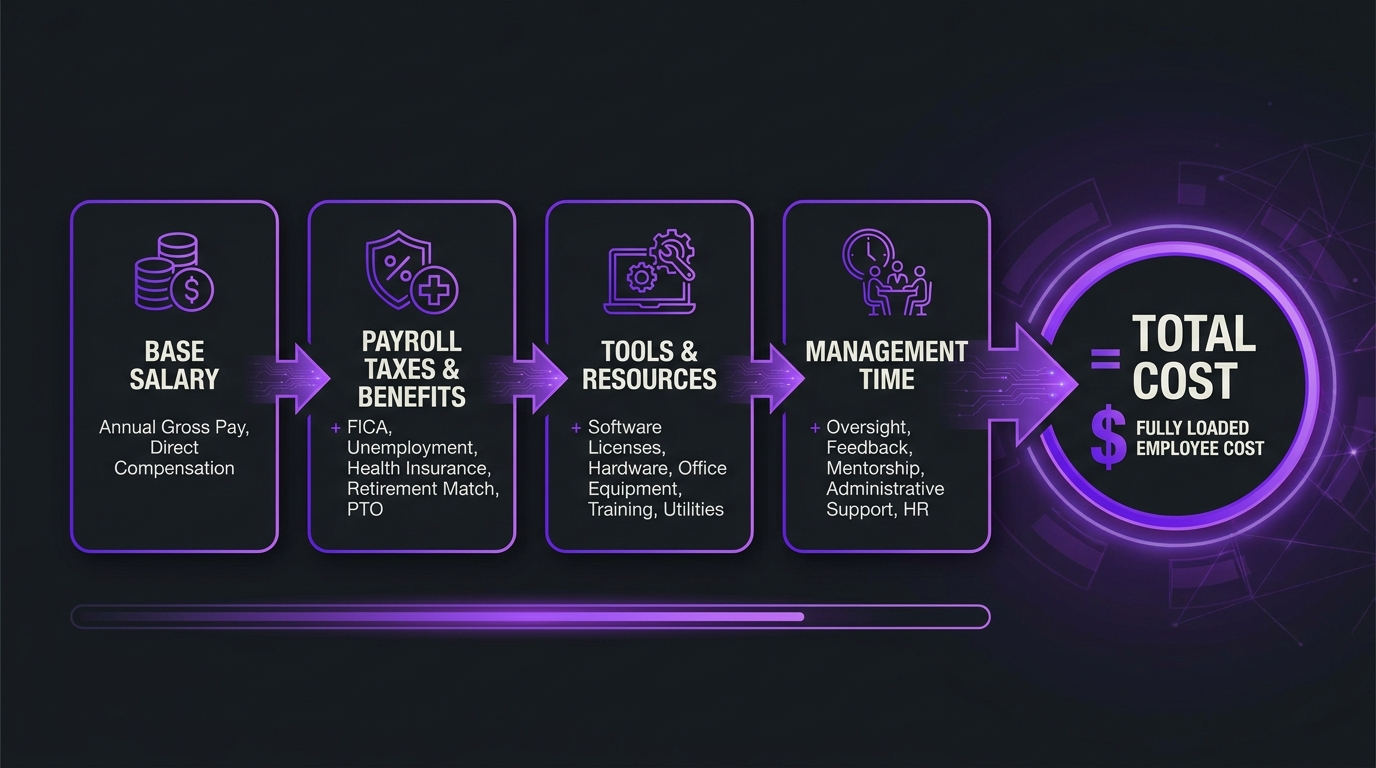
A salary is roughly two thirds of what an employee costs. BLS puts wages at 68.5 percent of total employer compensation cost for full-time private-industry workers, with benefits and legally required costs making up the other 31.5 percent. In June 2026 the BLS Employer Costs for Employee Compensation release showed full-time private-industry workers averaging $54.00 per hour in total compensation, of which $36.97 was wages and $17.03 was benefits. Paid leave accounted for $4.40 and legally required benefits for $3.76 of that hourly cost. Source: BLS Employer Costs for Employee Compensation, June 2026 (released September 9, 2026).
Dividing total cost by wages gives a loading factor of about 1.46 ($54.00 divided by $36.97). That is our arithmetic on BLS averages across all full-time private workers, not a figure published for editors specifically, so use it as a planning approximation rather than a quote. Applied to the medians above:
Rounded to the nearest $1,000 for the annual column. These figures still exclude software, hardware, recruiting and management time, which the next section covers.
Costs that never reach the offer letter
The loaded figure still understates the true cost, because several line items sit in other budgets. They are real, but we are not going to invent numbers for them. The table lists each item and tells you where to find your own figure.
Pro Tip: Management time is the item most teams leave out. If your VP of Marketing spends even a few hours a week briefing and reviewing, that time comes out of a salary the BLS puts well above the editor’s. Price it with the same 1.46 loading factor.
The utilisation trap
A salary is a fixed monthly cost, but B2B video demand is lumpy. Product launches, conference season and quarter-end sales pushes create peaks, then quiet weeks follow. An in-house editor is paid the same in both. If you want to plan this properly, our guide to video editing capacity planning walks through how to size a team to demand, and the same logic applies whether the team is employees or a partner.
What a retainer costs, annualised
Published retainer ranges run from under $2,000 a month for a basic package to $20,000+ a month for an enterprise team, so the right comparison for a full-time editor is the premium and enterprise bands. One production company’s published retainer guide, read October 9, 2026, gives these tiers: basic $750 to $2,000 per month, standard $2,000 to $5,000, premium $5,000 to $10,000+, and enterprise $10,000 to $20,000+. Its premium tier includes a dedicated editor and designer with bi-weekly strategy sessions, and its enterprise tier adds dedicated teams across video, design, animation and strategy with weekly strategy meetings. That guide also says retainers run 15 to 25 percent less per video than project pricing when you produce four or more videos a month. Source: Vidico, Video Retainer Cost 2026.
These are one vendor’s reported market ranges and the scope bundled into each tier varies by provider, so treat them as a guide to the shape of the market. Our own view of B2B pricing, including strategy-led scope, is in B2B Video Agency Cost and video editing retainer cost.
Annualised figures are our multiplication of the published monthly ranges. The line to notice: a loaded editor at about $9,200 a month sits inside the premium band, and an editor plus a producer at about $20,200 a month sits at the top of the enterprise band. At comparable spend, the retainer buys a team and a process. The salary buys one person.
One editor vs one retainer, side by side
At the same monthly spend, the in-house hire gives you control and proximity; the retainer gives you breadth, continuity and flexibility. Neither wins on every row, so the table below is deliberately honest about where an employee is better.
For the service-level questions that decide whether a partner is reliable, see video editing SLAs: what to demand from a vendor.
The skill-stack problem in complex B2B video
If your product needs explaining, one editor rarely covers the whole job, and the missing skills are the ones that decide whether a video lands. Selling AI, data or developer software to a technical buyer means someone has to understand the product, structure the story, script it, design the visuals and then cut it. An editor trained on cutting talking-head footage may do the last step superbly and still need a producer, a scriptwriter and a motion designer around them.
That is why the loaded cost of an editor plus a producer, about $20,200 a month, is the fairer comparison for strategy-led work. It also explains why a strategy-led partner such as Increditors is usually evaluated on the thinking around the edit, not only on cuts per month. Our explainer-focused guide to a SaaS explainer video agency shows what that thinking looks like for a complex product.
Two questions that decide which seat you need
- Will the work be mostly editing existing footage, or creating from scratch? Footage you already own (webinars, demos, interviews) points to an editor. New explainers, launch films and animation point to a team.
- Who owns the story? If your marketing lead already writes tight scripts and briefs, an editor can run with it. If nobody does, the missing seat is the strategist, and an editor will not fill it.
A break-even worksheet
Compare cost per finished video, not cost per month, because the real swing factor is how many videos each model actually delivers. Fill these five lines with your own numbers:
- A. Loaded annual cost of the in-house seat: base salary x 1.46, plus software, hardware and recruiting spread over the year.
- B. Hours per week of management time x loaded manager cost x 52.
- C. Videos the editor will realistically finish in a year, including launch peaks and quiet months.
- D. In-house cost per video = (A + B) / C.
- E. Retainer cost per video = annual retainer / videos delivered under the contract.
To show the arithmetic only, take a hypothetical: a loaded cost of about $110,000 with no extra items. If that editor finishes 6 finished videos a month (72 a year), the cost is about $1,530 per video. At 3 a month (36 a year), it is about $3,060 per video. Those throughput numbers are made up to illustrate the formula and are not a benchmark. The point is that cost per video swings by 2x with a change in utilisation, while a fixed retainer shifts the risk of a slow month onto the agreement’s terms.
Pro Tip: Use the finished-minute view as a cross-check. Our cost per finished minute benchmark post shows how to convert any quote, salary or retainer into a comparable unit.
When hiring in-house is the right call
Hire in-house when your video demand is steady and high enough to keep one person busy, and when someone on your team can brief and review daily. We would rather say that plainly than pretend a retainer is always the answer. In-house works best in a few situations:
- Constant, repetitive output. A daily or near-daily publishing rhythm that fills a full-time schedule.
- Deep, fast-changing product context. The editor needs to sit beside the product team and turn around same-day changes.
- An existing creative lead. You already have a producer or marketing lead who writes the scripts and owns quality.
- Sensitive footage. Material that should not leave your systems, such as unreleased product demos under embargo.
If most of those are false, a retainer, a fractional arrangement or a hybrid is usually cheaper and lower-risk. A common hybrid is one in-house producer or coordinator who owns the story and brief, with an external team doing the production work. That keeps product knowledge inside the company and moves the specialised skills outside. For a deeper view of the cost side of that split, see how much professional video editing costs.
How to run the numbers in an afternoon
You can reach a defensible answer in about four steps, using public data and two or three internal numbers.
- Pick the seats. Decide whether you are pricing an editor alone or an editor plus a producer, using the skill-stack questions above.
- Load the salary. Multiply the BLS median, or your local offer range, by about 1.46 and add your own software, hardware and recruiting lines.
- Annualise the retainer. Take quotes from two or three providers and multiply monthly fees by 12. Ask each what is included: strategy, scripts, motion, revision rounds.
- Compare cost per video and risk. Use the worksheet, then weigh coverage, ramp-up and hiring risk in the side-by-side table.
If the result is close, the tie-breaker is usually capability, not cost. Ask which option gives you the skills your product actually needs on day one. You can see how we have handled that for clients like AI, data and SaaS companies in our case studies.
FAQ
What is the average video editor salary in the U.S.?
The BLS reports a 2025 median annual wage of $75,420 for film and video editors. Individual pay varies by city, experience and specialty, so use the median as a planning anchor, not a guaranteed offer.
What does an in-house video editor really cost a company?
About 1.46 times base pay once benefits and payroll costs are included, based on BLS data for full-time private-industry workers. At the median salary, that is roughly $110,000 a year, before software, hardware, recruiting and management time.
Is an agency retainer cheaper than hiring an editor?
Not always per month, but often per unit of capability. A published guide puts premium retainers at $5,000 to $10,000+ a month, in line with a loaded editor, while including more than one skill. A retainer is typically cheaper when demand is uneven or when you need strategy, scripting and motion alongside editing.
How many videos does an editor need to make for in-house to pay off?
It depends on loaded cost and the retainer quote you are comparing against. Use the worksheet: divide loaded annual cost by realistic yearly output and compare it to retainer cost per video. Low utilisation is what usually makes in-house expensive.
Should a B2B software company hire an editor or a producer first?
If you already have a marketing lead who writes the briefs and scripts, an editor is the faster hire. If nobody owns the story, a producer or strategist is the missing seat, and an editor alone will not fix that.
Can a hybrid model work?
Yes. A common setup keeps one internal owner of the brief and brand, and uses an external team for editing, motion and production. It keeps product knowledge close and avoids hiring several specialist roles.
Verdict
Treat the video editor salary as the starting point of the cost model, not the answer. The BLS median of $75,420 becomes roughly $110,000 a year loaded, which is about $9,200 a month and sits inside the premium retainer band before you add tools and management time. At that spend, an agency typically brings a team and a strategy layer, while an employee brings one skill set and the benefit of proximity.
For B2B software companies selling a complex product, the deciding factor is usually the skill stack, not the price. If you already have a strong internal owner and steady volume, hire. If you need scripting, motion and strategy around the cut, price the team, not the seat. Either way, run the worksheet with your own numbers before you decide.
Want help running the numbers for your team?
Tell us what you sell and how much video you need. We will walk through the in-house and retainer options with you.