








![3D Explainer Video - ScribbleLive.mp4_snapshot_00.12_[2022.03.09_03.14.16]](https://increditors.com/wp-content/uploads/elementor/thumbs/3D-Explainer-Video-ScribbleLive.mp4_snapshot_00.12_2022.03.09_03.14.16-r7wb53mx72rxst3qcqyrfxdmeyzb5r9jbl0wbjujh4.png "3D Explainer Video – ScribbleLive.mp4_snapshot_00.12_[2022.03.09_03.14.16]")


























Hiring a fractional video editor gives growing brands flexibility and a dedicated relationship, but agencies like Increditors offer scalable capacity, quality-control infrastructure, and zero hiring overhead. If you’re producing 8+ videos per month or need consistent brand output across multiple formats, an agency almost always wins on total value — read on to see exactly why.
Every growing brand hits the same wall. You’ve proven that video content drives results — your YouTube channel is gaining traction, your course launch recaps generate actual leads, your LinkedIn clips are getting shared by the right people. Now you need more of it, faster, and at a higher production quality than you can manage in-house. Two paths appear: hire a fractional video editor or partner with a video editing agency.
It sounds like a simple staffing decision, but the choice you make here will shape your content velocity, your brand consistency, your operational risk, and your total cost of ownership for the next 12–24 months. We’ve worked with hundreds of creators, SaaS companies, coaches, and course builders at Increditors, and we’ve seen both models succeed — and fail — depending entirely on context. This guide gives you the honest, data-backed breakdown so you can make the right call for your business today.
We’re not going to pretend this is a balanced choice for every brand. It isn’t. The math, the operational reality, and the risk profile favor different options at different stages of growth. Let’s get into it.
What Is a Fractional Video Editora
A fractional video editor is a freelance or contract professional who dedicates a defined portion of their working time to your brand — typically anywhere from 10 to 30 hours per week — without being a full-time employee. The “fractional” framing has become popular across executive roles (fractional CFO, fractional CMO), and it’s now migrating into creative production roles as brands try to get dedicated talent without the overhead of a full-time hire.
How the Model Actually Works
In practice, a fractional video editor is often found through platforms like Upwork, Toptal, or Contra, or through personal referrals. You negotiate a monthly retainer — say, 20 hours per week — and that person integrates into your workflow via Slack, Frame.io, or whatever project management system you use. They learn your brand, your templates, and your creative preferences over time, and ideally they become faster and more autonomous as the relationship matures.
The appeal is real: you get someone who feels like “your editor,” who attends your planning calls, who knows your brand voice without a brief, and who can turn around edits with minimal back-and-forth. For founders who hate briefing new contractors every few weeks, this consistency is genuinely valuable.
Most fractional video editors specialize in one or two niches — YouTube long-form, short-form social clips, corporate explainers, or course content. They typically work in Premiere Pro, Final Cut, or DaVinci Resolve and may or may not have motion graphics skills depending on their background. The best ones command $35–$75/hour for experienced North American or European talent; offshore fractional editors on platforms like Upwork can be found for $15–$30/hour.
The Hidden Responsibilities You Inherit
What most people underestimate is the management overhead that comes with a fractional hire. You become the project manager, the quality control department, the creative director, and the HR function — all rolled into one. If a revision comes back wrong, you need to diagnose whether it’s a brief problem, a skills gap, or a communication failure. If the editor gets sick or takes a vacation, your production pipeline stops. If they decide to take on more clients or raise their rates, you’re suddenly renegotiating mid-campaign.
These aren’t hypothetical problems. In a survey of content creators who had hired freelance or fractional editors, 61% reported at least one production delay caused by editor unavailability in a 12-month period, and 44% said they had experienced a quality dip when their editor was managing multiple clients simultaneously. These are structural vulnerabilities of the one-person model, not character flaws in any individual editor.
When a Fractional Editor Makes Sense
A fractional editor is a reasonable choice when your content volume is low (under 6 videos per month), your budget is genuinely limited, and you have the time and skill to manage a creative relationship personally. Early-stage creators who are still finding their voice and don’t yet need machine-like consistency can benefit from the close relationship and the cost savings compared to a full agency retainer.
But as soon as you start scaling — more formats, more platforms, tighter deadlines, higher production standards — the fractional model starts showing cracks. That’s where the agency conversation becomes unavoidable.
What Is a Video Editing Agencya
A video editing agency is a specialized service business that handles video post-production as a managed service. You hand off raw footage (and a creative brief), and the agency handles editing, color grading, audio mixing, motion graphics, subtitles, and platform-specific formatting. The deliverable is finished, publish-ready video content.
What’s Actually Happening Behind the Scenes
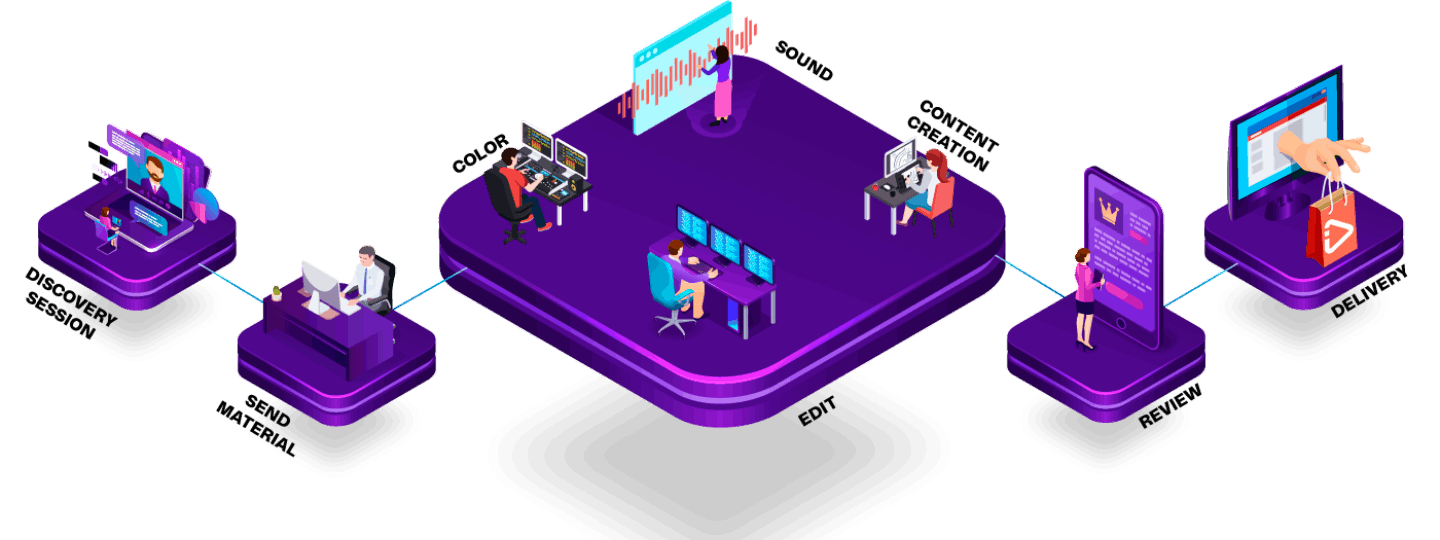
When you work with a professional video editing agency, your project doesn’t go to one person — it goes through a production pipeline. At Increditors, for example, a YouTube long-form edit passes through a dedicated video editor who handles the structural cut, a motion graphics specialist for titles and lower thirds, a colorist for grade and tone, an audio engineer for mix and cleanup, and a quality control reviewer before it ever reaches you for feedback. Each person is expert in their lane, and none of them is also simultaneously managing three other clients’ social media calendars.
This specialization is the source of an agency’s quality advantage. A fractional editor who is great at story structure may be mediocre at motion graphics. An editor who excels at YouTube pacing may struggle with the tight, punchy cuts that B2B LinkedIn content demands. Agencies solve this by staffing multiple specialists and routing work accordingly.
The Account Management Layer
Professional agencies assign a dedicated account manager or creative strategist to your account. This person becomes your single point of contact — they absorb your briefs, translate your feedback into production notes, manage the internal team, and shield you from the complexity of the production pipeline. Your time investment per video drops dramatically because you’re not managing individual contributors; you’re approving deliverables.
For founders and marketing directors who are already stretched thin, this is not a luxury — it’s a productivity multiplier. The hours you save on creative management can be reinvested in strategy, sales, or product. We regularly hear from Increditors clients that partnering with us freed up 8–12 hours per week they had previously spent on video coordination.
Agency Pricing Models
Video editing agencies typically price via monthly retainer (a fixed number of video deliverables per month), per-project, or per-minute-of-finished-video. Retainer pricing is most common for ongoing content programs and typically ranges from $1,500/month for basic packages (4–6 YouTube videos) to $8,000+/month for full-scale content programs with multiple formats, platforms, and deliverable types. Premium agencies serving enterprise clients can run $15,000–$30,000/month.
Per-project pricing for a single polished YouTube video with motion graphics and color grade typically falls in the $400–$1,200 range depending on length and complexity. Short-form social clips run $75–$250 per clip when produced as part of a batch.
Cost Comparison: The Real Numbers
The sticker price of a fractional editor almost always looks cheaper at first glance. But when you account for total cost of ownership — including your own time, the cost of quality failures, turnover risk, and the opportunity cost of delayed publishing — the gap narrows significantly and often reverses. Let’s run the actual math.
Direct Cost: Fractional Editor
A mid-tier fractional video editor working 20 hours per week at $45/hour costs $3,600/month in direct editing fees. Add platform fees if you found them on Upwork (typically 5–20% service fee on client payments), and your monthly spend is $3,780–$4,320. For that, you’re getting roughly 80 hours of editing time per month — but that 80 hours is divided among everything your editor touches: project prep, revision rounds, file management, and learning curves on new formats.
A realistic output for a solo editor at 80 hours/month: 4–6 long-form YouTube videos (assuming 20–30 minute raw footage, standard complexity) or 12–18 short-form clips, but not both simultaneously at high quality. Attempting to scale beyond this capacity leads to quality compression — the editor rushes, revision rounds multiply, and your effective cost-per-video climbs.
Direct Cost: Video Editing Agency
An agency retainer delivering 8 long-form YouTube videos plus 24 short-form social clips per month might run $4,500–$5,500/month at a quality-focused agency. That’s a higher headline number — but it includes project management, multiple specialists, quality control, revision rounds, and the account management layer. Your time investment per video is a fraction of what it would be managing a fractional editor.
When you factor in the 8–12 hours of management time a fractional editor requires monthly (at an opportunity cost of $100–$300/hour for a founder or marketing director), the real cost of the fractional model often exceeds $5,000–$6,000/month in total economic cost. The agency suddenly looks like the better deal.
💡 Pro Tip: When evaluating the cost of a fractional editor, calculate your own hourly rate and multiply it by the hours you’ll spend briefing, reviewing, revising, and managing that relationship every month. For most founders and marketing directors, this “hidden tax” adds $800–$2,000/month to the true cost of the fractional model.
Capacity and Scalability
One of the most consequential differences between a fractional editor and an agency is what happens when you need to scale. Content marketing doesn’t grow linearly — a product launch, a viral moment, a new platform push, or a course release can triple your video output needs overnight. How each model handles surge demand reveals a lot about its fitness for growing brands.
The Hard Ceiling of a Single Person
A fractional editor working 20–25 hours per week has a finite throughput ceiling. There are only so many hours in a week, and video editing is cognitively intensive — quality deteriorates meaningfully when an editor is pushing past their comfortable workload. When you need to double output for a launch, a fractional editor has three options: work longer hours (temporary and unsustainable), bring in a subcontractor they manage themselves (introducing new quality risk), or ask you to wait. None of these is a great answer.
In practice, we’ve seen brands hit this wall hard during their most important moments. A SaaS company gearing up for a Product Hunt launch needs 15 videos in 10 days — their fractional editor can handle 5. A course creator running a live launch needs daily social clips plus the long-form recap plus the sales video, all simultaneously — their editor is already maxed out on the weekly YouTube cadence. These capacity failures happen at exactly the wrong time, and they’re not recoverable.
How Agencies Handle Scale
Agencies are structurally designed to absorb volume spikes. When you need to double output for a month, your account manager contacts the operations team, a second editor is allocated, and the pipeline expands. You don’t need to recruit, onboard, brief, or manage that additional capacity — it just appears in your workflow. The cost may increase proportionally, but the delivery mechanism doesn’t break.
This is especially important for brands that are in growth mode. A YouTube channel going from 2 to 8 videos per month doesn’t need to fire their editor and hire someone new — the agency just adjusts the retainer. A B2B SaaS company expanding from one content format to four doesn’t need to hire three new fractional specialists — the agency already has them on staff.
Multi-Format Production
Modern content strategy rarely lives in a single format. A long-form YouTube video becomes a podcast clip, a LinkedIn short, three Instagram Reels, and a course module. Each of these formats has distinct pacing, aspect ratios, caption styles, and platform-specific best practices. A single fractional editor can technically produce all of these, but they’re likely stronger in one format than others, and producing five formats simultaneously multiplies their cognitive load and error rate.
Agencies with specialized team structures route each format to the right specialist. Long-form narrative editing goes to the story editor. Short-form clip extraction and optimization goes to the social specialist. Motion graphics for each platform get handled by the design team. The result is better quality across all formats without any single person being spread too thin.
Quality Control and Brand Consistency
Quality is where the agency model wins most decisively — and where the fractional model’s single-person dependency creates the most risk. For brands where video is a primary touchpoint (and it increasingly is for almost every content-driven business), a quality failure isn’t just a production annoyance. It’s a brand problem.
The QC Layer That Agencies Provide
A well-run video editing agency has a formal quality control stage built into every production. At Increditors, every video passes through a dedicated QC reviewer before it leaves the building — someone whose entire job is to catch timeline errors, audio sync issues, color inconsistencies, caption mistakes, branding deviations, and pacing problems. This reviewer didn’t edit the video, so they look at it fresh, which is the only way to catch the problems that editors become blind to after hours in the timeline.
With a fractional editor, you are the QC layer. You are the person who catches the jump cut that doesn’t work, the lower third with the wrong font, the audio that’s too loud in the second segment. This is cognitively exhausting and error-prone — especially when you’re a non-editor reviewing technical work. Most people miss things, and the mistakes that slip through end up in public on your YouTube channel or your client’s LinkedIn feed.
Brand Asset Management and Style Consistency
Consistent brand presentation across dozens of videos requires systematic asset management: a master template library, versioned motion graphics files, locked-down brand color profiles for color grading, and documented style guides for pacing and music selection. Agencies build and maintain this infrastructure as part of the onboarding process. Fractional editors may or may not be systematic about it — it depends entirely on that individual’s organizational habits.
When a fractional editor leaves (and they do leave — typically every 12–18 months as their rates or client mix changes), they often take institutional knowledge with them. Agencies retain that knowledge in documented systems, templates, and handover processes. The next editor who touches your account gets a full briefing package, not a blank canvas.
Specialized Skills: Color, Audio, and Motion Graphics
The quality ceiling of a fractional editor is defined by that one person’s skill set. If they’re a great story editor but a weak colorist, your videos will look slightly flat or inconsistent in color. If they can’t do complex motion graphics, your intro animations will look amateur. If they’re not an audio engineer, your mix will be slightly off — not enough that a layperson notices immediately, but enough to feel less professional than your direct competitors.
Agencies pull from a bench of specialists. The result is that every production discipline — editing, color, audio, graphics — runs at specialist quality, not generalist quality. For brands where production value is a differentiator (and increasingly, it is), this matters enormously.
Risk, Reliability, and What Happens When Things Go Wrong
Every production relationship eventually faces a stress test. A deadline gets moved up. A key deliverable is technically compromised. The editor has a personal emergency. The internet goes out on upload day. How the model handles these moments determines whether your content program is resilient or fragile.
Single-Point-of-Failure Risk
A fractional editor is, structurally, a single point of failure. If they get sick, their production stops. If they take a week off for vacation, your publishing calendar goes dark. If their computer dies, your project files are at risk. If they decide to take a full-time job or a better-paying client, you’re scrambling to replace them with typically 2–4 weeks of disruption while you search, interview, and onboard someone new.
This isn’t a criticism of fractional editors as professionals — it’s a structural reality of the one-person model. Reliability at scale requires redundancy, and a solo contractor has no redundancy built in. For brands publishing on a consistent schedule (which is what the YouTube and content marketing algorithms reward), even a one-week gap can measurably affect channel growth metrics.
Agency Redundancy and Business Continuity
Agencies maintain benches of trained editors and have explicit business continuity processes. If your assigned editor is unavailable, a backup editor who has been briefed on your brand standards steps in. Your project doesn’t stop. Your publishing calendar doesn’t break. This redundancy is baked into the agency’s operating model — it’s part of what the retainer fee is paying for, and it’s invisible to you precisely because it works.
Agencies also carry contractual accountability that freelancers don’t. If deliverables are late or substandard, there are formal SLAs, revision policies, and in extreme cases, refund or credit mechanisms. The business relationship creates accountability structures that don’t exist in a freelance arrangement.
Data Security and File Management
For B2B SaaS companies and larger brands, there’s a non-trivial data security dimension to the editing relationship. Your raw footage may contain unreleased product demos, customer interviews, internal processes, or leadership conversations. Entrusting this material to a solo contractor means it’s sitting on their personal hard drive and cloud storage, with whatever security hygiene they happen to have. Agencies typically have formal data handling policies, NDAs, secure file transfer systems, and defined retention and deletion schedules — all of which matter when you have compliance obligations or simply want to protect sensitive IP.
💡 Pro Tip: Before signing any video editing arrangement — fractional or agency — ask directly: “What happens if your primary editor on my account is unavailable for a weeka” A good agency will describe their bench and backup process. A solo fractional editor will tell you there will be a delay. That answer tells you everything you need to know about reliability risk.
Which Model Fits Your Stage of Growtha
The honest answer is that the “right” choice depends heavily on your current production volume, your growth trajectory, your internal capacity to manage creative relationships, and your tolerance for operational risk. Let’s map the decision to specific scenarios.
Early-Stage Creators and Solo Founders
If you’re publishing 2–4 videos per month, you’re still finding your creative voice, and your budget is under $2,000/month, a fractional editor may be the right fit. The volume doesn’t justify the agency retainer, and the close collaborative relationship with a single editor can actually help you develop your creative instincts faster. You’ll learn what works, what doesn’t, and what your brand actually needs before you scale up.
The key is being honest about your own management bandwidth. If you’re already stretched thin and the prospect of briefing and reviewing an editor every week feels like a burden, even 4 videos per month is enough reason to consider a lightweight agency package.
Growing YouTube Channels and Course Creators
For YouTube channels producing 6–12 videos per month, or course creators with ongoing content programs (weekly lessons, promotional content, launch assets), the agency model typically delivers better value. At this volume, the consistency and QC infrastructure of an agency directly affects channel performance — the algorithmic advantage of consistent publishing schedules and professional production quality is measurable in subscriber growth and watch time.
Course creators have a particularly high quality bar to meet: educational video that looks and sounds unprofessional undermines the perceived value of the course itself. Students pay premium prices for premium experiences, and the visual and audio quality of lesson videos is part of that experience. An agency with a defined quality standard produces more consistent results than a freelancer whose output varies week to week.
B2B SaaS Companies and Coaches at Scale
For B2B SaaS marketing teams producing video across multiple channels — product demos, thought leadership, customer testimonials, ads, webinar recaps, sales enablement clips — the agency model isn’t just preferable, it’s essentially required. The format diversity alone exceeds what any single fractional editor can handle at professional quality. Add in the compliance considerations, the brand governance requirements, and the multi-stakeholder review process typical of B2B marketing, and you need the infrastructure that only an agency provides.
Coaches building personal brands at scale — producing daily or near-daily content across LinkedIn, YouTube, Instagram, and podcast platforms — similarly need the volume capacity and multi-format expertise that agencies offer. The personal brand content market has become intensely competitive, and production quality is increasingly a differentiator rather than a baseline expectation.
The Verdict
After working through the cost, capacity, quality, and risk dimensions, the picture is relatively clear: a fractional video editor is a reasonable starting point for early-stage brands with low volume and high management bandwidth. It’s an acceptable bridge when budget is genuinely limited and you’re willing to invest personal time in the relationship. But it is not a scalable, resilient production model for growing brands.
The moment your content program becomes a meaningful business asset — the moment your YouTube channel is driving leads, your course library is generating revenue, your LinkedIn presence is winning clients — the stakes for quality and reliability become too high for a single-person model. One bad week, one quality failure, one missed launch deadline can cost more in lost opportunity than the cost difference between a fractional editor and an agency retainer.
The brands we work with at Increditors who had previously used fractional editors consistently report three things after making the switch: they get more videos published, the quality is more consistently professional, and they spend dramatically less time on production management. The freedom to focus on strategy and audience growth while trusting a professional team to handle execution is, for most content-driven businesses, worth the incremental cost difference — and the data suggests the cost difference is smaller than it appears once you factor in the real total cost of both models.
Our recommendation: if you’re producing fewer than 6 videos per month and have strong creative management skills, a fractional editor can work well. If you’re at or above 6 videos per month, operating across multiple formats, running content as a core revenue driver, or simply valuing your own time — partner with a specialized agency. The production infrastructure, quality control, and operational reliability will pay for themselves in better output and recovered management hours.
Video content is only getting more competitive. The creators and brands who win in 2025 and beyond are those who build production systems that are consistent, scalable, and professionally executed — not those who patch together ad-hoc freelance arrangements and hope the quality holds. Building the right production infrastructure now is an investment in your brand’s long-term competitive position.
Frequently Asked Questions
Is a fractional video editor the same as a full-time video editora
No. A fractional video editor is a contractor who dedicates a portion of their working time to your brand — typically 10–30 hours per week — without being an employee. A full-time editor works exclusively for you, typically 40 hours per week, with the full employment overhead (benefits, payroll taxes, equipment, software licenses). Fractional arrangements reduce cost and commitment compared to full-time hiring, but they come with less exclusivity and more turnover risk than a dedicated in-house hire.
How many videos per month do I need to justify an agency retainera
The economic crossover point where an agency typically delivers better value than a fractional editor is around 6–8 videos per month for long-form content, or 20+ short-form clips per month. Below that threshold, the agency’s management overhead and minimum retainer fees may exceed what a fractional editor would cost for the same output. Above it, the agency’s scale, QC, and reliability advantages create clear net value. That said, volume isn’t the only consideration — if your content is a primary revenue driver or your brand quality bar is high, an agency can be the right choice even at lower volumes.
Can a video editing agency match the personalization of a fractional editora
Yes, with the right onboarding process. Premium agencies invest heavily in brand onboarding — building template libraries, documenting style guides, creating detailed brand playbooks, and briefing their entire team on your creative preferences. After the first 4–6 weeks of working together, a good agency actually has deeper institutional knowledge of your brand than most freelancers, because that knowledge is documented and distributed across the team rather than sitting in one person’s head. The key is choosing an agency with a structured onboarding process, not one that just starts editing with minimal briefing.
What are the biggest red flags when hiring a fractional video editora
Watch out for editors who can’t provide references from long-term clients (suggesting high turnover), who work across too many client verticals simultaneously (suggesting limited bandwidth), who don’t have a clear process for managing revisions and feedback, and who are vague about their backup plan when unavailable. Also be cautious of editors who quote very low rates — at $15–$20/hour, the math rarely supports the level of care and attention your brand content deserves. The best fractional editors are transparent about their capacity limits and have clear systems for communication and delivery.
How do I transition from a fractional editor to an agency without losing brand continuitya
The transition is smoother than most people expect if you plan it properly. Before making the switch, compile a comprehensive brand asset package: your existing templates, your motion graphics files, your brand color profiles, your music preferences, examples of your best and worst previous videos with notes on why. Share this with your new agency during onboarding along with 6–12 past video examples. Ask for a test project before fully transitioning — a good agency will offer this. Plan for a 4–6 week ramp-up period where the agency is learning your brand voice, and give explicit, detailed feedback during that period. Most Increditors clients report that by week 6, the agency output matches or exceeds their previous editor quality.
Ready for Video That Actually Convertsa
Tell us about your project and we will put together a custom plan.