







































Developer marketing video is video made for technical buyers: engineers, data teams and the technical leads who vet a product before anyone signs. It works when it is accurate, shows the real product, respects the viewer’s time and is reviewed by an engineer before it ships. Start with YouTube because that is where technical buyers already learn, build a small set of formats (walkthroughs, build-alongs, architecture explainers, release notes), add chapters and captions, and measure trial and activation signals rather than views. Below: the formats, a channel map, production standards, a review workflow and the mistakes that lose engineers fast.
Developer marketing video works when it helps a technical person understand and trust your product faster than reading around would: it shows the real product, gets every command and claim right, respects the viewer’s time and is reviewed by an engineer before it goes live. That is the short answer, and the rest of this guide shows how to build a video program for technical buyers, from formats and channels to production standards and measurement.
A note on scope, because we already cover nearby ground. Our YouTube for B2B lead generation playbook is about YouTube as a pipeline channel for any B2B buyer, our B2B YouTube channel strategy is a 90-day plan for the channel itself and our guide to technical explainer videos covers one format. This post is different: it is about the audience. It covers what changes when the viewer writes code, runs your product in a terminal or reads your architecture diagram looking for the flaw, and how to make video that survives that scrutiny.
- What developer marketing video is
- Why technical buyers watch video
- How technical buyers judge a video
- Seven formats that earn trust
- Where each format lives
- Production standards for engineers
- A workflow with an engineer in the loop
- YouTube setup for technical content
- Measuring what matters
- Six mistakes that lose engineers
- Build in-house or bring in a partner
- How this played out
- FAQ
- Verdict
What developer marketing video is
Developer marketing, sometimes called developer relations or DevRel, is the set of practices a company that builds developer-facing software uses to connect with the people who use it. The Wikipedia entry on developer relations lists developer education among those practices and names product documentation and resources such as videos to aid learning a product. Developer marketing video is the video part of that: content made for technical buyers and users rather than for a general business audience.
For a B2B software, AI or data company the audience is wider than the word “developer” suggests. It includes software engineers, data engineers, ML engineers, security and platform teams, technical founders and the technical evaluator who sits on a buying committee and decides whether your product is real. A VP of Marketing or a CEO who sells a complex product to these people has the same problem: the buyer will not be moved by polish or promises, and will leave at the first sign of fluff.
That changes what “good” means. A well-lit founder monologue about vision works for some audiences. For a technical buyer, good means the terminal output is real, the architecture diagram is correct, the narrator knows what a webhook retry is and the video answers the question in the title.
Why technical buyers watch video
Technical buyers do their research in public places and on their own time. The 2025 Stack Overflow Developer Survey, based on tens of thousands of responses from developers worldwide, shows where that happens. In its community-platforms results, Stack Overflow leads at 84.2 percent of respondents, public GitHub follows at 66.9 percent and YouTube comes next at 60.5 percent, ahead of Reddit. The same page notes that respondents who are learning to code use YouTube for community more than professional developers do (70 percent versus 60 percent). Figures are as published in the 2025 survey and vary by audience, but the pattern is clear: YouTube is part of the technical learning stack, not a side channel.
The survey also reports that a large majority of respondents, 84 percent, use or plan to use AI tools in their development process. For AI, data and deep-tech companies that matters twice. Your buyers are fluent in the category and quick to spot a shallow explanation, and the products they evaluate are often hard to show. Video is one of the few formats that can show a pipeline running, a model responding or a dashboard updating in a few seconds, which a paragraph of copy cannot do.
💡 Pro Tip: Read the survey section on community platforms before you decide your channel mix. If your buyers use Stack Overflow, GitHub and YouTube, your video should be findable and useful on YouTube, linked from your docs and referenced in your repository, not locked behind a form.
How technical buyers judge a video
Technical viewers judge in the first thirty seconds, and they judge differently from other audiences. They are checking whether you respect their time, whether the product is real and whether the person speaking knows the subject. Here is how the common expectations map to what a marketing video usually does wrong.
Notice that none of these fixes are about production budget. They are about preparation, access to an engineer and an editor who understands the material. That is good news if your video budget is modest and the audience is demanding.
Seven formats that earn trust
You do not need dozens of formats. A small set, produced consistently, is easier to maintain and easier for the audience to recognize. These seven cover the technical buyer journey from first search to adoption.
1. Product walkthrough
A real session in the product that solves a specific task, start to finish. It answers “what does this actually do?” for the evaluator. Keep it task-based rather than feature-based, so the viewer sees the product used rather than toured.
2. Build-along or tutorial
The viewer follows along while someone builds something real with your product or API. This format earns more trust than any claim because the viewer can reproduce the result. Share the code or project so they can.
3. Architecture explainer
A short animated or diagram-led explanation of how your system works: data flow, components, trade-offs. This is where motion graphics earn their keep, because a clear animation of a data pipeline or model flow communicates what pages of documentation struggle to. The related guide on technical explainers goes deeper: how to make a technical explainer video for complex products.
4. Release notes video
A short video that shows what changed in a release and how to use it. It keeps existing users current, gives prospects a signal that the product is maintained and gives you a recurring reason to publish.
5. Conference talk edit
A talk your team gave, cut into a clean version with slides, captions and chapters, plus short clips for social. Conference footage often sits unused; a careful edit turns one talk into several assets.
6. Customer engineering story
A technical customer explains how they solved a problem with your product. Engineers trust other engineers more than they trust vendors, so let the customer’s technical lead explain the mechanism. The structure is similar to a B2B video case study, with more room for the technical detail.
7. Short clip
A focused clip, often under a minute, that answers one question or shows one trick. Clips work in social feeds, docs pages and community posts. They also send viewers to the longer videos where the depth lives. See our data on Shorts versus long-form video for how to balance the two.
The lengths above are working ranges rather than benchmarks. Use your own retention data to tune them, and see the B2B YouTube benchmarks for how to read performance in a B2B context.
Where each format lives
Technical buyers do not live in one place, so the same video should show up in several. The principle is to publish once on YouTube and then place the video where technical people already are, with context that fits each place.
Two of these deserve extra attention. The documentation site is often the highest-intent video location you have, because the viewer is already trying to do something. And sales follow-up is where a good architecture explainer can move a deal, because the technical evaluator can forward it to colleagues who were not on the call. For the sales side, see our guide to video editing for sales enablement teams.
Production standards for engineers
Technical audiences forgive a plain visual style and do not forgive errors. The production standards below are the ones that matter most.
Screen capture that is readable
Record at a resolution and zoom level where terminal text and code are legible on a laptop and a phone. Increase font size, hide unrelated tabs and notifications and use a clean demo environment. Where text is small, the editor can zoom or highlight the region that matters.
Real data, real commands
Use a real project and real outputs. If you must use sample data, say so, and do not fake results. Engineers notice when output does not match the command, and the damage extends to the rest of your claims.
Audio that is clear
Clear audio matters more than camera quality for tutorial content. A decent microphone in a quiet room beats an expensive camera in an echo-prone one. The editor can clean up noise and level the voice, but cannot restore a muddy recording.
Captions and accessibility
Captions help viewers who watch without sound, viewers who prefer reading code-heavy explanations and anyone who needs them for accessibility. The W3C guidance on captions and subtitles is a good reference, and our video accessibility guide covers the practical side for B2B teams.
Motion graphics used for clarity
Animation is most useful where the thing is invisible: data moving between services, a model processing input, a distributed system handling failure. Keep it precise and consistent with your actual architecture. Decoration for its own sake reads as filler to an engineer.
💡 Pro Tip: Create a short style sheet for your video program: terminal theme, font size, colors for different components in diagrams and a standard lower third. It makes every video look like part of the same program and gives editors clear rules to follow.
A workflow with an engineer in the loop
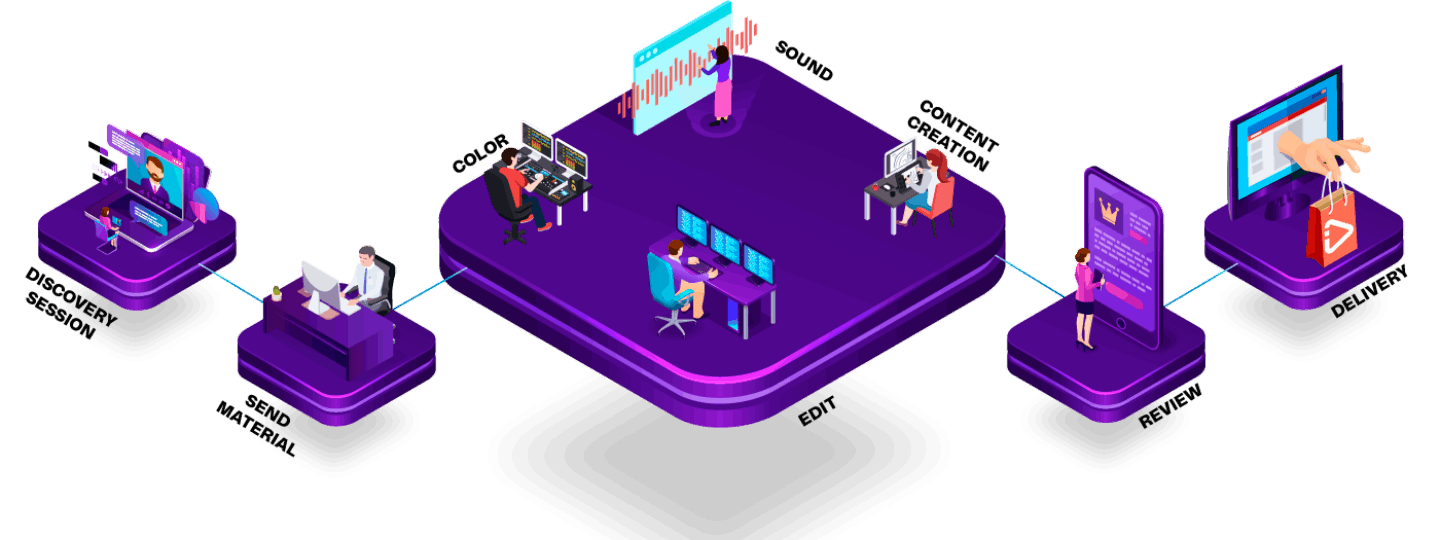
The most reliable way to keep technical video accurate is to build engineer review into the workflow rather than hoping for it at the end. Here is a lightweight process that works for small teams.
- Brief: write one sentence for the viewer problem, the job of the video and the next step. Name the engineer who will review.
- Outline: list the steps the viewer should see, in order, with the commands or screens for each.
- Record: capture the screen session and voiceover in a clean environment. Record twice if the first pass has slips; the editor can combine takes.
- Rough cut: the editor assembles the structure, pacing and captions. This is the cheapest point to change content.
- Engineer review: the reviewer checks commands, terminology, versions and claims against the product, and leaves timestamped comments.
- Polish: motion graphics, callouts, zooms, audio cleanup, chapters and end card.
- Publish and place: upload with title, description and chapters, then embed in docs and link from the repo and community posts.
The review step is the one teams skip, and it is the one that protects you. Ask the reviewer to look for things that are wrong, not things they would say differently. Style opinions slow the process and rarely change the outcome.
YouTube setup for technical content
Because YouTube is the primary home for most of this content, small setup choices matter. Keep them simple and consistent.
- Titles that match the search: write titles the way an engineer would type the problem, with the product or technology name where it belongs and no clickbait.
- Chapters: add timestamps so viewers can jump to the part they need. YouTube documents how in its video chapters help page.
- Descriptions with links: point to the docs page, the repo, the sandbox or the trial, and list the commands or versions used.
- Captions: upload clean captions rather than relying on automatic ones for technical vocabulary. Product names and code terms are where automatic captions fail.
- Playlists by task: group videos by what the viewer is trying to do, such as getting started, integrating or operating, rather than by release date.
- Search visibility: Google publishes guidance on making videos eligible to appear in results, in its video SEO documentation.
End screens and cards can send viewers to the next useful video; our guide to YouTube end screens and cards explains how to set them up for B2B. If you are planning the channel as a whole, the 90-day channel plan is the place to start.
Measuring what matters
Views are the easiest number and the weakest signal for a technical audience. A video that ten engineers on a target account watch to the end can be worth more than one that thousands skim. Measure signals that point toward evaluation and adoption.
Be honest about attribution. Technical buyers often watch, try and decide across weeks and tools, so a clean last-touch number rarely exists. Use directional evidence and ask new customers how they found you. For the metrics side of the channel, see the B2B YouTube benchmarks.
Six mistakes that lose engineers
1. Marketing language in a technical video
Words like “revolutionary” and “seamless” are filters. Say what the product does, in the vocabulary your audience uses.
2. Faked demos
Mock interfaces and staged outputs get noticed. Use the real product, and where something is simplified for the video, say so.
3. No engineer review
A wrong command or an outdated version on screen draws corrections in the comments and teaches viewers to distrust your content. Build review into the schedule.
4. A long intro before substance
Technical viewers want the problem and the answer early. Save the brand sting for the end card, or skip it.
5. Publishing once and disappearing
One burst of videos followed by silence signals that the product or the team is not maintained. A modest, steady cadence beats a big launch, which is why release-notes videos are so useful.
6. Ignoring the viewer who just wants the docs
Not every technical buyer wants video. Make sure written documentation, code samples and video support each other, and link between them, so each person can use the format they prefer.
Build in-house or bring in a partner
Many B2B tech teams start in-house, with an engineer or developer advocate recording and a generalist editing. That is a good way to learn what works. It tends to hit a limit when volume rises, when the editing quality has to match a larger brand or when the engineers who should be building the product are spending their time on timelines.
A specialist video editing company can take on the editing, motion graphics, captions and versioning while your engineers stay responsible for accuracy. The critical question to ask any partner is whether their editors can handle technical material: can they follow a data pipeline diagram, keep terminology consistent and ask good questions when something is unclear? Ask to see work on complex products, and ask how engineer review is built into their process. Our broader guide to video editing for SaaS companies covers how to evaluate a partner, and the overview of what professional video editing costs helps you frame the budget conversation. For a view of another premium B2B-focused option in the category, see VideoEditingCompany.
Whether you build or partner, keep the decision about audience and content in-house. The strategy of which questions your buyers ask and which formats answer them is yours. The editing is what scales.
If the program also includes educational content for a wider audience, our guide to educational video content for B2B shows how the same material can serve the whole buying group, and the B2B thought leadership video strategy covers the founder and executive side.
How this played out
QuantGenie is an algo-trading SaaS company, a technical product sold to people who know the domain well. Its team told us the domain-literate b-roll we produced was the best they had received. That comment is a good illustration of the principle in this guide: with a technical, specialist audience, the footage has to show that the people behind the video understand the buyer’s world, not just that they can cut clips together. You can read more on our case studies page.
FAQ
What is developer marketing video?
Developer marketing video is video content aimed at technical buyers and users, such as software engineers, data scientists, ML engineers and technical evaluators. It covers product walkthroughs, tutorials, architecture explainers, release notes and conference talk edits. Its job is to help a technical person understand and trust a product quickly, not to sell with hype.
Why is YouTube the first channel for developer-focused video?
Technical buyers already use it to learn. The 2025 Stack Overflow Developer Survey lists YouTube among the community platforms its respondents use, behind Stack Overflow and public GitHub, and it is the one place where a long, searchable, chaptered video can live and be found by someone with a specific problem. Your docs and repo still matter, but YouTube is where discovery often starts.
Do technical buyers actually watch marketing video?
They watch useful video. They tend to skip anything that feels like an ad and stay for a clear walkthrough, a real build or a straight explanation of how a system works. The practical rule is to make the video a better way to learn the product than reading around, and to leave the pitch out of the first minutes.
How long should developer videos be?
Long enough to complete the job and no longer. A product walkthrough or build-along often runs several minutes to well over ten, a release-notes video can be two to four minutes, and a short clip for social or a docs page may be under a minute. Chapters let viewers jump to what they need, so length is less risky than padding.
Who should review a developer video before it ships?
An engineer on your team who knows the product, ideally the one closest to the feature shown. They check commands, terminology, code, versions and claims. A single wrong command on screen costs more credibility with a technical audience than a plain visual style ever will.
Can an outside editing team handle technical content?
Yes, if they are literate in the domain and you give them a clear brief, source material and an engineer to answer questions. The editor shapes the story, pacing, motion graphics and captions; your team stays responsible for technical accuracy. Domain-literate editing is the difference between a video that feels credible and one that feels generic.
Verdict
Make developer marketing video the way technical buyers want to learn: real product, accurate details, clear structure and no wasted time. Start on YouTube, build a small set of repeatable formats, put an engineer in the review loop, add chapters and captions and measure movement toward trial and adoption rather than raw views. The companies that do this well treat video as part of documentation and developer education, not as an ad.
If you sell a complex software, AI or data product and want a partner for the editing, motion graphics and versioning side, Increditors works with B2B tech teams on strategy-led video, and we are happy to talk through your technical content on a call. Related reading: the B2B YouTube lead generation playbook and our guide to the B2B video case study format.
Selling a Product Engineers Scrutinize?
Tell us about your product and your technical buyers, and we will talk through how to make video they trust.