









![3D Explainer Video - ScribbleLive.mp4_snapshot_00.12_[2022.03.09_03.14.16]](https://increditors.com/wp-content/uploads/elementor/thumbs/3D-Explainer-Video-ScribbleLive.mp4_snapshot_00.12_2022.03.09_03.14.16-r7wb53mx72rxst3qcqyrfxdmeyzb5r9jbl0wbjujh4.png "3D Explainer Video – ScribbleLive.mp4_snapshot_00.12_[2022.03.09_03.14.16]")




























VFX costs for business videos range from roughly $150–$500 per shot for basic motion graphics to $2,000–$8,000+ per shot for complex 3D product renders or photorealistic compositing. Freelancers typically charge $50–$120/hr, boutique VFX studios $150–$350/hr, and full-service agencies bundle VFX into project rates. The single biggest cost driver is complexity — not duration. This guide breaks down every tier so you can budget accurately before you brief a vendor.
What Counts as VFX in Business Video?
VFX in business video covers any visual element that either didn’t exist in the camera frame or has been significantly transformed after filming. This is broader than most marketers expect — and it’s why VFX budget conversations often start with confusion about what’s actually being priced.
For B2B and corporate video contexts, VFX typically falls into five practical categories:
Motion Graphics and Animated Text
Lower thirds, animated statistics, kinetic typography, and branded transitions. These are the most common VFX elements in corporate video. A well-animated lower third can run from $80–$400 per element depending on complexity and how well the design system is already defined.
UI and Screen Mockups
Inserting a live product demo or polished UI into a filmed hand-holding-a-phone or laptop-on-a-desk shot. This requires either planar tracking (if the screen needs to follow camera movement) or a static replacement. Planar-tracked screen inserts commonly run $200–$800 per shot. Static replacements are faster and cheaper — often $80–$250 each.
3D Product Visualization and CGI
Photorealistic or stylized 3D renders of physical products, architectural visualizations, or abstract data representations. This is where costs escalate significantly. Building and texturing a 3D model from scratch typically starts at $1,500–$3,000 for a moderately complex product (before any animation or compositing). Animated 3D sequences rendered to look photorealistic start around $3,000–$8,000+ per finished minute.
Green Screen Compositing
Replacing a chroma-keyed background with a live-action, motion-graphics, or 3D environment. Cost varies hugely based on hair/fine-edge complexity, lighting match quality, and whether the background needs to be built or just placed. Clean corporate green-screen compositing with a simple background commonly runs $300–$1,200 per shot; complex foreground subjects with detailed edges or interactive lighting cost more.
Data-Driven Animation and Infographics
Animated charts, dashboards, and data visualizations that bring numbers to life. Popular in SaaS, fintech, and enterprise case studies. These typically start at $500–$2,000 per animated sequence depending on data complexity and how many states or transitions the animation cycles through.
VFX Cost Ranges by Type (2026)
The table below reflects market-rate ranges observed across independent VFX marketplaces, freelance platforms, and agency rate cards in 2026. These are indicative benchmarks — actual quotes will vary based on the vendor, revision policy, turnaround, and whether assets (3D models, design systems) already exist. For detailed guidance on overall video production pricing, see our breakdown of how much professional video editing costs.
These ranges assume professional-quality output — not broadcast-film VFX, but polished enough to appear in a LinkedIn campaign, a corporate sales video, or a SaaS product launch. For reference, Motionographer’s annual rate surveys and freelance platform data from Upwork and Fiverr Pro indicate that motion graphics rates have held relatively stable since 2024, while 3D and AI-assisted compositing rates have become more competitive as tooling has improved.
Freelancer vs. Studio vs. Agency Pricing
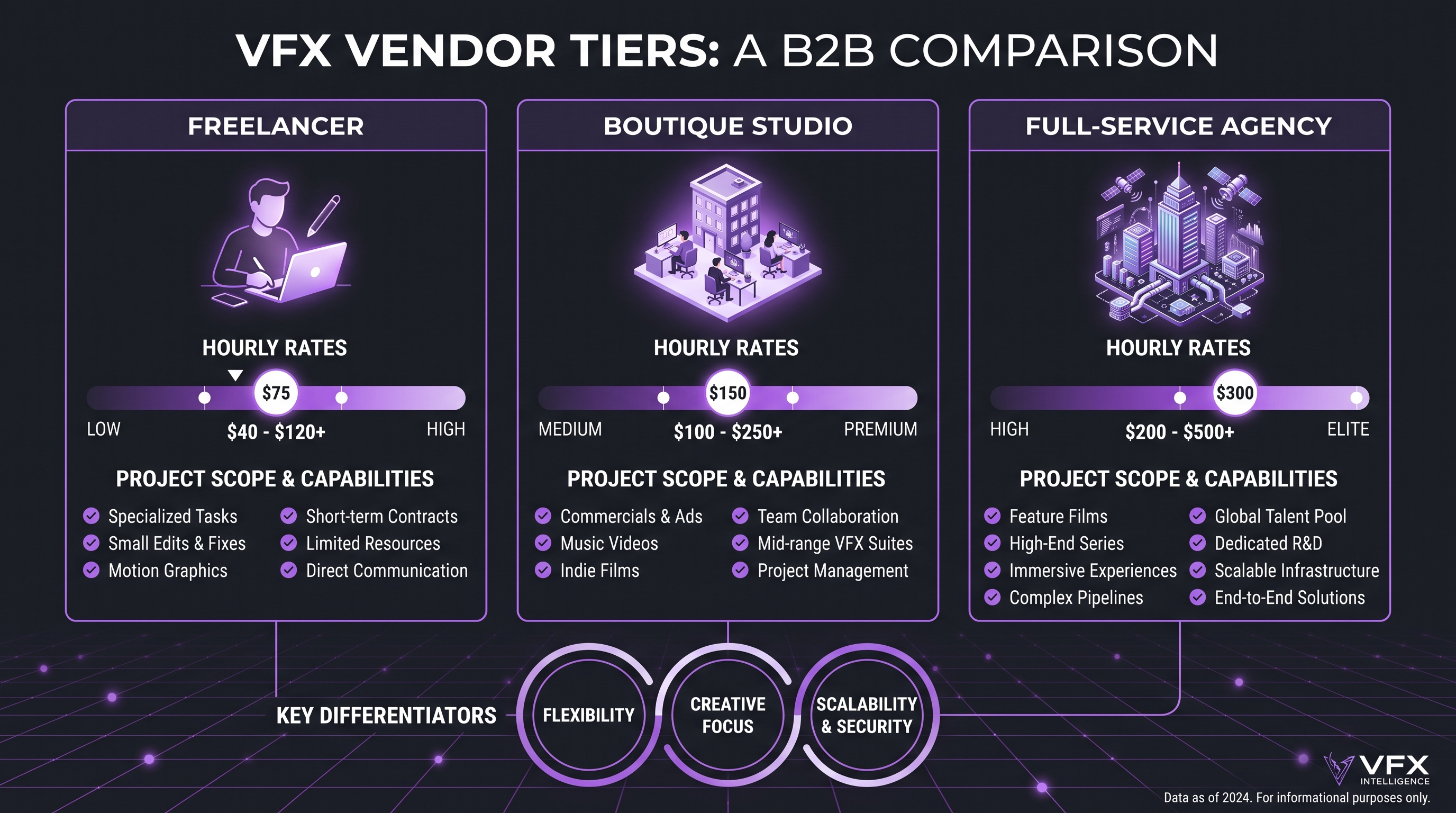
Who you hire shapes your cost ceiling as much as what you need built. Understanding the vendor tier before you send an RFQ saves weeks of misaligned proposals.
Freelance VFX Artists
Freelancers charging $50–$120/hr are the most accessible entry point. On platforms like Upwork or Contra, mid-career motion designers commonly quote $60–$90/hr; senior compositors and 3D generalists often run $100–$150/hr for B2B-grade work. The advantages: direct communication, negotiable rates, and tight iteration loops on simple projects. The risks: single points of failure (illness, bandwidth), no project management layer, and limited capacity for parallel complexity — you can’t have five artists finishing different shots simultaneously without serious coordination effort on your end.
Boutique VFX and Motion Studios
Small studios of 3–15 specialists typically quote $150–$350/hr or package their work into per-shot/per-deliverable rates. They offer team-based capacity, better project management, and in-house QC. For a 90-second corporate brand film with 12 VFX shots of mixed complexity, a boutique studio quote might land between $15,000–$45,000 depending on geography and shot difficulty. US-based studios sit at the higher end; studios in Eastern Europe, Southeast Asia, or Latin America often deliver comparable quality at 40–60% of those rates.
Full-Service Video Production and Editing Agencies
When you work with a video editing agency that handles VFX as part of an integrated post-production workflow, VFX is typically bundled into the overall project rate rather than line-itemed separately. This can be advantageous when VFX elements are tightly coupled with editorial decisions — color, pacing, sound design — because siloed handoffs between an editor and a separate VFX artist often introduce costly revision cycles. Full-service agencies working in the corporate/B2B space tend to scope projects at $5,000–$25,000+ for a complete short-form deliverable with integrated motion graphics, with complex 3D or heavy compositing pushing those numbers higher.
💡 Pro Tip: If your VFX shots require revisions to the underlying edit (a cut point moves, a title changes), working with a siloed VFX artist creates version-control nightmares. For projects where editorial and VFX are tightly coupled, bundling them with one team saves more than you’d save on the lower freelance rate.
The 7 Factors That Drive VFX Costs Up
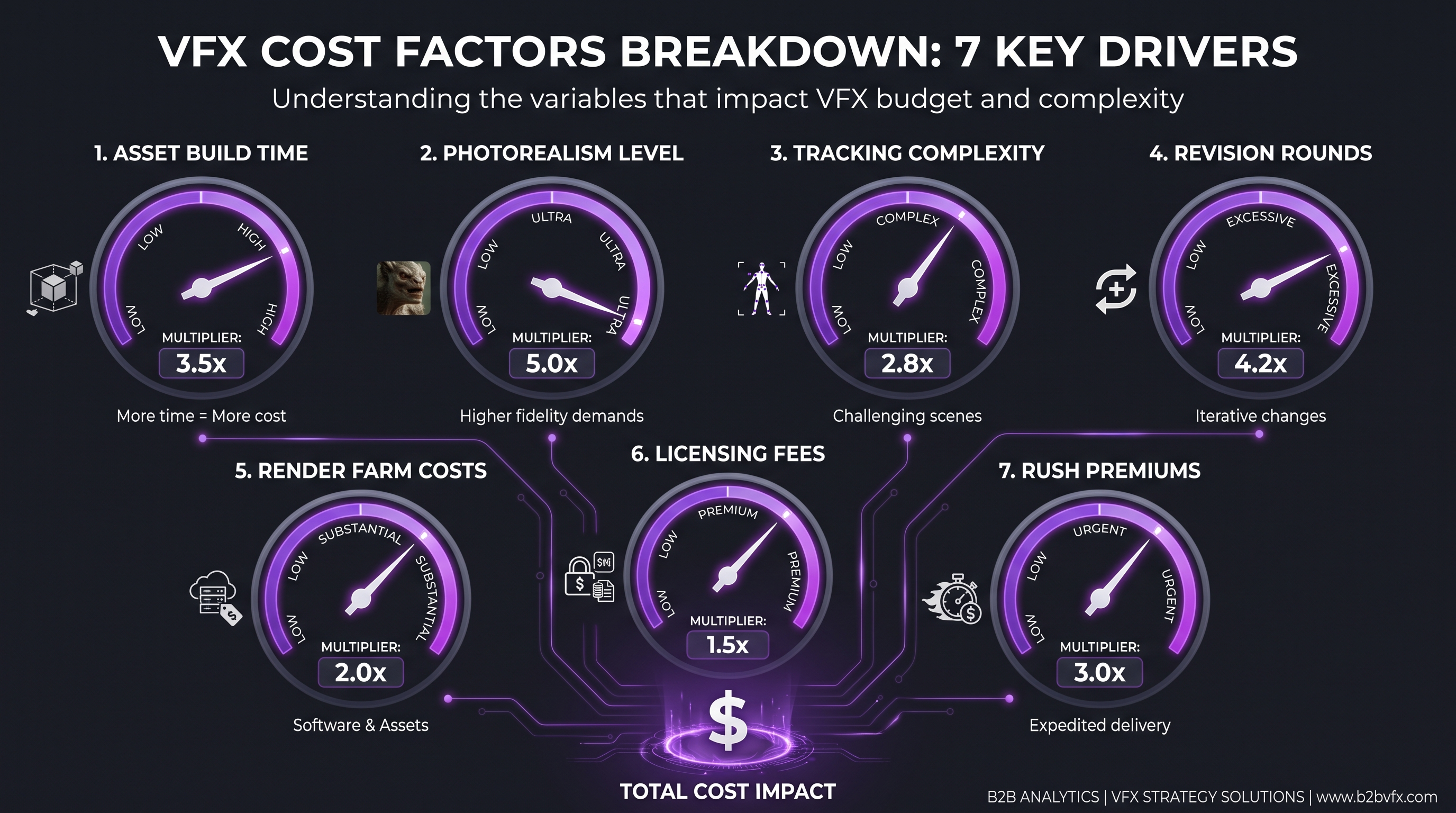
Duration is not the main cost variable in VFX — complexity is. A 5-second shot of a 3D product floating in a photorealistic environment costs far more than a 30-second lower-thirds package. Understanding what actually drives cost helps you scope more intelligently and avoid mid-project surprises.
1. Asset Build Time (Starting from Scratch vs. Existing Libraries)
Building a 3D model, designing a motion graphics system, or rigging a character from scratch is the most expensive phase. Vendors who already have a relevant asset library — a generic tech product model they can adapt, or a branded motion system from your prior work — can significantly reduce this cost. Always ask: “Do you have existing assets we can adapt?” before approving a scratch build.
2. Photorealism vs. Stylized Output
Photorealistic 3D or compositing is exponentially harder to execute than stylized or flat-design work. Achieving convincing subsurface scattering on a skincare product, realistic reflections on a glass bottle, or a seamless lighting match between a CG car and a live background requires orders of magnitude more render time and artist expertise than a clean flat-design infographic animation. For most business use cases, stylized animation delivers a higher perceived value-per-dollar than budget photorealism that misses the mark.
3. Tracking and Integration Requirements
Any VFX element that must seamlessly follow camera movement requires tracking data — either 2D planar tracking or full 3D camera solves (matchmoving). A static screen replacement on a locked-off shot is cheap. The same shot on a handheld camera with parallax movement requires a proper camera solve, which adds artist time and increases the acceptable failure rate (some footage simply doesn’t track cleanly).
4. Revision Scope and Approval Latency
VFX estimates almost always include a defined number of revision rounds. Beyond that, additional rounds are billed at hourly rates. In corporate video production, approval latency — where a shot sits waiting for stakeholder sign-off — can cause downstream costs when an earlier revision is ultimately discarded. Locking the script and style frames before VFX production starts is one of the most effective cost controls available.
5. Render Time and Render Farm Costs
High-quality 3D renders require significant compute. A vendor rendering locally on a single workstation faces a hard ceiling on turnaround speed; cloud render farm usage (AWS, Google Cloud, Conductor) adds cost but dramatically reduces delivery time. For deadline-sensitive projects, ask vendors whether their quote includes render farm budget and what the delivery commitment is.
6. Licensing and Stock Asset Fees
Motion graphics often incorporate licensed stock elements — background footage, sound effect libraries, or pre-built animation presets. These fees can be modest (a $30 stock clip) or substantial (a custom music license for a brand film). Ask vendors to itemize licensing vs. production labor in their quote so you can make informed substitutions.
7. Rush Premiums
VFX artists and studios commonly apply 25–50% rush premiums for turnarounds faster than their standard lead time. For a project that would normally deliver in 10 business days, a 3-day turnaround can cost nearly double. Building production timelines with a 2-week buffer before VFX delivery tends to be significantly cheaper than expediting at the end.
Budgeting by Use Case: SaaS, E-Commerce, Corporate
Different business contexts have very different VFX intensity requirements. A 2-minute SaaS product demo video has essentially zero need for 3D CGI but heavy need for polished UI animation and screen inserts. A 60-second e-commerce brand spot may need a photorealistic product CGI sequence but very little motion graphics. Aligning your budget to your actual use case prevents both overspending on capability you don’t need and underspending on elements that define your brand’s perceived quality.
SaaS and Software Demos
Typical VFX needs: screen mockups, UI animation, animated feature callouts, kinetic typography, data visualization. A well-produced 2-minute SaaS explainer with 8–12 animated UI elements and a branded motion system commonly has a VFX budget in the range of $2,500–$8,000, depending on whether the design system is being built from scratch or adapted from existing brand assets. This is also a category where a tight collaboration between editor and motion designer pays off — transitions between live interview and product footage often require VFX finessing. Our guide to video editing for SaaS companies covers the full production context.
E-Commerce and Physical Products
Typical VFX needs: product CGI or 360° renders, beauty shot compositing, text overlays, color-matched lifestyle composites. For brands that can’t afford large-scale studio shoots, CGI product sequences represent a real opportunity — once a 3D model is built and approved, rendering multiple angles, colorways, and environments costs relatively little compared to a full re-shoot. Product CGI sequences suitable for paid social commonly start at $3,000–$7,000 for the first deliverable (including model build) and significantly less for subsequent variations. According to Statista’s e-commerce advertising data, video ads consistently outperform static ads on conversion metrics, which provides a clear ROI framing for VFX investment in this category.
Corporate and Brand Films
Typical VFX needs: title sequences, branded motion graphics systems, green screen compositing, environment extensions, data-driven storytelling visuals. Corporate brand films vary enormously — a talking-head company culture video may have near-zero VFX cost, while a brand manifesto film with a stylized visual world might allocate 30–40% of its entire production budget to post-production VFX. For large enterprise projects, it’s common to see VFX scope grow during production as stakeholders see what’s possible — having a contingency of 15–20% on top of your VFX estimate is prudent planning.
💡 Pro Tip: The single highest-leverage VFX investment for most B2B brands is a motion graphics design system — a set of reusable animated components built once and applied across all video content. The upfront cost is higher than a one-off element, but every subsequent video costs far less and looks far more cohesive.
When to Invest in VFX (and When to Skip It)
Not every video needs VFX, and over-producing the wrong videos is one of the fastest ways to burn a content budget without measurable return. The decision framework is simpler than most briefs make it look.
Invest in VFX When:
The product can’t be filmed the way you need it. If your software product needs to look elegant in motion, if your physical product doesn’t exist yet, or if your brand world requires environments that can’t be built on a practical set — VFX is the only path to the output you need.
The video has a long shelf life or high-volume exposure. A hero brand video that lives on your homepage, runs in paid media, and gets shown at every sales call for two years earns back a $15,000 VFX investment in ways that a weekly social video simply doesn’t. Allocate VFX budget proportional to intended lifespan and distribution reach.
Competing content in your category is already doing it. In categories where sophisticated product visualization or high-quality motion graphics are table stakes — fintech, enterprise SaaS, premium consumer goods — showing up with raw footage and basic titles signals a brand quality level you may not intend to communicate.
Skip or Minimize VFX When:
Authenticity is the message. Customer testimonials, executive thought leadership, and documentary-style company culture videos often perform better with minimal production treatment. Over-polishing can undermine the credibility you’re trying to build.
Volume is more important than polish. For LinkedIn organic content, short-form educational clips, or weekly nurture videos, consistent publishing volume typically drives better pipeline outcomes than occasional high-production-value pieces. Budget accordingly. See our comparison of approaches in the video editing agency vs. freelancer guide for a broader cost-vs-volume framework.
The VFX element doesn’t serve the message. Abstract particle effects, generic tech-sphere animations, and decorative glitch transitions are VFX for VFX’s sake. If removing the effect doesn’t reduce clarity or persuasive power, it probably shouldn’t be there.
How to Brief a VFX Vendor to Control Costs
A vague brief produces a wildly inaccurate quote — either too high (vendor buffers heavily for unknown complexity) or too low (vendor underestimates, then surprises you with change orders). The following structure consistently produces more accurate quotes and fewer mid-project disputes.
Shot List vs. General Description
Don’t brief VFX as “we need some motion graphics and a product animation.” Brief it as a numbered shot list: Shot 01 — 10-second product reveal, 3D model, camera orbiting 180°, no background (transparent/white), 2K minimum; Shot 02 — 5-second lower third, two lines of text, brand colors, animate in/out with branded motion. Each shot should include duration, motion description, integration context (standalone or composited over live footage), and any reference examples.
Provide Reference Examples
Nothing reduces miscommunication and revision risk like a reference video. Gather 3–5 examples of VFX work at the quality level and stylistic direction you’re targeting — not necessarily from your industry, but visually representative. Reference cuts are the single most effective cost-control mechanism in the VFX brief.
Define “Done” Before Production Starts
Specify what constitutes an approved delivery: resolution (1080p, 4K?), codec (H.264 MP4 for web, ProRes for broadcast?), how many revision rounds are included, and what counts as a revision vs. a change-of-scope. VFX disputes almost always trace back to undefined acceptance criteria. Stating these upfront — even in an informal email — creates a shared standard that protects both parties. The Academy Software Foundation publishes open standards for post-production deliverable specifications that sophisticated vendors will recognize.
Lock the Edit Before VFX Starts
VFX is typically one of the last steps in post-production — but it’s also one of the most expensive to redo. If the edit changes after VFX has started (a cut point shifts by 10 frames, a shot is reordered), any VFX element timed to that edit may need to be completely reworked. “Picture lock” — formally signing off on the edit before VFX begins — is standard practice for good reason. Budget discussions should explicitly acknowledge whether the edit is locked or fluid.
Working with an experienced video editing agency that integrates VFX into its editorial workflow rather than handling them as a separate handoff dramatically reduces the risk of edit-VFX misalignment. When the same team owns both the cut and the effects, locking and unlocking the edit is a production decision, not an inter-vendor contract negotiation.
FAQ
How much does a simple logo reveal animation cost for a business video?
A clean, professionally animated logo reveal typically runs $150–$600 depending on complexity. Template-based reveals on platforms like Motion Array or Envato Elements can be purchased for $20–$80 and customized with your logo in a few hours — a legitimate option for low-budget contexts. Custom animated reveals built to match a specific brand motion style, with sound design included, tend to run $300–$600 from a mid-level freelancer. Reveals with significant 3D or particle work can reach $800–$1,500+.
Is AI reducing VFX costs for business videos in 2026?
In specific areas, yes — particularly for rotoscoping (AI-assisted masking tools in Premiere Pro, DaVinci Resolve, and After Effects have reduced manual masking time significantly), background removal, and certain tracking tasks. However, AI has not meaningfully reduced costs for high-complexity 3D CGI, photorealistic compositing, or custom motion graphics system design, where the bottleneck remains creative judgment and artistic quality, not raw processing time. According to reporting from VFX Voice, AI tooling is reshaping junior-level workflows while senior specialists are seeing their relative value increase as AI raises audience expectations for overall quality.
Should I get VFX quoted separately or bundled with editing?
It depends on how closely coupled your VFX elements are with the editorial decisions. For VFX that is largely timing-independent — standalone animated sequences, pre-rendered product loops, or separately delivered motion graphics — getting VFX quoted separately gives you cleaner cost visibility. For VFX that is tightly integrated with editorial pacing (composited screen inserts, transitions, context-sensitive callouts), bundling with an agency that handles both is usually more cost-effective because it eliminates handoff friction and revision misalignment risk.
What’s the difference between motion graphics and VFX?
Motion graphics are animated design elements — text, shapes, icons, infographics — that don’t originate from live footage. VFX (visual effects) specifically refers to elements that either alter live footage or combine real and synthetic imagery. In practice, the terms overlap significantly in B2B video production — a vendor who does “motion graphics” almost certainly also handles screen inserts and basic compositing. When scoping a project, the clearest approach is to describe what you want to see on screen, not to use category labels that mean different things to different vendors.
Can I reuse VFX assets across multiple videos to reduce cost?
Yes — and this is one of the most significant long-term cost optimizations available. A motion graphics system built for your first campaign (animated lower thirds, title templates, data visualization templates) can be licensed or owned outright and reused across every subsequent production. When negotiating with VFX vendors, clarify ownership rights: do you own the source files (After Effects project, Cinema 4D scene, etc.), or are you licensing a finished render? Owning source files enables internal teams or future vendors to adapt and extend the system without rebuilding from scratch.
Verdict: What Should Your VFX Budget Actually Be?
VFX cost for business videos in 2026 spans an enormous range — from $80 for a single animated lower third to $30,000+ for a full CG brand environment — but the answer to “what should I budget?” is consistently the same: budget to your video’s distribution life and audience quality threshold, not to your general sense of what looks impressive.
For the majority of B2B brands producing marketing and sales video content, the practical sweet spot is a well-designed motion graphics system ($2,000–$5,000 upfront, low per-video cost thereafter) combined with project-specific compositing and screen inserts budgeted at $200–$800 per shot. That combination covers 80% of the visual quality requirement in most business video contexts at a manageable cost basis.
Where brands consistently underinvest is in the design system itself — bribing production round by round without building reusable assets — which means every video costs roughly the same as the first one rather than benefiting from cumulative efficiency. The brands that produce consistently high-quality video content at scale almost always have a reusable motion graphics system anchoring their production stack.
For detailed cost guidance across the full video production process — not just VFX — see our comprehensive breakdown of professional video editing costs. If you’re evaluating unlimited video editing services as a cost-efficiency model, that guide covers how subscription-based agencies handle VFX scope within retainer agreements.
At Increditors, we build VFX into editorial workflows from the brief stage — so the motion system is planned before a single frame is edited, not bolted on at the end. That approach consistently reduces VFX revision cycles and delivers a more coherent final product than production models where effects are handled as an afterthought handoff.
Ready for Video That Actually Converts?
Tell us about your project and we will put together a custom plan.