








![3D Explainer Video - ScribbleLive.mp4_snapshot_00.12_[2022.03.09_03.14.16]](https://increditors.com/wp-content/uploads/elementor/thumbs/3D-Explainer-Video-ScribbleLive.mp4_snapshot_00.12_2022.03.09_03.14.16-r7wb53mx72rxst3qcqyrfxdmeyzb5r9jbl0wbjujh4.png "3D Explainer Video – ScribbleLive.mp4_snapshot_00.12_[2022.03.09_03.14.16]")





















There are eight core types of video editing services: long-form, short-form and social, motion graphics and animation, color grading, sound design and audio post-production, platform-specific and repurposing, live event and broadcast, and standalone technical services. Each type targets a different project need, budget level, and distribution channel. This guide maps every category, explains what it delivers, and gives you a direct decision framework so you know exactly which service — or combination — your next project actually requires.
- The Complete Taxonomy: Eight Types of Video Editing Services
- Long-Form Video Editing Services
- Short-Form and Social Video Editing
- Motion Graphics and Animation Services
- Color Grading and Color Correction Services
- Sound Design and Audio Post-Production
- Platform-Specific and Content Repurposing Services
- Live Event and Broadcast Editing
- Matching Service Type to Your Project: A Decision Matrix
- Frequently Asked Questions
- Verdict: Building Your Video Editing Stack
The Complete Taxonomy: Eight Types of Video Editing Services
The phrase “video editing services” covers an enormous range of specializations, and treating them as interchangeable is one of the most expensive mistakes a marketing team can make. Sending a 45-minute product demo to a team that specializes in 15-second Reels gets you a technically edited video that fails its purpose. Sending a documentary rough cut to a subscription retainer built for social clips burns budget and goodwill.
The right starting point is understanding that professional video editing services divide cleanly into eight functional categories. Each has distinct tooling, turnaround norms, pricing structures, and output formats. A full-service video editing agency like Increditors operates across most of these categories simultaneously — but many providers are specialists in just one or two.
According to Wyzowl’s annual State of Video Marketing report, the vast majority of businesses now use video across multiple formats and platforms simultaneously — yet fewer than half have a documented strategy for which editing type serves which content goal. That gap is exactly what this taxonomy closes.
Understanding the roles these categories play — and how they overlap — is the prerequisite for everything else: scoping a project correctly, hiring the right team, and writing a brief that doesn’t waste three rounds of revisions on mismatched expectations. If you want a deeper look at what a video editing company actually does operationally across these categories, see our guide: What Does a Video Editing Company Actually Do?
Long-Form Video Editing Services
Long-form editing is the most technically demanding category because it requires sustained narrative judgment over tens of minutes or hours of raw footage. The editor isn’t just cutting — they are making structural decisions: what to lead with, how to manage pacing across a 45-minute product demo, where to place chapter breaks in a six-module course. This is editorial work as much as it is technical work.
Corporate Video and Brand Films
Corporate video editing covers a wide spectrum: CEO keynote recordings, company culture films, investor presentations, product launches, and internal communications. The distinguishing characteristic is audience specificity — a corporate brand film for an investor roadshow has entirely different pacing and tonal requirements than a “day in the life” culture video for a careers page.
Brand films — typically 3 to 10 minutes intended for external audiences — demand the most editorial polish in the corporate category. They require a defined narrative arc, intentional music selection, and consistent visual language. Teams that commission brand films frequently also require color grading and sound design as companion services, making this one of the category combinations most often handled by a dedicated agency rather than a freelancer.
Educational Content and Online Courses
Course editing is a specialized discipline. A well-edited lesson isn’t just a clean recording — it includes chapter markers, lower thirds introducing concepts, on-screen text reinforcing key points, and tight pacing that respects the learner’s attention. Platform delivery requirements also vary: Teachable, Kajabi, Udemy, and corporate LMS platforms each have different aspect ratios, compression norms, and chapter-break conventions.
For teams producing 10+ hours of course content, volume editing rates and batch workflows matter as much as per-video quality. This is an area where a retainer model typically outperforms per-project freelancers, since consistency across the course catalog is as important as individual video quality.
Documentary and Feature-Length Editing
Documentary editing is a craft in itself, distinct from corporate work. A documentary editor shapes a story from interview footage, archival material, and B-roll without a pre-written script — they are discovering the narrative in post-production. Feature-length editing (25 minutes and up) also requires project management skills: organizing hundreds of bins, managing rough-cut feedback across stakeholders, and meeting delivery specifications for film festival or streaming submission.
Short-Form and Social Video Editing
Short-form editing is the highest-volume category in the current market. Brands, creators, and agencies are publishing at a cadence — sometimes daily — that would have been unimaginable five years ago. The editing demands here are different from long-form in almost every dimension: speed, hook engineering, platform native formatting, and subtitle styling all take precedence over cinematic polish.
Sprout Social’s social media video statistics research consistently shows that short-form video generates higher engagement rates per impression than any other content format across Instagram, TikTok, and LinkedIn. That demand has turned short-form editing into a standalone professional discipline — and a high-volume one at that.
Reels, TikToks, and YouTube Shorts
Platform-native short-form editing for Instagram Reels, TikTok, and YouTube Shorts shares core techniques — punchy cuts, text overlays, trend-aligned audio — but has meaningful differences in aspect ratios (all 9:16), caption font styles, and algorithmic content signals. A video that performs well on TikTok may need caption repositioning, audio swaps (to avoid regional content ID blocks), and duration trimming to optimize for Shorts.
The best short-form editors understand that the hook — the first 1 to 3 seconds of footage — is everything. According to Wistia’s video engagement research, viewer drop-off is steepest in the opening seconds; engineers who understand this build openings designed to spike curiosity before the viewer has a chance to scroll.
Short-Form Branded Ads and Promotions
Paid media short-form sits at the intersection of creative direction and performance optimization. A 15-second pre-roll ad and a 30-second Story ad are edited to entirely different briefs than organic social: the call to action must appear earlier, brand exposure must front-load within two seconds (for skippable placements), and visual contrast must be high enough to register in auto-play without sound.
Teams running performance marketing campaigns often need multiple creative variants — different hooks, different endings, different aspect ratio cuts — from the same raw footage. This is where batch editing workflows and a retainer-based relationship with an editing partner delivers compounding value: the editor learns the brand’s winning patterns and applies them proactively.
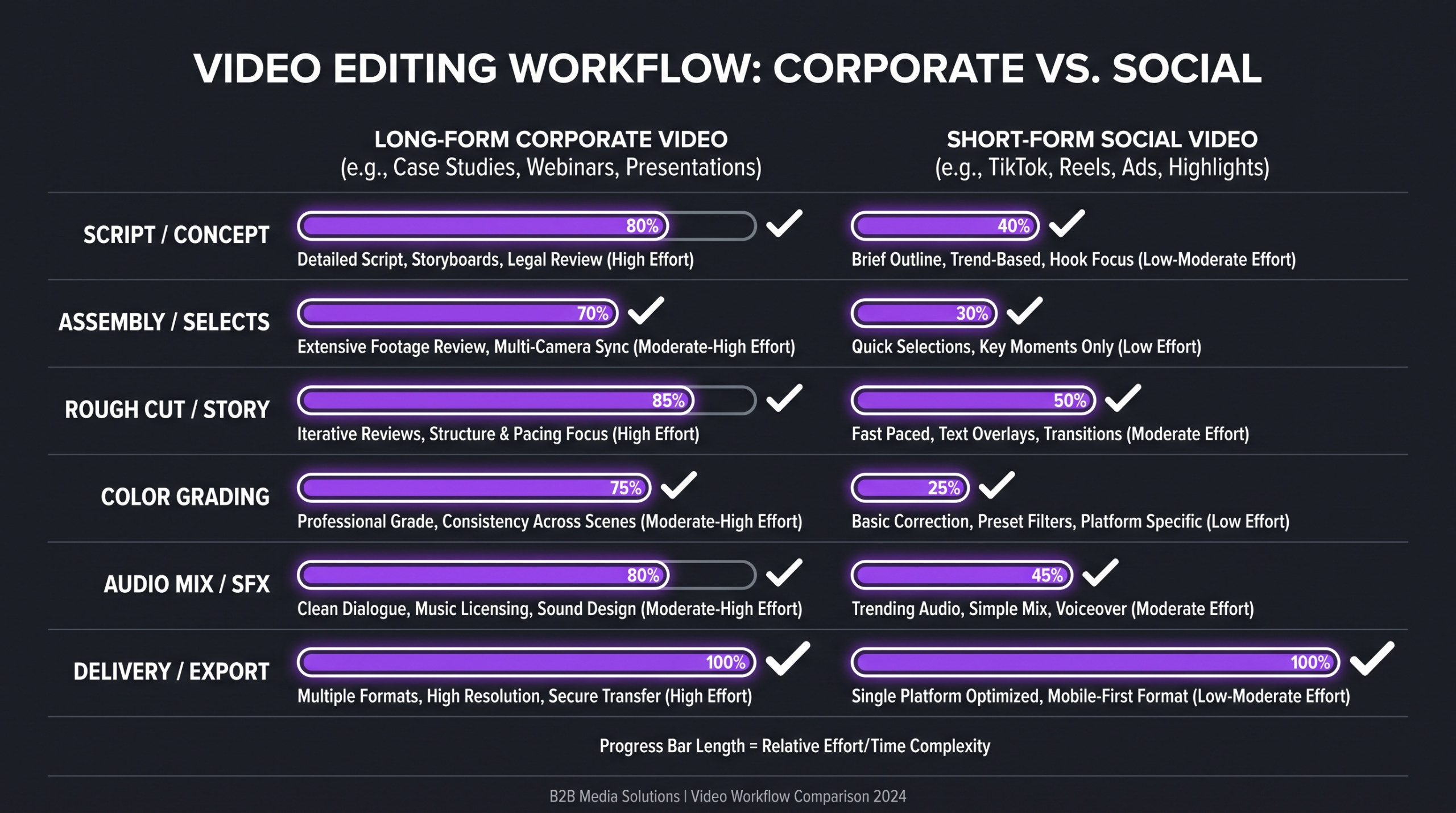
💡 Pro Tip: When briefing a short-form editor, specify the platform first, not the duration. “Instagram Reel” carries more useful formatting information than “60-second vertical video” — editors who know the platform will automatically apply the right caption style, safe zones, and export settings without being told.
Motion Graphics and Animation Services
Motion graphics is the category that bridges video editing and graphic design. An editor can assemble footage; a motion graphics artist creates visual elements that don’t exist in the footage — animated text, data visualizations, kinetic typography, branded lower thirds, and screen recordings with animated call-out arrows. This is a design discipline as much as a post-production one, and it commands a different price point for good reason.
2D Motion Graphics and Kinetic Typography
2D motion graphics — the bread and butter of this category — includes animated lower thirds, branded intros and outros, animated icons, and kinetic typography sequences where text moves and transforms in sync with audio. These elements are used across every other editing category: a long-form corporate film uses branded lower thirds; a short-form social video uses animated text hooks; a course module uses animated key-point callouts.
The distinguishing value of custom motion graphics over template-based elements is brand consistency. Template libraries (Envato, Motion Array, Motion Bro) accelerate production but result in visuals every other brand in the category also uses. Custom-built motion elements built in After Effects or Cavalry reflect brand guidelines precisely and become reusable assets across future productions, amortizing the initial design cost.
Animated Explainer Videos
Animated explainer videos — typically 60 to 180 seconds — are a distinct service type because they require original asset creation rather than footage assembly. The workflow begins with a script and storyboard, moves through illustration and character design (if character-based), then into animation. There is no raw footage involved; every frame is constructed. This makes explainer video production significantly more labor-intensive per minute of output than live-action editing.
Explainer videos are particularly effective for SaaS products and services that are difficult to demonstrate visually with live action — workflows, software interfaces, abstract concepts. The format works because animation can simplify complex processes into clear, sequential visual steps without the cognitive overhead of real-world footage.
3D Animation and Visual Effects
3D animation and VFX represent the highest-complexity, highest-cost segment of the motion graphics category. Product renders (a 3D model of a physical product rotating in space), architectural visualizations, and composited visual effects (integrating CG elements into live footage) all require specialized 3D software knowledge — Cinema 4D, Blender, Houdini — and significantly longer production timelines than 2D work.
Most marketing teams encounter 3D animation through product videos and launch trailers rather than through ongoing content production. The investment is justified by longevity: a high-quality 3D product video can anchor a product page for years without feeling dated in the way that live-action footage does.
Color Grading and Color Correction Services
Color work is one of the most misunderstood categories in video post-production because the terms are used interchangeably in everyday conversation — they shouldn’t be. Color correction and color grading are sequential steps with different objectives, different skill requirements, and different price points. Understanding the distinction helps you budget correctly and brief colorists accurately.
The Difference Between Correction and Grading
Color correction is the technical step: fixing exposure problems, normalizing white balance across clips shot in different lighting conditions, and ensuring consistent luminance so footage can be graded uniformly. It’s the foundation layer. Every professional video production — even content shot on a smartphone — benefits from at least basic correction.
Color grading is the creative step: applying a deliberate visual treatment — warmer tones for brand warmth, cooler desaturated looks for corporate authority, high-contrast cinematic looks for brand films. Grading is where footage develops a visual identity. Adobe’s color workflow documentation explains the technical pipeline well, but the creative judgment behind a grading style is what separates competent colorists from exceptional ones.
The industry standard tool for dedicated colorists is DaVinci Resolve (Blackmagic Design) — the same platform used in major film and television production. While Premiere Pro and Final Cut offer built-in color tools, teams producing brand films or any content with specific visual identity requirements typically benefit from a dedicated colorist working in Resolve.
When Standalone Color Services Make Sense
Standalone color services — hiring a colorist separately from the editing team — make sense in specific scenarios: when the production team shot RAW or LOG footage specifically to preserve color latitude; when a film or series requires consistent visual treatment across many episodes; or when a completed edit needs to be re-graded to match a refreshed brand identity.
For most marketing content, color is handled as part of a comprehensive editing service rather than as a standalone deliverable. The exception is high-stakes brand films and product videos where color is load-bearing for brand perception — in those cases, a dedicated colorist is worth the additional investment.
Sound Design and Audio Post-Production
Audio is the most underinvested category in video post-production among marketing teams, yet it’s the element viewers are most consciously aware of when it fails. Bad audio destroys credibility — even on a beautifully shot and edited video. Sound design and audio post-production as a standalone service category addresses the full pipeline from raw recorded audio to final mixed deliverable.
Music Licensing, Sound Beds, and SFX
Music selection and licensing for branded video content involves both creative and legal considerations. A music bed should support the emotional arc of the video without distracting from it, and it must be properly licensed for the intended distribution channel. YouTube’s Content ID system, for example, will flag and potentially mute or monetize videos using commercially licensed music without the appropriate platform license — a common and avoidable mistake.
Professional editing teams typically work with royalty-free music libraries (Artlist, Musicbed, Epidemic Sound) that provide blanket licensing for commercial use. Sound effect libraries complement music beds to add texture to otherwise visual-only moments: a software UI interface click, an ambient office environment bed, a subtle whoosh on a text animation transition.
Voice-Over Recording, Editing, and Mixing
Voice-over post-production covers the editing and mixing side of the audio pipeline: noise reduction, breath removal, room tone normalization, EQ, compression, and final mix against music and SFX. Some editing services include basic VO editing; dedicated audio post houses provide the full treatment including LUFS normalization to platform specifications (YouTube targets -14 LUFS; broadcast television -23 LUFS per EBU R128 standards).
For teams producing multilingual content — a growing requirement for global B2B brands — audio post-production services increasingly include voice-over localization workflows: editing translated voice tracks to match the video’s pacing, adjusting timing when translated dialogue runs longer or shorter than the original, and re-syncing on-screen captions to the localized audio.
Platform-Specific and Content Repurposing Services
Platform-specific editing services have emerged as a distinct category because different distribution channels have meaningfully different technical and editorial requirements. A YouTube channel edit is not just a “shorter version of the documentary” — it has a specific thumbnail-integration relationship, a subscriber-retention pacing structure, end screens, and chapter markers that affect algorithmic distribution.
YouTube Channel Editing Packages
YouTube-focused editing is one of the most mature platform-specific service categories. Editors who specialize in YouTube understand retention curve optimization — placing chapter markers at natural drop-off points, front-loading value in the first 30 seconds to establish a reason to stay, and pacing the revelation of information to maintain watch time. YouTube for Creators documents many of these principles, but applying them at speed requires hands-on editorial experience across many channels.
YouTube channel packages typically include: rough cut editing, color grading, captions and subtitles, intro/outro application, thumbnail frame selection, and chapter marker placement. Some services also include upload configuration (title, description template, tags, end screen setup) — bridging editing and channel management into a single deliverable.
Multi-Platform Repurposing Workflows
Content repurposing is the highest-efficiency play in modern video strategy: take one primary piece of content (a webinar, a long-form YouTube video, a podcast episode) and extract multiple platform-native assets from it. A 45-minute webinar becomes a LinkedIn article video, three YouTube Shorts, an Instagram carousel of key quotes, and a podcast clip. The repurposing editor’s job is to extract the highest-value moments and reformat them for each destination channel.
This service type has become strategically important for B2B content teams under pressure to produce more content with flat headcounts. Rather than creating 12 separate pieces of content monthly, a team can produce 2 anchor pieces and repurpose them into 10–15 platform-specific assets — a compounding return on the original production investment. For more on how a video editing agency handles repurposing vs. a freelancer, that comparison is worth reading before you source this service type.
💡 Pro Tip: When briefing a repurposing workflow, always brief the editor on the destination channels before they begin the primary edit — not after. Knowing that a long interview will become YouTube Shorts changes how the editor flags high-value moments during the rough cut, rather than having to hunt back through hours of footage after the fact.
Live Event and Broadcast Editing
Live event editing is a distinct service category because the raw material is fundamentally different from scripted production footage: it’s uncontrolled, often multi-camera, shot under inconsistent lighting, and frequently includes long stretches of low-value content surrounding the moments worth preserving. The editor’s primary job is intelligent extraction — finding the emotional and informational peaks in footage that wasn’t designed for post-production.
Conference Highlights and Event Recaps
Conference highlight reels and event recap videos serve multiple functions: internal documentation for stakeholders who couldn’t attend, marketing assets for future event promotion, and post-event engagement content for attendees. A well-produced 3-minute conference highlight captures the energy of a full-day event and compresses it into a shareable format that holds attention.
The technical challenges in event editing include managing audio from multiple sources (lapel mics, room mics, audience reactions), color-matching footage shot under venue lighting that shifts throughout the day, and synchronizing multi-camera angles. Turnaround time is also a pressure point: event content depreciates quickly, and same-day or next-day delivery requires teams that can work from proxy files and deliverable specs established before the event, not after.
Webinar Repurposing and Podcast Clips
Webinar and podcast video editing has grown significantly as B2B brands have invested in thought leadership content. A 60-minute webinar recording contains between 5 and 12 shareable moments — specific insights, data points, or memorable quotes — that can be clipped, captioned, reformatted vertically, and distributed across LinkedIn, Instagram, and YouTube Shorts as standalone clips. This is where live event editing overlaps with the repurposing service category.
Teams that run regular webinar series benefit from systematizing this repurposing workflow: a standing brief, standardized caption style, consistent branded frame template, and a turnaround commitment from the editing partner. The cost of professional video editing for this type of ongoing webinar repurposing typically works out significantly lower per clip when negotiated as a retainer than when commissioned per-project.
Matching Service Type to Your Project: A Decision Matrix
The most common mistake when procuring video editing services is starting with budget and working backward to service type. The more reliable sequence is the reverse: start with the output goal and distribution channel, derive the required service type, then budget for that service type accurately. The matrix below maps common project scenarios to their optimal service type combination.
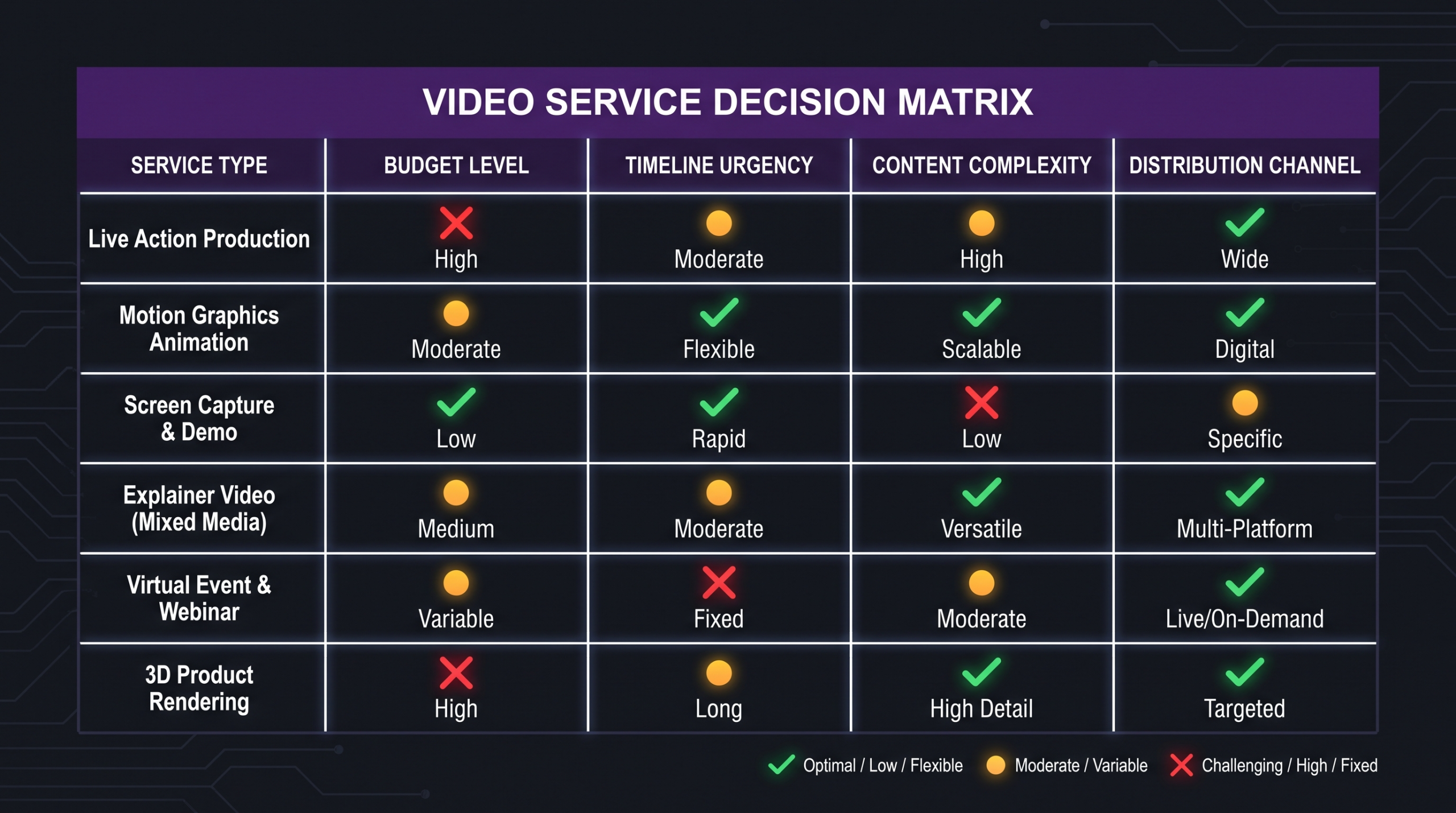
Increidtors’ teams work across all of these combinations simultaneously — handling the long-form brand anchor while concurrently running the repurposing pipeline for derivative social assets. If you’re evaluating whether you need a full-service video editing agency or a specialist for a single category, the checklist in our guide How to Choose a Video Editing Service maps selection criteria directly to scenarios like these.
One underappreciated insight from teams that manage high video output volumes: the service type combinations that compound most efficiently are long-form anchor content paired with a standing repurposing retainer. Producing a monthly 20-minute thought leadership video and then extracting 8–12 platform-specific clips from it delivers far more total distribution surface than producing 12 independent short-form videos — because the long-form content carries depth that the clips amplify. LinkedIn’s marketing solutions research on B2B video content consistently supports this format pairing for professional audiences.
Frequently Asked Questions
What is the difference between a video editor and a motion graphics artist?
A video editor assembles existing footage into a coherent sequence; a motion graphics artist creates visual elements that don’t exist in the footage — animated text, data visualizations, kinetic typography, and branded graphic elements. In practice, many editors have basic motion graphics skills for lower thirds and simple animations, but complex motion design requires a dedicated artist working in After Effects, Cavalry, or a 3D application. The distinction matters when budgeting: motion graphics work is generally priced higher per hour than straight cut editing because of the design and animation skill set involved.
Do I need separate services for color grading and editing, or can one editor do both?
For most marketing content — social videos, YouTube uploads, corporate communications — a skilled editor can handle both. The exception is content where color is a primary brand differentiator: brand films, product launch videos, scripted series, or anything intended for broadcast or streaming distribution. In those cases, a dedicated colorist working in DaVinci Resolve brings a level of precision and technical depth that general-purpose editors typically don’t match. The cost of a colorist pass is usually worth it for projects where visual identity matters as much as the edit itself.
Which type of video editing service is most cost-effective for high-volume content?
For teams with high output requirements — weekly or daily content — a platform-specific retainer that includes a repurposing workflow typically delivers the best cost-per-asset. Rather than commissioning individual short-form videos, producing one anchor piece of content monthly and repurposing it into 8–15 platform assets multiplies distribution without multiplying production cost. This model works best with a consistent editing partner who understands your content style and can move quickly without extensive re-briefing on each deliverable.
Can a single video editing service handle all eight types?
Full-service video editing agencies handle most or all of these categories under one roof by maintaining teams with different specializations — long-form editors, motion designers, colorists, audio engineers, and social-native editors. The advantage of a full-service partner is coordinated output: a single project brief can produce the brand film, the social clips, the motion graphics package, and the repurposed platform assets without handoff friction between separate vendors. Specialist providers, by contrast, excel within a narrower category — often at lower per-unit cost for that specific type, but requiring more client-side coordination across the production pipeline.
How do I brief a video editor on which service type I need?
The most effective brief starts with three specifics: (1) where the video will live (platform + format), (2) who will watch it (audience and their state of awareness), and (3) what you want them to do after watching (specific call to action). From these three inputs, a skilled editor can self-identify the correct service type and ask the right follow-up questions. Briefs that start with duration or budget first without specifying destination and audience tend to produce technically adequate videos that underperform on their actual goal. For a structured framework for briefing and evaluating service providers, see our full how to choose a video editing service guide.
Verdict: Building Your Video Editing Stack
The eight categories of video editing services are not competing options — they are complementary layers of a content stack. Most brands with a mature video strategy use three or four of them in parallel: long-form anchor content, short-form social distribution, motion graphics for visual identity consistency, and some degree of repurposing workflow to multiply reach from a fixed production budget.
The decision sequence that saves the most budget and revision cycles is this: map your distribution goals first, derive the service type from those goals, then scope your production budget against what that service type actually costs to do correctly. Reverse-engineering from a budget ceiling consistently produces content that underserves its intended function.
Understanding the taxonomy is step one. The next practical step is knowing what questions to ask a potential editing partner to verify they actually specialize in the type you need — not just that they list it in their service menu. An editing team that primarily works in social short-form will struggle with a 45-minute educational course, regardless of what their website says. Specialism matters, and the best way to verify it is through portfolio depth in the specific category, not by reading a service page.
If you’re evaluating a video editing partner across multiple service types, the operational breakdown of what a video editing company actually does is the right reference for understanding what to expect from each engagement model. And if you want an honest assessment of pricing across these categories, how much professional video editing costs maps ranges across service types with the hedged framing this topic actually requires.
Increditors operates across long-form, short-form, motion graphics, color, and repurposing workflows — with dedicated senior editors in each lane. If you’re building out a video content strategy and need a partner with range across these categories, the conversation starts at the link below.
Ready for Video That Actually Converts?
Tell us about your project and we will put together a custom plan.