








![3D Explainer Video - ScribbleLive.mp4_snapshot_00.12_[2022.03.09_03.14.16]](https://increditors.com/wp-content/uploads/elementor/thumbs/3D-Explainer-Video-ScribbleLive.mp4_snapshot_00.12_2022.03.09_03.14.16-r7wb53mx72rxst3qcqyrfxdmeyzb5r9jbl0wbjujh4.png "3D Explainer Video – ScribbleLive.mp4_snapshot_00.12_[2022.03.09_03.14.16]")



























Gaming video editing rates in 2026 range from roughly $15–$40 per hour for solo freelancers to $80–$200+ per hour for specialist agencies, with project pricing spanning $50 for a short highlight clip to $2,000+ for a polished esports brand film. Your actual number depends on content type, turnaround speed, revision cycles, and whether you need motion graphics or branded overlays. This guide breaks down rates by content format, creator tier, and service model so gaming channels, esports teams, and gaming brands can budget accurately.
What Makes Gaming Video Editing Different — and Why It Affects Rates
Gaming content sits at an unusual intersection of technical requirements, audience expectation, and sheer volume. A typical gaming editor does not just cut footage — they manage screen recordings that frequently run 4–8 hours for a single session, sync audio from multiple sources (in-game audio, microphone, optional face cam), add branded lower-thirds and overlays, and create the kind of pacing that keeps a gaming audience watching rather than clicking away. All of that adds cost and complexity that general-purpose video editing quotes rarely capture.
Gaming content also has a much wider format range than most other niches. A let’s play walkthrough has different editing needs than an esports tournament recap, which is completely different from a gaming essay or a 60-second gaming short designed for TikTok or YouTube Shorts. Each format has its own industry rate expectations, and conflating them leads to either overpaying for basic clips or underpaying for complex cinematic productions.
This guide focuses specifically on gaming content editing — not general professional video editing costs (which cover the full spectrum), and not just the narrow question of livestream clipping and editing costs. Here you will find rates for every format a gaming channel, esports team, or gaming brand actually produces.
The Technical Layer Most Quotes Miss
Gaming footage has a technical profile that raises baseline editing time. Screen recordings at 1080p60 or 4K are large files with long durations. Editors need to scrub through hours of raw footage to find the moments that matter. Face cam synchronisation, in-game audio mixing to avoid copyright-flagged background music, and subtitle generation for accessibility all add to the scope. An editor who lacks gaming-specific context — who does not know what a clutch play looks like or why a particular game moment matters — will take longer to make the same cuts. That slower workflow eventually shows up in your invoice.
Editors who specialise in gaming content typically charge a premium for their domain knowledge, but the efficiency gains frequently justify it. A generalist editor might spend four hours navigating six hours of Valorant gameplay to build a ten-minute video. A gaming specialist doing the same job might take two hours because they know instinctively which rounds are worth keeping.
💡 Pro Tip: When getting quotes from gaming editors, always ask whether their rate includes source footage review time — some quote only for the actual edit, leaving you to pay separately for the hours spent reviewing raw recordings.
Gaming Video Editing Rates by Content Type
The format you produce matters more than almost any other variable when it comes to editing rates. Let’s plays, montages, esports recaps, gaming essays, and short-form clips each have their own complexity profiles and market rate expectations. Below are the ranges you can expect to encounter in 2026 across freelance platforms and agency tiers.
Let’s Plays and Walkthrough Content
This is the bread-and-butter format for most gaming YouTube channels and historically the format with the most price variance. Rates span widely because scope varies so much. A basic let’s play edit — trimming dead air, syncing face cam, adding intro and outro — is a different job from a let’s play that includes chapter markers, custom animated transitions, audience engagement cards, and subscriber milestones overlaid at the relevant timestamp.
At the lower end of the freelancer range ($80–$120 per video), expect minimal post-production: clean cuts, basic colour correction, and a supplied intro template. At $200–$250 per video from a freelancer, you start getting custom motion graphic elements, more thoughtful pacing work, and chapter structuring. Agency production in this space typically starts around $300 and scales with the level of polish required for the channel.
Highlight Montages and Kill Compilations
Montage editing is more skill-intensive per minute of finished video than most gaming content types. The editor needs to identify specific high-action moments within long VODs, cut them to music with precise beat synchronisation, add text overlays and sound effects, and create the sense of continuous energy that makes montages watchable. This is a craft with its own techniques and community aesthetic standards that vary by game (Fortnite montages look different from Apex Legends compilations, which look different from fighting game highlight reels).
Rates for montages also reflect the music licensing situation. Editors who use royalty-free tracks charge differently from those who edit around licensed music with timing that avoids Content ID hits. Some creators pay additionally for the music licence sourcing itself, which can add $20–$80 per video depending on the track source.
Gaming Essays and Long-Form Video Reviews
Long-form gaming essays — the style popularised by channels covering narrative design, game history, or industry criticism — command the highest per-video rates in the gaming content space. These videos blend scripted voiceover with gameplay footage, archival clips, text overlays, animated diagrams, and documentary-style pacing. The editing is closer to short documentary production than traditional gaming content editing, which explains the premium.
A gaming essay in the 15–30 minute range handled by a skilled freelancer with documentary experience might run $400–$600 per video. The same output from a premium video editing agency with senior creative editors will typically start at $800–$1,200 and scale with scope, revision cycles, and whether custom animations are required.
Freelancer vs Agency: Rate Comparison for Gaming Content
The choice between a freelancer and an agency for gaming video editing is not purely a cost question — it is a capacity and consistency question. Understanding the rate landscape helps you evaluate what you are actually getting at each price point.
The decision tree is fairly straightforward. If you are producing one or two videos per month and are still learning what style you want, a mid-tier freelancer is usually the right call. When you are consistently publishing four or more videos per month, brand consistency becomes a real problem — a single editor going offline for two weeks can crater your upload schedule. That is when agencies with dedicated teams start to make financial sense despite the higher headline rate.
For a full breakdown of how the agency vs freelancer decision plays out across creator types and budgets, that guide covers the tradeoffs in much more depth.
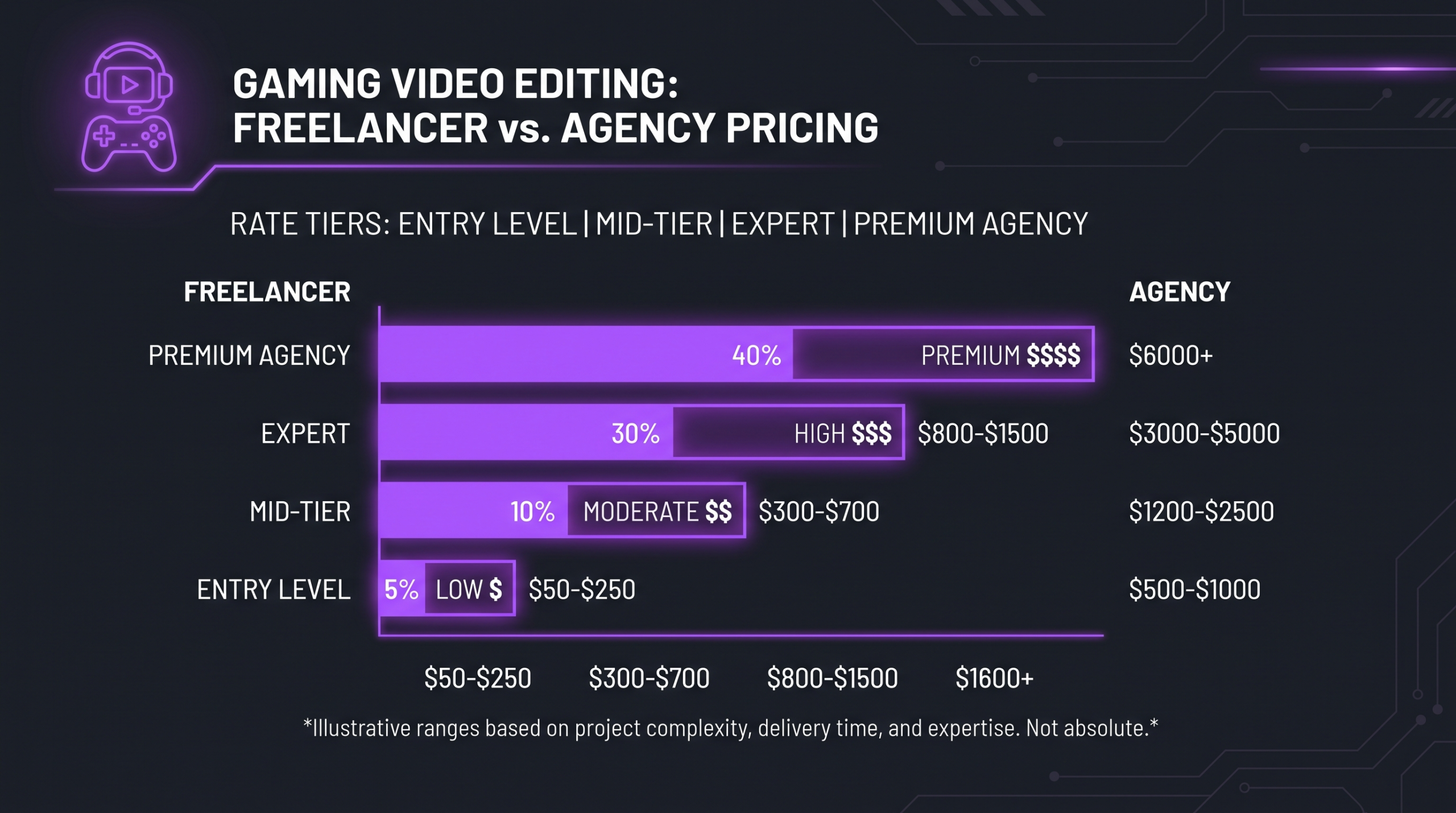
Rate ranges vary significantly by editor specialisation, content type, and turnaround requirement.
Gaming Video Editing Rates by Creator Tier
Creator tier affects editing rates in two ways: it shapes the budget available, and it changes the expectations for quality and turnaround speed. A creator with 50,000 subscribers has different leverage in negotiations and different tolerance for revision cycles than a creator with 2 million subscribers who needs to publish on a tight weekly schedule to maintain algorithm momentum.
Emerging Creators (Under 100K Subscribers)
At this tier, the budget reality is constrained. Most creators are not yet generating meaningful ad revenue, and sponsorship deals — if they exist at all — are modest. Editing budgets typically run $150–$600 per month for a consistent publishing schedule (two to four videos per month). Entry-level freelancers, often found on platforms like Fiverr or Upwork, service most of this tier.
The quality gap at this tier is worth understanding. Creators sometimes try to minimise editing costs by using template-heavy, low-cost editors whose output is recognisably generic. That is a calculated risk: it keeps costs down while the channel is still finding its audience, but it can also suppress growth if the editing style does not match the channel’s personality. The most cost-effective path for emerging creators is often to find one mid-range gaming freelancer and invest in a longer-term relationship rather than shopping for the cheapest option each video.
Mid-Tier Creators (100K–1M Subscribers)
This is the tier where editing becomes a genuine business investment rather than a variable experiment. Monthly ad revenue at this subscriber range can support meaningful editing budgets — commonly $800–$3,000 per month for a weekly or bi-weekly publishing schedule, with higher spending for channels that publish daily or produce long-form content. The calculation that mid-tier creators increasingly make: if better editing increases average view duration by even 10%, the CPM and sponsorship value generated by that improvement can pay for the upgrade in quality multiple times over.
YouTube’s own creator data consistently shows that watch time and average view duration are among the strongest signals for channel recommendation. This is why editing quality — particularly the pacing decisions that determine whether a viewer keeps watching — has a direct and measurable relationship to channel growth at this tier.
Large and Enterprise Gaming Channels (1M+ Subscribers)
At this scale, editing is part of a full production infrastructure. Channels publishing multiple videos per week with high production standards typically spend $4,000–$15,000 per month on editing, depending on format mix. The outputs at this tier often include multiple content types simultaneously: long-form YouTube content, short-form clips for TikTok and Shorts, edited highlights from live streams, and occasional branded or documentary-style productions.
Teams at this tier almost always work with dedicated agencies or in-house editors, since the consistency and volume requirements exceed what any individual freelancer can reliably deliver. They also tend to have separate contracts for motion graphics work, which is often handled as a distinct service from the editing relationship.
💡 Pro Tip: If your channel publishes more than eight pieces of content per month across multiple formats, calculate your editing cost per video published — not total monthly spend. This makes it easy to benchmark against alternatives and identify where investment in higher-quality editing is delivering outsized returns.
Esports Team and Gaming Brand Video Editing Rates
Esports organisations and gaming brands are a distinct client category from individual content creators, and their editing rate landscape reflects that. The key differences: higher production standards driven by sponsor relationships, tighter deadlines tied to tournament schedules, and a far more varied content mix that might include broadcast-ready recap videos, social media clips, player spotlight features, and brand deal activations — all within the same week.
Esports Tournament and Event Recap Production
Tournament recap videos are among the most technically demanding content in the gaming space. Editors must work with multi-POV footage, broadcast overlays, player webcams, official broadcast recordings (which may have usage restrictions), and sometimes crowd footage. The finished video needs to tell a coherent story of a multi-hour competitive event in ten to twenty minutes while maintaining the energy and drama that made the live experience compelling.
Rates for this work reflect the complexity. Freelancers who specialise in esports production commonly charge $500–$1,200 per recap video. Agencies handling this type of production — where multiple editors may work simultaneously on a single deadline-driven project — typically quote $1,000–$3,500 per event recap depending on the raw footage volume, revision requirements, and motion graphic complexity. The competitive gaming market has grown substantially, and so has the production quality expectation for official team and league content.
Player Spotlight and Brand Activation Videos
Player spotlight features and sponsor activation videos for gaming brands are priced closer to commercial video production than gaming content editing. These videos typically require face cam or studio footage, scripted voiceover or interview segments, branded motion graphics that meet sponsor guidelines, and a level of colour grading and audio mastering that matches broadcast quality expectations.
Per-video rates in this category commonly run $800–$2,500 for freelance production and $2,000–$6,000 for agency production. Gaming brands committing to ongoing production relationships — typically quarterly or annual retainers — often negotiate to 15–25% below the per-video rate. For esports teams producing this type of content at scale (multiple videos per month for sponsors), the economics of a monthly retainer arrangement almost always outperform per-video pricing.
Social Media Clip Pipelines for Esports
The volume requirement for esports social media is significant. During an active tournament, an organisation might need fifteen to thirty clips per day across platforms — highlights from the day’s matches, player reaction moments, clip compilations for Twitter/X, and Shorts-formatted clips for YouTube. This is not the same service as individual video editing — it is a clip production pipeline with its own workflows and rate structures.
Clip pipeline services are typically quoted on a monthly or per-tournament basis rather than per clip. Monthly rates for a dedicated clip editor handling an active esports social media account commonly run $1,500–$4,000 per month. For tournament periods requiring surge capacity, many agencies offer event-specific packages at $2,000–$8,000 per event depending on the organisation’s size and content requirements. Note that this is distinct from the broader category of Twitch stream editing services, which focuses on VOD editing for individual streamers rather than team social pipelines.
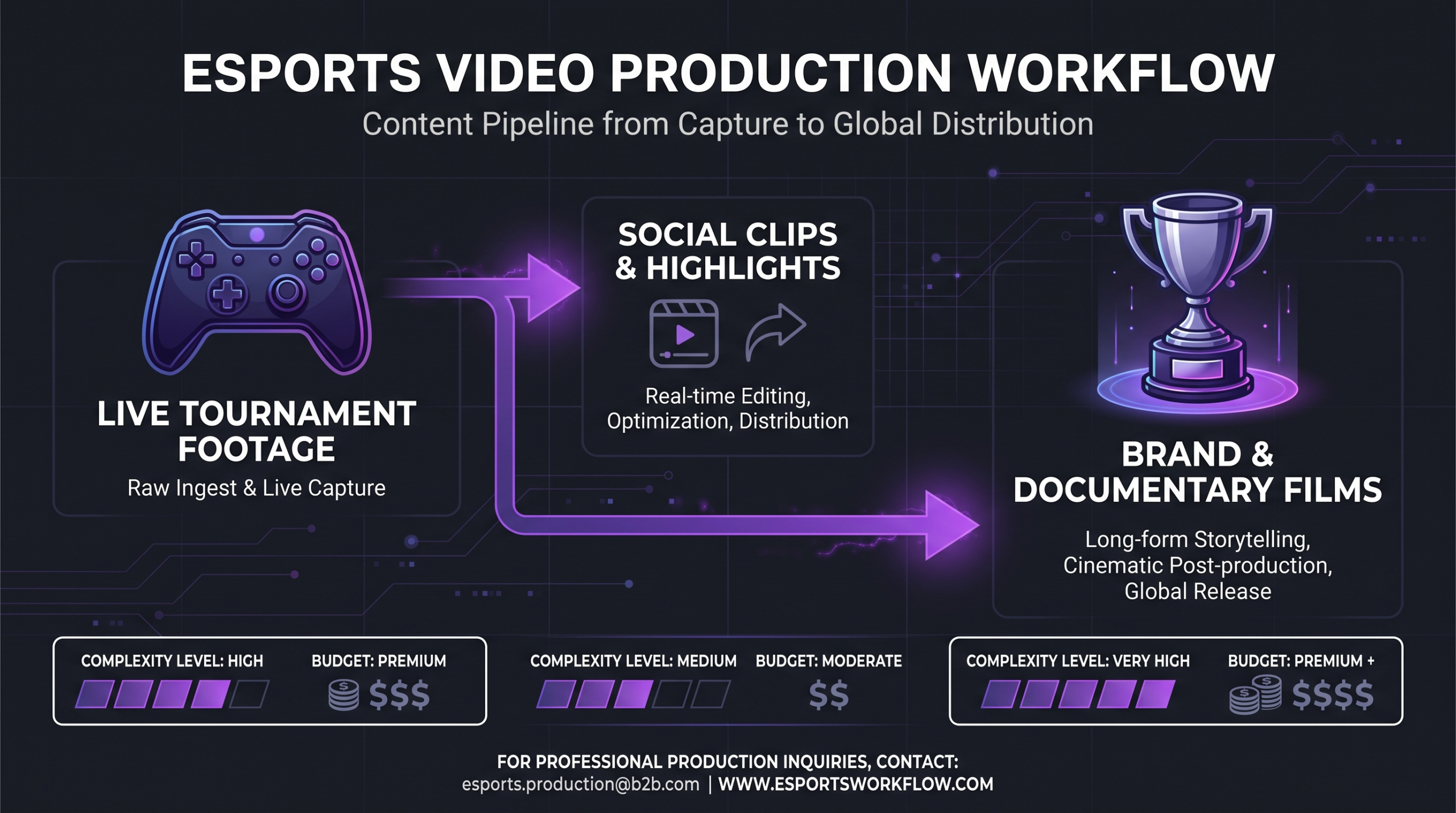
Esports organisations often require multiple simultaneous content types with tight tournament-day turnarounds.
What Drives Gaming Edit Costs Up or Down
Before committing to any quote, understanding the levers that move the price helps you evaluate whether what you are paying for matches what you actually need. Gaming content editing has specific cost drivers that differ from other video categories.
Factors That Increase Rates
Rush turnaround: Any delivery time under 48 hours typically attracts a 25–50% surcharge. For esports content tied to tournament moments, rush delivery is often not optional — and responsible budgeting accounts for it. Some editors offer guaranteed 24-hour delivery as part of a higher-tier retainer rather than as a per-job surcharge.
Custom motion graphics: Branded lower-thirds, custom overlay packages, animated intros, and title cards are a separate discipline from video editing. Editors who handle both typically charge $50–$200 extra per video for custom graphic work. Organisations with existing graphic asset libraries pay less; those requesting ground-up brand system development for their channel or team should expect separate motion design quotes.
Footage complexity and volume: Providing six hours of raw gameplay for a fifteen-minute final video is different from providing ninety minutes of curated footage. Editors who charge per hour of raw footage reviewed — rather than per finished minute — are pricing this accurately. If a quote does not address raw footage volume, ask explicitly, because unclear scope here is one of the most common sources of invoice disputes in gaming content production.
Revision rounds: Most freelancers include one or two revision rounds in their base quote. Unlimited revisions or additional rounds are charged separately, typically at the same hourly rate as the editor’s base fee. Agencies with structured revision policies generally have clearer terms here than individual freelancers.
Multi-format delivery: Producing a YouTube long-form video and a vertical clip variant and three thumbnail-format scenes from the same footage is not the same job as producing one output. Multi-format deliverables should be priced separately or as a bundle — expect to pay 30–60% more than the single-format rate when requesting simultaneous vertical, horizontal, and square formats. According to Bureau of Labor Statistics data, professional video editors’ median wages have risen steadily, and specialist gaming editors at the top of their tier command rates that reflect multi-platform expertise.
Factors That Reduce Rates
Volume commitments: Promising consistent work lowers your per-video rate. An editor who knows they will receive four videos per month from you can offer better pricing than an editor who receives one video every six weeks. Most editors will offer 10–20% off per-video rates for a three-month or six-month volume commitment. Agencies typically structure this as formal retainer tiers.
Providing structured assets: Delivering pre-trimmed footage (not six hours of raw recording), a complete brand asset folder with all overlays and intro elements ready to use, and clear timestamps noting key moments reduces the editor’s working time significantly. Some editors charge separately for asset organisation or deduct time from their quote when assets arrive clean and structured.
Flexible turnaround: Removing rush requirements and allowing five-to-seven day standard turnaround can reduce project costs by 20–30% compared to 48-hour delivery expectations. If your upload schedule allows for buffer time, communicating that flexibility during quoting can meaningfully shift the rate.
How to Budget for Your Gaming Channel or Team
Translating rate knowledge into an actual editing budget requires knowing your content volume, your quality tier target, and the realistic cost of both. Below is a practical framework for gaming creators and teams at different stages.
The 20% Rule for Monetised Channels
A commonly cited rule among creators who treat their channels as businesses: allocate roughly 20% of monthly channel revenue to production costs, with editing as the largest line item. This is not a rigid formula — it is a starting heuristic. At early monetisation stages, you may need to invest more than 20% to accelerate growth. At large-channel scale, 10–15% may cover exceptional quality editing because the revenue base is large. The point is that editing should be treated as a revenue-linked investment, not a fixed cost to minimise.
Monthly Budget Scenarios
The streaming ecosystem has created a two-speed content model for gaming channels: VOD content (long-form YouTube videos) and live clip content. Many gaming creators now produce both, which means their editing budget needs to account for two distinct production pipelines with different rate structures. For creators also actively streaming, understanding the separate cost structure for livestream clipping and editing is important before bundling both into a single editing quote.
When to Move to an Agency Model
The inflection point most gaming creators encounter: they have found a good freelancer, the channel is growing, but capacity is becoming a constraint. The editor takes on too many clients or has an emergency, and the upload schedule slips. Consistent publishing is one of the most important factors in YouTube algorithm momentum, and a two-week gap in uploads can set a growing channel back disproportionately.
A specialist video editing agency with gaming experience solves the capacity problem by providing a dedicated editor backed by a team. When your editor takes time off, another trained-to-your-style editor steps in. For channels where consistent publishing directly drives revenue, that reliability has a calculable financial value that justifies the agency premium. Increditors, for example, works with gaming creators and brands who need that kind of consistent throughput without quality dips between videos.
Frequently Asked Questions
How much does it cost to edit a 10-minute gaming video?
A standard 10-minute gaming video — think let’s play or gameplay walkthrough with basic motion graphics, face cam sync, and clean pacing — typically costs $80–$200 from a mid-tier gaming freelancer and $250–$500 from an agency. If the video includes extensive custom motion graphics, multiple POVs, or complex sound design, expect the upper range. Rush delivery (under 48 hours) usually adds 25–50% to the base rate.
What is the difference between gaming video editing rates and regular video editing rates?
Gaming video editing involves domain-specific knowledge (knowing which gameplay moments matter), experience handling very long raw recordings, familiarity with gaming community aesthetic expectations, and often the ability to work with branded overlay systems that gaming channels use. Generalist editors may charge less per hour but take longer on gaming content, often delivering lower-quality results because they lack the context to make good creative decisions within the footage. Specialist gaming editors command a modest premium — typically 15–30% above generalist rates — but deliver better results per dollar spent on gaming-specific content.
Are gaming video editing rates on Fiverr representative of market rates?
Fiverr rates for gaming video editing span a very wide range — from $5 for extremely basic cuts to $300+ for experienced specialist editors on the platform. The lower end of Fiverr pricing reflects editors working in lower-cost markets with limited experience; the output quality often matches. Experienced Fiverr sellers with verified gaming portfolios tend to price within the lower-to-mid freelancer ranges in this guide. Fiverr is a reasonable sourcing channel for emerging creators; for established channels or esports organisations with brand standards, direct relationship sourcing or agencies tend to produce more reliable, consistent results.
How do esports teams typically contract video editing work?
Most esports organisations use a combination of in-house production staff and agency or freelance support. The in-house team typically handles day-to-day social clip production and tournament VODs, while agency partners handle higher-production-value content like brand deals, player spotlights, and season-opening brand films. Retainer arrangements with agencies — commonly structured as monthly commitments with defined deliverable counts — are the norm for organisations producing content at consistent volume. StreamElements’ streaming industry data reflects the growth in professional content production across the esports ecosystem, which has driven demand for higher-quality post-production partnerships.
Should I pay per video or per hour for gaming editing work?
For gaming content, per-video pricing is generally preferable to hourly pricing for the creator. It gives you cost certainty, creates an incentive for the editor to work efficiently, and makes budgeting predictable. Hourly pricing is appropriate when scope is genuinely unknown in advance — for example, when commissioning a new content format for the first time or handling a large, unusual project with unclear raw footage volume. The risk with hourly pricing on gaming content specifically is that raw footage review time can vary enormously, creating invoice surprises. Negotiate a per-video or per-project rate with a scope definition and an agreed rate for out-of-scope additions.
Verdict: What Should You Actually Pay for Gaming Video Editing?
The gaming video editing market in 2026 rewards specificity. Creators and organisations who go into the market knowing their content type, volume requirements, quality expectations, and turnaround needs consistently get better rates and better results than those who search for “cheap gaming editor” without a clear brief.
A practical rate baseline for planning: budget $100–$200 per video for mid-tier freelance gaming editing on standard YouTube content (let’s plays, highlights, reviews). Plan for $300–$700 per video for agency-quality output with motion graphics and multi-format delivery. Esports event and brand production sits above that range, often in the $1,000–$3,500 per project territory depending on scope.
The cost that is hardest to see in a rate card is the cost of inconsistency — of editors going offline, missing deadlines, or delivering quality that drifts video to video. For gaming channels where the algorithm rewards consistent publishing and view duration, the hidden cost of unreliable editing relationships often exceeds any savings from choosing the cheapest option. That is the argument for investing in quality and reliability at whatever tier your budget supports. For a broader perspective on how professional video editing costs compare across content categories, that guide provides useful context alongside the gaming-specific rates in this one.
Ready for Gaming Video Editing That Actually Delivers?
Tell us about your channel or gaming brand and we will put together a custom production plan — whether you need weekly YouTube editing, esports recap production, or a full multi-format content pipeline.