





































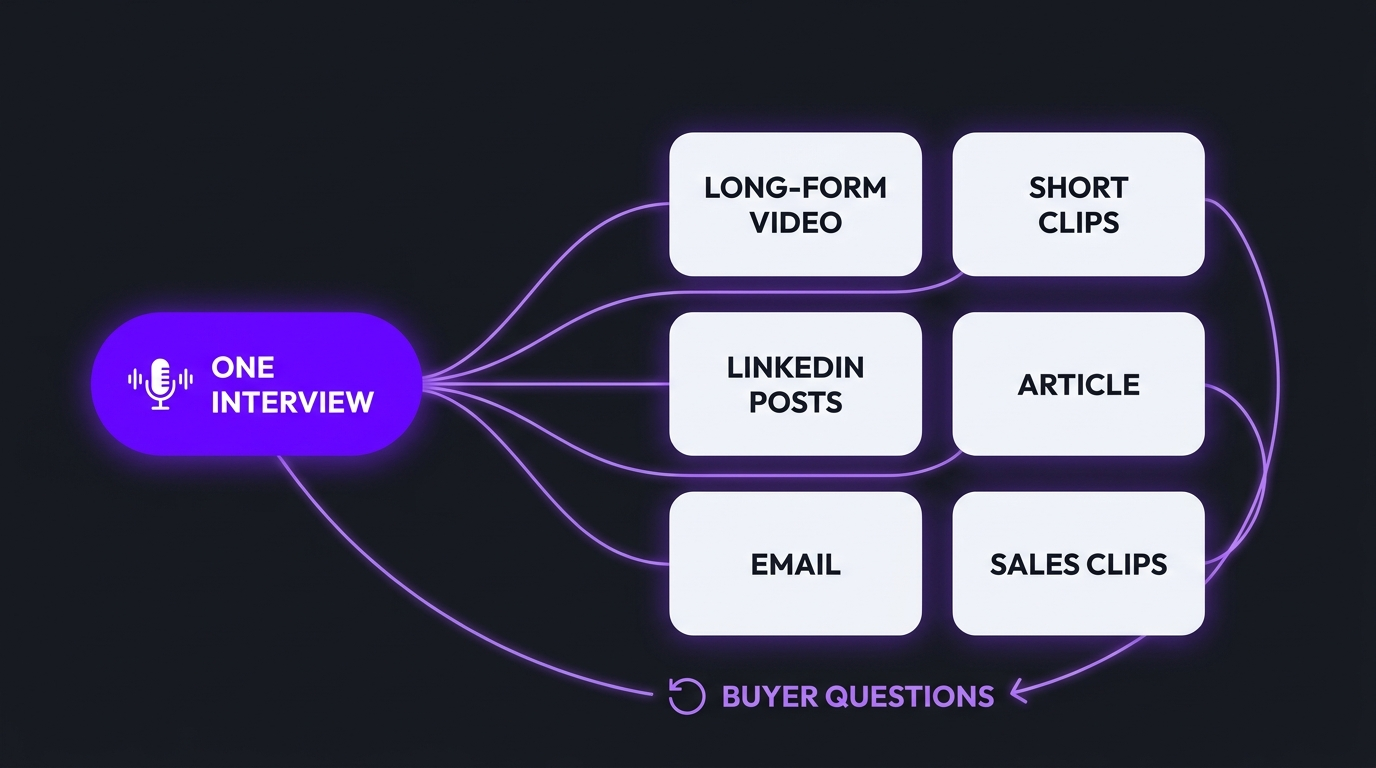
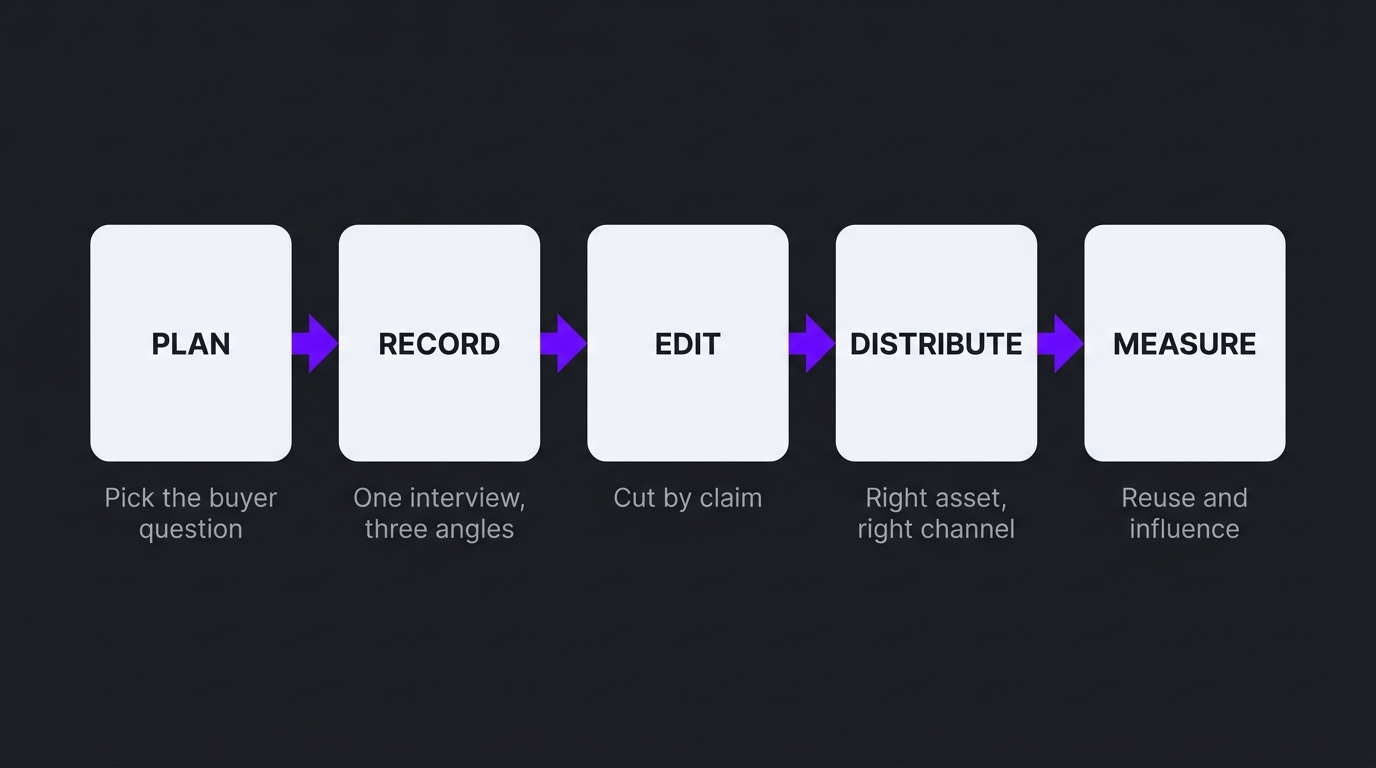
A B2B video content engine turns one well-planned expert interview into a library of assets: a long-form video, a handful of short clips, a motion explainer, written pieces, email and sales material. It runs in five stages: plan the buyer question, record with several angles in mind, edit by claim, distribute by buyer stage, and measure what influenced real deals. Twenty assets is a planning menu for a strong 45 to 60 minute interview, not a promise. The engine only works as a loop, so topics for the next interview come from what sales and the data tell you about the last one.
A B2B video content engine is a repeatable system that converts one scarce resource, expert time, into a steady flow of buyer-facing video, written and sales assets built around the questions your buyers actually ask. For a software or tech company selling a complex product, the expensive part of content is never the camera. It is getting a founder, engineer or customer to explain something accurately for an hour. An engine makes sure that hour is planned, captured and reused deliberately instead of published once and forgotten.
How this differs from what we have already published: our guide to video repurposing defines the idea and its ROI, our interview-to-clips guide goes deep on cutting one conversation into platform formats, and our video repurposing service explainer describes what a repurposing vendor delivers. This post is the layer above all three. It treats repurposing as one stage of a pipeline and shows how to design the whole system: who to interview, how to design the conversation, what the asset menu looks like, how to schedule distribution and how to close the loop with data.
We write this as the video editing company that works with AI, data and deep-tech companies on exactly this kind of recurring system. Audience for this post: founders and marketing leads at B2B tech companies who have experts, a considered sale and not enough hours.
- What a content engine is (and is not)
- Why complex B2B products need an engine
- The five stages
- Stage 1: Plan around buyer questions
- Stage 2: Record with reuse in mind
- Stage 3: Edit by claim
- The 20-asset menu
- Stage 4: Distribute by buyer stage
- Stage 5: Measure and feed the loop
- Who does what
- How this played out
- Common mistakes
- Accessibility and findability
- In-house or with a partner
- Frequently asked questions
- Verdict
What a content engine is (and is not)
The phrase “content engine” gets used loosely, so it is worth pinning down. In this post it means a system with four properties: a defined input (a scheduled expert interview), a defined output (a menu of assets), defined owners at each stage, and a feedback loop that changes the next input. Take away any one and you have something else.
Content marketers sometimes call the loop a “flywheel”: each piece of content produces signals (questions, objections, search terms, sales usage) that make the next piece better targeted. That image is useful as long as you can name the actual signal. If you cannot say what data goes back into planning, you have a calendar, not an engine. For background on the discipline itself, see the overview of content marketing.
Why complex B2B products need an engine
Three features of a considered B2B sale make a system worth more than a series of isolated videos.
Expert time is the bottleneck
In a software company selling something technical, the people who understand the product best are the founders, the engineers and a few customers. Their calendars are the scarcest input in your content operation. A system that extracts maximum reusable material from every hour they give is cheaper than one that asks them to record a new video for each channel.
The buying committee needs different things
A technical evaluator wants to know how it works, a finance reviewer wants to know why it is worth it, an executive sponsor wants the short version and a champion wants something to forward. One interview can supply all four if it is designed to, and an engine makes that design deliberate. The LinkedIn B2B Institute publishes research on how marketing works in B2B markets, which is a good place to test any assumptions about long buying cycles against evidence rather than opinion.
Consistency beats bursts
Buyers form a view of you across many small encounters. A library that grows steadily, in a consistent voice, with accurate answers to real questions, builds that view better than a launch-week burst followed by silence. That is a scheduling and ownership problem, which is exactly what a system solves.
💡 Pro Tip: Ask which of your last five lost or stalled deals would have gone differently if the champion had had a clear five-minute video to forward. That list is your first set of interview topics.
The five stages
The engine has five stages. Each stage has one owner, one output and one check, so nothing waits on a vague hand-off.
Stage 1: Plan around buyer questions
Most weak content starts with “what should we post about?” An engine starts with “what is the buyer trying to find out, and who on our side can answer it best?” The brief that comes out of this stage is short, but it decides whether the interview produces twenty usable assets or three.
Where buyer questions come from
- Sales calls and discovery notes. The questions asked in the first twenty minutes of a call are your highest-intent topics.
- Lost and stalled deals. The objection that ended a deal is a topic with proven commercial weight.
- Support and onboarding tickets. Confusion after purchase is usually confusion before purchase too.
- Search and AI-assistant queries. Look at how buyers phrase category questions; Google’s guidance on helpful, people-first content is a useful test of whether a topic serves a reader or only the publisher.
- Previous engine output. Which clips did sales actually send? Which videos did prospects mention? Feed those answers back in.
Choose the guest by the question
Write the three-angle brief
For each interview, write down three angles before you record: the claim (the one thing you want the viewer to believe), the story (a concrete example that makes it believable) and the action (what a viewer should do or consider next). An interview designed this way produces clips that stand alone, because each segment already has a claim, evidence and a next step. Our post on educational video content for B2B explains why the claim should teach rather than pitch.
Stage 2: Record with reuse in mind
The recording session is the only moment the expert is in the room, so designing it for reuse is the highest-leverage move in the engine. A few decisions made here save hours in editing.
- Ask one question per claim. Short, specific questions produce short, specific answers that clip cleanly. A rambling “tell me about your product” produces one rambling answer.
- Ask for the example, then the lesson. Stories give clips an emotional anchor; the lesson makes them quotable.
- Re-ask the hard sentence. If the guest buries the point, ask them to say it again in one sentence. That sentence is your clip title.
- Capture clean audio. Separate tracks per speaker, a quiet room and headphones for the guest remove noise problems that no edit can fully hide.
- Record a few direct-to-camera answers. Two or three tight statements to the viewer give you clean openers and closers for clips.
- Keep a running claim list. Whoever hosts the interview notes each distinct claim with a timestamp, which becomes the editor’s map.
💡 Pro Tip: Ten minutes at the end of the session is the cheapest time to ask, “What is the one thing a sceptical buyer should walk away believing?” The answer is usually your best short clip and your best email subject line.
If the interview is remote, record locally on each side where possible, because a recording of a video call is rarely as clean as local capture. If your team already runs a podcast, our podcast clip strategy covers how to select moments, and our post on what B2B teams should expect from a podcast-to-YouTube agency describes the vendor side of that workflow.
Stage 3: Edit by claim, not by time
The common repurposing mistake is cutting by time: take minutes five to six, then minutes twelve to thirteen. Cutting by claim means starting from the claim list and building each asset around one idea. A claim-based edit has three consequences that matter for B2B.
- Every clip stands alone. A viewer who has never seen the full interview should be able to state the claim after thirty seconds.
- Context is added, not assumed. A line of on-screen text, a quick motion graphic or a one-sentence setup supplies what the full conversation had built up.
- Technical accuracy survives the trim. Shortening an expert’s sentence can change its meaning. A claim ledger, where every cut statement is checked against the original, prevents the quiet errors that damage credibility with technical buyers.
Keep a claim ledger
The ledger is a one-page document, not a project-management system. Its job is to make approval fast: the expert reviews claims, not frames, which cuts the review burden on their time. For process detail, see our guide to video approval workflows.
The 20-asset menu
Below is a planning menu for a strong 45 to 60 minute interview. Treat it as a ceiling to plan against, not a quota. Some interviews will support fewer assets, and that is fine; the point is to know what is available before you decide what to publish.
The numbers in the first column are not a target, they are a way to show how many distinct, defensible uses a single conversation can support when it is cut by claim. A research-heavy interview may yield a stronger article and FAQ block but fewer clips. A story-heavy customer interview may do the reverse. Your editor should tell you honestly which assets are worth making from a given recording and which would be padding.
💡 Pro Tip: Ship assets in order of buyer value, not in order of how easy they are. A sales clip that answers a live objection is worth more than a quote graphic, even though the graphic takes ten minutes.
Stage 4: Distribute by buyer stage
Publishing every asset at once wastes the engine. Spread the output over the following weeks so each channel gets something fresh and you can see what is landing before committing the rest. A representative four-week rhythm for one interview looks like this.
Match asset to channel
On the short-versus-long question, resist treating them as competitors. Short clips are distribution and long-form is the destination; we looked at the trade-offs in our Shorts versus long-form data post. In an engine, a short clip should always point somewhere: the full episode, the article or a related video.
Stage 5: Measure and feed the loop
The loop is what turns a pipeline into an engine. You do not need a complex model, but you do need a monthly review that changes next month’s brief. Four signals are enough for most B2B tech teams.
Be careful with vanity numbers. Views on a clip tell you what attracted attention; they do not tell you what moved a deal. A clip that eight prospects were sent by their account executives is doing more commercial work than one that got a lot of casual views. If you want more on the principle, our video marketing strategy playbook covers goals and measurement across the whole program.
Who does what
The most common reason an engine stalls is unclear ownership. Here is a simple division that keeps expert time small and quality high.
One person must own the whole loop. If marketing owns planning, the editor owns production and nobody owns the review, the engine produces assets but never learns.
How this played out
Stratabeat is a B2B marketing agency that works with Increditors on a monthly retainer. Their business sells into a complex, considered sale, which is the situation where a one-off video does the least and a steady library does the most. Their own summary of the work is that “the videos are helping,” in a complex considered sale. That is a client’s own verdict on a recurring system, not a measured result for any specific engine, and we do not claim figures we cannot back. You can see how we describe our client work on the case studies page.
What we take from that kind of relationship is the principle behind this post: in a considered sale, steady, well-edited, accurate output beats occasional large bets, and the retainer shape exists so that planning, production and review run on a rhythm the client can rely on.
Common mistakes
Accessibility and findability
Every asset in the engine should be usable by people who cannot or do not want to watch with sound, and by search engines and AI assistants that read text. That is not a nice-to-have; for a B2B audience it affects whether your content is understood in a muted office, a meeting or a screen reader.
- Captions on every video. The W3C’s guidance on captions and subtitles is a good baseline; our video accessibility guide covers the practical workflow.
- A transcript page with chapters. It makes the interview searchable and gives AI assistants a clean text source. YouTube’s video chapters feature lets viewers jump straight to the segment they need.
- Video markup and indexing hygiene. Google’s video SEO guidance explains how to make embedded videos discoverable.
- Answer-first writing in the article and FAQ. Lead with the direct answer, then the support, as this post does.
In-house or with a partner
A first interview or two can run in-house. Beyond that, the economics usually shift: a steady cadence needs consistent editing quality, clip-selection judgement, motion design for the hard concepts and a review discipline that does not rely on whoever has time that week. Our guide to what professional video editing costs helps you compare options, and our guide to choosing a B2B video marketing agency offers a scorecard for vetting a partner. If you are thinking about a founder-centred version of this system, see our founder-led content agency breakdown.
At Increditors we work as a strategy-led partner rather than a production vendor: we help define the buyer question and the three-angle brief, then cut, produce and quality-check the assets on a rhythm. Your team keeps what only it can do, which is choosing the topics and approving the facts.
Frequently asked questions
What is a B2B video content engine?
A B2B video content engine is a repeatable system that turns a small amount of expert time into a steady flow of buyer-facing assets. One planned interview becomes a long-form video, short clips, written pieces, email and sales material, all cut around the same buyer questions, and the results feed back into what you plan next. The difference from ad hoc repurposing is the loop: topics are chosen from real buyer questions and performance is reviewed on a schedule.
Is 20 assets from one interview realistic?
Twenty is a planning menu, not a guarantee. A substantive 45 to 60 minute interview with a knowledgeable guest usually contains enough distinct claims to fill a menu like the one in this post, but the real number depends on how many separate, quotable ideas the conversation holds. If the interview was a vague chat, you will get far fewer good assets. Plan the questions so each one produces a standalone claim.
How is a content engine different from video repurposing?
Repurposing is a task: take a finished video and reformat it. A content engine is a system around the task. It decides which interviews to record and why, designs the conversation so it yields reusable claims, cuts and distributes by buyer stage, and measures what influenced opportunities. Repurposing is one stage of the engine, not the whole of it.
Who should be interviewed?
Choose by the buyer question. A founder or product lead answers vision and category questions, a customer answers proof questions, a practitioner or researcher answers how-to and evaluation questions, and a partner answers integration and ecosystem questions. For a complex product, rotate across these four so the library covers the whole buying committee rather than one voice.
How much of our team’s time does this take?
The point of the design is to concentrate expert time. A subject-matter expert typically gives the interview hour plus a short accuracy review. Marketing owns topic selection and distribution, and the editing partner owns cutting, motion design and quality control. If the engine needs more than that from your experts, the process has too many hand-offs.
Should we run an engine in-house or with a partner?
A first interview or two can be handled in-house with a good microphone and a patient editor. A steady monthly cadence needs consistent editing quality, clip selection judgement and review discipline, which is where a specialist partner usually pays for itself. Keep topic choice and fact approval inside your company either way.
Verdict
For a B2B software or tech company with expert time to protect and a considered sale to support, a video content engine is a better investment than another standalone video. The structure is simple: plan the buyer question, record with reuse in mind, edit by claim, distribute by buyer stage and review what sales actually uses. The twenty-asset menu is a ceiling to plan against, and the real value is in the loop that makes each interview better than the last. If you want help turning your next expert interview into a system, book a call below.
Want a video content engine built around your experts?
Tell us about your product and the questions your buyers ask, and we will tell you honestly how we would design the system.