



















































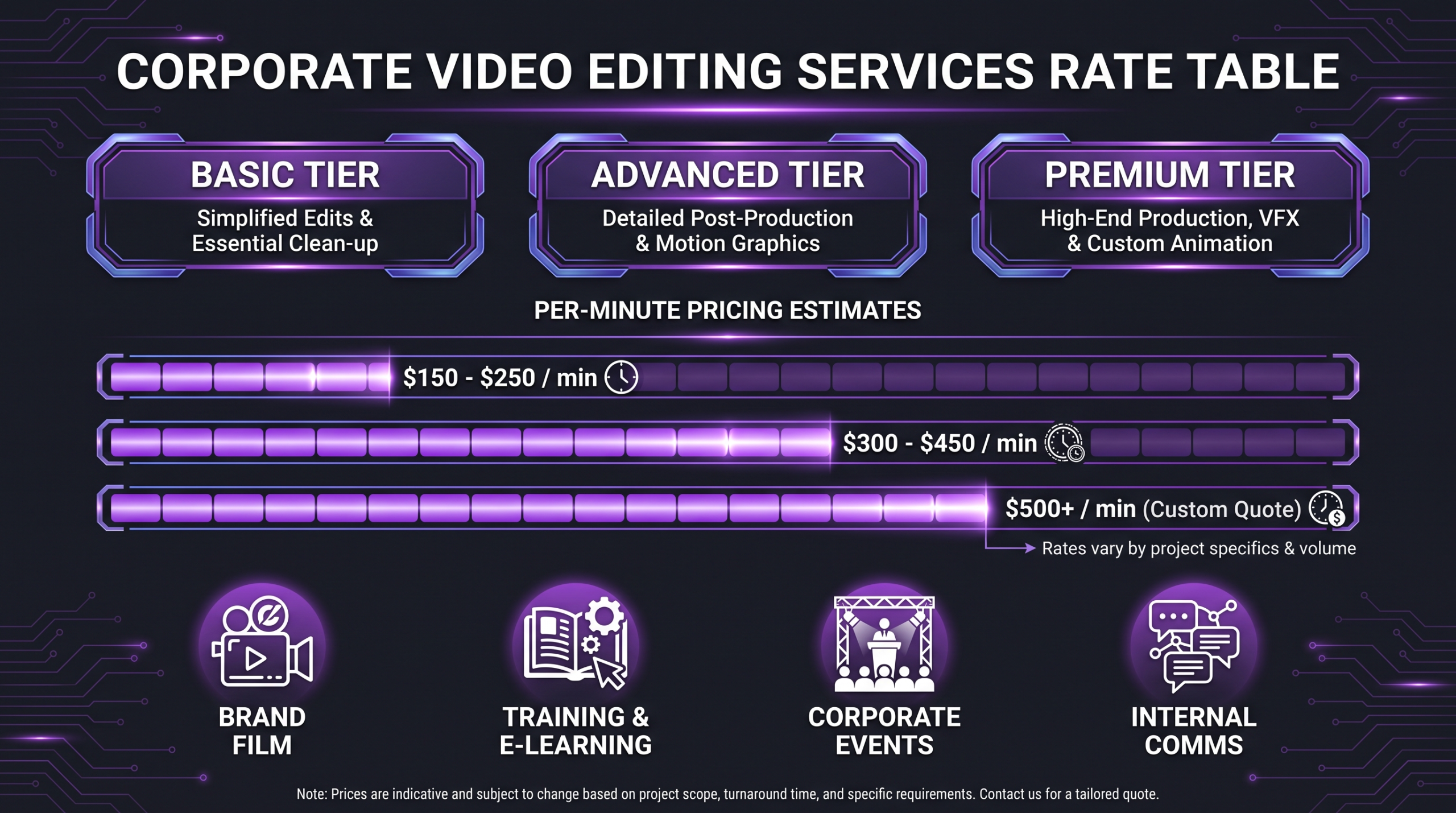
Corporate video editing services cost $75–$400 per finished minute for freelancers or $2,500–$6,000+/month for an agency retainer. Brand films, internal communications, events, and training content each have different complexity drivers that push rates up or down. This guide covers every pricing tier, the four main service formats, and a step-by-step framework for choosing the right editing partner for your business.
- What Is Corporate Video Editing?
- Types of Corporate Video Content
- Corporate Video Editing Costs: Per-Minute and Per-Project Rates
- Corporate Video Editing Service Options
- How to Evaluate Corporate Video Editing Providers
- The Corporate Video Editing Workflow
- When to Outsource Corporate Video Editing
- FAQ
- Verdict
What Is Corporate Video Editing?
Corporate video editing is the post-production process of assembling, refining, and delivering business-focused video content — brand films, internal communications, event recordings, training modules, and executive presentations. Unlike creator content, corporate video carries institutional stakes: a poorly edited brand film can undermine a product launch; a muddy internal comms video signals organizational dysfunction. The quality bar is high, the review cycles are longer, and the deliverables often need to match a visual identity guide down to the font and colour hex.
This post is a buyer’s guide, not a service page. If you have already decided on corporate production and are looking for an editing partner, our enterprise video editing service page covers how Increditors handles high-volume corporate accounts. Here, the focus is on helping businesses and creators understand the full market — costs, options, and selection criteria — before making a vendor decision.
According to Wistia’s 2026 State of Video report, companies with 200+ employees now produce an average of 44 videos per month — a figure that makes in-house editing teams expensive to staff and freelancers hard to coordinate at scale.
Types of Corporate Video Content That Require Professional Editing
Corporate video is not a monolith. Each content type carries different editing requirements, review cycles, and complexity flags that directly affect cost. Misidentifying the type is one of the most common reasons businesses get back quotes that feel wildly inconsistent.
Brand Films
Brand films (also called corporate films or company story videos) run 2–5 minutes and are the most complex editing engagement in corporate video. They require multi-camera assembly, colour grading to a specific visual identity, licensed music synchronisation, motion graphics, lower-thirds for executives, and often multiple rounds of stakeholder review. Budget $2,000–$8,000 per finished film for agency editing; $800–$3,000 for a senior freelancer.
Internal Communications Videos
CEO updates, HR announcements, town-hall highlights, and change-management communications are the highest-volume corporate video type for large organisations. They are typically simpler edits — talking-head assembly, title cards, logo integration, captions — but require fast turnaround (24–48 hours) and a discreet handling of confidential information. Per-minute rates run $75–$150 for a freelancer or subscription service; agencies charge $150–$300/min.
Corporate Events
Conference keynotes, product launches, investor days, and sales kick-offs generate hours of multi-camera footage that needs to be cut into shareable highlights (2–5 min recap) and, in many cases, individual session recordings. Event editing involves sync of multiple camera angles, audio mixing of PA systems, and branded lower-thirds. Budget $1,000–$4,000 per event recap and $300–$800 per individual session cut.
Training and Learning Videos
Onboarding modules, compliance training, product tutorials, and LMS content require screen recording integration, chapter markers, interactive element layering, and accessibility compliance (accurate captions, audio descriptions). The corporate training video cost guide covers this type in depth; typical editing costs run $1,500–$5,000 for a 5–10 minute training module depending on the screen-recording complexity and caption standards required.
Testimonials and Case Study Videos
Client testimonials, customer success stories, and proof-of-concept videos are typically short (90 sec–3 min) but require precise soundbite selection, b-roll sourcing or motion graphics, and tight pacing that builds credibility. Per-project rates: $600–$2,500 for a 2-minute edited testimonial, rising if the client supplies rough multi-camera footage that needs significant assembly work.
Corporate Video Editing Services: Costs and Rate Benchmarks (2026)
Rates vary by provider type, video complexity, and revision allowance. The tables below use real 2026 market ranges consistent with our broader professional video editing cost data. All per-minute rates refer to finished minutes of delivered video, not raw footage duration.
Per-Minute Rate Table by Complexity Tier
Per-Project Rate Table by Video Format
💡 Pro Tip: The biggest hidden cost in corporate video editing is revision cycles. Every unmanaged stakeholder review round adds 30–50% to your effective per-project cost. Before you select a provider, confirm exactly how many revision rounds are included and what the overage charge is.
Corporate Video Editing Service Options: Four Models Compared
Businesses and creators sourcing corporate video editing services typically encounter four models. Each has a different cost structure, capacity ceiling, and risk profile. Understanding the trade-offs is the fastest way to avoid a vendor mismatch.
1. Freelance Corporate Video Editors
Freelancers offer the most flexibility and the widest quality range. Senior corporate editors on platforms like Upwork and LinkedIn charge $75–$150/hr and often have deep experience in one niche (financial services, tech, healthcare). The limitations: single-point-of-failure risk (if they go offline, your deadline goes with them), no built-in QC layer, and limited capacity for high-volume or multi-deliverable projects. For a one-off brand film, a vetted senior freelancer is often the most cost-efficient option. For ongoing corporate content programmes, the coordination overhead becomes a real cost. See our video editing agency vs freelancer breakdown for a full comparison.
2. Subscription-Based Video Editing Services
Subscription services (flat monthly fee, one dedicated editor) work well for high-frequency, format-consistent content. Monthly plans typically start around $1,000–$1,500/month. For corporate video, the constraint is specialisation — most subscription services are optimised for social and YouTube content, not multi-camera brand films, screen-recording-heavy training modules, or event packages with complex audio mixing. If your corporate content is mainly internal comms or short social cuts from event footage, a subscription service can deliver strong value. If you need complex post-production, you will likely exhaust the service’s capability.
3. In-House Video Editing Team
Large enterprises often build in-house post-production teams. A mid-level corporate video editor costs $55,000–$85,000/year in the US (salary, benefits, software, and equipment included), not counting overhead. The break-even versus an agency retainer depends on volume: at 10+ completed videos per month, in-house teams often reach cost parity with a premium agency retainer. Below that threshold, in-house capacity sits idle. The hidden cost of in-house is organisational: managing a creative team, handling churn, maintaining software, and managing freelancer overflow during crunch periods all add non-trivial overhead for non-media companies.
4. Corporate Video Editing Agency (Retainer)
A dedicated agency provides a team — lead editor, motion graphics designer, colour specialist, project manager — under a single monthly retainer. Agency retainers for corporate video work run $2,500–$6,000+/month in 2026. The advantages: built-in QC, backup coverage, brand consistency across all deliverables, and a single point of accountability. Premium remote video editing agency relationships also include strategic input — not just cutting footage, but advising on format, pacing, and distribution. For businesses running video as a core revenue or communications channel, this model typically delivers the lowest effective cost-per-video at scale.
How to Evaluate Corporate Video Editing Services
The best corporate video editing partner is rarely the cheapest or the one with the most impressive showreel. The right choice depends on the fit between their process, your internal review workflow, and the formats you actually produce. Here is a six-point evaluation framework that works for businesses and creators alike.
1. Corporate Reel Specificity
Ask for a reel that includes your specific format — not just a general highlight reel. A provider who shows you a polished brand film, an internal comms cut, and a training module from actual clients is demonstrating genuine capability. A generic reel full of music video and social content signals a mismatch, regardless of the technical quality.
2. Revision and Approval Workflow
Corporate video typically involves three to five internal stakeholders, each with veto authority. The editing partner’s review workflow needs to accommodate this — timestamped comments, version control, and a clear process for consolidating conflicting feedback are non-negotiable. Platforms like Frame.io have become the standard for professional corporate video review. Ask if the provider uses it or an equivalent.
3. Turnaround and Capacity
Get explicit commitment on turnaround for your specific formats at your expected volume. “We typically deliver in 48–72 hours” means nothing if you regularly need five brand films edited in the same week around an annual conference. Confirm the provider’s capacity ceiling and what happens when you go over it.
4. Brand Standards Compliance
Corporate video editing must match your visual identity guide — fonts, colour values, motion style, music guidelines, and sometimes legal compliance requirements (disclaimers, accessibility captions). Ask how the provider ingests and enforces brand standards and how they handle updates when your guidelines change mid-engagement.
5. Confidentiality and NDA
Internal communications, investor presentations, and pre-launch product content are sensitive. Any professional corporate video editing service should offer an NDA without friction. If this conversation is awkward with the provider, that is a signal.
6. Integration with Production
Post-production that is disconnected from the production team creates a chaos tax — misaligned expectations, missing assets, last-minute scrambles. The cleanest partnerships are with providers who have either produced corporate video themselves or who have a defined onboarding process for receiving footage from external productions. Review the best corporate video production companies list for a look at how top-tier providers handle the production-to-post handoff.
The Corporate Video Editing Workflow: From Footage to Final Delivery
A clean corporate video editing workflow has five phases. Understanding what happens in each helps you set realistic expectations and avoid the most common cause of blown budgets — scope creep inside the editing phase itself.
Phase 1: Asset Ingestion and Prep
The editor receives the footage package — raw camera files, audio files, graphics assets, brand guidelines, and a brief (or a script). This is where proxy file creation, folder organisation, and initial sync of multi-camera footage happen. A disorganised footage dump at this stage can add two to four hours of prep time that you will be billed for.
Phase 2: Rough Cut
The editor assembles a structure-first cut — selecting the best takes, establishing the narrative arc, and placing b-roll markers. This is the highest-leverage review moment. Structural changes after the fine cut begin are expensive; catching a pacing problem in the rough cut costs almost nothing.
Phase 3: Fine Cut and Graphics
The rough cut is tightened, b-roll is laid in, lower-thirds and title cards are built, music is synchronised, and motion graphics are added. For complex brand films, this phase may involve a separate motion designer working in After Effects and handing off final renders. Turnaround at this phase is typically 24–48 hours from rough-cut approval.
Phase 4: Colour Grade and Audio Mix
Colour grading ensures a consistent visual look across cuts; for corporate video, this means matching to brand colour values and ensuring the video looks professional on a broadcast monitor, a laptop screen, and a conference room display. Audio mixing normalises levels, removes background noise, and mixes music against dialogue. This phase is where corporate video editing parts company with fast-and-cheap social content.
Phase 5: Export and Delivery
Corporate video typically requires multiple delivery formats: a master file (ProRes or DNxHR), a web-optimised H.264, a compressed version for internal distribution, and sometimes a platform-specific cut (LinkedIn square format, YouTube 16:9, internal portal). Clarify delivery specifications in the brief before editing begins — last-minute format requests after final sign-off are a common source of extra charges.
💡 Pro Tip: According to Sprout Social’s video benchmarks, businesses that distribute corporate video across three or more platforms see 2.4× the engagement of single-platform publishers. Ask your editor for platform-optimised exports from the master — not additional edit sessions.
When to Outsource Corporate Video Editing (and When to Keep It In-House)
The decision to outsource corporate video editing is not primarily about cost — it is about where your organisational competency actually lives. Here are the signals that point clearly in each direction.
Outsource When:
Your video output is growing faster than your in-house team can staff for. You are producing multiple video formats (brand films, social, training, events) that require different skill sets. Your in-house editor is spending more than 20% of their time managing freelancers. Your video quality is inconsistent across deliverables. You need faster turnaround than your current workflow provides. Biteable’s survey of business video teams found that 63% of companies outsource at least some post-production work precisely because the per-video cost drops significantly beyond a certain volume threshold when using a dedicated external team.
Keep In-House When:
Your content is extremely sensitive and even NDA-protected contractors introduce unacceptable security risk. Your brand identity is complex enough that editor onboarding takes longer than the marginal efficiency gain. Your video is tied to a real-time news or communications cycle that requires sub-four-hour turnaround at unpredictable times. These scenarios are real but narrow — most organisations that think they fall into this category are simply underestimating how well a dedicated external team can match their standards once a proper onboarding is complete.
Businesses and creators who partner with a dedicated video editing agency at the right volume typically see cost-per-video drop 30–50% versus coordinating a roster of freelancers, with improved consistency and faster turnaround. The economics shift depends on your monthly video volume and how much management overhead your internal team currently carries.
Think with Google’s research consistently shows that businesses investing in high-quality video see compounding returns over time — quality drives completion rates, which drive algorithmic distribution, which drives organic reach. Cutting corners on post-production is one of the most expensive savings available to a marketing or communications team.
FAQ: Corporate Video Editing Services
What is the average cost of corporate video editing?
Corporate video editing averages $150–$400 per finished minute for standard-complexity content (brand films, internal comms, training). Simple internal comms with a freelancer can run as low as $75/min; premium agency editing for broadcast-quality corporate content can reach $1,000–$2,500/min. On a per-project basis, the mid-market range is $800–$5,000 per corporate video, with brand films at the higher end and short internal comms at the lower end.
How long does corporate video editing take?
A simple 2–3 minute internal comms video typically takes 24–48 hours from footage delivery to first cut. A standard brand film with motion graphics takes 3–5 business days for a first cut, with 1–2 additional days per revision round. Event packages covering full-day conferences typically take 5–10 business days from footage delivery to final delivery of all session recordings and highlight reel.
What is the difference between corporate video editing and commercial video editing?
Corporate video editing refers specifically to internal or B2B-focused content — brand films, internal comms, training, investor relations. Commercial video editing typically refers to consumer-facing advertising (TV spots, digital ads). The techniques overlap, but commercial editing usually involves tighter pacing, stronger emotional arc construction, and closer alignment with media-buying specifications. Many agencies handle both, but they optimise differently for each.
Should we use a local agency or a remote corporate video editing service?
Remote corporate video editing services have become the standard for post-production work. The editing phase requires no physical presence — footage is shared digitally, reviews happen via timestamped comment tools like Frame.io, and final delivery is cloud-based. Remote agencies typically offer faster turnaround and lower overhead costs than local boutique studios while maintaining comparable or superior quality. The only scenario where a local agency has a genuine advantage is if you require on-site presence during production.
How many revisions should a corporate video editing package include?
A standard corporate video editing engagement should include at least two structured revision rounds — one on the rough cut and one on the fine cut. For high-stakes content (investor presentations, CEO brand films) or content with multiple internal approvers, three rounds is a more realistic baseline. Verify what constitutes a “revision” in your contract — a comprehensive round of timestamped comments should be one round; a late request to change the entire narrative structure should be scoped separately.
Verdict: Choosing the Right Corporate Video Editing Partner
Corporate video editing is not a commodity purchase. The quality of post-production directly shapes how internal audiences respond to communications, how prospects perceive your brand at its first touchpoint, and how efficiently your event footage gets repurposed into lasting content assets.
For one-off brand films or occasional training modules, a vetted senior freelancer ($75–$150/hr) is often the most efficient choice — provided you have the internal bandwidth to manage the relationship and the review cycles. For businesses and creators running a consistent corporate video programme — monthly internal comms, quarterly brand films, annual event coverage — an agency retainer at $2,500–$5,000/month typically delivers a lower effective cost-per-video, faster turnaround, and stronger brand consistency than coordinating freelancers at the same volume.
The non-negotiables in any selection: see a reel specific to your formats, clarify the revision scope before you sign, confirm the review tooling and NDA process, and verify the provider’s capacity ceiling against your peak demand. An agency that can handle your average month but falls apart at your busiest one is not a real solution.
Increditors works with businesses and creators at the premium end of corporate video editing — dedicated senior editor teams, motion graphics, structured review workflows, and brand standards compliance across all deliverables. If you are evaluating options, start with the enterprise corporate video editing page for scope and pricing context.
Ready for Video That Actually Converts?
Tell us about your project and we will put together a custom plan.
Clients, on camera