








![3D Explainer Video - ScribbleLive.mp4_snapshot_00.12_[2022.03.09_03.14.16]](https://increditors.com/wp-content/uploads/elementor/thumbs/3D-Explainer-Video-ScribbleLive.mp4_snapshot_00.12_2022.03.09_03.14.16-r7wb53mx72rxst3qcqyrfxdmeyzb5r9jbl0wbjujh4.png "3D Explainer Video – ScribbleLive.mp4_snapshot_00.12_[2022.03.09_03.14.16]")



























A video editing trial project is a short paid assignment you give a candidate before making a hiring commitment. Done right, it reveals technical skill, communication style, revision behavior, and creative judgment in 48–72 hours — things no portfolio or interview can expose. This guide gives you a field-tested framework: how to design the brief, what footage to use, how to score the submission, and what red flags to kill on sight.
- Why a Trial Project Is Non-Negotiable Before You Hire
- How to Design an Effective Video Editing Trial Project
- The Trial Project Brief: Template and Must-Have Elements
- How to Evaluate Trial Project Results (Scoring Framework)
- Red Flags and Green Flags in Trial Submissions
- Trial Projects by Editor Type: Freelancer, Agency, In-House
- Common Trial Project Mistakes (and How to Avoid Them)
- FAQ
- Verdict
Why a Trial Project Is Non-Negotiable Before You Hire
Portfolios lie — not intentionally, but structurally. Every editor shows their best 10% of work; you hire based on what they produced under ideal conditions, for clients who trusted them, on briefs they genuinely connected with. What you actually need to know is how they perform under your conditions, with your footage, interpreting your brand guidelines.
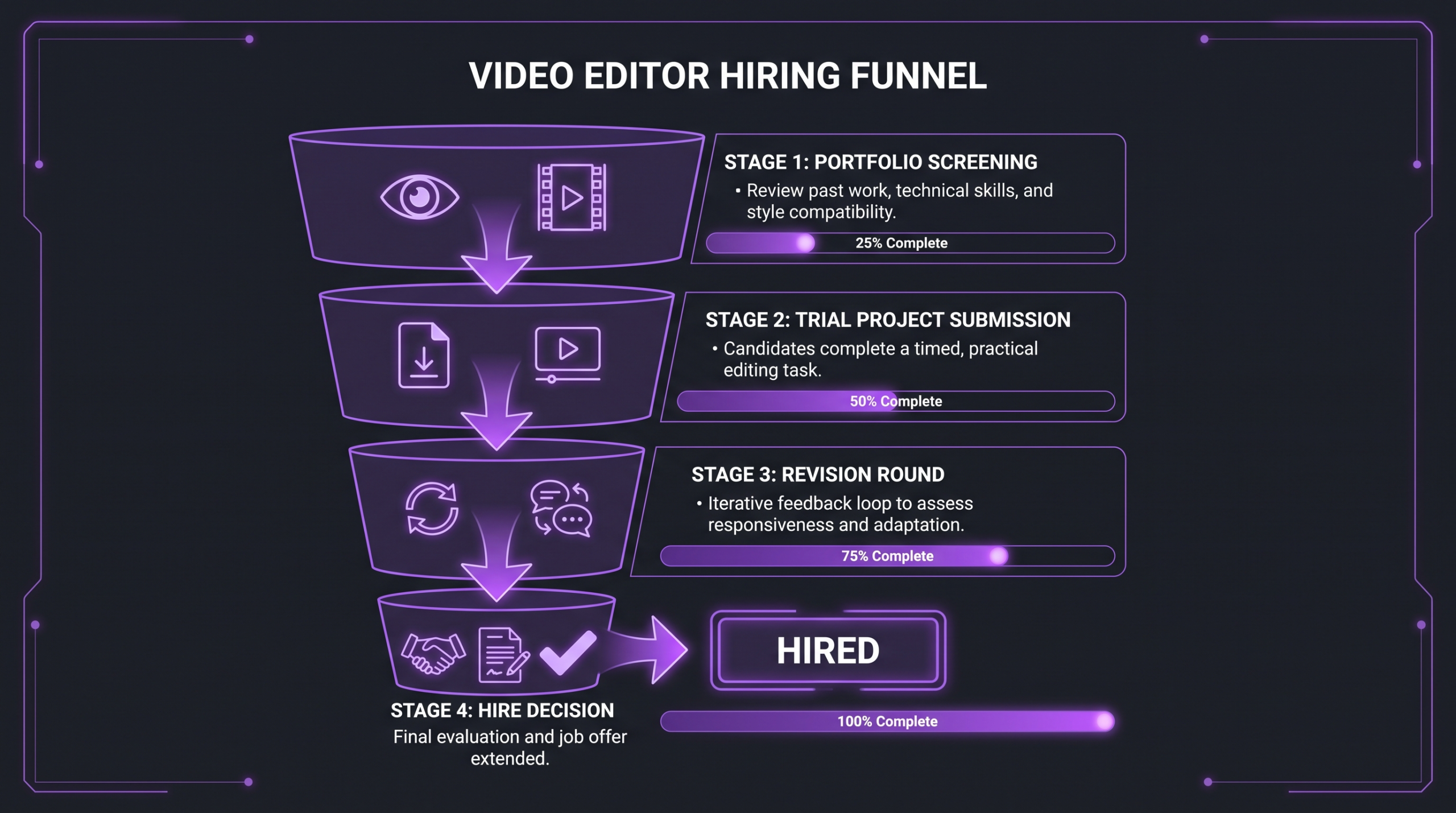
A well-designed video editing trial project answers five questions no portfolio or interview can:
- Technical floor: Can they actually cut at the level you need, or is the polished portfolio hiding limited hands-on skill?
- Brief interpretation: Do they read a creative brief carefully, or do they freewheel and deliver something you didn’t ask for?
- Communication under pressure: How do they ask questions? Do they clarify before starting, or deliver first and explain later?
- Revision behavior: When you send a round of notes, do they get defensive or do they iterate quickly with professional detachment?
- Deadline reliability: A 48-hour trial deadline is a proxy for every real deadline they’ll have with you.
Bad hires in creative roles are expensive. Research published by Harvard Business Review suggests that replacing a mid-level employee typically costs organizations many months of that person’s salary once you factor in recruiting time, onboarding, lost output, and rework. In video production, the downstream costs are higher still: a poor edit can end up re-shot, re-cut, or quietly shelved — wasted budget that never appears on any single line item.
The trial project is your cheapest insurance policy. A paid assignment of two to four hours costs a fraction of one week’s salary for a full-time hire, and it gives you real signal instead of aspirational signal. Marketing directors at companies spending meaningfully on video tell us the same thing in almost every conversation: the editors they regret hiring skipped the trial, and the ones they kept long-term passed it.
When Trial Projects Are Especially Critical
Not every engagement needs a formal trial, but the stakes are high enough to justify one whenever you’re: (a) bringing on a long-term freelancer for a recurring series; (b) hiring your first in-house video editor; (c) shortlisting an agency for an ongoing retainer; or (d) onboarding a new editor into a team that has strict brand standards. For one-off, fully specified projects with a clear price, the trial may be overkill — but for anything involving a creative partnership lasting more than a few weeks, skip it at your own risk.
💡 Pro Tip: Always pay for trial projects — even at a flat rate. Unpaid trials screen out great candidates who are already busy, select for desperation, and create legal grey areas depending on your jurisdiction. A paid trial signals respect and gets you better-quality submissions.
How to Design an Effective Video Editing Trial Project
The biggest mistake buyers make is treating the trial as a free work sample. That framing produces bad briefs, resentful candidates, and results that don’t actually predict performance. Instead, frame the trial as a structured evaluation that gives the editor everything they need to show you what they can do — then measure against a defined rubric.
Choose Real Footage, Not Demo Material
The most reliable trials use real footage from your actual projects — ideally raw material from a recent shoot that already has a published version. This lets you compare the trial submission against a known benchmark, and it forces the editor to work with material that is genuinely imperfect: wrong exposures, redundant takes, audio inconsistencies. That’s where technical skill actually shows.
If you can’t share proprietary footage, a second option is royalty-free raw footage packages. Several platforms publish unedited B-roll libraries specifically for editor testing purposes. Avoid polished stock footage that’s already color-graded — it removes too much of the challenge.
Scope the Project for 2–4 Hours of Work
The best trial projects are scoped to require two to four hours of actual editing time, not twenty. An oversized trial sends a message that you’re mining free labor and disqualifies candidates with multiple clients. An undersized one (less than 90 minutes of real work) won’t differentiate candidates effectively — everyone can produce one clean cut from two solid takes.
For a 90-second to 3-minute deliverable, allocate roughly:
- 15–30 minutes of raw footage to review and selects
- 1–2 hours of assembly and rough cut
- 30–60 minutes for color, audio, and finishing
- 15 minutes for export and file delivery
Write a Specific, Realistic Brief
Vague briefs reveal nothing about the editor and everything about your process. Give the candidate a realistic brief that matches what they’d receive in a real working relationship: the platform, audience, tone, duration target, music preferences (or restrictions), color reference, and any specific executional notes (jump cuts vs narrative pacing, motion graphics included or excluded, lower thirds style).
Intentionally leave one or two decisions open — for instance, the choice of background music or the order of a section — and see how they interpret that autonomy. The best editors make decisive creative choices and then explain their reasoning. Editors who make no choices and ask you to decide everything are a support burden, not an asset.
Set a Hard Deadline and Observe the Observation
Give candidates 48–72 hours from the moment they receive the brief and footage. This is long enough for a professional to fit it around other work, and short enough to test deadline discipline. If someone asks for an extension before they’ve even started, note it — it’s not automatically disqualifying, but it’s a data point about how they’ll behave when your real deadlines press.
The Trial Project Brief: Template and Must-Have Elements
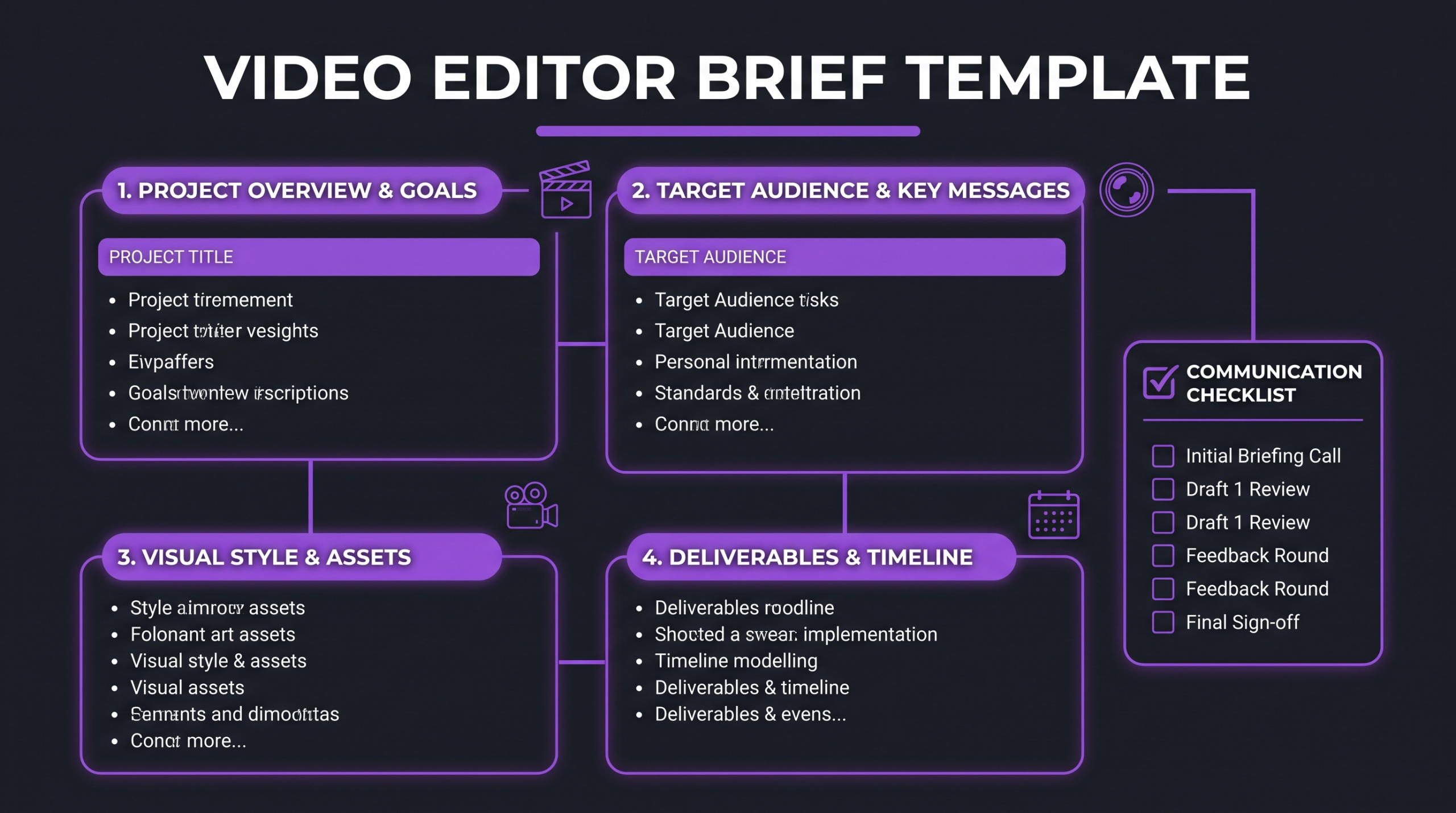
Below is the trial brief template we recommend to any team running a structured video editor evaluation. Fill each section with real specifics — copy-pasting it blank will produce useless submissions.
One element many teams forget: include a brief note on how the trial will be evaluated. This isn’t about telegraphing your scorecard — it’s about signaling that you’ve thought seriously about this evaluation and that the candidate’s time will be assessed fairly. Editors talk to each other. A reputation for thoughtful, paid, well-briefed trials attracts more applicants than any job board listing.
💡 Pro Tip: Send the same brief to all candidates. Comparing results is only fair when starting conditions are identical. If you custom-tailor each brief, you can’t objectively compare submissions — you’re evaluating your own briefing skill, not theirs.
How to Evaluate Trial Project Results (Scoring Framework)
Gut feel is not a hiring rubric. When you’re evaluating two or three trial submissions side by side, you need a structured framework that separates objective criteria from subjective preference. Below is the scoring framework we recommend for marketing teams evaluating a freelancer or agency shortlist.
How to Score Each Dimension
Use a simple 1–5 scale per dimension, weighted by the percentages above. A score of 4+ across all five dimensions is a strong hire signal. Any dimension scoring 2 or below deserves a specific conversation before you proceed — it may be fixable with clearer internal processes, or it may be a fundamental mismatch.
One nuance worth calling out: Technical Execution is often the easiest dimension to evaluate, but it’s also the least predictive of long-term performance. An editor who scores 5/5 technically but 2/5 on Communication will be expensive to manage at scale. For teams running recurring video content — like weekly thought leadership series or monthly product videos — the Communication and Process dimensions tend to matter more than raw technical scores at the margin.
For more context on the economics behind hiring decisions, see our breakdown of professional video editing costs — it covers the real difference between what you pay for a freelancer trial versus what you budget for an agency retainer.
The Revision Round Test
If you’re down to two candidates with similar scores, add one revision round to the trial. Send them three to five specific notes — some clear (fix an audio level), some interpretive (the pacing in the middle section feels slow), and one that requires a creative decision (the interview B-roll isn’t working here, find another way). How they respond to notes predicts almost everything about what working together will feel like.
Editors who receive notes as collaborative input — acknowledge, clarify, implement, deliver — are systematically easier to work with than those who receive notes as criticism and negotiate about them. This is not a personality judgment; it’s a workflow compatibility signal.
Red Flags and Green Flags in Trial Submissions
After reviewing dozens of trial projects across many categories of client work, certain patterns repeat themselves reliably. Here’s what to look for — and what to act on immediately.
Green Flags: Indicators of a Strong Hire
- They asked one or two smart clarifying questions before starting — not ten, and not zero. The right number of questions shows they read the brief, identified a genuine ambiguity, and cared enough to resolve it before investing time.
- The submission includes a brief delivery note — one paragraph explaining the creative choices they made on the open-ended decisions. This is the video equivalent of a commit message: it shows professional accountability and makes revision easier.
- The pacing matches the platform — a LinkedIn cut feels different from a YouTube cut, which feels different from an Instagram Reel. Editors who understand platform context without being told are genuinely platform-literate, which saves real time at scale.
- The audio is clean and balanced — under-resourced edits often have inconsistent audio levels or music that fights the voice. Clean audio is a baseline of professionalism that should require no reminders.
- They delivered a frame early — candidates who submit 4 hours before the deadline, not 4 minutes after, are demonstrating how they’ll behave when real projects are in the pipeline.
Red Flags: Walk Away or Proceed with Caution
- The output is significantly over or under the duration target — more than 20% variance without explanation means they either didn’t read the brief or didn’t take the constraint seriously. Both predict future deadline behavior.
- The deliverable doesn’t match the spec — wrong codec, wrong resolution, missing captions that were required. This is a process red flag, not a skill red flag, but it signals that quality control is not part of their personal workflow.
- They asked to negotiate the brief mid-trial — changing what you asked for rather than delivering it is a scope-creep preview. Some negotiation is healthy; replacing the brief outright is not.
- The edit is technically clean but feels empty — technically correct is the floor, not the ceiling. An edit that checks all boxes but generates no energy usually signals a candidate who is competent but not invested. For commodity output, fine; for any content that needs to drive action, it’s a problem.
- They sent it late without warning — a professional editor who knows they’ll miss a deadline gets ahead of it. Silence until 20 minutes after the deadline is information about how they handle pressure.
- Their follow-up email is defensive about feedback — “I made it this way because…” followed by reasons why the brief was unclear or subjective is a sign of what revision rounds will look like when real stakes are involved.
Trial Projects by Editor Type: Freelancer, Agency, In-House
The structure of a good trial project shifts depending on who you’re evaluating. Testing a freelancer is different from onboarding an agency, and both differ from assessing an in-house hire. Here’s how to adapt the framework for each context.
Testing an Agency: What Changes
When you’re evaluating an agency rather than an individual editor, the trial project tests the system, not just the person in front of you. An agency that sends its best editor for the trial and then hands you off to a junior team member is a well-documented pattern. The solution: specify in the trial brief that the team who delivers the trial is the team you’ll work with on the retainer. Then ask for a kickoff call and pay close attention to who attends and how they communicate.
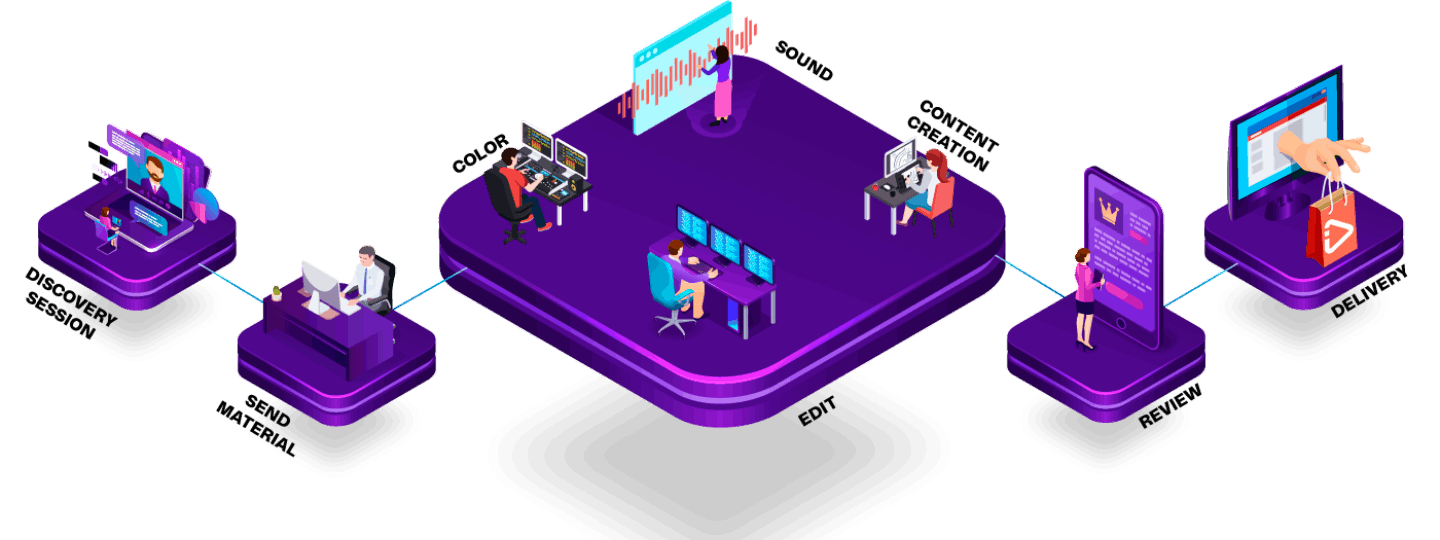
A video editing agency worth its retainer price will be comfortable with this requirement. At Increditors, for example, every new client goes through a structured onboarding that includes a sample project — because we want the first real deliverable to feel like a continuation of the trial, not a departure from it. Agencies that push back on transparency during the sales process are showing you exactly what project management will look like on month three.
For a deeper comparison of what you get from each model, our agency vs. freelancer guide breaks down the real trade-offs across price, quality consistency, and scalability.
Common Trial Project Mistakes (and How to Avoid Them)
Most trial projects fail not because of the editor — they fail because of how they were designed and evaluated. Here are the mistakes we see most often, and what to do instead.
Mistake 1: Using the Trial as a Free Production Run
The tell: the “trial” is actually a full-scale project — 10 minutes of content, complex motion graphics, six revisions — given to three candidates simultaneously, all unpaid. This is exploitation, not evaluation. It burns out your best candidates (who have alternatives), creates legal risk, and gets you content you didn’t really commission — which means you can’t confidently use it. Keep the trial scoped to the minimum that gives you signal: two to four hours of work, one clear deliverable, paid.
Mistake 2: Evaluating Without a Framework
Watching three trial submissions back-to-back and then asking the team “which one did you like?” produces preference data, not hiring data. Preference correlates with style familiarity, not quality or long-term fit. Run every submission through the scoring framework before any discussion. Only then should you layer in taste.
Mistake 3: Only Evaluating the Output
The finished file is one data point. The process that produced it — the questions the candidate asked, the communication during the trial, how they responded to feedback — is equally important for any long-term relationship. Create a simple process log for each candidate: date they received the brief, any questions they asked, the delivery time, any follow-up notes they sent, and your reaction. Review the log alongside the output.
Mistake 4: Not Testing for Your Actual Use Case
If you publish primarily long-form documentary-style content, testing candidates on a 60-second Instagram cut is measuring the wrong thing. Conversely, if you need fast-turnaround social content, testing on a 10-minute thought-leadership piece won’t predict performance. The trial format should mirror your actual production workflow as closely as possible — including the kind of raw footage, the turnaround time, and the collaboration style you use internally.
Mistake 5: Skipping the Trial for a “Strong Portfolio”
An impressive portfolio creates cognitive bias. Teams that skip the trial for “obviously strong” candidates hire on the portfolio and then discover the candidate struggles with their specific briefing style, their internal feedback culture, or the technical requirements of their platform. Every strong portfolio is strong in someone else’s context. The trial tests yours. Wistia’s video marketing research consistently shows that brand-consistent video performs significantly better than one-off quality spikes — which is exactly what you lose when you hire without testing brand fit.
Mistake 6: Running Trials in Serial Instead of Parallel
Some hiring managers run one candidate at a time, waiting for feedback before trying the next. This takes weeks, forces time-pressure decisions before comparisons are possible, and risks losing good candidates to faster-moving competitors. Send the same brief to all finalists simultaneously. You’ll have comparable data and a hiring decision within a week.
FAQ: Video Editing Trial Projects
How much should I pay for a video editing trial project?
A common range for a structured two-to-four-hour trial is $50–$200 flat, depending on the complexity of the deliverable and the seniority of the candidates you’re evaluating. Some teams pay a half-day rate based on the candidate’s stated hourly. The amount matters less than the fact that you’re paying — unpaid trials systematically exclude the best candidates who are already booked with other clients. If you’re hiring an agency for a retainer rather than an individual, the “trial” is often a discounted or strategically priced first project rather than a flat fee.
Can I use the content produced during a trial commercially?
Only if your trial agreement explicitly grants you usage rights. In most jurisdictions, the editor retains copyright on the work they create unless there’s a written transfer of rights. If you’re using real footage and intend to use the finished edit, include a simple rights clause in your trial agreement. If you’re using a benchmark project specifically for evaluation purposes, state that the deliverable is for internal evaluation only. Either way, a one-paragraph written agreement is standard practice and protects both parties.
What’s the right number of candidates to trial?
Two to four candidates is the practical range. Fewer than two limits your ability to compare; more than four creates evaluation fatigue and signals poor shortlisting earlier in the process. Spend more time on screening (portfolios, brief introductory calls) so you trial only the finalists. The cost of trialing three strong candidates is well below the cost of one wrong hire.
Should I give feedback to candidates who don’t get the job?
Yes, briefly. A one-paragraph email that names one or two specific evaluation factors is both professional and strategically smart — editors talk, and your reputation in the freelance community affects who applies. You don’t owe a detailed rubric breakdown, but “your technical execution was strong; we went with someone whose communication style matched our internal workflow better” is the kind of feedback that respects the candidate’s investment. Avoid vague rejections after a paid trial: “we went in a different direction” after someone spent four hours on your brief is unkind and unprofessional.
How is a trial project different from a skills test?
A skills test is typically a standardized exercise designed to assess technical competency in isolation — whether someone knows how to color grade, use audio keyframes, or conform frame rates. A trial project is a realistic simulation of actual working conditions: real or realistic footage, a real brief, a real deadline, and real communication expectations. Skills tests screen for minimum competency; trial projects screen for actual fit. You need both in sequence — test minimum skills first to avoid wasting trial resources, then run the trial on candidates who pass the floor.
Verdict: Build the Trial Into Your Hiring Standard
A video editing trial project is not optional for any company that depends on video as a meaningful marketing channel. Portfolios are curated; interviews are performed; references are selected. The trial project is the only part of the hiring process that gives you unfiltered signal about how an editor will actually work with you, on your material, under your constraints.
The framework is straightforward: define the scope tightly (two to four hours of real work), use real or realistic footage, write a specific brief, pay every candidate, run candidates simultaneously, score against a rubric before gut-checking, and use the revision round as a tiebreaker. Build this into your standard hiring process and you’ll stop making bad video hires.
For companies that want to skip the evaluation entirely and go straight to a team that has already been vetted at the agency level, that’s a different model — but it’s also a valid one. See how top video editing services compare if you’re weighing the agency route against building in-house.
Additional reading for teams building their video production function: LinkedIn’s research on common hiring mistakes gives useful context on how creative-role evaluation fits into broader talent acquisition practices. Clutch’s guide to evaluating video production agencies is worth reading alongside this framework if you’re on the agency evaluation path. And if you need benchmarks for what post-production services cost at different quality tiers, our professional video editing cost guide walks through the full market range with honest framing.
Ready for Video That Actually Converts?
Tell us about your project and we will put together a custom plan.