






![3D Explainer Video - ScribbleLive.mp4_snapshot_00.12_[2022.03.09_03.14.16]](https://increditors.com/wp-content/uploads/elementor/thumbs/3D-Explainer-Video-ScribbleLive.mp4_snapshot_00.12_2022.03.09_03.14.16-r7wb53mx72rxst3qcqyrfxdmeyzb5r9jbl0wbjujh4.png "3D Explainer Video – ScribbleLive.mp4_snapshot_00.12_[2022.03.09_03.14.16]")
















VSL editing runs $0–$50/month for DIY tools, $200–$2,500 for capable freelancers, and $2,500–$8,000+ for specialist agencies with full-service packages including motion graphics, hook variants, and conversion strategy. The price difference between tiers isn’t cosmetic — it reflects whether the edit is built to convert or just built to look finished.
- What Is VSL Editing — and Why Does It Cost More?
- VSL Editing Cost Overview
- The 5 Cost Factors That Drive the Final Number
- DIY Tools — Cheapest Entry, Highest Hidden Cost
- Freelancers — The Wide Middle Ground
- Specialist VSL Editors and Agencies
- Full Comparison: All Tiers Side-by-Side
- How to Choose the Right VSL Editing Partner
- Frequently Asked Questions
- Verdict
What Is VSL Editing — and Why Does It Cost More?
A video sales letter (VSL) is the most conversion-sensitive video format in direct-response marketing. Unlike brand films, product explainers, or social content, a VSL exists for one reason: to move a qualified viewer from skeptical stranger to paying customer. That singular commercial purpose changes everything about how editing should work — and what it realistically costs.
Standard video editors know how to cut footage, sync audio, color grade, and export. VSL editors need to understand the psychological architecture of persuasion. They know when to cut away from the talking head to reinforce a claim with a supporting graphic. They understand how to pace the hook section to hold viewer attention through the critical first 90 seconds — the window when most VSL audiences decide whether to keep watching. They know how to structure the offer reveal so it lands after enough social proof has been established. They understand that a poorly timed cut during the close can suppress conversions measurably, even when every other element in the video is technically correct.
That is a fundamentally different skill set from general video production — and it commands a meaningful price premium across every tier of the market.
The VSL editing market has also stratified significantly in recent years, driven by the expansion of course creators, info-product businesses, SaaS companies running video funnels, and direct-to-consumer brands scaling on paid traffic. As demand has grown, so has the range of options: from offshore general editors at $5–$15/hour, to boutique VSL agencies pricing flagship packages at $5,000–$8,000+ with motion graphics, A/B hook variants, and conversion strategy sessions included.
Understanding where those prices come from — and which tier actually matches your stage and needs — is what this guide covers. One important clarification before the numbers: cost ranges here reflect public market observations and commonly cited rates across platforms and providers. Individual quotes vary based on deliverables, timeline, and provider quality. Always scope your project in writing before comparing prices; two “$2,500 VSL packages” can represent radically different levels of actual work.
VSL Editing Cost Overview
For a standard 10–25 minute VSL — the most common format for direct-response funnels — here is how the market typically prices editing services across tiers:
These ranges assume a standard direct-response VSL structure: hook, problem-agitate-solve, proof section, offer stack, and close. Shorter VSLs under 8 minutes compress these ranges downward. Longer webinar-style VSLs at 30–90 minutes can push full-service agencies toward $10,000–$15,000+ depending on deliverables and strategy involvement. The core principle: you are not just paying for edit hours — you are paying for the editor’s direct-response knowledge, the production infrastructure behind the delivery, and accountability for revisions and ongoing testing support.
The 5 Cost Factors That Drive the Final Number
Most VSL editing quotes are not flat-rate. They are built from a base editing fee plus a set of variables that stack on top quickly. Understanding these factors helps you scope your project accurately, evaluate competing quotes fairly, and identify which add-ons actually move the conversion needle for your specific campaign.
1. Video Length
Length is the most straightforward driver. Most experienced editors quote by finished minute — the duration of the final delivered video, not the raw footage. But the raw-to-finished ratio matters significantly for actual edit hours. A VSL shoot that generates 90 minutes of raw talking-head footage to yield a 20-minute final cut involves substantially more timeline work than a scripted production where talent delivered near-final takes. High raw-to-finished ratios mean more logging, more selects work, and more structural decision-making from the editor.
Experienced VSL editors commonly work in the range of $30–$150 per finished minute, depending on tier and complexity. That puts a 20-minute VSL at $600–$3,000 in base editing fees before motion graphics, captions, or variant cuts. At the lower end of that range, you get clean technical cuts with basic titles. At the upper end, you get conversion-optimized structure, precise pacing decisions, and often motion work bundled into the per-minute rate.
2. Motion Graphics and Animation
Animated bullet reveals, lower thirds, price reveal animations, countdown timers, testimonial overlays, and product mockup sequences are common in VSLs — and almost universally excluded from base editing rates unless explicitly stated in the scope. Template-based motion work using pre-built After Effects or MotionArray assets typically adds $200–$500 to a project. Custom-branded animation — unique to your typography, color system, and visual identity — typically runs $400–$1,200 for a standard VSL’s motion needs.
If your VSL requires explainer-style animated segments — product mechanism illustrations, SaaS UI walkthroughs, or whiteboard-style breakdowns — that is a distinct production category that can add $1,500–$5,000 depending on complexity and segment length. Always confirm what “motion graphics” actually covers in any quote before signing off on scope.
3. Captions and Subtitles
Open captions — burned-in subtitles visible without sound — have become effectively mandatory for paid social distribution and for meeting accessibility standards. AI-generated captions via tools like Descript, Adobe Premiere’s speech-to-text, or Rev run $0–$0.25 per finished minute for raw output. Human-reviewed captions with consistent on-brand typography, word-wrap preferences, and timing corrections typically add $100–$300 to a VSL project.
For international campaigns requiring multi-language subtitle tracks — common for brands running ads across EMEA, LATAM, or APAC — expect $200–$600 per additional language for professional translation with proper timing and line-break formatting.
4. A/B Hook Variant Cuts
Running two to three distinct hook variations is standard practice for paid-traffic VSL funnels. Each variant shares the core body — the problem-agitate-solve section, proof elements, and close — but opens with a different 30–90 second hook: a different pain angle, a different credibility entry point, a different emotional framing. Editors typically charge $150–$400 per additional hook variant, depending on how much the opening structure diverges from the primary cut and how much timeline reorganization is required.
At scale, a flagship VSL with a primary cut plus two hook variants and one alternate body structure can add $600–$1,200 to the base editing cost. For brands spending $10,000+ per month on paid traffic driving to a VSL page, this testing infrastructure frequently delivers 2–5x its cost in improved campaign efficiency within the first testing cycle.
5. Hook Editing and Optimization
Some specialist editors offer hook optimization as a distinct service: reviewing raw footage specifically for the strongest hook-worthy moments, building the opening sequence for maximum early retention, and advising on re-shoots when the hook material is structurally weak. This service is offered standalone at $200–$600 or bundled into specialist retainer rates.
The hook is the most conversion-sensitive segment of any VSL. Teams commonly report that two VSLs with identical bodies but different opening sequences differ in completion rate by 20–30 percentage points — which translates directly to cost-per-acquisition on every dollar of ad spend behind the funnel. If you are investing in VSL production at any meaningful budget level, under-spending on hook optimization is rarely where the savings are actually realized.
💡 Pro Tip: When comparing VSL editing quotes, map each deliverable explicitly before evaluating the price. A quote of $1,200 that includes motion overlays, styled captions, and two hook variants often represents better value than a $900 quote covering edit-only — even though the number looks higher. Always scope deliverables in writing before comparing line items.
DIY Tools — Cheapest Entry, Highest Hidden Cost
Tools like CapCut, Descript, iMovie, and DaVinci Resolve’s free tier have lowered the technical barrier to VSL self-editing significantly. For early-stage operators testing a new offer on a constrained budget, DIY editing is a legitimate option — particularly for shorter VSLs under 10 minutes where the structural complexity is lower and production expectations are calibrated accordingly.
Here is what DIY realistically costs for a 15–20 minute VSL:
Software: $0–$50/month (CapCut Pro, Descript Creator, or DaVinci Resolve free tier)
Stock music license: $10–$30 per track (Artlist or Epidemic Sound single-use licenses)
Caption tool: $0–$30/month for AI-assisted caption generation
Time investment: 15–50 hours of editing depending on your experience level and the complexity of the raw footage
The time cost is where DIY becomes expensive in ways that never appear on an invoice. At a modest effective hourly rate of $100 for a founder or marketing director, 40 hours of editing represents a $4,000 opportunity cost — before accounting for the learning curve required to execute a conversion-optimized structure, or the likelihood that the first version underperforms and needs a re-cut.
DIY also does not resolve the structural knowledge gap. Knowing how to operate a timeline editor is different from knowing how to sequence a VSL for maximum retention. Many founder-edited VSLs fail at the hook — not because they look technically poor, but because the opening 90 seconds does not build sufficient tension or curiosity to earn the viewer’s attention through the next 20 minutes. The editing skill and the conversion optimization knowledge are separate problems, and DIY tools only address the first one.
DIY makes sense when: you are pre-revenue and capital is genuinely constrained; you have editing experience or are committed to developing it; you are testing a raw offer before committing production budget; or you are producing short-form VSL content where structural complexity is limited.
Freelancers — The Wide Middle Ground
Freelance platforms — Upwork, Fiverr Pro, Contra, Toptal for video — represent the widest quality and price range in the VSL editing market. A search for “VSL editor” on any major platform returns proposals from $15/hour to $150/hour, spanning offshore general editors and US-based direct-response specialists with proven paid-traffic funnels in their portfolios. Understanding what you are buying at each tier requires more than looking at the hourly rate.
Entry-Tier Freelancers ($150–$600)
At this range, you are typically working with editors who are technically competent — they will cut your footage cleanly, sync audio, add basic title cards, and deliver in your required format — but who may not have conversion-focused VSL experience. They execute the brief you give them. What they will not do is restructure your footage for better retention, flag a weak hook before cutting, or advise that your proof section arrives too late in the sequence to support the offer reveal. The output will look professional. The conversion performance depends entirely on how strong your script and raw footage were before editing began.
Mid-Tier Freelancers ($600–$1,500)
This is where direct-response experience begins appearing in portfolios. Editors at this level often have backgrounds in agency work, course creator content, or eCom brand video — categories where conversion-oriented editing is part of the job description rather than a bonus. They understand A/B testing workflows, can advise on hook sequence, and know how to pace a proof section effectively. Turnaround at this tier commonly runs 3–7 business days for a standard VSL, with one to two revision rounds included in the base price. This tier offers the strongest risk-adjusted value for a validated offer you are beginning to scale on paid traffic.
Upper-Tier Freelancers ($1,500–$2,500+)
At the top of the freelance market, experienced VSL specialists deliver work that competes with boutique agency output. Some have spent years editing for 8-figure info-product businesses and bring deep conversion optimization instincts to each project. The practical challenge is availability: top-tier solo editors are frequently booked 3–6 weeks out, have limited revision tolerance (additional rounds cost extra), and charge separately for every add-on. They are also single points of failure — if they go unavailable mid-project, your timeline moves without recourse.
The structural risks that persist across all freelancer tiers include limited redundancy when editors become unavailable, revision friction on scope-adjacent requests, quality inconsistency under deadline pressure, and the absence of a strategic layer — most freelancers execute your brief rather than challenge it when the brief itself has conversion problems. For a detailed comparison of how these dynamics play out at scale, this breakdown of video editing agency vs. freelancer covers the structural differences in depth.
Specialist VSL Editors and Agencies
This tier operates on different economics from a general video production studio or subscription editing service. Specialist VSL editors and boutique agencies are organized around direct-response outcomes — many track client conversion benchmarks across campaigns, advise on scripting structure before production begins, and build deliverables designed from day one for systematic A/B testing.
Specialist VSL Editors
Individual specialists with verified direct-response portfolios typically charge $1,000–$3,500 for a complete VSL package: primary cut, one to two hook variants, motion overlays, styled captions, and export in multiple formats. Many work on retainer with clients running consistent paid traffic — providing ongoing re-cuts and hook refreshes as campaign testing generates new learnings. The advantage is close working relationship and faster revision cycles. The limitation is capacity: a single editor means one VSL in active production at a time, with limited flexibility for urgent re-cut requests or parallel campaign needs.
Full-Service VSL Agencies
Full-service agencies — with dedicated editing teams, motion designers, strategists, and account management — price flagship VSL packages at $2,500–$8,000+. At this level, you are purchasing considerably more than editor hours: you are purchasing production infrastructure, accountability structures, and the capacity to manage re-cut cycles across multiple concurrent campaigns without the coordination overhead of managing individual contractor relationships.
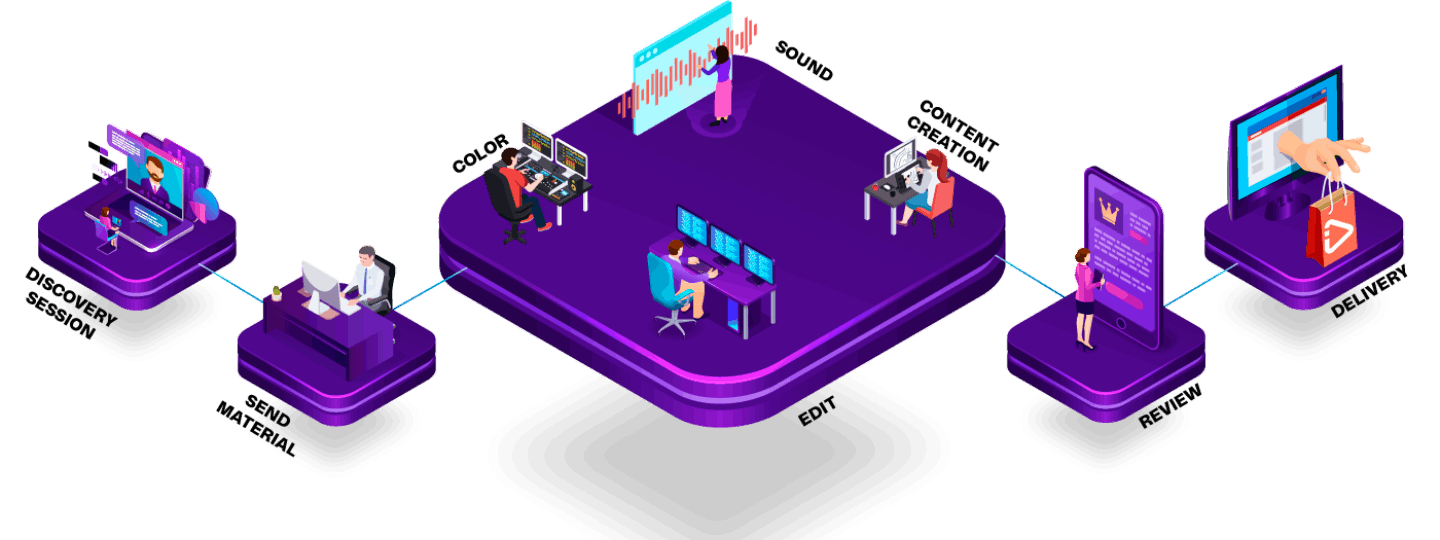
As a premium video editing agency, Increditors operates at this tier — senior editors who specialize in conversion-focused video production, dedicated account relationships, and the workflow infrastructure to handle ongoing campaign development, variant testing, and parallel production at scale. The full-service model delivers the clearest return for brands actively scaling on paid traffic where the VSL is the central conversion asset in a $10,000+/month media plan.
At that scale, improving conversion rate by 0.5 percentage points — well within the range achievable through production quality and systematic hook testing — can represent $25,000–$50,000 in improved monthly ad efficiency. The production investment to achieve that improvement is rarely the constraint. For context on how professional editing costs scale across different video formats and production categories, this detailed cost breakdown covers the full landscape.
Full Comparison: All Tiers Side-by-Side
Here is how each option compares across the dimensions that matter most for VSL production decisions:
How to Choose the Right VSL Editing Partner
The right tier is almost entirely determined by where you are in your testing and scaling cycle — not by what sounds appropriately “professional” or what your competitors appear to invest. Overspending on production before validating an offer is a common mistake. Underspending on production when you are actively scaling proven paid traffic is an equally costly mistake at the other end.
Testing a New Offer
Your first VSL for an unproven offer does not need full agency production. The offer, the script, and market-message fit are what you are validating — production quality has limited influence on whether a new concept resonates with a fresh audience. A mid-tier freelancer at $700–$1,500 provides professional enough execution to test the offer without over-capitalizing before you know whether it converts. Once positive ROI is confirmed from initial traffic, then commit to higher-tier production for the scaling phase.
Scaling a Proven VSL
Once conversion is established and you are scaling ad spend, production quality becomes a direct revenue lever. At $5,000–$20,000/month driving to a VSL page, optimizing conversion rate by 0.3–0.5 percentage points delivers meaningful returns on almost any production investment at the specialist or agency level. This is where full-service editing pays for itself — through better hook optimization, systematic variant testing, and the production consistency required to support ongoing campaign management without constant friction.
Running Ongoing Campaigns
Brands producing VSLs monthly — new angles, seasonal offers, audience segment variants — find retainer structures significantly more efficient than project-by-project engagements. Both specialist solo editors and agencies offer retainer arrangements. The practical difference is reliability under campaign pressure and production capacity when multiple concurrent re-cuts are required simultaneously.
What to Include in Your VSL Brief
Regardless of tier, the quality of your editing brief determines a substantial portion of the outcome quality. A strong VSL brief includes: raw footage inventory and total duration, target final length, reference VSLs you want the editor to study, brand guidelines, platform delivery specs and aspect ratio requirements, hook variant count and angle directions, revision round expectations and timeline, and the commercial context — what conversion rate you are targeting and what the current benchmark is. Editors at every level produce measurably better work when they understand what commercial success looks like for the specific campaign they are editing.
💡 Pro Tip: Ask any prospective VSL editor to share three examples where they edited a VSL that ran on paid traffic — not just videos that looked good in a portfolio reel. If they cannot name the platform, the offer type, and roughly how long the campaign ran, they may not have the direct-response experience required for a conversion-sensitive production where your ad spend is on the line.
Frequently Asked Questions
How much does VSL editing cost for a 15-minute video?
For a 15-minute VSL, base editing costs typically range from $450–$2,250 when working with experienced freelancers at $30–$150 per finished minute. When motion graphics, styled captions, and one or two hook variants are included, full packages from specialist editors or boutique agencies commonly run $1,500–$5,000+. The base edit is only part of the total — factor in all deliverables when comparing quotes across providers to avoid scope surprises after you have committed to an engagement.
Can AI tools replace a VSL editor?
AI editing tools can automate useful technical tasks — caption generation, rough cut assembly from transcripts, color correction passes, and audio leveling — but they do not replace the structural judgment required for conversion-optimized VSL editing. The decisions that most influence conversion rate (hook sequence, pacing through the proof section, close structure, cut timing on key claims) require human judgment grounded in direct-response experience. AI tools are useful complements to skilled editors; they are not substitutes at the level where commercial performance matters and ad spend is at stake.
What is typically included in a full VSL editing package?
A complete VSL editing package from a specialist or full-service agency commonly includes: primary edit from raw footage, one to two hook variant cuts, motion graphics and title overlays, styled open captions, music licensing and sound design, color grading, and export in multiple formats and aspect ratios for various platform placements. Some packages include a pre-production strategy session or hook consultation. Entry-tier freelancers typically provide the primary edit only. Always confirm scope in writing before starting any engagement.
How long does VSL editing take from raw footage to delivery?
Turnaround times commonly range from 3–5 business days for an experienced freelancer on a standard 15–20 minute VSL, to 7–14 business days for full-service agency packages with motion graphics, multiple variants, and multi-round review cycles included. Rush delivery at 48–72 hours is available from some providers at a premium of 25–50% above standard rates. For planning purposes, always build in buffer for at least one revision round — the first delivered cut rarely exits without feedback even with an excellent editor in a well-briefed engagement.
Should I hire a freelancer or a specialist agency for a VSL running on paid ads?
If your monthly ad spend driving to the VSL is under $5,000, a well-vetted mid-tier freelancer at $700–$1,500 typically provides the best value while you validate and optimize the offer. Once you are spending $5,000–$10,000+ per month on traffic and the VSL is a proven conversion asset, the ongoing production support, reliability under campaign pressure, and systematic variant testing infrastructure of a full-service agency justify the higher investment. The right answer depends on your campaign’s lifecycle stage — not on what sounds like the appropriately professional choice in isolation.
Verdict: Match Your Production Investment to Your Scaling Stage
VSL editing is a precision investment, not a commodity purchase. The price gap between a $250 DIY cut and a $5,000 agency package is not arbitrary — it reflects meaningfully different skills, process infrastructure, and production accountability that directly affect whether your video converts at 1% or 3%. At serious ad spend levels, that difference represents hundreds of thousands of dollars per year in campaign efficiency.
For most operators, the cost-effective path follows the same arc: DIY or entry-tier freelancer for raw offer validation, mid-tier freelancer for a validated offer in early scaling, specialist editor or full-service agency once paid traffic is meaningful and conversion rate optimization is the primary lever for growth.
The mistake most brands make is treating VSL editing as a one-time production event. The highest-performing VSLs are edited iteratively — new hooks tested regularly, body structures refreshed as audiences evolve, offer framings updated as competitive dynamics shift — over months of systematic testing. The infrastructure for that iteration is a significant part of what you are paying for when you move up the tier ladder. Plan your production budget accordingly.
Wherever you are in your testing and scaling cycle, the economics are consistent: spend proportionately to what you are risking in ad spend, scope your deliverables completely before comparing quotes, and treat your editing partner as part of the campaign team rather than a transactional vendor at the end of a project checkout.
Ready for Video That Actually Converts?
Tell us about your project and we will put together a custom plan.