






















































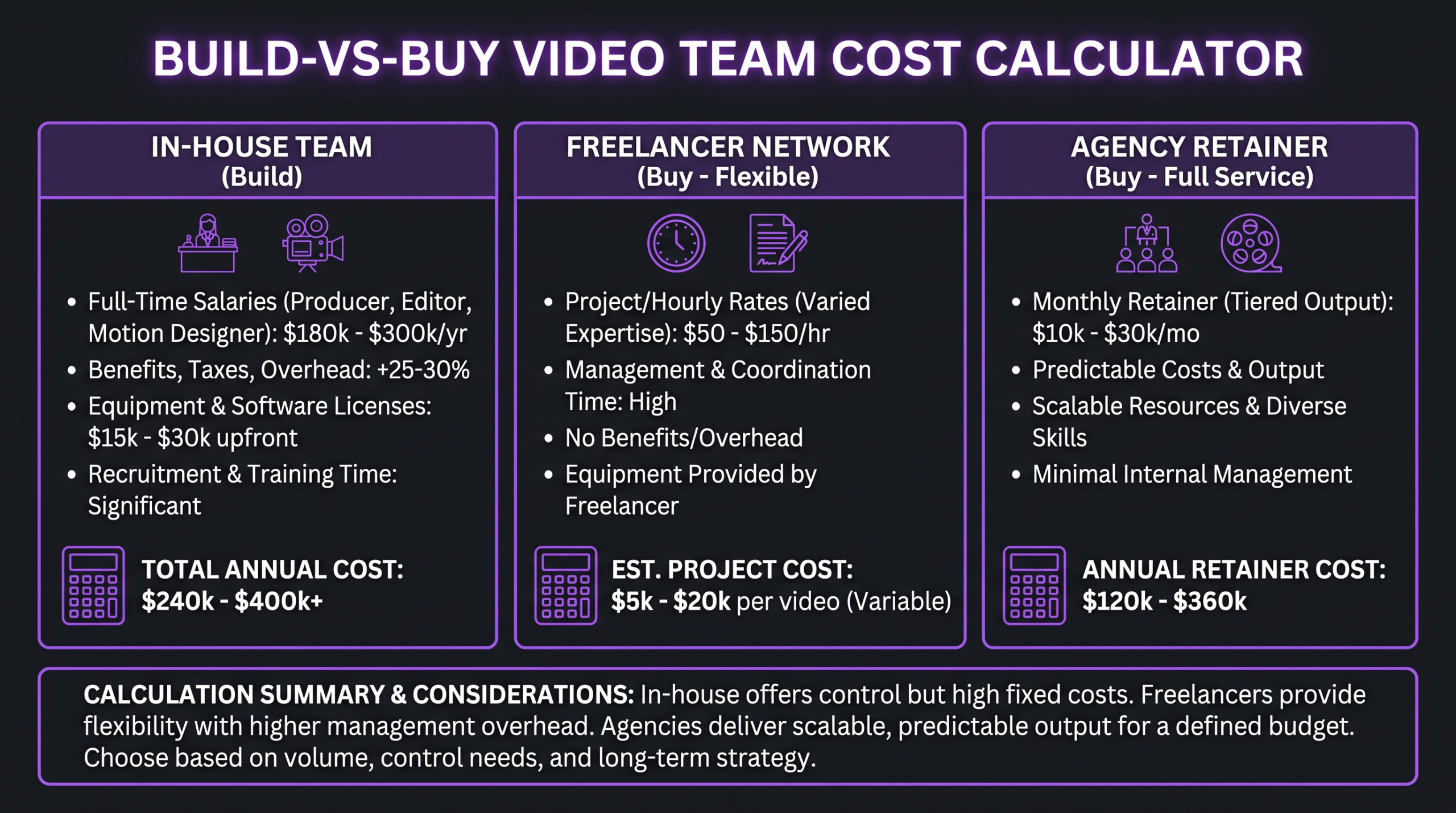
Building an in-house video team typically costs $180,000–$350,000+ per year in fully-loaded salary and overhead. Buying through a specialist agency or subscription service typically runs $2,000–$12,000/month — often 60–70% less for comparable output. This post gives you the actual line-item breakdown so you can make the decision with real numbers, not assumptions.
- Why This Decision Shapes Your Entire Content Budget
- The True Cost of Building In-House
- The True Cost of Buying (Agency or Subscription)
- The Build vs Buy Calculator Framework
- Output Quality and Ramp Time Comparison
- Scalability, Volume, and Capacity Ceiling
- Hidden Costs Nobody Puts in the Calculator
- When Building In-House Actually Wins
- When Buying Wins (Most Companies)
- The Hybrid Model Most Teams Eventually Land On
- FAQ
- Verdict
Why This Decision Shapes Your Entire Content Budget
Video now sits at the center of nearly every B2B and B2C content strategy. Published platform data from LinkedIn, YouTube, and major ad networks consistently shows video outperforming static content on engagement, time-on-page, and conversion rate — often by a significant margin. The problem is that producing video at volume is expensive, and the question of whether to hire internally or outsource it is one of the highest-stakes budget decisions a marketing leader makes.
Most companies get this decision wrong because they compare the wrong numbers. They compare a single editor’s salary to an agency’s monthly retainer and call it done. That misses the equipment, software, management overhead, benefits, churn costs, ramp time, and the ceiling of what one or two internal editors can realistically produce. This post builds the full picture.
Whether you’re a SaaS company scaling content for demand generation, an e-commerce brand building product video infrastructure, or an enterprise marketing team evaluating a budget reallocation — the framework here will give you concrete numbers to take into the decision.
The True Cost of Building In-House
Building a competent in-house video team requires more headcount than most teams initially plan for. A single video editor — no matter how skilled — cannot handle the full production pipeline for an organization producing more than 8–12 polished videos per month. Once you account for motion graphics, color grading, audio mixing, caption generation, and format resizing across platforms, that ceiling drops further.
Salary: The Starting Point, Not the Whole Picture
Based on industry benchmarks across job boards and salary aggregators, video editor base salaries in major US markets typically fall in these ranges:
Fully-loaded cost typically runs 30–35% above base salary when you include employer-side payroll taxes, health insurance, dental/vision, 401k match, PTO, and any equity or performance bonuses. These figures represent industry benchmarks — actual costs vary by location, company stage, and benefit structure.
Equipment and Software Overhead
Professional video editing requires hardware capable of handling 4K and increasingly 6K+ footage. A capable editing workstation or high-spec MacBook Pro typically costs $3,500–$6,000 per seat, with expected replacement cycles of 3–4 years. Storage infrastructure — fast external drives, NAS systems, or cloud storage for raw footage — runs $500–$2,000/year per active editor depending on volume.
Software licensing adds another layer. A typical editing stack for a professional team includes:
- Adobe Creative Cloud (Premiere Pro, After Effects, Audition, Photoshop) — typically $600–$900/year per seat on team plans
- DaVinci Resolve Studio — around $300 one-time per seat (color grading standard)
- Frame.io or similar review/approval platform — typically $500–$2,000/year depending on team size and storage tier
- Stock footage/music licensing — $500–$3,000/year depending on production volume
- Captions and accessibility tools (3Play, Rev.ai, Kapwing, etc.) — $300–$1,200/year
Total software and licensing overhead commonly runs $2,500–$7,000 per editor per year, plus the amortized hardware cost of roughly $1,000–$1,500/year per seat. For a three-person team, that’s $10,000–$25,000 in tooling costs annually before anyone touches the timeline.
Recruitment, Onboarding, and Churn Costs
Hiring a skilled video editor is not a quick process. Industry benchmarks suggest the average time-to-fill for a mid-level creative role is 45–70 days, and recruiting fees (agency or job board spend) commonly run 15–20% of first-year salary for specialist hires. For a $75,000 editor, that’s $11,000–$15,000 in acquisition cost before day one.
Onboarding and ramp time is the cost nobody models. A new editor typically needs 4–8 weeks to become fluent with your brand style, internal workflow, asset libraries, and feedback cadence. During that period you’re paying full salary for 50–70% output. That’s an effective first-month cost of roughly 1.5x monthly salary per hire.
Creative talent turnover is also elevated compared to general corporate roles. Published HR industry data suggests median tenure for in-house creatives runs 2–3 years at many companies. A departure and rehire cycle for a mid-level editor can cost $25,000–$45,000 in combined recruiting, gap coverage, and ramp time — and that’s before accounting for institutional knowledge loss.
💡 Pro Tip: When modeling your in-house cost, add a 20% “churn buffer” on top of annual salary costs. Even if you retain your team, project delays and quality gaps during transitions are a real operating cost that finance teams rarely capture in headcount budgets.
The True Cost of Buying (Agency or Subscription)
The “buy” side of the equation has become significantly more structured over the past five years. The market has segmented into three distinct tiers, each with different economics, quality ceilings, and appropriate use cases.
Tier 1: Subscription/Unlimited Editing Services
Platforms like Tasty Edits, Vidpros, and similar unlimited video editing services typically run $500–$2,500/month depending on the plan tier, turnaround speed, and number of parallel requests. These services work well for social content, YouTube, and high-volume lightweight edits. Quality can be inconsistent across editors, and complex motion graphics or branded animation often falls outside what these tiers deliver reliably. See how subscription services compare for a full breakdown.
Tier 2: Freelancer Retainers and Project-Based Hiring
Experienced freelance video editors on platforms like Toptal, Contra, or direct hire typically charge $50–$150/hour or $2,000–$6,000/month on retainer for 20 hours/week of dedicated capacity. The upside: you get a known individual whose style you can calibrate over time. The downside: one person, one output ceiling, and any illness, overcommitment, or departure immediately disrupts your pipeline. For a deeper look at the tradeoffs, the agency vs. freelancer comparison is worth reading before signing a retainer.
Tier 3: Premium Agency Retainers
Specialist video editing agency retainers provide a dedicated team — typically a senior editor, a motion graphics specialist, and a project coordinator — under a single monthly fee. Retainers for this tier commonly run $3,500–$12,000/month depending on monthly video volume, complexity, and the level of strategic input included. Agencies like Increditors operate in this tier, providing brand-consistent output, defined SLAs, and the ability to scale volume up or down without hiring cycles.
The key distinction at the premium agency tier: you’re not paying for hours or headcount — you’re paying for a managed output system. That changes the value equation significantly when your real constraint is consistent, on-brand video at scale, not just editing capacity.
The Build vs Buy Calculator Framework
Rather than giving you a single number, here’s the calculation structure you can run against your own situation. Fill in the yellow rows with your actual or estimated figures.
Build Cost Formula
Annual Build Cost = (Headcount × Fully-Loaded Salary) + Annual Tooling + Amortized Recruiting + Management Overhead
Management overhead is often ignored entirely. If a marketing manager spends 5–8 hours per week managing, reviewing, and directing an editing team, and their total compensation is $120,000/year, that’s roughly $15,000–$25,000 in management cost that belongs in the video team budget. At scale, it’s often more efficient to have an agency own that coordination layer.
Let’s run a concrete example for a 2-person in-house team (one mid-level editor, one motion designer) in a mid-market US market:
Buy Cost Formula
Annual Buy Cost = (Monthly Retainer × 12) + Onboarding/Setup + Internal Coordination Time
Internal coordination with an external agency is far lighter than managing direct reports — typically 2–4 hours per week for a project manager or marketing coordinator, versus 5–10 hours for a hands-on manager of in-house creatives. The setup phase (1–2 months of brand onboarding, asset transfer, and style alignment) typically costs $500–$3,000 depending on brand complexity.
At a mid-market premium agency retainer of $6,000/month, the same output comparison looks like this:
The delta between $81,820 and $268,000 (the midpoint of the build estimate) is $186,000 per year — which at a 50-person company represents roughly 10% of a modest total marketing budget. That’s not a rounding error; it’s a strategic allocation decision.
Output Quality and Ramp Time Comparison
Cost is only half the equation. The other half is what you actually get for that money — and the quality gap between options is not linear with price.
In-House Quality Curve
An in-house team typically starts slow and improves over time as they internalize your brand language. The quality ceiling depends heavily on the seniority of the people you hire — a junior editor will hit a ceiling that no amount of internal mentoring fully corrects. Most in-house teams report reaching consistent quality output somewhere between months 3 and 6, depending on brand complexity and content type.
The upside: deep institutional knowledge. An editor who has been with you for two years knows your spokesperson’s quirks, your brand’s pacing preferences, which sound effects you’ve vetoed, and how your legal team wants disclaimers handled. That institutional depth is real and difficult to replicate externally.
Agency Quality Curve
A premium agency like Increditors maintains a senior-level team whose exposure to dozens of brands simultaneously creates a cross-pollination of quality standards that single-brand in-house teams rarely develop. The learning curve is steeper at first — typically 4–6 weeks of intensive brand onboarding — but many agencies report reaching brand-consistent output faster than an in-house hire because their onboarding systems are more systematized.
For context on what professional video editing costs at different quality tiers, see the detailed breakdown at how much professional video editing costs.
💡 Pro Tip: Ask any agency for three recent work samples in your content category before signing. The right agency should be able to produce brand-adjacent examples without hesitation. If examples are sparse or heavily filtered, that’s a quality signal to take seriously.
Scalability, Volume, and Capacity Ceiling
The scalability comparison is where build vs buy becomes most stark. In-house teams have hard capacity ceilings tied to headcount. Adding capacity means adding FTE — which means a 3–5 month hiring cycle, plus ramp time. If you’re running a campaign push or a product launch that requires 3x normal volume for 6 weeks, your in-house team cannot flex to absorb it.
Volume Benchmarks by Team Configuration
Based on industry benchmarks for professional video production, these are realistic sustainable output volumes for different configurations:
The scalability advantage of external teams is most pronounced for companies in growth phases. If you expect your video output to double in the next 12 months, an in-house build will require at least one additional hiring cycle during that period. An agency retainer tier upgrade is typically operational within a few weeks.
Hidden Costs Nobody Puts in the Calculator
Every build vs buy analysis has a list of visible costs. The invisible costs are where the real delta lives.
Opportunity Cost of Management Bandwidth
Managing an in-house creative team is a management job. It requires performance reviews, 1:1s, career development conversations, conflict resolution, and the ongoing creative direction work of keeping output quality high. If your VP of Marketing or Content Director is spending 8–12 hours per week on video team management, that’s real opportunity cost — those hours are not going toward strategy, channel expansion, or the higher-leverage work that justifies senior marketing salaries.
Revision Cycle Drag
In-house teams often have longer effective revision cycles because the feedback structure is informal. Teams commonly report 3–5 revision rounds on complex videos before final approval, with each cycle adding 1–2 business days. Professional agencies typically enforce structured briefing processes that reduce average revision counts to 2–3, with defined turnaround SLAs that compress total calendar time significantly.
Idle Capacity Cost
Content pipelines are not linear. Most companies have sprint-and-pause cycles: heavy production around launches, events, and campaigns, with relative lulls in between. An in-house team costs the same during slow periods. Agency retainers can often be paused or reduced between high-demand periods, converting idle capacity from a sunk cost to a variable one.
Technology Upgrade Cycles
AI-assisted editing tools, generative B-roll, automated captioning, and platform-specific export optimization are evolving rapidly. An in-house team requires ongoing training investment and tooling budget upgrades to stay current — typically $1,000–$3,000 per editor per year in training budget alone, plus tool subscription increases as new capabilities are added. An agency absorbs these upgrade costs internally, since staying at the leading edge of tooling is core to their competitive positioning.
When Building In-House Actually Wins
The build case is real in specific circumstances. Understanding when it applies prevents the mistake of assuming external always wins.
Broadcast Volume and Proprietary IP
If your organization produces 60+ videos per month across multiple formats, a fully-built internal team can reach cost parity with external options — at broadcast volume, the fixed cost of headcount becomes competitive with per-unit agency pricing. Similarly, organizations with highly sensitive IP (unreleased product footage, confidential strategic content, legal-constrained materials) may have legitimate reasons to keep production entirely internal.
Real-Time Production Requirements
Live event coverage, same-day news-style production, and real-time social content that requires immediate turnaround (same-hour, not same-day) are inherently in-house activities. External agencies operate on standard SLAs — 24–72 hours for most deliverables — that don’t accommodate genuinely real-time production requirements.
Cultural and Brand Immersion at Scale
For certain brand categories — particularly consumer brands with strong cultural identities, celebrity-adjacent entertainment content, or organizations where authentic internal perspective is the editorial product — in-house teams can produce content that genuinely cannot be replicated externally. The value isn’t in the editing; it’s in the presence, context, and access.
When Buying Wins (Most Companies)
For the majority of B2B companies, SaaS businesses, e-commerce brands, and professional services firms, the buy case dominates on every meaningful dimension except cultural immersion.
Under 40 Videos Per Month
Below roughly 40 polished videos per month, the fixed cost of an in-house team almost never beats a well-chosen agency retainer on a like-for-like quality comparison. The break-even point moves lower if you factor in management overhead and the quality ceiling of junior in-house staff.
Growth-Phase Companies
Series A through Series C companies are almost universally better served by external video partnerships. Headcount is expensive, hiring is slow, and the ability to redirect budget in a pivot situation has real value. An agency relationship can be terminated or scaled down in 30–60 days. An in-house team cannot.
Complex Multi-Format Content Needs
Organizations producing video across multiple formats simultaneously — YouTube long-form, LinkedIn clips, paid social ads, website hero videos, product demos, webinar post-production — typically need a range of specialisms that are difficult to staff internally without multiple FTE. A premium agency team provides that range within the retainer without additional headcount.
For a practical view of what specialist video editing services look like across tiers, the unlimited video editing services comparison is a useful reference for understanding what’s available at different price points.
The Hybrid Model Most Teams Eventually Land On
The most common evolution path for companies that start with pure in-house or pure outsource is convergence toward a hybrid model. The pattern typically looks like this:
One internal video strategist/producer + external execution team. The internal person owns the brief, the brand voice, the editorial direction, and the stakeholder relationship. The external team executes production, post-production, and format distribution. This model captures the institutional knowledge benefits of in-house (one person is enough to carry the brand context) while keeping execution flexible and scalable.
This hybrid captures the best of both models: the internal producer is cheaper than two in-house editors (one salary versus two, no motion designer needed), the external team brings specialist depth, and the total annual cost typically lands between $140,000–$200,000 — substantially less than a full internal build, while producing more output at higher consistency than either model alone.
💡 Pro Tip: If you’re transitioning from in-house to hybrid, retain one existing editor as the internal producer if their instincts lean strategic rather than technical. People who understand your brand deeply but also understand how agencies work make the best internal video leads — they brief externally in ways that actually translate to good output.
FAQ
At what video volume does building in-house become cost-competitive?
Industry benchmarks suggest in-house teams reach rough cost parity with premium agency retainers somewhere between 40 and 80 polished videos per month, depending on video complexity and the seniority required. Below that threshold, fully-loaded in-house costs almost always exceed comparable external options on a per-video basis. Above that threshold, the fixed cost of a larger team begins to amortize more favorably — but management complexity also scales non-linearly.
Can I switch from agency to in-house if I change my mind?
Yes, but plan for a 3–6 month transition period. You’ll be running agency and hiring costs in parallel while the internal team ramps. Budget for this overlap explicitly rather than assuming you can flip the switch. Most companies that move from external to internal do so after a period of high-volume production proves the ROI of full internalization.
How do I evaluate agency quality before signing a retainer?
Request work samples in your exact content category — not their best-of reel, but three to five recent deliverables for clients in your industry and format type. Ask about their revision process, SLA commitments, and what happens if your primary editor becomes unavailable. A high-quality agency will have clear answers to all of these without hesitation.
What’s a realistic onboarding timeline for a new agency?
Most premium agencies report reaching consistent brand-aligned output quality within 4–8 weeks, assuming thorough brand guideline documentation, access to existing approved footage, and clear feedback on the first two to three test deliverables. The onboarding accelerates significantly if you have a dedicated internal point of contact who can turn feedback around quickly during the calibration phase.
What does “fully-loaded cost” actually include?
Fully-loaded cost includes base salary, employer-side payroll taxes (typically 7.65% for FICA alone), health/dental/vision insurance (commonly $6,000–$15,000/year per employee depending on plan), 401k employer contribution, PTO value (20 days represents roughly 8% of annual salary in idle time), and any equity, bonus, or profit-sharing. In aggregate, these typically add 28–38% above base salary — higher in states with additional payroll taxes or in companies with generous benefit packages.
Verdict: Run Your Numbers, But the Benchmark Is Clear
For most companies producing under 40 videos per month, a well-chosen external partner — whether a premium agency retainer or a structured hybrid model — will deliver more output, at higher quality, with greater scalability, for 40–70% less total cost than a comparably capable in-house team. Those aren’t marketing claims; they’re the outcome of running the numbers the way this post has.
The in-house case is real, but it requires broadcast-level volume, significant IP sensitivity, or genuine real-time production requirements to justify. Most B2B and mid-market companies don’t have those constraints — they have the assumption that control requires ownership. It doesn’t.
The hybrid model — one strong internal video strategist working with a specialist external team — represents the mature end-state for most organizations serious about video as a channel. It’s where the cost efficiency, quality consistency, and operational flexibility arguments converge. If you’re not there yet, the framework in this post is how you build the case to get there.
Ready for Video That Actually Converts?
Tell us about your project and we will put together a custom plan.
Clients, on camera