
















































Last checked: October 2026 · prices read on vendor sites, 24 Oct 2026.
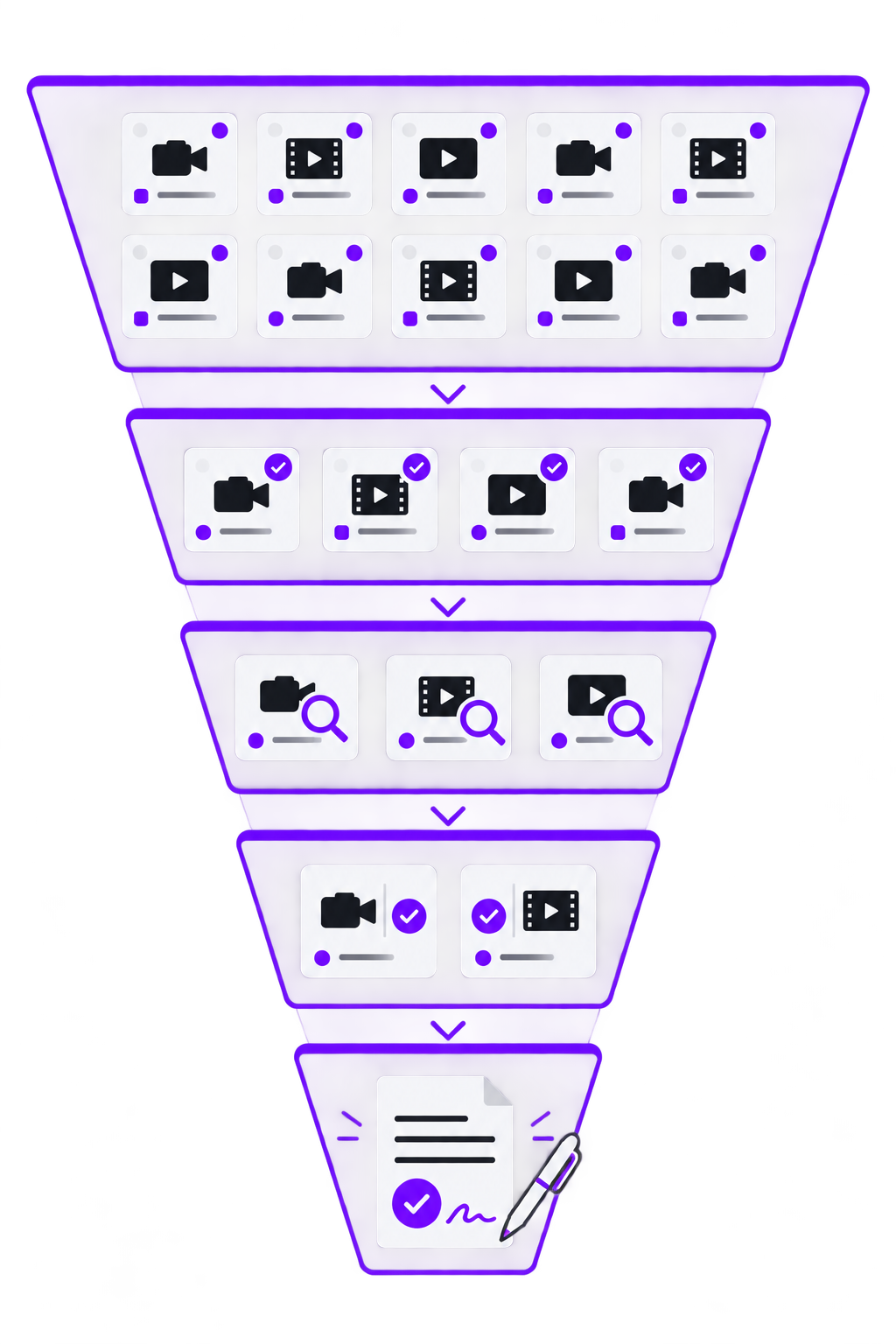
To pick a commercial video production company, collect three itemised bids on one brief, call two B2B references each, run a paid pilot with your top two, and sign only a contract that puts ownership in writing. Published prices run from $1,500 to $250,000+.
Match the type of company to the job first (packaged, project studio, subscription or editing-led). Then use the 12-point checklist, compare bids line by line, and read the contract for ownership, licensing, revisions and insurance. Red flags are vague scope, one lump-sum price and a refusal to name the people doing the work. The whole process takes about four to six weeks.
- Match the company type to the job
- What commercial video production costs in 2026
- The 12-point selection checklist
- How to compare bids line by line
- Contract terms to get in writing
- Red flags in proposals and contracts
- Run a paid pilot and score it
- How this guide was built
- Where Increditors fits, and where it does not
- FAQ
- Verdict
Most buyers pick a production company on the strength of a reel and a sales call. That is how a $20,000 project ends up with unclear ownership and three surprise add-ons. This guide is the buyer-side process for choosing a commercial video production company for B2B work: what to ask, what to put in the contract and which warning signs to act on.
How this differs from our other pages. Our Best Video Production Services 2026 compares ten named vendors side by side with a fixed set of fields. Our video editing company vs production company guide explains the difference between shooting footage and finishing it. This post does neither: it gives you the selection checklist, the bid comparison method, the contract terms and the red flags, using prices from vendor pages as reference points only.
Match the Company Type to the Job
“Video production company” covers several business models that price, schedule and contract differently. Choosing the wrong model costs more than choosing the wrong vendor inside a model, so decide which one you are buying first.
If your video is a customer interview, a product demo with screen capture or a webinar cut-down, you may not need a crew at all: see our video editing company vs production company guide, and our live action vs animation for SaaS post for the animation side. If you do need footage shot, everything below applies.
💡 Pro Tip: Write the one-line purpose of the video before you contact anyone: “a 90-second customer story for the pricing page that raises demo requests.” A purpose line lets every bidder price the same job, and it gives you a test for the final cut.
What Commercial Video Production Costs in 2026
Treat these figures as reference points, not quotes. Every figure below was read on the vendor’s own public page on 24 Oct 2026, and each vendor defines scope differently (length, style, crew, revisions). They are useful for one thing: spotting a bid that is far outside the published range for the same type of work.
Two things stand out. The spread is wide even inside one vendor: Epipheo publishes a $5K to $25K entry tier and a $15K minimum production engagement on the same page, so the number that matters is the one in your written bid. And the same page says two-thirds of a typical budget goes to pre-production (strategy, script, storyboard). Ask every bidder where their money goes.
For agency-side budgets see our guide to how much a B2B video agency costs, and for one vendor’s plans in detail the Vidico pricing breakdown. Rush fees and extra revision rounds are covered under contract terms below.
The 12-Point Selection Checklist
Use this as a scoring sheet. Rate each company 0 to 2 on every point (0 = not shown, 1 = partly, 2 = clearly shown) and total it. A company that scores below 18 out of 24 has not earned a retainer or a large project.
Points 4, 7, 8 and 9 are where most disputes start. If a company declines to answer any point in writing, treat the refusal as an answer.
How to Compare Bids Line by Line
Send every bidder the same one-page brief and ask for the bid in the same structure. The AICP Bid Form was introduced in 1975 to standardise bidding on commercials, the association says (see the AICP bidding resources). You do not need an AICP member to borrow the logic: ask each company to break the price into the same lines.
- Pre-production: creative brief, script or shot list, storyboard, location scouting, scheduling and logistics.
- Production: crew (director, camera, lighting, sound), equipment, talent, travel, permits and any set or location fees.
- Post-production: editing, colour grading, sound mix, motion graphics, music licensing.
- Deliverables: master file, platform cut-downs, captions, thumbnails, and whether project files are included.
- Revisions: the number of rounds included and the price of an additional round.
- Contingency and taxes: a stated contingency percentage, or a statement that none is included, and any sales or VAT applied.
Levitate Media publishes a similar list of what a professional quote should include. Use the lines above as a gap check: any line blank in one bid and filled in another is where the price difference lives.
💡 Pro Tip: Compare the second total, the one with the gaps filled in. Ask the cheapest bidder to price each missing line before you decide. A low headline price that grows by 30% once licences, revisions and deliverables are added is not the low bid.
Contract Terms to Get in Writing
Read the contract as carefully as the creative. These are the terms that decide who can use the video, for how long and what happens when something goes wrong. This is a buyer’s checklist, not legal advice: have counsel review the final document.
Ownership and source files
Under US copyright law, a commissioned work is a “work made for hire” only if it fits one of nine categories (part of a motion picture or other audiovisual work is one), the parties expressly agree in writing, and all parties sign, according to US Copyright Office Circular 30. Many production contracts instead assign copyright to the client on final payment: Epipheo states that full copyright transfers on final payment, with source files as an add-on. Either way, ownership has to be in a signed document that says whether raw footage and project files are included.
Licences for music, stock and talent
A finished video can be yours and still unusable if the music licence covers one platform or one year. Ask for a licence schedule listing each licensed element, the media it covers (web, paid social, broadcast), the territory and the term, plus signed releases and usage periods for on-camera talent.
Revisions, rush work and cancellation
Define a “round” (one consolidated set of comments), the number included and the price of an extra one. Epipheo says two rounds is standard on its entry tier, three on its signature tier, and each additional round adds roughly 8% to 12% of the invoice plus about a week; rush work runs 25% to 50% above standard. Levitate Media lists music licensing, extra rounds, travel and equipment rentals as the items most often left out of flat-fee quotes. Write rush and kill fees down before kickoff.
Insurance and payment
For any shoot, ask for a certificate of insurance and confirm your company is a named insured where relevant. AICP, the commercial producers’ trade body, runs a named-insured status and coverage confirmation form for exactly this reason (see the AICP production insurance page). Tie payments to milestones (kickoff, approved script or storyboard, first cut, final delivery) rather than paying most of the fee up front.
⚠️ Warning: Never accept “ownership transfers on the final retainer month” or “ownership transfers when the project is complete” without a date. Ask for the exact event (final payment received) and put it in the signed contract.
Red Flags in Proposals and Contracts
These are the patterns that show up before problems do. One flag is a question to ask; three flags together are a reason to walk.
- A single lump-sum price. You cannot compare it or see what is missing.
- No named people. If they will not say who produces, shoots and edits, you are buying a sales team.
- A reel with no B2B work in your format. Consumer polish does not prove they can explain your product to a buyer.
- Pre-production is missing. Epipheo says two-thirds of the budget lives in strategy, script and storyboard. A bid that skips them will push the cost into revisions.
- “Unlimited revisions” with no definition of a round. The timeline stretches until you give up.
- Ownership held back. Source files, raw footage or the finished video withheld until a later payment or a renewal.
- A timeline far shorter than the vendor’s own published range. If 6 to 10 weeks is standard and you are quoted 2, ask what is cut.
- No insurance certificate. Any crew-based shoot should have one on request.
- References only on the vendor’s own site. Look for independent reviews.
- Pressure to sign this week. A discount that expires on a call is a sales tactic, not a schedule.
Run a Paid Pilot and Score It
A reel shows what a company did for someone else. A paid pilot shows what it does for you. For a one-off video, the pilot can be a paid discovery and script stage (the first two or three weeks of the project). For a recurring programme, it is one real deliverable, such as a single customer story, done against a written brief and a fixed price. Pay for it, so you own the result and can compare two companies on the same task.
The weights are ours and are a starting default; if the video carries legal or brand risk, move weight from working fit to contract terms. Score each line 0 to 10, multiply by the weight and total out of 1,000. Decide before the pilot what total wins.
Here is a realistic timeline for the whole process: about a week to write the brief, a week to collect and compare bids, one to two weeks for references and the pilot, and a week to finalise the contract. That is four to six weeks before production starts. Once you have chosen, a video post-production checklist keeps the handoff tidy.
How This Guide Was Built
How we picked what to include. Vendors were chosen because they publish prices or timelines on their own pages, so a reader can verify each figure; criteria were public data, B2B relevance and a distinct business model. Prices, timelines and contract statements were read on the linked pages on 24 Oct 2026, the Copyright Office and AICP pages the same day. The checklist, scores and weights are our own editorial framework, not an industry standard.
Limits. Published figures are starting points or ranges that vendors define differently and change. Many production companies publish no prices and are not in the tables. Nothing here is a quote, a ranking or legal advice.
⚖️ Disclosure: This guide is published by Increditors, a video editing agency, and includes our own services. We publish no Increditors prices in this guide. The only figures from our own group are the public monthly plans of our sister business, videoeditingcompany.com, shown in the tables.
Where Increditors Fits, and Where It Does Not
Increditors is a remote-first video editing agency and animation team. Our Clutch profile shows 5.0 from 12 reviews, we have delivered 1,700+ videos for 340+ clients, and our named clients include Emerj (The Trajectory), TuMeke, Riley Coleman, Trade with Pat, VYVE Wellness, Dr. Jonathan Tam, a GoDaddy pilot, eSafetyFirst and Rhythm Monster. Our sister business videoeditingcompany.com sells dedicated monthly editing teams for SaaS and B2B marketing.
We do not run multi-day location shoots with camera crews, sets and talent. If you need a flagship brand film shot on location, a crew-based company or project studio from the types above is the right buy, and we can take the footage from there. If you already have footage, interviews, webinars, screen captures or podcast recordings to edit, animate and ship on a schedule, that is what a video editing company is for. You can see how a managed team handled a technical audience in the TuMeke project, and more in our case studies and this B2B video case study. For a ranked comparison of production vendors, see Best Video Production Services 2026, the best corporate video production companies list and the best video production companies list.
FAQ: Choosing a Video Production Company
How do I choose a commercial video production company?
Write a one-page brief, collect itemised bids from three companies, call two B2B references each, and run the same paid pilot with your top two. Score them on a weighted card and sign only a contract that puts ownership and licensing in writing.
How much does a commercial video production company cost in 2026?
On vendor pages read on 24 Oct 2026, packaged videos started at $1,500 (Lemonlight) and subscriptions at US$1,000 to about $5,000 per month (Shootsta, Vidico). Single-day crew-based productions ran $4,500 to $12,000 and premium multi-day productions $25,000 to $60,000+ (Levitate Media); Epipheo’s live-action band was $40K to $250K. Compare written scope, not headline numbers.
What should a video production contract include?
Itemised deliverables, a milestone schedule, revision rounds and the price of extras, ownership of the video and source files in a signed agreement, licences for music, stock and talent with term and territory, insurance, milestone payments and a cancellation clause. Have counsel review it; this is not legal advice.
How long does a commercial video take to produce?
Published timelines ran from 3 to 8 weeks for a Lemonlight curated video and 4 to 6 weeks for Epipheo’s entry explainer, to 6 to 12 weeks for live action and 10 to 16 weeks for flagship work. Shootsta quotes a 48-hour first edit once footage exists. Scripting from a blank page adds two to four weeks (Epipheo).
Should I hire a production company or a video editing company?
Hire a production company to plan and shoot new footage. Hire a video editing company when you already have footage, recordings or screen captures to cut and animate. Our guide to the video editing company vs production company decision covers cost and timing.
How many bids should I collect?
Three is enough for most commercial projects: fewer leaves no price reference, and more than four costs more in calls than it saves. Send all three the same brief and ask for the same line items.
Verdict
The best production company for you is the one whose bid you can explain line by line, whose references confirm the work, and whose contract leaves you the finished video, the licences and an exit. Decide the model first, collect three itemised bids on one brief, score a paid pilot, and read the contract before you read the showreel again. That process takes a month and protects a budget that is usually five figures or more.
Changelog: 24 Oct 2026 – first published: company-type table, 14 sourced price points from six vendor pages, 12-point checklist, bid comparison sheet, contract terms and red flags.
About the author
Increditors Team
The Increditors editorial team is made up of working video editors and producers at a video editing agency that has delivered 1,700+ videos for 340+ clients. We write buyer guides from live vendor pages and say when our own services are included.
Need Video Finished, Not Just Filmed?
Tell us what footage you have and what the video has to do. We will tell you honestly whether you need a crew or an edit.
Clients, on camera