








![3D Explainer Video - ScribbleLive.mp4_snapshot_00.12_[2022.03.09_03.14.16]](https://increditors.com/wp-content/uploads/elementor/thumbs/3D-Explainer-Video-ScribbleLive.mp4_snapshot_00.12_2022.03.09_03.14.16-r7wb53mx72rxst3qcqyrfxdmeyzb5r9jbl0wbjujh4.png "3D Explainer Video – ScribbleLive.mp4_snapshot_00.12_[2022.03.09_03.14.16]")
























Searching “video editing near me” filters out roughly two-thirds of your best options. Video editing is a fully digital service — files travel at broadband speed, not commute speed. Remote-first agencies consistently deliver faster turnaround, lower overhead costs, and access to deeper specialist talent pools than any single local market can provide. In 2026, your best video editing partner is almost certainly not in your zip code.
- What “Video Editing Near Me” Actually Returns
- The Proximity Myth: Why Location Is Irrelevant for Video
- Remote Wins on Speed: Turnaround Time Compared
- Remote Wins on Cost: The Overhead Math
- Remote Wins on Quality: Access to Real Specialists
- Local vs. Remote: Full Head-to-Head Breakdown
- How to Choose a Remote Video Editing Partner
- How Remote-First Agencies Work Day-to-Day in 2026
- Frequently Asked Questions
- Verdict: Drop the “Near Me” Filter
What “Video Editing Near Me” Actually Returns
Type “video editing near me” into any search engine and something predictable happens: the results are constrained by geography, not by quality. You see a mix of solo freelancers working from home setups, small two-person studios hustling for local corporate events, and the occasional side-project offering weekend edits at low hourly rates. The agencies that are genuinely exceptional — the ones with dedicated senior editor teams, systematic revision workflows, and deep creative specialization — rarely optimize for local search because they do not need to. They serve brands across multiple continents and fill their pipeline through referrals, case studies, and targeted industry searches. Geography is not part of their acquisition strategy because it was never a constraint on their service delivery.
This is the first hidden cost of the “near me” search: you are not applying a quality filter. You are applying a geographic filter. And for a service that delivers entirely via shared cloud drives, review platforms, and export links, geography is the wrong variable to optimize for entirely.
The Geographic Constraint Problem
Consider a mid-sized city with a metropolitan population of roughly 500,000. That market might support anywhere from fifteen to fifty video production and editing operations at any given time. The overwhelming majority of them skew toward local corporate event coverage, wedding films, real estate walkthroughs, and local business commercials — because that is where the steady, recurring local revenue lives. If you are a SaaS company looking for a team that specializes in product demo videos, customer testimonial cuts, or high-frequency social content production, your local pool has already narrowed to perhaps three or four viable options, and the odds that any of them have worked extensively on software product content are low.
Now consider what becomes available when you remove the geographic constraint entirely. Remote-first agencies draw their editor teams from markets where cost of living is fundamentally different — which means they can attract and retain exceptional talent without passing downtown commercial real estate costs to you. They hire based on portfolio depth in specific content categories, not proximity to your office. The talent pool expands from a few dozen local candidates to thousands of credentialed specialists globally.
What Your Local Search Is Systematically Missing
Here is a concrete picture of what rarely surfaces in a “near me” search: agencies that have built systematic post-production pipelines with multi-pass quality control. Teams where individual editors have completed hundreds of videos in a single content category and have developed genuine pattern recognition for what makes that format work. Post-production houses that run distributed workflows across multiple time zones, so your rush edit is in active production long after your local studio has closed for the evening. Agencies that pair dedicated account managers with stable editor teams, so client context accumulates over time rather than resetting with every project. None of these teams prioritize your city’s map results. They are booked through referral and direct search, and they compete on quality, not proximity.
The Proximity Myth: Why Location Is Irrelevant for Video Editing
There is an intuitive appeal to working with someone nearby. When something goes wrong — or when you want to review a cut in real time — having a physical address to walk into feels safer. This instinct made sense for services that require physical presence: commercial printing, on-site installation, equipment rental. It does not apply to post-production work in 2026.
Video editing is among the most location-independent professional services that exists. Raw footage moves as data files. The edit timeline is a digital project file. The deliverable is a video export — in whatever format, resolution, and codec your distribution platform requires — delivered via a shared cloud link. Nothing physical changes hands at any stage of the process. The entire creative and technical workflow can be, and routinely is, executed between a client in Toronto and an editor in Warsaw, with a brief prepared by an account manager in Austin and a color grade applied by a colorist reviewing on a calibrated monitor in Cape Town. For the best remote-first agencies, this is not an exception. It is the standard operating model.
File Transfer Is a Solved Problem
A common hesitation about remote editing involves file size. Raw video files can be substantial — a full day of 4K footage can run anywhere from 100 GB to 500 GB depending on the camera system and codec. But this is a well-solved technical problem. Frame.io, Dropbox, Google Drive, WeTransfer Pro, and dedicated production asset management platforms all handle large file transfers reliably. Many professional agencies use proxy-based review workflows: compressed preview files are shared for client review while the editor works on full-resolution originals stored in cloud storage. You review in your browser; the editor cuts on the original. No physical hard drive ships anywhere, and the quality of the final export is unaffected. The logistics are genuinely seamless for any agency that has invested in the right infrastructure.
Communication Tools Have Made Nearby Obsolete
In-person meetings felt essential when the alternative was a telephone call. Today the alternative is timestamped, frame-level comments pinned directly to the specific moment in the video you are referencing via Frame.io or similar platforms. It is a Slack channel where your account manager is responsive during overlapping business hours. It is a shared project dashboard showing you the exact production stage of every active deliverable. It is a Loom walkthrough from your editor explaining their creative choices before you even open the file, so your first feedback round is informed rather than reactive. The communication quality inside a structured remote production workflow commonly exceeds what you experience at a local studio where the editor is juggling three concurrent projects and answering your questions between render queues.
💡 Pro Tip: When evaluating any editing partner — local or remote — ask for a detailed walkthrough of their communication and revision process before you look at their portfolio. A brilliant editor with a chaotic feedback loop will cost you more time and frustration than a solid editor with a clear, structured workflow that scales predictably.
When Local Actually Does Matter
To give a genuinely useful answer: there are specific situations where a local partner makes sense. If your project requires on-site filming — camera operators, lighting setups, directors physically present at a shoot location — you need someone who can be there. If your workflow involves real-time color grading sessions in a reference-calibrated screening room with the creative director in the room, proximity matters. But pure post-production — taking footage that already exists and transforming it into a finished, polished deliverable — has no geographic requirement at any stage. If your “video editing near me” search is really a search for a film crew, that is a different service category with different logistics. For editing alone, location adds no value and removes significant options.
Remote Wins on Speed: Turnaround Time Compared
Turnaround time is one of the most consistent pain points brands report when working with local video editors. The small local shop has one or two editors, a waiting queue that fluctuates unpredictably with the local event and commercial season, and business hours that mirror your own — meaning when you submit a revision request at 5 PM on a Thursday, nothing happens until 9 AM Friday. The effective turnaround window is frequently narrower than the advertised timeline suggests once you account for the actual production hours available.
The Time Zone Advantage in Distributed Production
A distributed remote agency operates across multiple time zones by design. When your account manager in New York ends their day and your feedback arrives at 6 PM Eastern, an editor in Eastern Europe or Southeast Asia is starting their morning and can begin the revision immediately. This is not a workaround — it is a deliberate structural advantage. Your project can be in active production for sixteen to twenty hours of every twenty-four without requiring a single person to work an unusual shift. The arithmetic produces turnaround times that routinely outperform what a same-city studio can offer for any project that spans more than one business day.
Dedicated Capacity vs. Available Slots
Local studios commonly operate on a project-booking model, fitting new clients into available windows between existing commitments. Your project competes for editor time with whatever else landed in the queue that week. Remote agencies that operate on retainer or ongoing account models assign dedicated editor capacity to your brand. When you submit, your editor picks it up — that is their role and their commitment for the period. Agencies like Increditors structure their engagements around dedicated senior editor teams precisely because clients should not experience the stop-start rhythm that generalist local studios create when a higher-priority client comes in.
Structured Feedback Loops That Compress Revision Cycles
The most underrated turnaround accelerator in remote production is a well-designed asynchronous feedback process. When revision requests are timestamped, specific, and submitted through a structured platform rather than a phone call or a vague three-line email, the editor can action them faster and with fewer clarification rounds. The best remote agencies have invested in making this process efficient: frame-level comment tools that eliminate ambiguous verbal descriptions, templated brief formats that ensure all creative direction is captured before production starts, and account managers who translate client notes into precise editorial language before they reach the editor. This discipline reduces the iteration cycles that inflate timelines at both local studios and poorly managed remote vendors.
Remote Wins on Cost: The Overhead Math
Pricing for professional video editing varies significantly depending on scope, complexity, volume, and the business model of the vendor. But there is a structural cost factor that consistently makes local studios more expensive for equivalent creative output: physical overhead. A studio with a commercial footprint in your city pays local real estate rates, local utility costs, local equipment depreciation, and local employer taxes and salary expectations. All of those fixed costs flow through to your invoice, often without being explicitly visible as line items.
Remote-first agencies typically carry substantially lower fixed overhead. They may have a small coordination office or operate fully distributed. Either way, they are not passing downtown commercial real estate costs — or the premium for local talent in a high-cost city — to you. For a thorough breakdown of how professional video editing is actually priced across different service tiers and volume levels, see this guide to professional video editing costs, which covers freelancer hourly ranges, subscription model economics, and agency retainer structures in useful detail.
Why Local Overhead Lands in Your Invoice
A boutique local studio with two full-time editors in a mid-tier US city carries monthly operating costs — commercial rent, utilities, equipment leases, software subscriptions, and payroll — that commonly range from $15,000 to $35,000 per month depending on city, studio size, and equipment level. Every client invoice has to contribute to that fixed cost base or the studio stops being viable. A remote agency operating the same creative output through distributed teams carries a fraction of that overhead. The savings do not always pass entirely to the client — remote agencies have their own costs and margin requirements — but the structural flexibility creates pricing competitiveness that location-bound studios simply cannot match at the same creative quality tier.
These are illustrative market ranges — actual pricing varies by scope, volume, and the specific agency’s positioning. The structural point holds: for equivalent creative output at the same quality tier, remote models routinely deliver better cost economics than geographically constrained alternatives because the overhead burden is structurally lower.
Remote Wins on Quality: Access to Real Specialists
Quality in video editing is not primarily a function of equipment — any competent editor in 2026 works on capable hardware with professional post-production software. Quality comes from experience density: how many videos of this specific type, in this specific category, with this specific production challenge, has this editor actually completed? A local generalist who has edited two hundred weddings and fifteen corporate event recaps is not the right person for your SaaS product demo series. Not because they lack raw talent, but because they lack the pattern recognition that only comes from repetition in a single category.
Specialist Matching at Scale
Remote agencies that recruit globally can build specialized editor teams in a way that no local market can support. An agency serving technology companies might have editors who have each individually completed several hundred SaaS demo videos — who instinctively understand how to pace a product walkthrough for maximum comprehension, where to cut to maintain tension without losing the instructional thread, and how to match music energy to the emotional arc of a software problem-solution narrative. They have made the common mistakes, learned the non-obvious patterns, and developed real craft in that category. Local shops simply cannot develop this specialization depth because the local market does not generate sufficient volume in any single specialized content type to build those skills.
Quality Control Infrastructure That Scales
The best remote agencies invest in quality control infrastructure that most local studios cannot prioritize: multi-pass review systems where a senior editor reviews work before any draft reaches the client; client-specific style documentation that captures approved brand voice, visual preferences, pacing benchmarks, and recurring content elements; version tracking protocols that prevent accidentally reverting approved creative decisions; and structured post-delivery review cycles to identify recurring issues and improve the editor-client match over time. This infrastructure is what distinguishes a premium remote-first agency from a marketplace platform where you are functionally hiring a solo freelancer through a nicer interface.
💡 Pro Tip: Ask any prospective editing partner — local or remote — “who reviews the edit before it reaches me?” If the answer is “the editor themselves” or a vague “we do internal checks,” you are looking at a single point of failure for quality. Structured, named review stages with accountable reviewers are a reliable signal of an agency that has thought seriously about consistency.
Local vs. Remote: Full Head-to-Head Breakdown
Here is an honest side-by-side on the primary decision criteria most marketing teams and brand managers use when selecting a video editing partner. The goal is not to overstate the remote case — local studios have genuine strengths in specific scenarios — but to map the actual trade-offs honestly.
The local studio wins in two specific and narrow scenarios: when you need physical camera crews present at a shoot location, and when in-person review sessions are a hard operational requirement. For pure post-production — which is what the vast majority of “video editing near me” searches are actually seeking — the remote model wins six of eight criteria clearly, with one draw and one genuine local advantage that only applies to a specific workflow minority.
How to Choose a Remote Video Editing Partner
Once you accept that location is not a useful filter, the question becomes: what variables actually predict whether a remote editing partnership will deliver what you need? Here are the criteria that consistently distinguish excellent experiences from frustrating ones, based on what brands commonly report after making the transition from local or freelance vendors to structured remote partnerships.
Portfolio Match: Category First, Reel Second
Ask to see examples from the specific content category you are hiring for — not the agency’s general highlight reel. A polished general reel demonstrates that the agency can produce high-quality video. Concentrated examples in your specific category demonstrate that they understand the structural and creative conventions that make your content type work. The distinction matters: knowing how to edit a cinematic documentary short and knowing how to edit a sixty-second SaaS product demo for maximum conversion are genuinely different skill sets. The best agencies can show you dozens of examples in your content category because they have built that depth deliberately.
Communication and Revision Process: Ask Before Portfolio
Ask how feedback is submitted, how revisions are tracked, what happens if you are not satisfied after the included revision rounds, and who your primary point of contact is on a day-to-day basis. These questions reveal whether the agency operates from a structured process or improvises. Structured processes produce consistent outcomes and scale with volume; improvised approaches work until they do not. For a clear breakdown of how agency models compare to the alternatives on these structural dimensions, see this detailed analysis of video editing agency vs. freelancer trade-offs — it covers accountability, communication, and scalability differences in practical terms.
Revision Policy: Define Before You Sign
Undefined revision policies are the most common source of billing disputes and relationship breakdowns in video production engagements. Before signing any agreement, confirm in writing: how many revision rounds are included at each stage? What distinguishes a revision from a new deliverable or a scope change? What is the documented turnaround time for revision delivery? What is the escalation path if you are not satisfied with a final result? The best agencies answer all of these questions before you ask, because they have learned from experience that ambiguous scope produces friction that frustrates both parties.
References at Your Volume and Industry
Ask for references from clients at a similar production volume and in a similar industry to your own. A glowing testimonial from a nonprofit hiring for a one-time anniversary video tells you almost nothing about how the agency performs for a marketing team producing ten to twenty videos per month on an ongoing retainer. References who operate at your volume and in your content category are the most reliable leading indicator of whether the relationship will work for your specific production needs.
How Remote-First Agencies Work Day-to-Day in 2026
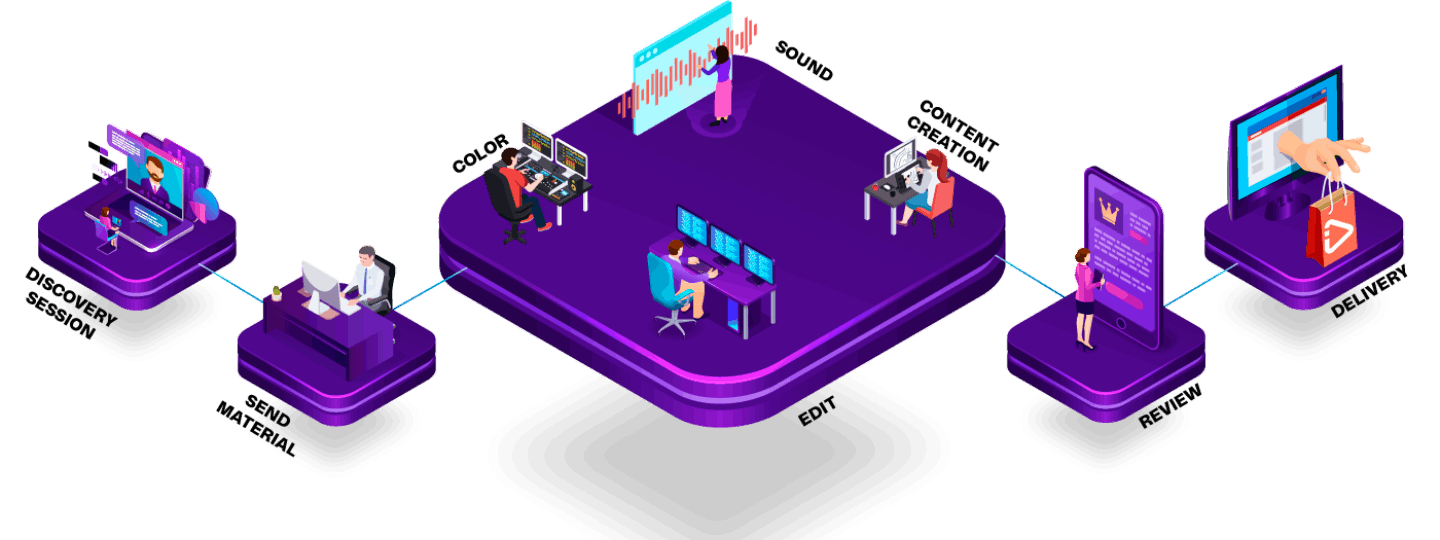
For brands considering a remote agency for the first time, the practical question is often: what does working with them actually look like day to day? How do files move? Who do you communicate with and how? Where do you leave feedback? How do you know where your project is at any given moment? Here is a representative picture of how a structured, well-run remote-first video editing agency operates in 2026.
Onboarding: Brand Intake and Editorial Documentation
Professional remote agencies front-load the relationship with a thorough onboarding process before any editing begins. This typically includes a structured brand intake covering visual style preferences, audio preferences and music guidelines, pacing expectations across different content lengths, reference videos that represent both the style you are aiming for and styles you want to avoid, and any specific elements that appear consistently across your content (logo placements, subtitle styles, brand graphics). This documentation becomes the living editorial brief that guides every editor who works on your account. Done well, this phase means your third video requires a fraction of the feedback of your first, because the editor team is already aligned to your brand before the project brief arrives.
Day-to-Day: Submission, Production, and Review
The standard production cycle for a well-run remote agency looks like this: you submit your raw footage along with a project brief — either through a client portal, a shared intake form, or a project management tool — specifying the objective, duration, distribution platform, and any specific creative direction. Your account manager logs the brief and assigns it to an editor based on content type and specialization match. The editor produces a first draft, often with a brief recorded walkthrough explaining their creative decisions so your first review round is informed rather than reactive. You receive a notification that the draft is ready for review, typically via the agency’s review platform. You leave timestamped comments at the specific frame level. The editor actions the revisions and delivers an updated cut, typically within one business day for standard scope. Final delivery arrives in your specified format, properly named, organized, and ready to upload to your distribution platform.
Account Management and Creative Continuity
Premium remote agencies separate the account management function from the editorial function structurally. Your account manager is your primary communicator — they receive briefs, translate them into editorial language, coordinate timelines, manage any escalations, and maintain the relationship continuity that makes the creative work improve over time. They are not also editing your video while handling your messages. This separation means that your day-to-day communication quality is consistent and responsive regardless of which editor is working on your specific project. Increditors builds its engagements around this model — dedicated account management paired with a consistent senior editor team — specifically so client brands get the continuity and creative coherence of a long-term creative relationship without the fragility of depending on a single individual who might be unavailable, overloaded, or transitioning to a different role.
Frequently Asked Questions
Is there any situation where hiring a local video editor makes more sense in 2026?
Yes, in two specific scenarios. First, if your project requires on-location production — camera operators, lighting setup, a director physically present during filming — you need someone who can be there. Second, if your workflow has hard requirements for in-person review sessions, such as regulatory environments where footage cannot leave a secure physical location, local presence matters. For pure post-production — taking footage that already exists and editing it into finished deliverables — there is no functional advantage to a local editor over a qualified remote one. The output is a digital file in both cases, and the process that produces it is entirely digital throughout.
How do large raw video files get shared with a remote editor?
Most professional remote agencies have an established file submission workflow already in place. Common options include Frame.io (industry standard for collaborative video review and delivery), Dropbox, Google Drive with shared folders, WeTransfer Pro for one-off large transfers, and proprietary client portals. For very large raw file sets, many agencies use proxy workflows — you upload compressed preview files for review while the editor works on full-resolution originals stored in a cloud asset management system. Your agency will walk you through the specifics during onboarding. You should not need to solve the logistics yourself; it should be a documented part of their standard process.
How fast can a remote agency actually turn around a video edit?
Turnaround depends heavily on scope and the agency’s current capacity. A simple 60-second social cut from clean footage with a detailed brief commonly comes back in 24–48 hours from a well-staffed remote agency. A longer-form piece with complex motion graphics, multi-camera footage organization, and multiple revision cycles might take five to ten business days. Rush options are typically available at an additional fee. Remote agencies with distributed teams often outperform local studios on standard-scope turnaround specifically because production can continue across time zones overnight — no waiting for the next business morning.
Can I have real-time feedback sessions with a remote editor?
Yes, entirely. Live review sessions work smoothly via screen-sharing video calls — you see the edit on your screen, you give direction verbally or via chat, the editor applies changes in real time, and you see updates immediately. Many agencies offer scheduled live review sessions as a service tier, particularly for complex projects or final approval milestones. The practical difference from an in-person session is minimal for pure editing feedback. Some clients prefer asynchronous feedback because it lets them think through notes carefully and leave specific timestamped comments; others prefer the pace of live sessions. Professional agencies accommodate both approaches.
How do I verify that a remote agency will actually deliver consistently before committing long-term?
Apply the same due diligence you would to any professional services vendor: check references from clients at your volume and in your content category; review their portfolio critically for examples in your specific content type, not just their curated highlight reel; ask for a detailed walkthrough of their production and revision process before signing anything; and start with a smaller, defined project before committing to a long-term retainer. Published case studies with quantifiable results, transparent pricing discussions, and willingness to answer process questions in detail before you have signed are all strong positive signals. Vague answers about process, reluctance to share client references, and pressure to commit to a long contract before a trial period are warning signs regardless of whether the agency is across town or across the world.
Verdict: Drop the “Near Me” Filter
If you are searching for “video editing near me,” you are starting with the wrong filter. Location is not a quality signal for a fully digital service delivered entirely through cloud platforms. The strongest video editing agencies — the ones with genuine specialization in your content category, multi-timezone production infrastructure, structured quality control, and account management that reduces your workload rather than adding to it — are almost certainly not a few miles from your office. They do not need to be, and they do not compete on proximity. They compete on results.
The correct filter is: who has produced the most content of exactly the type I need, at the volume I need to sustain, with a production process that makes the experience smooth enough that video actually gets made consistently rather than stalling at the brief stage? That search leads to a different and significantly better set of candidates than any map radius provides. Remote-first agencies dominate that shortlist in 2026 — not because local talent is poor, but because the economics of specialization, distributed capacity, and lower structural overhead favor agencies that were built for digital delivery from the start.
For brands treating video as a consistent growth channel rather than an occasional project, a premium remote video editing agency offers what local markets rarely can: dedicated editors who accumulate real knowledge of your brand over time, a production infrastructure built for volume and consistency, and the strategic oversight that turns raw footage into content that performs measurably against your business objectives. Your zip code is the last thing that should factor into that choice.
Ready for Video That Actually Converts?
Tell us about your project and we will put together a custom plan.