








![3D Explainer Video - ScribbleLive.mp4_snapshot_00.12_[2022.03.09_03.14.16]](https://increditors.com/wp-content/uploads/elementor/thumbs/3D-Explainer-Video-ScribbleLive.mp4_snapshot_00.12_2022.03.09_03.14.16-r7wb53mx72rxst3qcqyrfxdmeyzb5r9jbl0wbjujh4.png "3D Explainer Video – ScribbleLive.mp4_snapshot_00.12_[2022.03.09_03.14.16]")





























EdTech companies that invest in the right video formats — from course promos to instructor explainers — consistently report higher enrollment, better completion rates, and lower refund requests. This guide breaks down every video type your platform needs, what professional post-production actually costs, and what to look for in an editing partner built for the education space.
- Why Video Quality Directly Impacts EdTech Metrics
- The 7 Core Video Types Every EdTech Platform Needs
- ROI and Completion Rate Outcomes
- The EdTech Video Production Workflow
- Comparing Production Options: In-House vs Agency vs Freelancer
- What to Look For in a Video Editing Partner
- Budget Planning for EdTech Video at Every Stage
- FAQ
- Verdict
Why Video Quality Directly Impacts EdTech Metrics
The EdTech sector has grown more crowded every year since the early 2020s. Thousands of platforms compete for the same learner, and the deciding factor in whether a prospective student purchases — and whether a paying student completes — is almost never the curriculum alone. It is the experience.
Video is the primary delivery mechanism for that experience. A blurry intro video with poor audio tells a learner everything they need to know about the production quality they can expect inside the course. A polished, well-paced promo video signals that the platform takes its content seriously. That signal converts — and it keeps learners engaged once they are inside.
The challenge is that most EdTech teams are not video production teams. Instructors record great content, curriculum teams build excellent sequences, product teams ship functional platforms — but the post-production pipeline is an afterthought. Raw recordings land on a shared drive, a part-time editor cobbles something together, and the result undersells a genuinely strong product.
That gap between raw footage and a finished, conversion-optimized asset is exactly where a specialist video editing agency earns its keep. This guide walks through every video type the EdTech sector needs, why each one matters to your numbers, and how to build a production workflow that scales with your catalog.
The Learner’s Trust Equation
Trust is the currency of online education. Before a learner hands over payment details, they are asking themselves: is this platform credible? Will I actually learn what they are promising? Video answers both questions faster than any other medium. A well-edited course trailer communicates production quality, instructor credibility, and the transformation the learner can expect — all in under two minutes.
Learners who trust a platform before purchasing are also more likely to complete the content after purchasing. Completion rates and trust are not independent variables. They are closely linked through the initial signal that video quality sends.
Why Generic Video Editing Falls Short for EdTech
EdTech video has specific technical and editorial requirements that a generalist editor often misses. Screen recordings need careful attention to resolution and cursor behavior. Instructor explainers benefit from caption timing that matches pedagogical pacing, not just dialogue. Learning platform walkthroughs require clear UI annotation that a marketing video editor may not know how to handle. The genre has its own conventions, and those conventions exist because they serve learning outcomes.
The 7 Core Video Types Every EdTech Platform Needs
Different video formats serve different parts of the learner journey. A strong EdTech video strategy is not one type of content repeated — it is a deliberate library covering acquisition, onboarding, instruction, social proof, and retention. Here is what that library looks like in practice.
1. Course Promo Videos
The course promo is the closest EdTech analogue to a product trailer. It lives on the course landing page, runs as a paid ad, and gets shared across social. Its job is to convert a browsing visitor into a paying student, typically in 60 to 120 seconds.
Effective course promos blend instructor authority (face-to-camera moments), transformation promise (before/after framing), social proof (quick testimonial clips or review overlays), and production quality that signals the content inside is worth the price. The editing is tight. Every cut earns its place. B-roll and motion graphics reinforce the key benefit statements without burying them under visual noise.
For platforms with catalog depth — dozens or hundreds of courses — maintaining a consistent visual language across every promo is a significant post-production challenge. A systematic approach to video editing with reusable templates and defined brand specs keeps the library coherent as it grows.
2. Student Testimonial Videos
Testimonials are among the highest-converting assets in EdTech marketing. A real learner describing a real transformation carries far more weight than any brand claim. The editing challenge is that raw testimonial footage is rarely usable as-is. Subjects ramble, lose their thread, repeat themselves. Post-production turns that raw material into a tight, credible, emotionally resonant story.
Strong testimonial editing includes selective transcript-based cuts that keep the narrative arc intact, B-roll of the learner at work or using the platform, lower-thirds identifying who the person is and what they achieved, and sound design that makes the audio feel intimate and trustworthy rather than corporate. These are not cosmetic choices — they are the difference between a video that feels authentic and one that feels like a commercial.
3. Instructor Explainer Videos
The explainer is the backbone of most EdTech content libraries. Whether the instructor is on camera, delivering a screen-recorded walkthrough, or using a whiteboard animation style, the editing requirements are the same: clear visual hierarchy, pedagogically appropriate pacing, clean audio, and consistent on-screen text that reinforces key concepts without cluttering the frame.
Explainers fail when post-production is rushed. Jump cuts at wrong moments break the instructional flow. Poor audio mixing makes viewers abandon content mid-way. Inconsistent caption timing creates a mismatch between what learners hear and what they read. Getting these details right requires editors who understand how video editing serves learning — not just entertainment.
💡 Pro Tip: For explainer-heavy catalogs, invest in a consistent caption style guide before production begins. Retroactively reformatting captions across 200 lessons is among the most expensive post-production corrections EdTech teams make.
4. Product Demo Videos
For platforms that teach software tools, product demos are essential. They show prospective learners exactly what they will be able to do after completing the course, and they show the platform experience to learners considering enrollment. The editing here is highly technical: cursor movements need to be clean and deliberate, UI elements need annotation and zoom-in treatment at the right moments, and the narration pacing needs to match the on-screen action precisely.
Product demos that are edited poorly — with too much dead screen time, unclear cursor paths, or mismatched audio — signal that the course content itself will be confusing. The demo is a preview of the learning experience. It should make complex things look learnable, not overwhelming.
5. Learning Platform Walkthroughs
Platform walkthroughs reduce friction at onboarding and decrease support volume. A new learner who watches a two-minute orientation video is significantly less likely to submit a “how do I access my course” support ticket than one dropped into the platform cold. These videos are primarily screen recordings with voiceover, and they need to be updated regularly as the platform UI evolves.
Editing requirements include clear UI callouts, logical chapter markers so learners can navigate non-linearly, and crisp audio that does not sound like a corporate training video from 2012. Platforms that invest in these tend to see measurable reductions in onboarding drop-off — the phase between purchase and first lesson completion that quietly destroys LTV for many platforms.
6. Webinar Recordings and Replays
Webinars generate enormous content value when repurposed correctly. A 90-minute live webinar can yield a polished evergreen replay, a five-minute highlight reel for social, a series of 90-second clips for individual distribution, and an edited short-form piece for course marketing. Without post-production, the raw recording is a liability — full of technical hiccups, dead time, and audience Q&A that is hard to follow out of context.
Editing webinar content requires a different skill set than editing polished studio shoots. The editor needs to reconstruct a coherent narrative from a live performance, identify the moments worth preserving, and trim the rest without disrupting the flow. When done well, a webinar replay can perform as well as scripted content for both lead generation and learner retention.
7. Onboarding Video Series
The onboarding series is a sequence of short videos that guides a new learner from enrollment to first lesson completion. It is the most underinvested video format in EdTech, and the most directly tied to completion rate and LTV. A learner who completes onboarding is significantly more likely to finish the course, leave a review, purchase again, and refer others.
Each video in the series should be short — two to four minutes maximum — and serve a single purpose: welcome, platform orientation, first lesson preview, or community introduction. The editing needs to be warm and energetic rather than dry and procedural. The goal is to build momentum toward the first learning moment, not to deliver a policy briefing.
ROI and Completion Rate Outcomes
The business case for investing in professional video editing is not difficult to make in the EdTech sector — but it does require thinking beyond cost-per-video and toward the downstream metrics that determine platform profitability.
Completion Rates and the LTV Multiplier
Completion rate is the metric most EdTech platforms track but few aggressively optimize through video quality. Industry data consistently suggests that most online courses see completion rates well below 20%, with many MOOCs reporting single-digit completion. Platforms with well-edited, engaging content, strong onboarding sequences, and frequent learner touchpoints through video tend to perform significantly above that baseline.
The LTV multiplier effect is straightforward: a learner who completes one course purchases another at a much higher rate than a learner who drops out partway through. Teams that invest in the video quality factors that drive completion — pacing, audio clarity, visual engagement, logical structure — report measurable improvements in repeat purchase rates over 12 to 18 month windows.
Enrollment Conversion from Course Promos
Course landing pages that feature a professionally edited promo video commonly outperform those relying on static imagery alone. The improvement in conversion can vary widely depending on traffic source, price point, and category — but teams that have A/B tested polished promos against raw instructor intros regularly report meaningful conversion lifts that justify the production investment within the first enrollment cohort.
For platforms with higher-ticket courses — premium programs, bootcamps, professional certifications — the math becomes even more compelling. A single incremental enrollment on a $2,000 course justifies a significant post-production budget. At scale, the ROI on professional video editing is rarely in question.
Refund Rate Reduction
Refunds in EdTech are largely driven by unmet expectations. A learner who purchases based on a misleading or low-quality promo and then encounters high-quality content inside feels a cognitive dissonance that can be resolved in either direction. But a learner who purchases based on a professional promo and encounters content that matches or exceeds that standard rarely requests a refund.
The refund-reduction case for professional post-production is often overlooked in EdTech financial modeling. Platforms that have tracked refund rates before and after investing in consistent video quality tend to find that the production investment partially pays for itself through refund reduction alone — before accounting for the enrollment and completion rate benefits.
💡 Pro Tip: Before budgeting for video production, calculate your current refund rate and the revenue lost per refund. If a 2-point reduction in refund rate covers your annual video production cost, the investment has zero net cost even before completion and enrollment improvements are counted.
The EdTech Video Production Workflow
Most EdTech video production failures are workflow failures rather than quality failures. The raw content is often strong. The problem is that there is no system for moving it from record to publish reliably, at scale, without bottlenecks.
Phase 1: Content Planning and Brief
Before a single frame is recorded, every video needs a brief. For EdTech content, that brief should specify the target audience (prospective learner vs enrolled learner vs social visitor), the desired outcome (conversion, completion, engagement), the format (interview, screen record, face-to-camera, animation), the target length, and any platform-specific requirements (aspect ratio for course player vs 16:9 for YouTube vs square for Instagram).
Skipping the brief is the single most expensive mistake EdTech teams make in production. Editors cannot optimize for outcomes they were not told about. Reshoots and fundamental revisions cost far more than the time the brief would have taken.
Phase 2: Recording and Asset Handoff
The quality of the edit is constrained by the quality of the raw material. EdTech instructors recording from home offices need basic production guidance: consistent background, dedicated microphone, adequate lighting, 1080p or higher camera resolution, and recording in segments rather than one long take. Editors who receive well-organized raw files — clearly labeled, with a shot list or timestamps of key moments — can turn around polished content significantly faster than those working from undocumented recordings.
Asset handoff should also include brand assets: logo files, color codes, approved fonts, lower-third templates, and any motion graphic elements that need to appear consistently across the library. A shared asset folder with version-controlled templates dramatically reduces QA rounds.
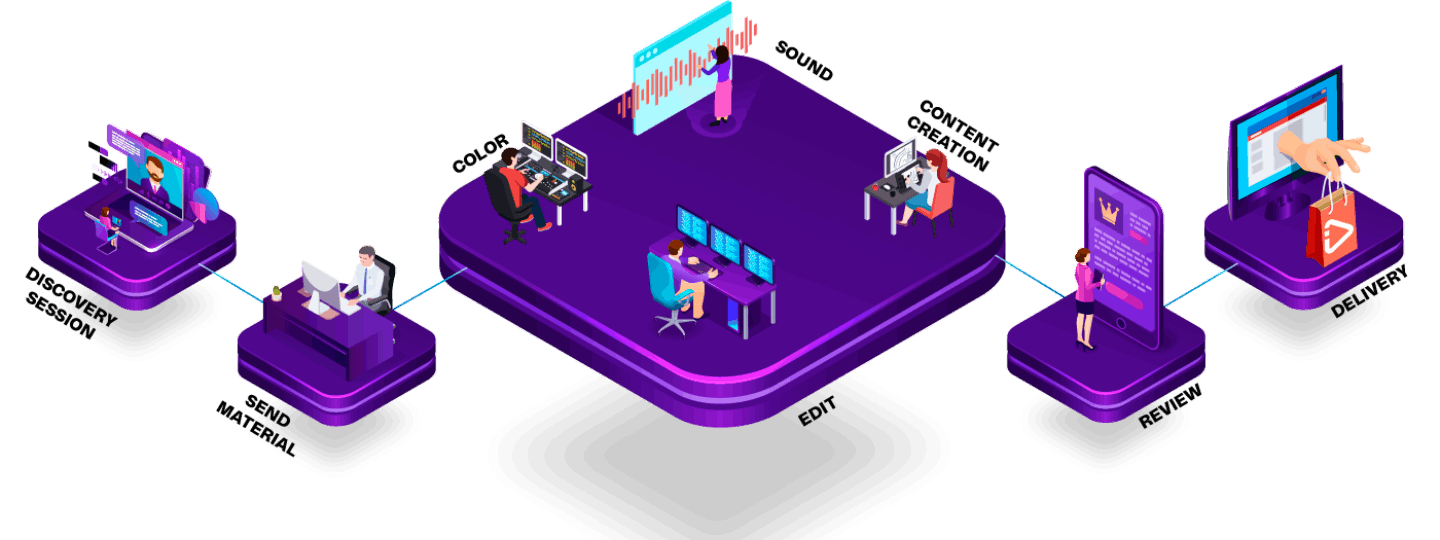
Phase 3: Editing, Review, and Approval
A clear review workflow is essential for EdTech teams producing content at volume. The first-cut review should focus on structure and pacing — is the core message clear, does the narrative arc work, is anything missing? The second-cut review handles brand compliance, caption accuracy, and technical specs. Feedback at each stage should be specific and tied to time codes, not impressionistic.
Agencies like Increditors build dedicated review workflows for clients producing at scale, often using frame.io or similar tools that allow stakeholders to leave time-coded comments without exporting or screen-recording. This reduces the average approval cycle significantly for teams that were previously emailing unstructured feedback on downloaded files.
Phase 4: Distribution Format Exports
Every master edit should yield multiple distribution formats. The course player version (typically MP4 at 1080p, H.264 or H.265), the YouTube version (with intro/outro, description chapter markers), the short-form social cut (vertical 9:16, 60 to 90 seconds with captions baked in), and any ad versions (15-second, 30-second cuts). Capturing these from a single edit session is far more efficient than treating each distribution channel as a separate production.
Comparing Production Options: In-House vs Agency vs Freelancer
EdTech teams at different stages face different trade-offs when choosing how to staff their video production. Here is how the three main options compare across the dimensions that matter most.
The in-house editor model makes sense for platforms with very high volume and very stable output requirements. The freelancer model works for early-stage platforms testing content formats before committing to a production system. The agency model — particularly a specialist agency with EdTech experience — typically becomes the most cost-efficient option once a platform is producing more than four to six videos per month and cares about consistency across the library.
For a full cost breakdown across production options, this guide to professional video editing costs covers pricing structures in detail.
What to Look For in a Video Editing Partner
Not all video editing services are built the same, and almost none of them are built specifically for the needs of an EdTech platform. When evaluating potential partners, the following criteria separate the agencies that will accelerate your content output from those that will create new bottlenecks.
Demonstrated EdTech Portfolio
Ask to see examples specifically from EdTech or adjacent sectors: professional training, corporate learning, SaaS tutorials, instructional content. An agency that has only edited brand films and music videos will likely struggle with screen recording workflows, pedagogical pacing, and the specific aesthetic conventions of educational content. The best agencies have existing templates and processes tuned to the format.
Clear Communication and Revision Process
For EdTech teams producing at volume, ambiguity in the revision process is expensive. You need to know: how many revision rounds are included, what constitutes a revision versus a new request, how feedback is collected and actioned, and what the turnaround time is at each stage. Agencies that communicate clearly about process tend to deliver on time. Those that are vague about process almost always create schedule delays.
Motion Graphics and Caption Capability
EdTech video regularly requires lower-thirds, on-screen annotations, animated text overlays, data visualizations, and caption tracks. An editing partner that cannot produce these in-house — or subcontracts them to a separate party — creates coordination overhead that slows down your production cycle. Look for teams where motion graphics and caption work are part of the standard deliverable, not add-ons.
Template System and Brand Consistency
A good video editing partner for EdTech will build and maintain a template system: branded intros and outros, consistent lower-third styles, approved font treatments, color palettes mapped to your brand, and reusable motion graphic elements. This system is what makes it possible to scale your content library without losing visual coherence. Without it, each new video is effectively a from-scratch design exercise.
Accessibility Compliance Support
Accessibility is an increasingly important factor for EdTech platforms serving institutional customers — universities, corporate training departments, and government bodies often have formal accessibility requirements. This means properly formatted caption files (SRT or VTT), audio descriptions for visual content, and compliance with WCAG video accessibility guidelines. An editing partner with experience in institutional EdTech will understand these requirements. One that only works with consumer content creators may not.
Budget Planning for EdTech Video at Every Stage
Video budgets in EdTech vary enormously by company stage, content volume, and distribution ambition. The following framework helps teams at different stages think about allocation appropriately — without over-investing before content strategy is validated or under-investing once it is.
Early-Stage Platforms (Pre-Product-Market Fit)
At the pre-PMF stage, the priority is speed and learning, not polish. A bootstrapped EdTech startup should focus on getting content in front of learners quickly, gathering completion and conversion data, and iterating on the curriculum. Production quality at this stage should be “good enough not to embarrass” rather than “broadcast-ready.” Investing heavily in post-production before validating that the market wants the content is a common and expensive mistake.
Early-stage teams typically work with a single freelancer or a low-cost editing service, producing core course content and one promo per launch. Budget at this stage commonly falls in the $500 to $2,000 per month range, with occasional spikes for launch campaigns.
Growth-Stage Platforms (Scaling a Validated Model)
Once a platform has validated its core offer and is growing its catalog and user base, the production constraints shift. Volume increases, consistency becomes a competitive differentiator, and the cost of production failures — delayed launches, inconsistent quality across courses, accessibility gaps — compounds. This is where the transition from ad-hoc production to a systematic partnership pays off.
Growth-stage platforms often benefit most from a retainer relationship with a specialist agency. Predictable monthly volume, consistent brand templates, and a defined workflow reduce coordination overhead while increasing output. Monthly budgets at this stage often range from $3,000 to $8,000 depending on video count and complexity.
Established Platforms (Enterprise and Institutional)
Established EdTech platforms — those with six or seven-figure monthly revenue, institutional contracts, or significant content libraries — face the complexity of managing multi-team content production, ensuring accessibility compliance, and maintaining brand consistency across a catalog that may include thousands of videos. At this stage, production is a core operational function, not a marketing expense.
Budget allocations vary widely at the enterprise level, but production efficiency — the cost per quality video delivered — becomes the key metric. Agencies with established EdTech-specific templates, workflows, and QA processes can deliver at significantly lower cost-per-video than building the equivalent capacity in-house.
When choosing between a freelancer and a specialist partner, the agency vs freelancer comparison comes down to your need for consistency, scalability, and strategic partnership rather than just execution capacity.
Why Specialist Post-Production Matters for EdTech
The word “specialist” gets overused in the agency market, but in EdTech video production it has a precise meaning. A specialist team has not just edited educational content before — they have built systems, templates, and workflows specifically for the genre’s demands. They understand that the pedagogical pacing of an explainer video is different from the pacing of a product film. They know that screen recordings require different quality control than face-to-camera content. They have solved the accessibility compliance question for institutional clients before you even bring it up.
Working with Increditors, for example, EdTech clients benefit from onboarding processes that translate brand identity into video templates before a single frame is edited. The goal is that by the time the first course video is in production, the visual language is already defined, approved, and ready to apply consistently across hundreds of assets without reinventing the wheel on each delivery.
Specialist post-production also means strategic input, not just execution. When a team that has edited hundreds of EdTech assets tells you that your course promo is front-loading instructor credentials rather than leading with the learner transformation, they are drawing on pattern recognition that a generalist editor simply does not have. That input can change conversion rates meaningfully — and it does not cost extra.
FAQ
How long should an EdTech course promo video be?
Most high-converting course promos fall between 60 and 120 seconds for paid ads and social distribution, and between two and four minutes for landing page placements where learners are already in research mode. The goal is to answer the core purchase questions — what will I learn, who is teaching, what does the content look like inside, what result can I expect — within the viewer’s attention window. Longer videos are appropriate for higher-ticket courses where the trust requirement before purchase is higher.
What is the difference between a course promo and an explainer video?
A course promo is a marketing asset — its primary job is to convert a prospective learner into a paying student. An explainer is an instructional asset — its primary job is to teach a concept or skill to an enrolled learner. The editing objectives differ: promos are paced for emotional engagement and conversion; explainers are paced for comprehension and retention. Using a marketing edit style on instructional content makes it feel rushed. Using an instructional style on marketing content makes it feel boring.
Should EdTech videos be captioned?
Yes, for almost every use case. Captions improve completion rates for learners watching without audio (a significant fraction of mobile viewers), support learners with hearing impairments, improve comprehension for non-native speakers, and are a legal requirement for platforms serving certain institutional customers. Auto-generated captions from YouTube or zoom recordings are typically 80 to 90 percent accurate — good enough for casual content, not good enough for professional EdTech. Human-reviewed or professionally corrected captions are the standard for any content you are charging for.
How do I maintain visual consistency across a large course catalog?
The answer is templates and a documented style guide. Before you produce your first video, define: intro/outro sequence, lower-third style and placement, color palette for on-screen text and graphics, font stack, approved music beds by content type, and caption format. Give these to every editor working on your content — in-house or agency. Auditing an existing catalog for consistency and retroactively applying templates is possible, but far more expensive than establishing standards upfront. The platforms with the most visually coherent libraries almost always invested in standards before they had large catalogs, not after.
When does it make sense to move from freelancers to a video editing agency?
The transition typically makes sense when you are producing more than five to six videos per month, when brand consistency has become a meaningful concern, when a single freelancer’s availability or absence is regularly impacting your launch schedule, or when you need strategic input on video format and distribution — not just execution. Agencies provide team redundancy, broader skill sets, and institutional knowledge that accumulates over time. Freelancers provide flexibility and low overhead when volume is low and formats are simple.
Verdict: Video Quality Is a Product Decision, Not a Marketing Expense
EdTech platforms that treat video production as a line item in the marketing budget miss the full picture. Video quality is a product decision. It determines whether a learner trusts the platform enough to purchase, completes the content they paid for, returns for a second course, and refers others. Those outcomes compound over the lifetime of a learner relationship — and they are all directly influenced by the quality of the post-production behind the content.
The good news is that professional post-production in EdTech is not prohibitively expensive relative to its impact. A well-edited course promo that lifts conversion by even a modest percentage quickly covers its cost. A well-edited onboarding series that reduces early drop-off has a long-term LTV impact that compounds with every enrollment cohort. These are not aspirational outcomes — they are the consistent experience of platforms that invest in this area seriously.
The question is not whether professional video editing is worth it in EdTech. For any platform past the validation stage, it clearly is. The question is whether you are working with a partner who understands the specific demands of the education sector and can deliver at the quality level, consistency, and volume your growth stage requires.
If you are evaluating your options, the most useful next step is to audit your current video library against the standards in this guide — then request a sample edit from any agency you are considering before committing to a retainer. That sample edit will tell you more about fit than any sales call.
Ready for Video That Actually Converts?
Tell us about your project and we will put together a custom plan.