









![3D Explainer Video - ScribbleLive.mp4_snapshot_00.12_[2022.03.09_03.14.16]](https://increditors.com/wp-content/uploads/elementor/thumbs/3D-Explainer-Video-ScribbleLive.mp4_snapshot_00.12_2022.03.09_03.14.16-r7wb53mx72rxst3qcqyrfxdmeyzb5r9jbl0wbjujh4.png "3D Explainer Video – ScribbleLive.mp4_snapshot_00.12_[2022.03.09_03.14.16]")






























Video captioning and subtitling costs range from free (AI auto-captions) to around $3.00 per minute for human-made captions, with translation-based subtitling typically running $5–$15 per minute depending on the language pair. Businesses spending on regular video content should factor captioning into their editing budget from the start — not as an afterthought. This guide breaks down every pricing tier, what drives costs up or down, and how to decide which option fits your production workflow in 2026.
- What Captioning and Subtitling Actually Cover
- Video Captioning Cost Breakdown: What to Expect in 2026
- Cost Per Minute: Captioning vs Subtitling vs Translation
- What Drives the Price Up (or Down)?
- DIY vs Professional Captioning: Real Cost Comparison
- Leading Captioning Services and Their 2026 Pricing
- How Captioning Fits Into Your Video Production Budget
- FAQ: Video Captioning and Subtitling Cost
- Verdict
What Captioning and Subtitling Actually Cover
Captioning and subtitling are often used interchangeably, but they refer to different deliverables — and that distinction directly affects what you pay. Understanding the difference before you request a quote will save you from scope confusion and unexpected costs.
Closed Captions vs Open Captions
Closed captions can be toggled on or off by the viewer and are embedded as a separate data layer (SRT, VTT, or TTML file). Open captions are burned directly into the video frame and are always visible. Open captions cost slightly more to produce because the post-production workflow is more involved — the text becomes part of the export, not an attachment.
For social media distribution — especially LinkedIn, Instagram Reels, and TikTok — open captions have become standard because many viewers watch without sound. For broadcast, corporate training, and streaming platforms, closed captions are typically required to meet accessibility standards.
Subtitles vs Captions: The Real Difference
Captions assume the viewer cannot hear the audio. They include speaker labels, sound effects, and music cues in addition to the spoken words. Subtitles assume the viewer can hear but does not understand the language — they contain only dialogue, no sound descriptions. When translation is involved, the correct term is subtitling or localization, and the cost structure changes significantly because a linguist enters the workflow.
For compliance purposes — such as FCC closed captioning regulations for broadcasters or WCAG 2.1 success criterion 1.2.2 for web media — the term is always “captions,” and the accuracy bar is higher than casual subtitling.
What You Are Actually Paying For
When you hire a captioning service, you are typically paying for some combination of: transcription (converting speech to text), timing (synchronizing text to audio), formatting (line breaks, maximum characters per line), quality review (catching errors an AI missed), and file delivery (SRT, VTT, embedded burn-in). The more of these steps that require human judgment, the higher the per-minute rate. Automated pipelines handle transcription and timing cheaply; formatting, accuracy review, and niche vocabulary (technical jargon, proper nouns, multiple speakers) are where human editors earn their premium.
Video Captioning Cost Breakdown: What to Expect in 2026
The captioning market in 2026 has three distinct tiers based on who (or what) does the work. Each tier has a fundamentally different accuracy profile, turnaround time, and cost structure. The right choice depends on your accuracy requirements, content complexity, and whether the captions are audience-facing or internal.
Tier 1: AI Automated Captioning
Platforms like YouTube Studio, Adobe Premiere’s auto-transcription, Descript, and Rev.ai’s automated API all use AI speech-to-text to generate captions with minimal human intervention. Costs in this tier typically run from free (for platform-native tools like YouTube’s automatic captions) to around $0.10–$0.25 per minute of content for standalone AI captioning services.
Accuracy varies significantly. For clean studio audio with a single speaker and standard vocabulary, modern AI captioners regularly achieve word error rates below 10 percent — acceptable for internal content or social video where perfection isn’t legally required. For content with accents, crosstalk, technical terminology, or background noise, error rates can jump sharply. These captions are rarely suitable for compliance use without a human review pass.
Tier 2: Professional Human Captioning
Human captioning services — such as Rev.com’s human-captioned option, 3Play Media, and Verbit — combine AI transcription with a trained human editor who reviews and corrects every line. Industry standard turnaround is typically 24–48 hours, with rush options available for a premium. Pricing for this tier commonly ranges from around $1.50 to $3.00 per minute of video, with accuracy guarantees of 99 percent or higher. For compliance, legal, or medical content, this tier is the minimum viable option.
Rush delivery — typically same-day or within a few hours — often adds a 50–100% surcharge on top of the standard rate. If your editorial calendar requires captions before a same-day publish, it’s worth building the rush premium into your cost model from the beginning rather than treating it as an exception.
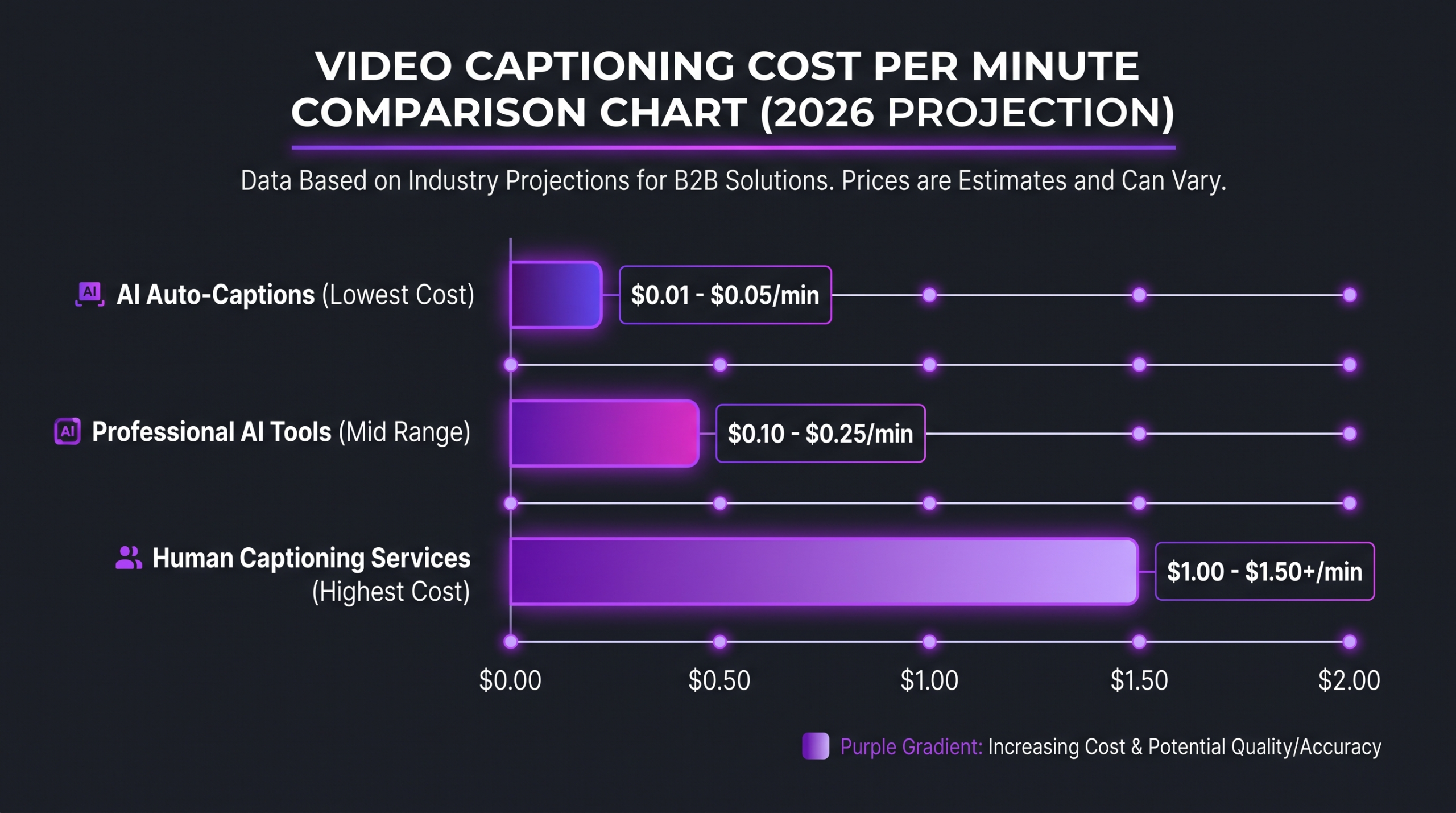
Cost per minute across the three main captioning tiers in 2026
Tier 3: Agency-Bundled Captioning
A growing number of video teams source captioning through their primary video editing company rather than through a standalone captioning vendor. When captioning is included in a monthly editing retainer or per-project scope, the effective per-video cost is typically lower than buying it separately — and crucially, the team handling the edit already knows the content, making the caption pass faster and more accurate for brand-specific terminology.
For teams producing 10 or more videos per month, bundled captioning often becomes the most economical route because the overhead of quoting, uploading, and managing a separate captioning vendor for each video disappears. The tradeoff is that not every editing service offers captioning — you need to verify it is explicitly in scope before assuming it’s included.
Cost Per Minute: Captioning vs Subtitling vs Translation
The table below summarizes typical 2026 market rates across service types. These are representative ranges drawn from publicly listed vendor pricing and common market patterns — actual quotes will vary based on volume, vendor, and project specifics.
💡 Pro Tip: Foreign language subtitling is priced per source minute, not per word. A 10-minute video translated into Spanish + French + German typically costs more than three times the per-minute rate for a single language — translation pairs, QC, and timing sync multiply. Budget accordingly when localizing for multiple markets at once.
What Drives the Price Up (or Down)?
Captioning quotes for the same 10-minute video can differ by 5x depending on how you spec the job. Understanding the main cost levers lets you make smarter trade-offs rather than just accepting the first quote you receive.
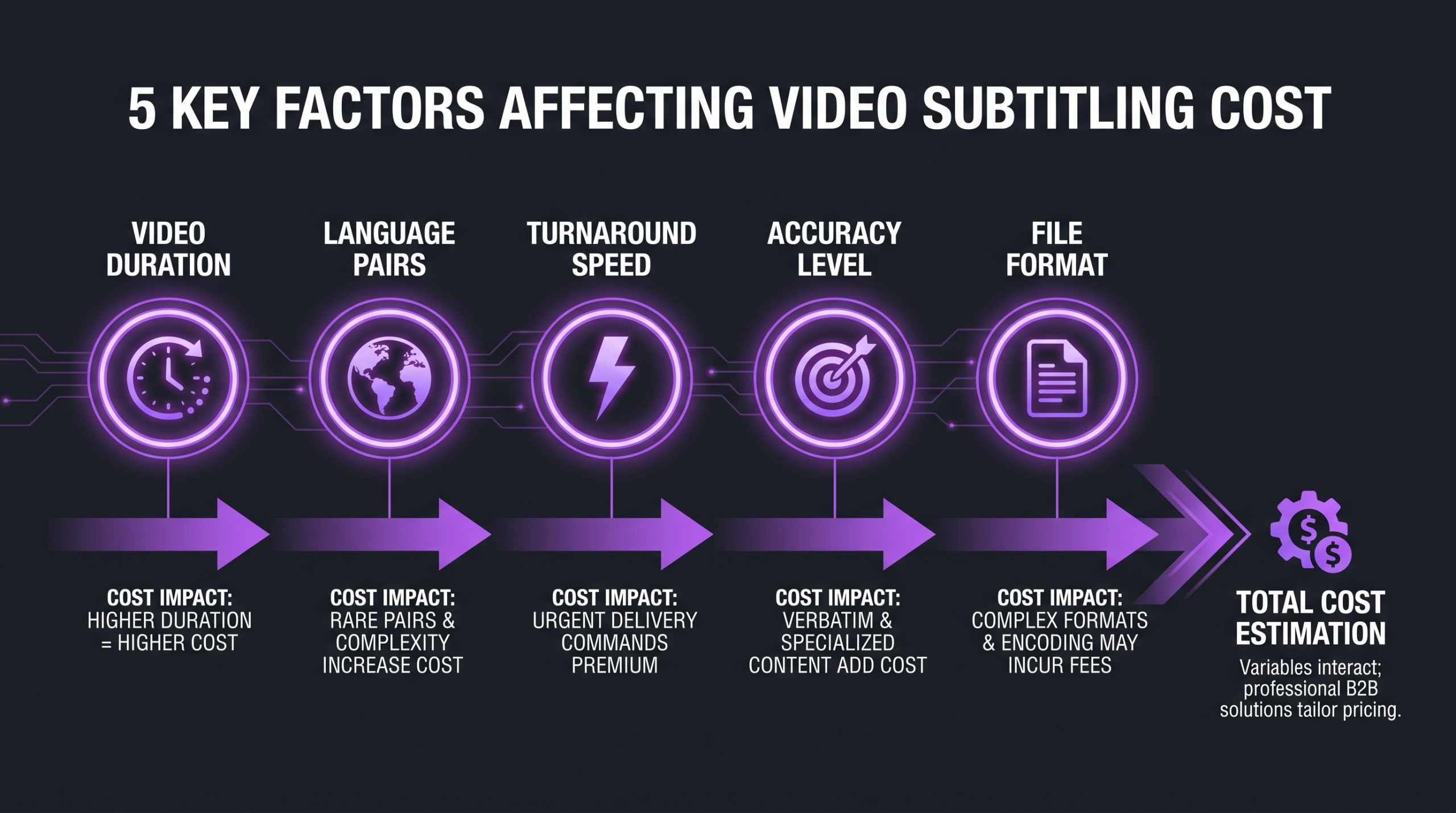
The five main variables that move your captioning quote up or down
Audio Quality and Speaking Clarity
Audio quality is the single biggest hidden cost driver. Clean studio recordings with a single speaker reduce AI error rates dramatically, which means less human correction time. Interviews with crosstalk, conference room recordings with echo, event footage with ambient crowd noise, or content featuring heavy accents or fast delivery all require more human editing time — and human editing time costs money. Some services explicitly charge more for “difficult audio” or limit their accuracy guarantee to clean recordings only.
Technical and Specialized Vocabulary
Generic AI models struggle with brand names, product names, medical terminology, legal language, and technical jargon — and they don’t know to ask for context. Professional captioning services let you submit a glossary of preferred terms, which improves accuracy significantly. Some premium tiers include custom vocabulary training for ongoing clients. If your content routinely uses specialized terminology, factor in the cost of a glossary review or expect a higher per-minute rate for human correction.
Turnaround Time
Standard turnaround (24–48 hours) is the baseline pricing. Same-day or 4-hour rush delivery routinely adds 50–100% to the base rate. For teams that publish frequently on tight editorial cycles, planning captions as part of the production schedule rather than ordering them after final export eliminates most rush fees and gives editors time to review.
Output Format and Burn-In Requirements
Delivering an SRT or VTT caption file is the standard, lowest-cost output. Burning captions directly into the video (open captions) requires your editing team or an encoding service to composite the text into the exported file — that is a post-production step, not just a captioning step. If you need styled open captions (specific fonts, animated text, branded colors), the cost climbs further still. Multiple format deliveries (SRT for the web, embedded for social, translated version for Spanish) multiply per-minute costs by the number of outputs.
Number of Languages
Monolingual captioning (same-language captions for English content in English) is the cheapest scenario. Adding one foreign-language subtitle track typically triples the per-minute cost because translation, cultural adaptation, and re-timing all add significant work. Common language pairs — Spanish, French, Portuguese — tend to be cheaper than rare combinations because there is more translator supply. Certified or legal-quality translations carry a further premium regardless of language pair.
DIY vs Professional Captioning: Real Cost Comparison
The DIY vs professional decision for captioning is not just about the dollar amount on the invoice — it is about the full cost including your team’s time, correction overhead, and the downstream cost of accuracy errors. The comparison below uses a hypothetical 30-minute training video to illustrate the real trade-off.
The hidden cost most teams underestimate in the DIY scenario is correction time. A 30-minute video with 90% AI accuracy contains roughly 150–300 errors (assuming ~500 words per minute average speaking rate across the full recording). Correcting those manually, line by line, typically takes 90–120 minutes of a skilled editor’s time — often making the “free” AI option more expensive in labor terms than paying for a human-reviewed service. For teams billing their time or prioritizing throughput, the math usually favors professional captioning above a modest weekly output volume.
💡 Pro Tip: The real ROI case for professional captioning is not about the captions themselves — it is about reach. Research cited by 3Play Media consistently shows that captioned video outperforms uncaptioned video for completion rates and engagement, particularly on mobile. If your video is already costing $500–$5,000 to produce, adding $50–$90 for accurate captions and improving its performance is straightforward math.
For teams weighing this decision at scale, it is worth reading about the broader video editing agency vs freelancer trade-offs, since captioning is just one part of a broader production cost picture.
Leading Captioning and Subtitling Services: 2026 Pricing Overview
The market for captioning services is well-established, with a handful of vendors dominating the professional tier. Pricing and feature sets below are based on publicly available information as of mid-2026 — verify current rates directly before committing, as vendors update pricing regularly.
For accessibility-focused publishing workflows, it is also worth noting that platforms like YouTube provide free auto-captions — but as WebAIM’s guidance on captions notes, auto-generated captions are not compliant replacements for human-reviewed captions under WCAG or Section 508 requirements. For any content that must meet an accessibility standard, plan the budget for at minimum an AI+human-review tier.
How Captioning Fits Into Your Video Production Budget
One of the most common budgeting mistakes video teams make is treating captioning as an afterthought — quoting the edit, getting approval, producing the video, and only then realizing captions need to be added before publish. The better approach is to price captioning as a standard line item in every video scope, the same way color grading or sound design would be included.
A rough rule of thumb for budgeting: professional captioning (AI + human review tier) typically adds 5–15% to the overall cost of a produced video. For a $500 corporate talking-head video, that is $25–$75 — a small fraction of the production cost for a deliverable that materially expands the video’s accessibility and social media performance. For teams producing dozens of videos per month, understanding the full cost of professional video editing including captioning is essential for accurate client scoping and internal budget planning.
When to Invest in Premium Captioning
Invest in the human-reviewed or compliance-grade tier when: the content will be publicly distributed and subject to accessibility regulations; the video includes complex terminology where AI errors would be noticed and embarrassing; the content has a long shelf life (training materials, course content, evergreen marketing videos); or the audience includes viewers who rely on captions to understand the content.
Stick with AI-only when: the content is internal-only and accuracy errors won’t have consequences; you have the team capacity to review and correct the AI output as part of the normal editing workflow; or the video has a very short shelf life (event highlights, news-adjacent content) where speed matters more than perfection.
Volume Pricing and Retainer Economics
Most captioning vendors offer volume discounts once you cross a monthly or annual threshold — typically around $0.20–$0.40 per minute off their standard rate for enterprise accounts. If your organization produces more than 20 hours of video per year, it is worth requesting an enterprise quote rather than relying on pay-per-use pricing. Alternatively, working with a video editing services partner that bundles captioning can eliminate the separate vendor relationship entirely, simplifying invoicing and improving turnaround coordination.
The video production industry has seen increasing interest in accessibility-driven captioning investment since major platforms began prioritizing caption quality in their algorithmic distribution — particularly for professional content on LinkedIn and YouTube. Investing in accurate captions today is as much an SEO and distribution decision as it is an accessibility one.
Captioning and SEO: The Hidden ROI
Beyond accessibility and compliance, captions carry an underappreciated SEO benefit. Search engines cannot watch video — but they can read caption files and on-page transcript text. A video with an accurate caption file (or an embedded transcript) gives Google indexable text content directly linked to the video’s topic, which can support ranking for conversational and long-tail search queries that the surrounding page copy alone might not cover. This is particularly relevant for educational content, product walkthroughs, and webinars, where the spoken content is dense with keyword-rich information that never appears in the written page.
YouTube’s own caption and transcript support documentation confirms that captions contribute to indexability for YouTube search. For content hosted on your own domain, adding a collapsible or visible transcript alongside the video player is a straightforward on-page SEO enhancement that costs nothing once the caption file exists. If you are already paying for professional captioning, converting that SRT file into a formatted transcript block takes minutes and extends the return on your captioning investment.
FAQ: Video Captioning and Subtitling Cost
How much does it cost to caption a 10-minute video?
A 10-minute video with AI-only captioning typically costs between free and $2.50. With a human-reviewed service, plan for around $15–$30. Full human captioning with 99% accuracy guarantee runs approximately $15–$30 at the high end of AI+human tiers, or $20–$30 for fully human services. Rush delivery adds a 50–100% premium. These are representative market ranges — actual pricing varies by vendor and audio difficulty.
Are subtitles and captions the same thing, and do they cost the same?
No. Captions include dialogue plus sound descriptions (for deaf and hard-of-hearing viewers). Subtitles include dialogue only (for viewers who hear but don’t understand the language). Same-language captioning and same-language subtitling are priced similarly, but adding translation for foreign-language subtitling typically triples or more the per-minute cost because a qualified translator must be involved in addition to the captioner.
Can I use YouTube’s free auto-captions for professional content?
You can use YouTube’s auto-captions as a starting draft, but they are not suitable as-published for compliance purposes, branded content where terminology accuracy matters, or any content where caption errors could mislead or embarrass. The typical workflow is to export YouTube’s auto-generated SRT file, correct it manually or via a professional service, and re-upload the corrected file. This hybrid approach saves transcription time while maintaining accuracy.
Do I need captions for compliance, and what are the penalties for missing them?
Compliance requirements depend on your distribution context. In the US, the FCC requires captions for broadcast and certain online-distributed television content. Section 508 of the Rehabilitation Act requires federal agencies (and their contractors) to caption video content. The ADA has been increasingly interpreted to apply to commercial web content. WCAG 2.1 Level AA (widely adopted as a standard for web accessibility) requires captions for all pre-recorded audio content in synchronized media. Penalties and enforcement vary, but failing to caption content in regulated contexts exposes organizations to complaints, audits, and legal action. When in doubt, caption.
What is the difference between an SRT file and burned-in captions?
An SRT (SubRip Text) file is a separate text file containing timed caption data that is loaded alongside the video. The viewer or platform renders the text on top of the video. Burned-in (or hardcoded/open) captions are permanently composited into the video frame during export — they cannot be turned off, restyled, or removed by the viewer or platform. SRT files are more flexible and cheaper to produce; burned-in captions require a post-production render pass and are essential for social platforms that do not support caption sidecar files, such as Instagram Feed video and certain TikTok formats.
Verdict: What Should You Actually Budget for Captioning in 2026?
The right captioning budget for your organization depends almost entirely on your accuracy requirements and output volume. Here is a practical framework:
Low volume (under 5 videos/month), internal-only, no compliance requirement: Use platform AI tools (free). Accept some errors. Budget: $0–$25/month.
Mid-volume (5–20 videos/month), client-facing or public, no hard compliance requirement: AI + human review tier from a service like Rev or 3Play. Budget: $75–$500/month depending on average video length.
High volume (20+ videos/month) or compliance-required content: Enterprise captioning contract or agency-bundled captioning as part of a full video production retainer. Volume discounts and simplified workflow management make this tier increasingly cost-effective at scale. Budget: negotiate directly based on minutes per month.
Multilingual distribution: Add $3–$8 per minute per language for common language pairs, with specialist rates for rare languages. Build translation timelines (typically 3–5 business days) into your production calendar from the start.
For teams producing high-quality branded video and wanting captioning handled as part of an integrated post-production workflow — rather than as a separate vendor to manage — Increditors includes captioning as part of its senior editing retainers. The advantage: the editor who knows your brand, your terminology, and your audience is also the one reviewing the caption pass, which catches the errors an outside captioning vendor would miss. That kind of integrated quality matters more as your video output grows.
Ready for Video That Actually Converts?
Tell us about your project and we will put together a custom plan — captioning included.