








![3D Explainer Video - ScribbleLive.mp4_snapshot_00.12_[2022.03.09_03.14.16]](https://increditors.com/wp-content/uploads/elementor/thumbs/3D-Explainer-Video-ScribbleLive.mp4_snapshot_00.12_2022.03.09_03.14.16-r7wb53mx72rxst3qcqyrfxdmeyzb5r9jbl0wbjujh4.png "3D Explainer Video – ScribbleLive.mp4_snapshot_00.12_[2022.03.09_03.14.16]")



























UGC video editing rates in 2026 typically range from $20–$60 per short clip with freelancers, $75–$200 per deliverable with mid-tier agencies, and $300–$800/month for retainer-based UGC editing with a dedicated team. The wide spread isn’t random — it comes down to platform format, hook complexity, revision rounds, and whether the editor understands UGC-specific aesthetics like lo-fi visual style, authentic audio mixing, and split-second pacing. This breakdown explains exactly what drives those numbers and how to get fair value at any tier.
What Makes UGC Editing Different — and Why Rates Vary So Much
UGC editing is its own discipline. It isn’t about making footage look polished — it’s about making polished footage look real. That inversion changes everything: the workflow, the skill set, the tools, and the time investment per deliverable. When brands misunderstand this, they underpay for expertise and overpay for the wrong service.
Traditional video editing is additive: you bring color, motion graphics, transitions, and sound design to elevate raw material. UGC editing is subtractive and architectural. The editor’s job is to find authenticity in footage that was shot on a smartphone, remove anything that signals “produced,” and build a narrative arc — usually within 15 to 60 seconds — that feels native to the platform it will live on. TikTok’s native-feed behavior, Instagram Reels autoplay dynamics, and YouTube Shorts’ recommendation loop each demand different pacing, caption placement, and hook structure.
According to TikTok’s own creator marketing guidance, ads that feel native to the feed — meaning they use organic video cues, text overlays, and lo-fi aesthetics — typically outperform heavily produced equivalents in scroll-stop rate. This has driven a surge in brands hiring UGC editors specifically, not just general video editors, which has created a distinct and increasingly specialized rate market.
The rate spread you’ll encounter ($15 at the low end, $800+ at the high end for monthly retainers) reflects three main variables: the editor’s platform specialization, the complexity of the hook-to-CTA structure required, and whether you’re buying individual clips or a continuous creative testing pipeline. Understanding those variables lets you buy precisely what you need without overspending on capability you won’t use — or underspending into wasted ad spend.
💡 Pro Tip: UGC editing rates are closely tied to what platform the content will run on. TikTok and Reels editors who live on those platforms daily will charge more — and deliver more — than a general editor who treats short-form social as an afterthought. Always ask to see platform-native examples, not showreels.
UGC Video Editing Rate Tiers in 2026
The market has organized into four recognizable tiers, each serving a different production need. None is universally “better” — the right tier depends on your volume, brand standards, and whether you’re testing creative concepts or scaling proven winners.
Entry-tier editors are commonly sourced from Fiverr or Upwork and deliver workable edits at speed. The limitation is strategic depth: they execute a brief well but rarely push back on hooks that won’t perform or suggest structural improvements based on platform behavior. For testing five creative concepts at $25 each, that’s entirely reasonable. For scaling a proven winner into 20 ad variants, the lack of strategic input becomes expensive in wasted ad spend.
Mid-tier freelancers — typically platform-native creators who’ve pivoted into editing — bring real TikTok or Reels intuition to the edit. They understand scroll behavior, why a hook needs to land in the first 1.5 seconds, and how to use text overlays to compensate for silent autoplay. These editors commonly have portfolios of ad accounts they’ve worked on and can speak to performance outcomes, not just aesthetic choices.
Agency-tier editing comes with a full feedback infrastructure: creative strategy, brief development, revision SLAs, and often A/B testing frameworks. This is where editorial continuity matters — you’re not re-briefing a new editor every month. A video editing agency operating at this tier will assign a dedicated editor or small team to your account, maintain brand guidelines across all deliverables, and flag when creative fatigue is building before it tanks your ROAS.
Monthly Volume Discounts
Most mid-tier and agency editors offer meaningful volume discounts. Brands producing 10+ clips per month commonly negotiate 20–35% below the per-clip rate. At retainer level, the math usually inverts entirely — you’re buying bandwidth and strategic continuity, not individual clips, and the per-deliverable cost drops substantially with consistent volume. Always ask whether a retainer makes sense before committing to a per-clip arrangement if you know your monthly volume exceeds eight to ten pieces.
Rate Breakdown by Platform and Format
UGC editing rates are not one-size-fits-all across platforms. Each major short-form platform has distinct editorial demands that affect time-per-deliverable and therefore cost. Here’s how the market typically segments.
TikTok UGC ads generally have the lowest per-clip rate because the lo-fi aesthetic means less technical post-production — no color grade, no sound design, intentionally rough text overlays. The expertise cost is all in the structural decision-making (which moment to open on, where to cut for maximum hook retention), not in technical execution. This is why raw footage selection skill matters as much as editing skill in this format.
Instagram Reels UGC commands slightly higher rates because the platform has trained audiences to accept a moderate polish level — branded lower thirds, on-trend audio sync, and coherent color feel are expected without breaking the “organic” illusion. Editors need to thread a finer needle between produced and authentic.
Multi-platform cut packs represent the best per-deliverable value when you’re already generating strong source footage. Rather than shooting separate UGC for each platform, a skilled editor re-structures the same raw material for TikTok, Reels, and Shorts simultaneously — saving you 60–70% compared to commissioning three separate edits while still meeting each platform’s native demands. This is worth negotiating explicitly in any retainer arrangement. For full context on what drives overall video production budgets, see our video ad production cost breakdown.
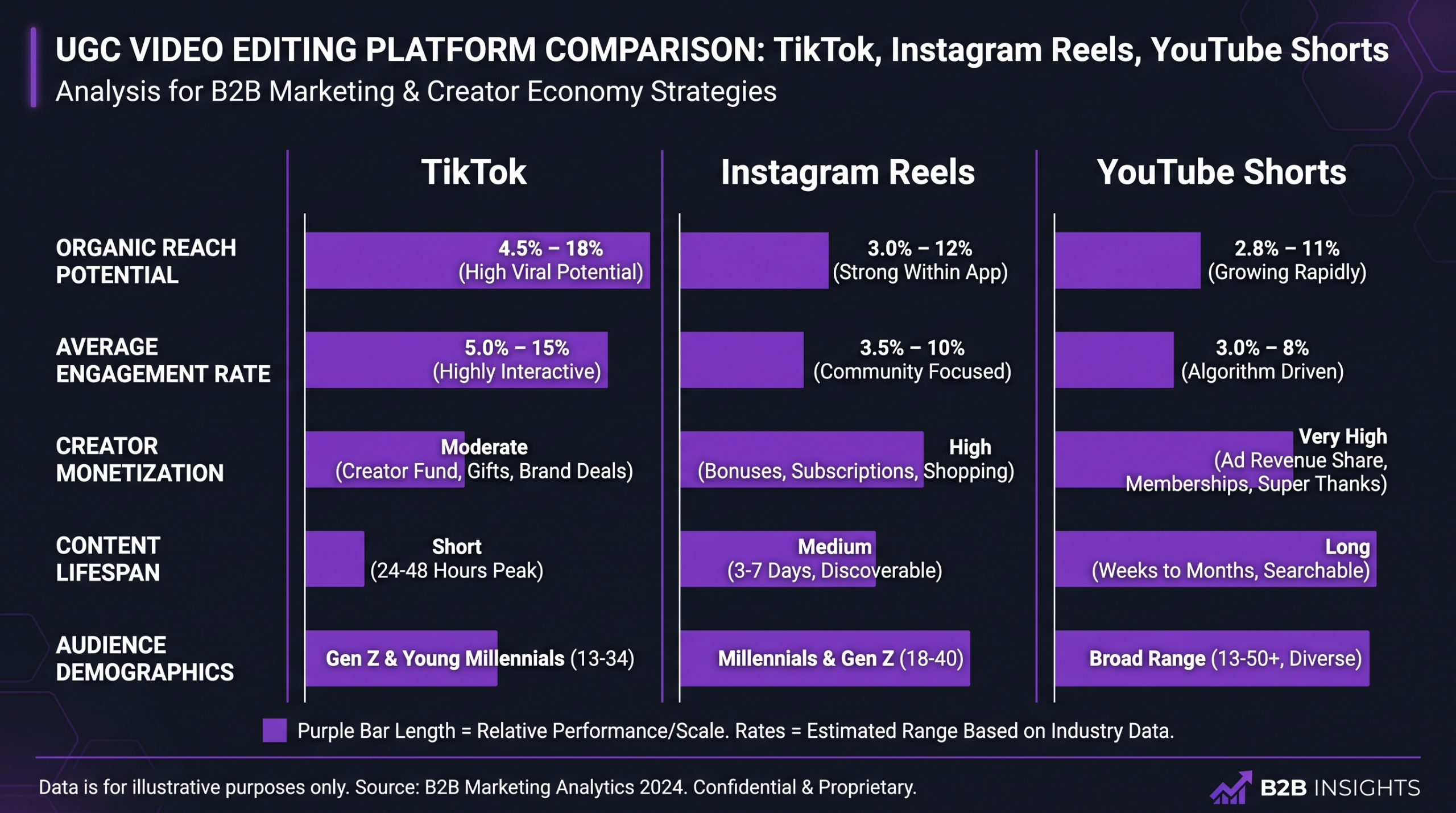
UGC editing rate ranges by platform — lo-fi TikTok at the lower end, multi-platform cut packs offering best per-deliverable value
What Drives UGC Editing Costs — The Real Variables
When two editors quote you wildly different rates for what sounds like the same deliverable, one of five variables is usually driving the gap. Understanding them helps you ask better questions and avoid scope creep surprises.
1. Raw Footage Quality and Volume
Editors who receive well-organized footage with clear selects and a brief will complete an edit in a fraction of the time compared to those who receive 2 hours of disorganized clips with no direction. Most UGC editors build raw footage prep into their quote — if your footage is chaotic, expect a 20–40% premium for “cleanup” time on top of the edit rate.
2. Number of Hook Variants
High-performing UGC creative testing typically involves three to five hook variants of the same clip — same body, different openings — to A/B test at the top of funnel. Each hook variant is a separate edit decision, not a minor tweak. Editors typically charge 50–70% of the full clip rate per additional hook variant. If you need five hooks, budget for roughly three to three-and-a-half times the base clip rate.
Meta’s own A/B testing guidance confirms that creative variation at the hook level — not the body — is where most performance divergence occurs. Brands that understand this budget for hook variants from the start rather than retrofitting them mid-campaign.
3. Revision Rounds
Most UGC editing quotes include one to two revision rounds. Beyond that, time-and-materials billing kicks in at $40–$80/hour for most mid-tier editors and $80–$150/hour for agency-tier. Brands without a clear creative brief commonly burn through two to three extra revision rounds — which can double the effective cost of a clip. A detailed creative brief upfront is, counterintuitively, one of the highest-ROI investments in your UGC workflow.
4. Turnaround Time
Standard turnaround for a UGC clip at mid-tier is three to five business days. Rush delivery (24–48 hours) typically adds a 25–50% premium. During peak periods — Q4 e-commerce season and January new-year campaign surges — rush slots often sell out entirely and any available capacity commands the highest premium. Plan your UGC calendar four to six weeks ahead if timing is a constraint.
5. Rights and Usage Licensing
UGC editing that incorporates licensed music (beyond royalty-free), third-party footage, or creator content with usage rights attached carries licensing costs on top of the edit fee. This is separate from the editor’s rate but commonly bundled in agency quotes. Clarify what rights are included before signing any retainer — especially if you plan to run paid ads on the edited content, which typically requires broader licensing than organic-only usage. Shopify’s UGC licensing guide covers the basics of usage rights for e-commerce brands.
💡 Pro Tip: The single highest-leverage action you can take before hiring any UGC editor is to create a one-page creative brief template. Editors who receive structured briefs consistently produce better first drafts with fewer revisions — which means your effective cost-per-deliverable drops 20–30% compared to briefing via Slack messages and voice notes.
Freelancer vs Agency UGC Editing: Full Rate Comparison
The freelancer vs agency decision in UGC editing is primarily about scale and operational overhead, not quality per se. A senior freelance UGC editor can match agency creative quality — but can rarely match agency throughput, backup capacity, or project management infrastructure. Here’s how the two models compare across the dimensions that matter most at different production volumes. Many brands and content creators work with a remote video editing agency to handle volume, maintain consistency, and scale output without adding internal headcount.
The inflection point where an agency retainer becomes more cost-effective than per-clip freelancer rates typically sits between eight and twelve deliverables per month. Below that, freelancers offer better per-deliverable value. Above it, the combination of volume discount, dedicated capacity, and reduced project management overhead tips the math toward a retainer.
There’s also a quality consistency argument at scale. A single freelancer producing twenty clips a month is at their capacity ceiling, which means creative fatigue — and quality drift — tends to appear in the second half of each month. An agency distributes that volume across a team with internal QC, keeping consistency stable across the full production cycle. For a deeper look at the full financial comparison, our agency vs freelancer breakdown covers it comprehensively, including hidden costs on both sides.
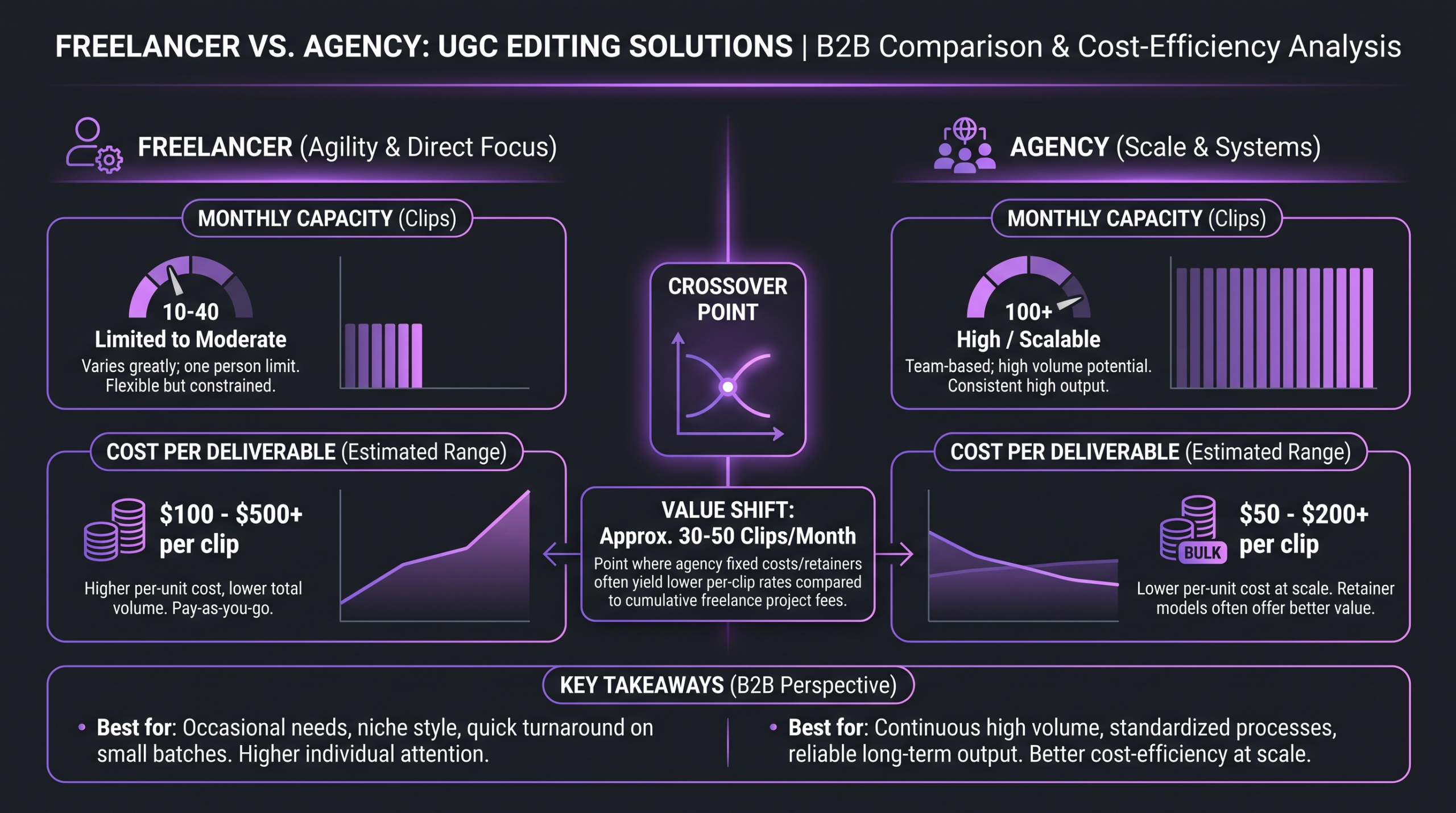
Freelancer vs agency: the cost-efficiency crossover typically happens around 8–12 UGC deliverables per month
Hidden Costs in UGC Editing You Should Budget For
The quoted rate is rarely the total cost. Brands that haven’t worked with dedicated UGC editors before commonly underestimate four categories of spend that appear on top of the clip rate. Budget for these from day one.
Project Management and Feedback Tools
Professional UGC editors at the agency tier use structured review tools — Frame.io, Wipster, or equivalent — for time-stamped feedback. Some include tool access in the retainer; others bill it as a pass-through. Budget $20–$50/month for review infrastructure if your editor doesn’t absorb the cost. The alternative — feedback via email and Slack — consistently produces worse revision outcomes and longer turnaround times.
Music Licensing
Royalty-free music subscriptions (Artlist, Epidemic Sound) that cover ad usage typically run $150–$300/year. If your editor handles licensing, it’s usually included in agency retainers but quoted separately by freelancers. Budget for this explicitly rather than assuming it’s covered — music licensing disputes on paid ad content can be costly to resolve post-campaign. Epidemic Sound’s commercial licensing is one of the most common solutions in the UGC space.
Creative Brief Development
Some agencies bill a one-time onboarding fee ($200–$500) to develop your brand’s UGC creative brief template. This is almost always worth it — a well-built brief reduces revision rounds and improves first-draft quality across every clip going forward. If a freelancer doesn’t offer this, consider developing it yourself with a session or two of their time billed at their hourly rate.
Format Conversion and Spec Delivery
Different ad platforms have different technical spec requirements for upload. Ensuring your UGC clips meet TikTok’s recommended bitrate and file size, Meta’s aspect ratio requirements, and YouTube’s audio normalization targets is technical work that often falls outside the creative edit brief. Some editors include spec delivery; others charge a nominal fee per format. Clarify this before signing off on any retainer or project agreement. Platform spec requirements are updated frequently — an editor who stays current with spec changes saves you re-export fees and campaign delays.
For a broader view of how UGC editing costs fit into the overall ad creative budget, our related breakdown on TikTok ad creative costs in 2026 covers full production costs including filming, creator fees, and platform-specific strategy.
How to Evaluate UGC Editors at Any Price Point
Rate is an input, not an outcome. A $200/clip editor who understands retention pacing will outperform a $30/clip editor who doesn’t — but a $300/clip editor operating at scale with strategic support will consistently outperform both. Here’s how to evaluate across all three tiers.
Review Platform-Native Work, Not Showreels
Ask to see clips that actually ran on the platform you’re targeting. A showreel is curated for impressiveness, not performance. A live TikTok ad or Instagram Reel that ran in-feed shows you how the editor thinks about native behavior. Bonus: ask if they have any metrics data on clips they’ve worked on. Editors who’ve contributed to high-ROAS campaigns are usually proud to say so (in general terms).
Test With a Paid Trial Project
Before committing to a monthly retainer, commission one to three test clips at the full quoted rate. Evaluate first-draft quality, brief comprehension, communication speed, and revision responsiveness. A $200 test project that rules out a bad-fit editor saves you months of retainer spend and campaign underperformance. This applies equally to freelancers and agencies — always test before you commit volume.
Ask About Their Hook Framework
A strong UGC editor has a defined framework for structuring hooks. Ask them: “Walk me through how you decide what the first three seconds of a UGC ad should look like.” An editor who can articulate a systematic approach to hook selection — based on scroll behavior, ad fatigue patterns, platform algorithm signals — is operating at a different level than one who says “I just go with what feels right.” This question alone separates editors who understand the medium from those who just know the software. According to Buffer’s short-form video research, the first three seconds determine retention for the rest of the clip in most platform environments.
Clarify Ownership and Revision Policy Upfront
Any professional UGC editor should provide clear written terms on file ownership (you own the final deliverable), revision rounds included in the quoted price, and what happens after the agreed rounds are exhausted. An editor who can’t articulate this clearly before the project starts will create billing disputes after it. Agencies working at scale with consistent video editing services maintain these terms as standard practice — it’s part of what the premium price pays for. See also our full guide on professional video editing costs for broader context on what you should expect at different spend levels.
FAQ: UGC Video Editing Rates
What is a typical UGC video editing rate per clip in 2026?
For a standard 15–30 second UGC clip edited for TikTok or Instagram Reels, rates typically range from $15–$45 at the entry/marketplace tier, $50–$120 for a mid-tier platform-specialist freelancer, and $150–$400 per clip from an agency with a strategy layer. Monthly retainers for dedicated UGC editing commonly run $800–$3,500 depending on volume and included deliverables.
How is UGC editing different from regular short-form video editing?
UGC editing intentionally avoids the polished look of produced video. The goal is to make content feel native to the feed — lo-fi color, authentic sound, natural text overlays. The skill is architectural (hook structure, pacing for scroll behavior, retention engineering) rather than technical. A general editor can cut any video; a UGC editor knows why a particular moment should open the clip and how the platform algorithm rewards or penalizes specific structural choices.
When does a UGC editing retainer make financial sense?
A retainer typically becomes more cost-effective than per-clip freelancer rates at roughly eight to twelve deliverables per month. At that volume, the combination of volume discount, dedicated capacity, consistent brand standards, and reduced project management overhead makes the retainer model cheaper on an effective cost-per-deliverable basis — while also removing the operational overhead of managing multiple freelance relationships.
Should I hire a UGC creator and editor separately, or find someone who does both?
For testing and early-stage campaigns, creator-editors (who shoot and edit their own UGC) can work well — they reduce coordination overhead and often have strong platform intuition. As volume scales, separating the roles typically produces better results: specialized creators generate more authentic footage while dedicated editors focus on the structural editing decisions that drive performance. The hybrid model becomes a bottleneck at volume.
What’s the most common mistake brands make when budgeting for UGC editing?
The most common error is budgeting only for the quoted clip rate without accounting for hook variants, revision overruns, and the time cost of managing a fragmented freelance roster. Brands that run 10+ clips per month with three to five separate freelancers commonly spend more in coordination overhead and revision costs than a single agency retainer would have cost. Count the total operational cost, not just the line-item rate.
Verdict: What to Budget for UGC Editing in 2026
UGC video editing rates in 2026 reflect the maturation of a discipline that barely existed as a distinct category three years ago. The market is now clearly stratified: entry-tier work for volume testing, specialist freelancers for growth-stage campaigns, and agency retainers for brands running consistent UGC pipelines at scale.
The most important insight from the rate data: the cheapest option is rarely the lowest total cost. Budget overruns from revision cycles, quality inconsistency across a fragmented freelance roster, and the hidden cost of campaigns that underperform due to weak hook structure all push effective costs above the sticker rate. Paying for platform expertise and structural editing discipline upfront — whether from a specialist freelancer or an agency — consistently delivers better cost-per-result at any scale.
If you’re running fewer than eight UGC pieces per month: a strong mid-tier freelancer at $60–$120/clip is the right call. If you’re running eight to twelve pieces: test both freelancer and agency models with a paid trial project each and compare total cost including revisions. Above twelve pieces per month: an agency retainer with a dedicated editor almost always wins on both quality consistency and effective cost-per-deliverable.
At Increditors, our UGC editing approach is built for brands at that growth inflection — where creative volume is climbing and consistency of quality starts to matter more than lowest-unit cost. If that sounds like where you are, we’d be glad to walk through what a dedicated editing arrangement looks like for your content volume.
Ready for Video That Actually Converts?
Tell us about your project and we will put together a custom plan.