

















































Offshore video editing typically costs 40–70% less than domestic alternatives, but the real trade-off isn’t money — it’s management overhead, quality consistency, and IP risk. This guide breaks down every variable so you can make the decision that’s right for your brand, not just your budget.
- Cost Breakdown: What You’re Actually Paying
- Quality Considerations: Talent vs. Process
- Communication & Timezone Challenges
- IP, NDA, and Legal Risk
- Turnaround Speed & Workflow Integration
- How Top Brands Use Offshore Teams Successfully
- What to Look for in an Offshore Partner
- Side-by-Side Comparison
- FAQ
- Verdict
The offshore vs. onshore debate in video production has been raging in marketing budget meetings for the better part of a decade. And yet most of the advice online is either hopelessly outdated or written by someone with a stake in one answer. This guide is neither. We’ll give you real numbers, real trade-offs, and a decision framework built for marketing directors who actually have to defend budget decisions to a CFO.
Whether you’re managing a high-volume content calendar, overseeing a product launch series, or simply trying to stretch a lean production budget further, understanding the true cost — not just the rate card — of each model will change how you make this call.
Cost Breakdown: What You’re Actually Paying
The sticker-price difference between offshore and onshore video editing is real and significant. But the total cost of ownership is a different number — and that’s the one that matters.
Onshore Rates: What the Market Looks Like
In the US, UK, Australia, and Canada, professional video editors typically bill anywhere from $65–$150/hour for mid-level work, rising to $200+ for senior editors with specialist skills (motion graphics, color grading, broadcast experience). Project-based pricing for a polished 2–3 minute brand video can range from $1,500 to $8,000+ depending on complexity, revisions included, and the firm’s positioning.
Freelance platforms can bring that down to $40–$80/hour domestically, but you trade reliability and continuity for savings. Agency-side production houses in major markets (New York, London, Sydney) routinely quote $3,000–$12,000 for mid-tier branded content — and that’s before any original footage is involved.
If you’re running consistent volume — 20+ videos per month — the annualized cost of onshore editing can easily exceed six figures. For brands with ambitious content calendars, that math becomes difficult to ignore.
Offshore Rates: The Real Range
Offshore markets vary significantly. India, the Philippines, Eastern Europe, and Latin America are the most common sources of offshore video talent. Rates in these markets for skilled editors typically range from $10–$40/hour, with premium senior-level work sitting at $35–$60/hour — still well below the onshore floor for comparable skill.
The keyword there is “comparable skill.” Not all offshore talent is equal, and the cheapest option is rarely the most cost-effective. A $12/hour editor who needs five revision rounds on every deliverable and misses half your brand guidelines costs more than a $35/hour editor who nails it on the second pass.
Managed offshore services — agencies that handle hiring, QC, and project management on your behalf — typically charge $25–$55/hour blended, which is where most marketing teams ultimately land when they want the savings without the operational burden.
The Hidden Costs of Going Cheap
The most commonly under-counted cost in offshore editing is internal management time. If a marketing manager at $80,000/year spends 10 hours per week on revision cycles, quality checks, and async communication with offshore vendors, that’s roughly $40,000 per year in salary cost alone — before a single frame is exported. That figure doesn’t show up in the vendor invoice, but it absolutely shows up in your team’s capacity.
You should also factor: rework costs (reshooting or re-sourcing footage when edits miss the brief), brand damage from inconsistent quality, and the opportunity cost of delayed publishing. None of these are hypotheticals — they’re regular line items for teams that went with the cheapest offshore option.
Quality Considerations: Talent vs. Process
Quality in video editing isn’t a geography problem — it’s a process problem. There are brilliant editors in Manila, Kyiv, and Bogotá, just as there are mediocre ones in Los Angeles. The real quality question isn’t where your editor sits; it’s how their work is structured, reviewed, and iterated.
Where Geography Does Matter for Quality
Cultural fluency is one area where onshore editors have a genuine edge, particularly for content targeting a specific domestic audience. An editor in New York intuitively understands pacing norms for American social media, the visual language of certain industries, and humor that lands with a US audience. That cultural intuition is hard to teach in a style guide.
For global brands or content that doesn’t rely heavily on cultural nuance — product demos, explainer videos, B-roll heavy brand films, motion graphics work — the geography gap closes significantly. The craft fundamentals of color, pacing, transitions, and sound design are not location-dependent.
Process Is the Real Quality Driver
The teams that get consistent quality from offshore partners are not lucky — they’re systematic. They have detailed brand guides, annotated reference edits, standardized brief templates, and structured review cycles. They treat offshore editing like a production system, not a gig transaction.
Teams that struggle with offshore quality tend to have the same profile: vague briefs, inconsistent feedback, no documented brand standards, and a “you should just know what we want” expectation. That’s a setup for frustration regardless of where the editor is located — but offshore makes it worse because there’s no opportunity for a quick hallway conversation to course-correct.
💡 Pro Tip: Before engaging any offshore team, create a 10-minute “brand edit walkthrough” video. Record yourself narrating what you like and don’t like in 3–5 reference edits. This single asset will do more to align your offshore team than a 20-page brand guide ever will.
Communication & Timezone Challenges
Timezone differences are the most cited obstacle in offshore engagements — and they’re also one of the most misunderstood. The challenge isn’t time zones per se; it’s the communication workflow those time zones force you to develop.
The Real Timezone Trade-Off
A 10–12 hour difference between a US-based team and an editor in the Philippines means same-day turnarounds are virtually impossible for complex revision cycles. You send feedback at end of day; they work overnight; you review the next morning. For teams accustomed to instantaneous Slack replies, this rhythm feels like friction. For teams with structured workflows, it can actually be an advantage — work happens while your team sleeps.
Eastern European markets (Poland, Ukraine, Romania, Serbia) offer a more comfortable overlap for US East Coast teams — typically 6–8 hours ahead, meaning a morning handoff call is feasible. For European brands, these markets often provide near-zero timezone friction at 30–50% cost savings over Western European rates.
Latin American markets (Colombia, Argentina, Mexico) are increasingly popular for US brands specifically because of timezone compatibility — often just 1–3 hours off from US Eastern time — while still offering meaningful cost advantages over domestic rates.
Building Async-First Communication Systems
The marketing teams that thrive with offshore editing partners don’t fight the asynchronous nature of the relationship — they engineer around it. That means: frame.io or Vimeo Review for timestamped visual feedback rather than email chains; Loom for async video notes instead of live screen shares; standardized brief templates that answer questions before they’re asked; and a clear revision escalation path so small decisions don’t wait for a live meeting.
With these systems in place, the communication overhead of offshore editing often falls below that of managing a slow-responding local freelancer. Without them, timezone friction compounds with every cycle.
Onshore Communication Advantages
Real-time collaboration, fast pivots on urgent timelines, and the ability to bring an editor into a stakeholder meeting are genuine advantages of onshore partners. For brands in fast-moving industries — news, live events, reactive social content — the ability to turn around edits in hours rather than days can be worth the cost premium. Same-day campaign launches, urgent creative pivots, and investor-facing content often warrant paying more for proximity.
IP, NDA, and Legal Risk
This is the section that legal teams ask about and marketing teams wave off. Neither reaction is quite right. IP risk in offshore video editing is real but manageable — and often lower than people assume when working with a professional managed service rather than individual freelancers.
Where the Risk Actually Lives
The IP risks in offshore editing typically fall into three categories: (1) footage security — your raw footage and unreleased product assets sitting on foreign servers; (2) NDA enforceability — whether a signed non-disclosure agreement between a US brand and an individual in another jurisdiction is practically enforceable; and (3) work-for-hire clarity — ensuring that edited content ownership is unambiguously assigned to your company under your jurisdiction’s law.
Individual offshore freelancers present all three risks. A professional offshore agency with a US or UK legal entity, formal employment agreements with their editors, and enterprise-grade file security infrastructure presents significantly less. The risk profile of offshore editing varies enormously depending on who you’re working with.
Practical Risk Mitigation
Before signing with any offshore partner, get clear answers to: Where are files stored, and who has access? Are editors on the project employees or contractors of the agency? Does the contract include explicit IP assignment and work-for-hire language? What happens to your files at contract end? Can you audit their access controls? A reputable offshore partner will have clear, documented answers to all of these. Hesitation or vagueness is a red flag.
For highly sensitive content — unreleased product footage, M&A-related materials, confidential executive interviews — the safest play is working with an agency that has a legal entity in your jurisdiction, even if the editorial work happens offshore. This gives you a local counterparty to your NDA that can actually be held accountable.
💡 Pro Tip: Never share raw footage via email or consumer cloud storage with any external partner, offshore or onshore. Use a dedicated project management platform with access controls, audit logs, and expiring share links. Frame.io, Wipster, or even a managed AWS S3 bucket is better than a Google Drive folder.
Turnaround Speed & Workflow Integration
Turnaround time is where the offshore vs. onshore decision often becomes most tangible. Not in weeks — in days. And sometimes in hours, when a campaign deadline is bearing down.
Realistic Turnaround Expectations
For a standard 60–90 second social video with a clear brief and no major revision cycles, a professional offshore team can deliver a first cut in 24–48 hours. Two revision rounds typically add another 2–3 business days depending on timezone overlap. Total elapsed time from brief to final: 5–7 business days for most projects.
Onshore agencies at the same quality tier typically deliver first cuts in 2–5 business days, with revision cycles resolved same-day or next-day. Total elapsed time: 7–10 business days, often longer at busier agencies with multiple clients. The offshore advantage in raw throughput speed is real — but it assumes clean communication, which brings us back to workflow systems.
For genuinely urgent content — breaking news response, same-day social, crisis communications — neither offshore nor a slow-moving onshore agency will serve you. You need a partner with dedicated capacity and escalation protocols for rush work, regardless of geography.
Integrating Offshore Teams Into Your Existing Workflow
The brands that successfully integrate offshore editing into their content operations typically do it in phases. Start with a defined content type — say, social cut-downs from existing long-form — where the brief is templated and the quality bar is well-defined. Use that engagement to stress-test your communication tools, build shared vocabulary around your brand, and establish revision norms. Only once that’s running smoothly should you expand to more complex, brand-critical work.
Trying to offshore your flagship brand campaign in the first 30 days of a new vendor relationship is a predictable way to produce a predictably bad outcome. Treat the ramp-up as an investment in future efficiency, not a shortcut to instant savings.
How Top Brands Use Offshore Teams Successfully
Many of the world’s highest-output content brands — media companies, D2C e-commerce brands, SaaS companies with aggressive content marketing — use offshore or remote editing partners as a core part of their production engine. They don’t talk about it loudly, but the practice is widespread. Here’s how they actually make it work.
The Hub-and-Spoke Content Model
The most common successful pattern is what practitioners call the hub-and-spoke model. A small internal or onshore creative team owns strategy, brand direction, and the hero content — the flagship pieces that define the brand. Offshore partners handle the volume work: the social cuts, the regional adaptations, the platform-specific reformats, the content series episodes. This lets the brand produce 5–10x more content without proportionally scaling internal headcount.
The internal team acts as creative director, not production house. They set the vision, review the output, and maintain quality standards. The offshore team executes. When this division of labor is clearly understood by both parties, it’s highly effective.
Building Long-Term Offshore Relationships
The brands with the best offshore outcomes are not constantly testing new vendors for better rates. They invest in long-term relationships with partners who have learned their brand deeply. The ramp-up cost of getting a new offshore team up to your brand standard is real — typically 4–6 weeks of heavier-than-normal feedback cycles. That investment pays dividends over months and years, but only if you stay with the relationship long enough to collect them.
Brands that churn through offshore vendors every few months because the first batch of work wasn’t perfect are essentially paying the ramp-up cost over and over without ever reaching the steady-state quality that makes the model worthwhile.
Dedicated Editors vs. Pooled Resources
One underappreciated factor: whether your offshore partner assigns you a dedicated editor (or small team) vs. routing your work through a general pool. Dedicated editors learn your brand, your preferred pacing, your feedback style, and your recurring format quirks. Pooled resources — where any available editor picks up your next job — produce inconsistent output even when the individual editors are skilled. Always negotiate for dedicated assignment when volume allows it.
What to Look for in an Offshore Video Editing Partner
Not all offshore video editing services are built alike. Before signing, there are specific signals that separate professional operations from problematic ones.
Non-Negotiable Due Diligence Checklist
Portfolio depth and relevance. Don’t just look at their best work — look at work that’s similar to yours. A reel full of cinematic brand films doesn’t tell you much if you need fast-paced social content. Ask for examples in your specific format and industry.
Editor seniority and assignment model. Find out who will actually be editing your content. Ask about their experience level, what tools they use, and whether you’ll work with the same person across projects. Agencies that can’t tell you this are routing you through a pool.
Revision policy clarity. Understand exactly what’s included in the base rate and what triggers additional charges. Vague revision policies lead to scope disputes and unexpected invoices.
Communication infrastructure. Ask what tools they use for project management and feedback. Agencies using professional tools (Frame.io, Asana, Slack) signal a professional operation. Agencies coordinating via WhatsApp and email attachments signal the opposite.
Client references you can actually call. Not just a logo wall on the website — actual references at a similar company size and content type who will take your call and give you an honest account of the relationship.
At Increditors, a remote-first video editing agency with senior editors across time zones, the model is built specifically to solve the two biggest offshore pain points: quality consistency and communication friction. Senior-only editorial teams — no junior pooling — mean your brand gets experienced eyes on every deliverable, regardless of where those eyes are located. It’s the model increasingly chosen by brands that want offshore economics without offshore compromise.
Signals That Should Give You Pause
Prices significantly below market for the quality tier they’re claiming. Inability to provide specific editor bios. Contracts with no IP assignment language. No defined escalation path for quality issues. Pressure to decide quickly before a “spot” disappears. Any of these individually warrants caution; multiple together are a clear exit signal.
Side-by-Side Comparison
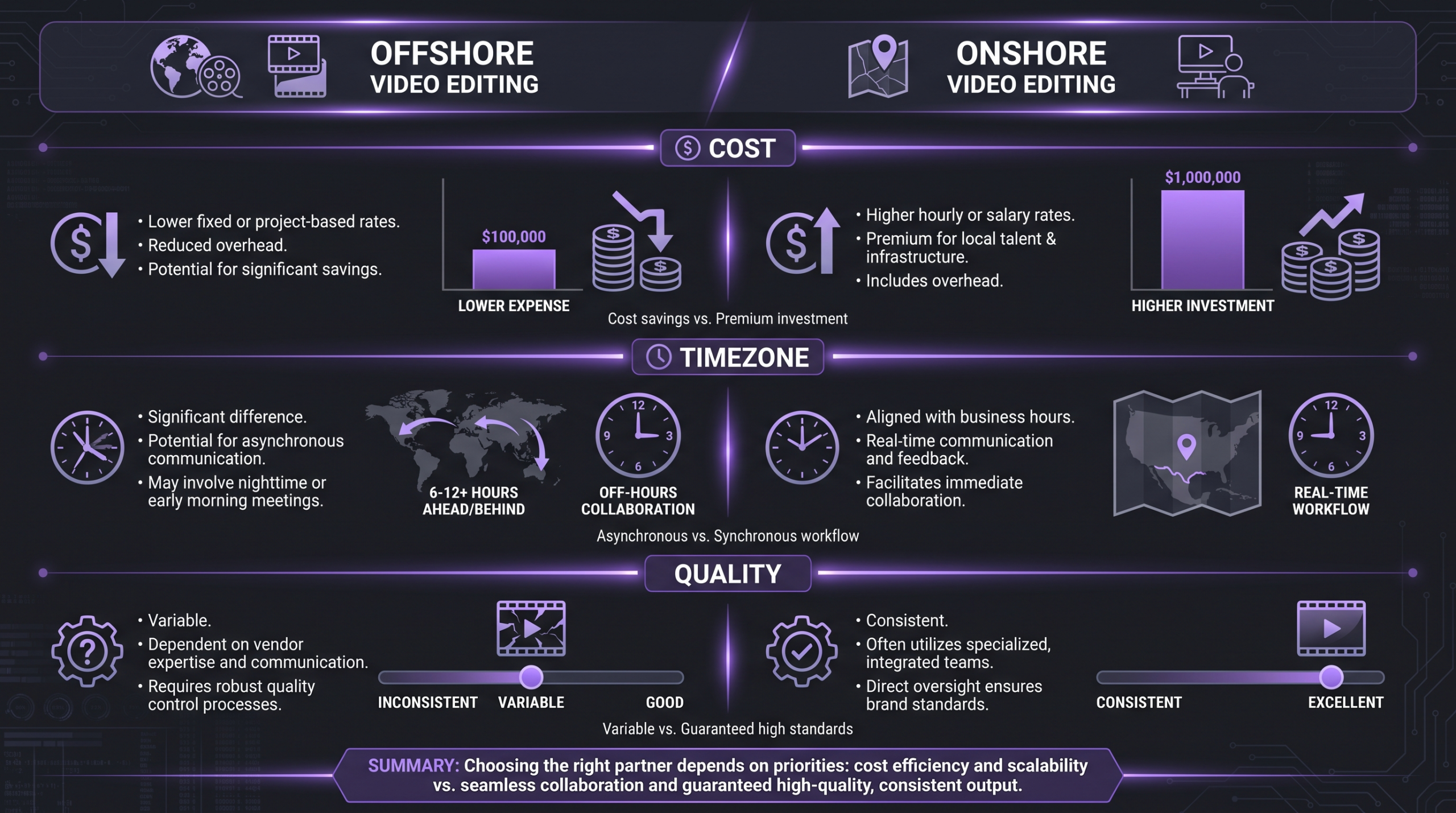
Understanding the full cost of professional video editing means looking beyond hourly rates. Here’s how the two models compare across the dimensions that actually drive decision-making.
When you’re evaluating your options, it’s also worth reading the full breakdown on the agency vs. freelancer decision — because the offshore/onshore question often intersects with how you want to structure the engagement entirely.
FAQ
Is offshore video editing actually lower quality?
Not inherently — but it’s more variable. The best offshore teams produce work indistinguishable from top domestic agencies. The worst offshore options produce inconsistent output that costs more in rework than it saves in rates. The quality difference is primarily a function of which vendor you pick, how well you brief them, and how structured your feedback process is. Geography itself is not a quality determinant.
How do I protect my intellectual property when working with offshore editors?
Use a vendor with a legal entity in your jurisdiction, get explicit IP assignment and work-for-hire language in your contract, use secure file-sharing platforms rather than consumer cloud storage, and limit access to only what’s needed for the current project. For particularly sensitive footage, consider watermarking or proxy workflows where editors work on lower-resolution proxies until the final approved version is exported.
What content types work best with offshore editing?
Social media cut-downs, product demos, explainer videos, motion graphics, documentary-style content, podcast clips, and educational series all work extremely well offshore when the workflow is set up correctly. Content that relies heavily on local cultural nuance, requires same-day turnaround, or involves highly sensitive footage is better handled onshore or with a managed remote agency with strong communication systems.
How long does it take to onboard an offshore editing team?
Plan for 4–6 weeks of heavier-than-normal communication before the relationship reaches steady-state efficiency. The first few projects should be treated as a paid calibration period: you’re investing in building shared vocabulary and style alignment. Teams that expect offshore partners to be immediately autonomous from day one consistently report disappointment. Teams that budget for a ramp period get excellent long-term returns.
Can I use a hybrid model — some offshore, some onshore?
Yes, and it’s increasingly the approach sophisticated content teams take. Use offshore partners for volume and repeatable formats; use onshore capacity for flagship brand content, time-sensitive reactive work, and projects requiring real-time collaboration. The key is clarity about which projects go where — ambiguity in routing leads to confusion and quality inconsistencies across your content library.
Verdict: How to Actually Make the Decision
Here’s the honest answer: the offshore vs. onshore question has no universal right answer. What it has is a right answer for your situation — based on your volume, your timeline requirements, your content type, your budget constraints, and your team’s capacity to manage a new vendor relationship.
Go onshore if: You need same-day or next-day turnaround consistently. Your content is highly culturally specific to a single domestic market. You’re producing a small volume of high-stakes flagship content. Your team doesn’t have bandwidth to build offshore workflow systems. You’re working with highly sensitive unreleased materials where IP risk is paramount.
Go offshore (managed) if: You need 15+ videos per month and budget won’t support onshore rates. Your content type doesn’t depend on local cultural fluency. You have — or are willing to build — structured async workflows. You can tolerate a 4–6 week onboarding period. You’re prioritizing long-term scale over short-term convenience.
The smartest brands don’t think in binary terms. They build flexible production engines that route different content types to different partners based on what each requires. They treat video production like a supply chain — with multiple nodes optimized for different outputs — rather than a single vendor relationship that has to do everything.
What makes Increditors different is that the remote-first model collapses the traditional offshore trade-off. When you staff a production team with senior editors distributed globally — not junior editors in a cost-reduction play — you get offshore economics without offshore quality risk. The team is senior by design, not by accident, and the communication infrastructure is built for exactly the async workflows that make distributed editing work. If you’re evaluating what a managed remote video editing agency could do for your content output, that’s the conversation worth having.
Ready for Video That Actually Converts?
Tell us about your project and we will put together a custom plan.
Clients, on camera