









![3D Explainer Video - ScribbleLive.mp4_snapshot_00.12_[2022.03.09_03.14.16]](https://increditors.com/wp-content/uploads/elementor/thumbs/3D-Explainer-Video-ScribbleLive.mp4_snapshot_00.12_2022.03.09_03.14.16-r7wb53mx72rxst3qcqyrfxdmeyzb5r9jbl0wbjujh4.png "3D Explainer Video – ScribbleLive.mp4_snapshot_00.12_[2022.03.09_03.14.16]")































The fastest way to hire a video editor online in 2026 is to pick the right platform tier first, then run a paid trial brief before any long-term commitment. Upwork and Fiverr Pro work for defined, repeatable scopes. LinkedIn surfaces specialists for mid-to-senior roles. For consistent volume — more than one video per week — a dedicated-editor agency removes the hiring overhead entirely. Rates in 2026 range from $15–$35/hr for entry-level marketplace editors to $50–$90/hr for senior specialists, with agency retainers starting around $2,000/month.
Where to hire: Upwork (Expert-Vetted filter), Fiverr Pro, LinkedIn, or a specialist agency for scale.
What to pay in 2026: $15–$35/hr entry-level · $50–$90/hr senior · $2k–$4k/mo agency retainer.
How to start: 200-word brief → $100–$300 paid trial → evaluate communication + revisions before committing.
Red flags: No portfolio in your content category, vague revision policies, no contract or milestone structure, disappearing communication mid-project.
Best for scale: Agencies and subscription services consistently outperform individual freelancers when you need more than one video per week.
- Where to Hire a Video Editor Online in 2026: Platform-by-Platform
- Platform Comparison: Choosing Where to Hire Video Editors
- How to Hire a Video Editor Online: The Vetting Process
- What Does It Cost to Hire a Video Editor in 2026?
- Red Flags When You Hire a Video Editor Online
- Video Editor for Hire: Freelancer, Agency, or Subscription?
- FAQ
Where to Hire a Video Editor Online in 2026: Platform-by-Platform Breakdown
The platform you choose shapes the candidate quality, communication norms, and pricing expectations you’ll encounter. Getting this decision right saves you from running the same hiring process twice on a worse talent pool. Here’s a structured breakdown of every major channel where to hire video editors in 2026.
Upwork: Largest Pool, Highest Noise
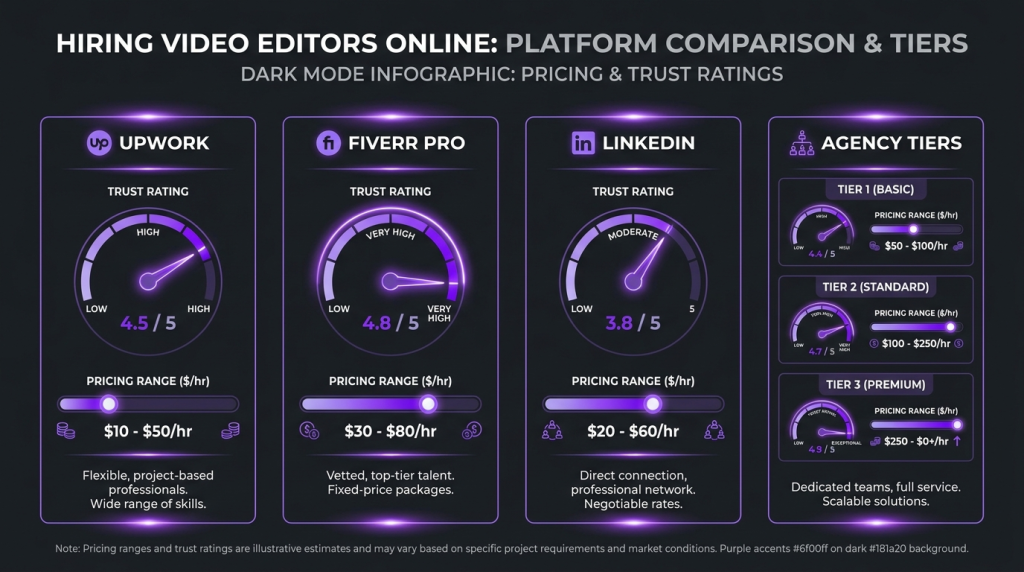
Upwork is the largest general freelance marketplace and the default starting point for most companies that want to hire video editor online for the first time. The raw pool is enormous — but so is the variance. Open marketplace profiles range from $8/hr hobbyists to $150/hr specialists, and sorting by price alone is a mistake.
To use Upwork effectively in 2026: filter by Expert-Vetted or Top Rated Plus and verify the editor has logged hours in your specific content category (product demos, social reels, long-form YouTube, explainer animation). Hourly contracts with time-tracking create accountability that fixed-price contracts lack. Escrow protects both parties. Expect to evaluate 3–5 profiles before finding a reliable match at your brief complexity. Typical hourly rates on Upwork for mid-senior video editors: $45–$75/hr in 2026.
Fiverr Pro: Structured Gigs for Contained Scopes
Fiverr’s standard tier is inconsistent for anything beyond simple cuts. Fiverr Pro is a different product — editors are hand-vetted, and the structured gig format (defined deliverables, set revision counts) suits contained, repeatable projects: a 60-second brand video, a YouTube intro, a batch of social clips. For iterative creative work where the brief evolves, Fiverr Pro’s rigidity becomes friction. It’s the right call when you know exactly what you want and need it delivered fast with no back-and-forth negotiation. Budget: $200–$800 per project for typical social content packages.
LinkedIn: Discovery for Mid-to-Senior Roles
LinkedIn is underused as a sourcing channel when you want to hire a video editor at the mid-to-senior level. Unlike Upwork, LinkedIn profiles show professional history, endorsements, and often portfolio reels on their profile. Job postings on LinkedIn video editor listings attract editors who are actively looking for stable contracts, not just one-off gigs. The trade-off: LinkedIn has no built-in payment protection or dispute process, so you’ll need your own contract and milestone structure. Most effective for: 10–20hr/week ongoing contracts with editors who treat it like a part-time role.
Specialist Agencies and Subscription Services
When output volume exceeds one video per week, or when brand consistency across multiple content formats matters, specialist agencies and subscription-based services offer the most reliable path. You’re not hiring an individual — you’re engaging a production system with senior oversight, quality review, and editorial continuity built in. A dedicated video editing company eliminates the search-vet-hire cycle entirely and replaces it with a brief-to-delivery workflow that scales to your content calendar.
Subscription tiers (unlimited video editing models) start around $1,200–$1,500/month for basic plans. Full-service agencies with dedicated senior editors and strategy layers run $2,500–$5,000/month. The premium is real — but so is the output consistency improvement when your volume exceeds what a solo freelancer can sustain.
💡 Platform Rule of Thumb: If you need 1–3 videos/month, Upwork or Fiverr Pro fits. If you need 5+ videos/month across different formats, start scoping agencies — the management overhead of coordinating multiple freelancers will cost more than the agency premium.
Platform Comparison: Choosing Where to Hire Video Editors
The table below compares the four main channels by the variables that matter most when you’re deciding where to hire video editors in 2026. HubSpot’s video marketing research consistently shows video as the highest-ROI content format — which means your editing partner choice is a business decision, not just a creative preference.
How to Hire a Video Editor Online: The Vetting Process
Regardless of which platform you use, the vetting process follows the same three-step framework. Skip any step and you risk committing to someone who looked good in the proposal phase but can’t execute on your actual brief.
Step 1: Write a 200-Word Trial Brief
Most companies send vague briefs and then blame the editor for the wrong result. The brief is your diagnostic tool. A well-written 200-word brief tells you whether the editor asks smart clarifying questions (good sign), asks none at all (flag), or asks about format without probing on audience and tone (neutral).
Your brief should include: target platform and aspect ratio, approximate length, audience description, tone (formal / casual / energetic), any brand assets available (logo, fonts, music), and what “done” looks like. For a paid trial, include one raw footage file of 3–5 minutes and one example of editing style you want to match.
Step 2: Run a Paid Trial ($100–$300)
A paid trial brief is the single highest-signal test in any editor evaluation. Free tests attract low effort; paid trials attract professional behaviour. Budget $100–$300 for a 60–90 second deliverable — it’s cheaper than three weeks of disappointing work on your real project. Evaluate: turnaround speed, communication responsiveness, revision quality after feedback, and whether the final cut uses your source footage efficiently or relies on canned B-roll.
💡 Revision Quality Test: The most revealing part of any trial isn’t the first cut — it’s how the editor incorporates your feedback. An editor who asks “what specifically didn’t work?” is showing craft. One who re-submits with minor cosmetic changes is showing avoidance.
Step 3: Evaluate Before Committing
After the trial, score three things independently: technical quality (pacing, colour, audio levelling), brief adherence (did they execute your tone and format accurately), and communication quality (proactive updates, clear questions, on-time delivery). All three matter. A technically brilliant editor who goes quiet for three days mid-revision will cost you more in management overhead than a slightly less polished one who communicates clearly and delivers on schedule.
What Does It Cost to Hire a Video Editor in 2026?
Pricing in 2026 has shifted from previous years as AI-assisted editing tools have compressed rates at the low end while senior specialists with strong creative judgment have held their rates or increased them. Sprout Social’s video marketing data shows increasing demand for original short-form video content — which means quality editors are in higher demand, not lower. See our detailed breakdown at professional video editing cost guide.
One important pricing shift in 2026: AI-assisted tools (CapCut Pro, DaVinci Resolve AI, Adobe Premiere’s generative fill) are now standard in professional workflows. Editors who use them intelligently can deliver faster without sacrificing quality — but they should be transparent about which parts of the workflow are AI-assisted. An editor who claims all output is hand-crafted when it clearly isn’t is a trust problem, not just a process one.
Red Flags When You Hire a Video Editor Online
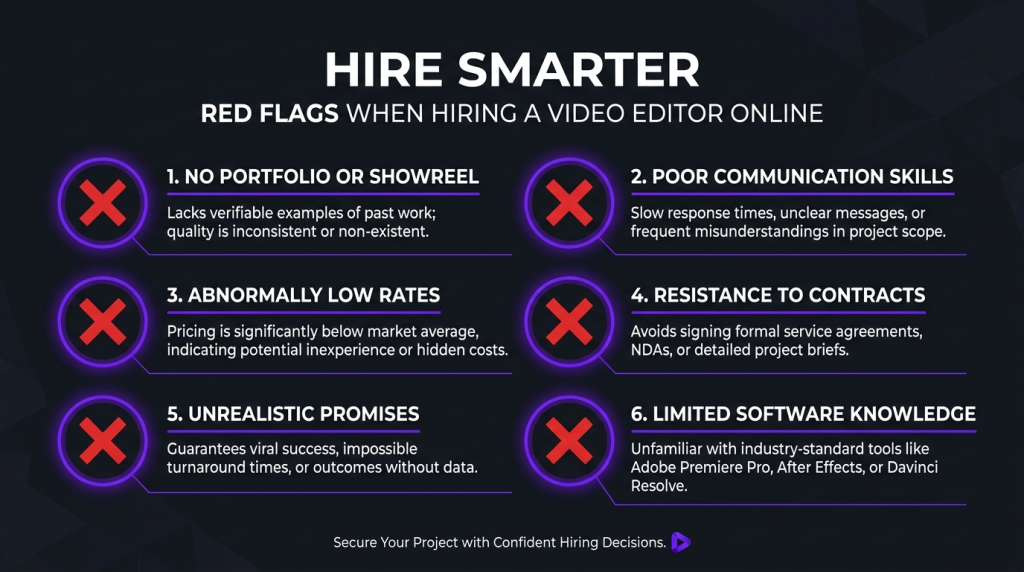
Most companies only discover red flags three weeks in. Knowing what to look for before you commit saves significantly more than it costs in evaluation time. HubSpot’s marketing statistics show that video content failure is rarely a quality problem — it’s a process and reliability problem. Here are the flags that matter.
Portfolio Red Flags
Portfolio doesn’t include your content category. An editor with a strong reel of music videos isn’t automatically the right choice for B2B SaaS explainers. The skills overlap, but the editorial sensibility, pacing, and tone are different disciplines. Always ask for examples specifically in your content format before agreeing to even a paid trial.
Can’t name the tools or describe their workflow. A competent editor can tell you exactly which NLE they work in (Premiere, Resolve, Final Cut), how they handle asset organization, and what their revision delivery process looks like. Evasive answers about workflow are a sign of someone who borrowed their reel content, not created it.
All work is spec, concept, or “personal projects.” Personal projects in a portfolio are fine as supporting evidence. A portfolio with no commissioned client work is a problem — it means they’ve never had to satisfy a brief from someone else.
Contract and Communication Red Flags
No written contract or milestone structure. Any editor working professionally will have a standard agreement that covers: deliverable specs, revision rounds included, payment schedule, and IP transfer terms. If they push back on putting things in writing, treat it as a hard stop.
Vague revision policies. “Unlimited revisions” is not a policy — it’s a setup for scope creep and resentment. A healthy revision policy specifies what counts as a revision (structural changes vs cosmetic tweaks), how many rounds are included, and what additional rounds cost. Clarity here protects both sides.
Goes quiet mid-project. Slow communication at the proposal stage almost always gets worse mid-project. Test responsiveness during the brief phase — send a question and time the response. Editors who respond within 4–8 business hours during evaluation are the ones who’ll stay responsive when a deadline is 48 hours away.
Pricing Red Flags
Rate drops dramatically after seeing your budget. An editor who quotes $75/hr and immediately discounts to $40/hr when you express price sensitivity either inflated the original quote or is discounting quality. Reasonable negotiation is normal; dramatic drops signal something off in their pricing model.
No clarity on what extras cost. Rush fees, additional revision rounds, motion graphics, sound design, subtitles — a transparent editor prices these clearly upfront. Editors who reveal add-on costs only after work begins will consistently come in over budget.
Video Editor for Hire: Freelancer, Agency, or Subscription?
The decision framework is simpler than most buying guides make it. Run through three questions in order:
1. How many videos do you produce per month? If fewer than four, a freelancer handles the volume. Above four, the management overhead of a single freelancer (chasing revisions, managing availability, covering sick days) starts eroding the cost savings.
2. How much format variety does your content calendar have? A brand producing only one format (e.g. weekly 3-minute YouTube videos) can get away with a specialist freelancer. A brand producing YouTube + social reels + product demos + webinar clips in the same month needs either multiple freelancers (coordination cost goes up) or an agency that can handle format switching without losing brand consistency.
3. How much does brand continuity matter? For emerging brands, freelancer-level consistency is usually adequate. For established brands where off-tone content creates real damage, the overhead of briefing a freelancer from scratch each project adds up — and the risk of inconsistency is higher. This is the scenario where a video editing agency vs freelancer comparison most clearly favours the agency model.
Subscription services occupy the middle ground: they offer predictable pricing and capped turnarounds but typically assign different editors per project, which means consistency depends on the quality of your written brief, not on relationship continuity with one editor. For content-heavy brands that prize cost predictability over creative depth, subscriptions are a strong fit. For brands where creative judgment and brand voice matter as much as output volume, a dedicated-editor model is worth the premium.
FAQ: Hire a Video Editor Online
How do I hire a video editor online for the first time?
Start with Upwork (Expert-Vetted filter) or Fiverr Pro depending on whether you prefer hourly flexibility or a fixed-scope gig. Write a 200-word brief that specifies platform, length, tone, and what “done” looks like. Run a $100–$300 paid trial on a real but low-stakes project before any ongoing commitment. Evaluate turnaround, communication responsiveness, and how the editor handles your first round of feedback — that’s the actual hiring decision, not the proposal.
Where to hire video editors for social media content specifically?
For social media content (Reels, TikTok, YouTube Shorts), Fiverr Pro’s structured gig format often works better than Upwork for contained batches of 5–10 clips per month. For ongoing social content at volume, a subscription service or agency typically delivers better consistency — social content is highly format-dependent, and editors who specialise in short-form vertical video are worth the premium over generalists. Look for editors who specifically list social platforms in their portfolio rather than generalists who include social as one item in a long list.
How much should I budget to hire a video editor in 2026?
Budget depends on volume and complexity. Entry-level marketplace editors: $15–$35/hr for simple cuts and social clips. Mid-senior specialists: $45–$75/hr for branded content, YouTube, and explainers. Senior specialists: $60–$90/hr for campaign work and high-production finishes. Monthly retainers: $2,000–$5,000/mo for dedicated-editor agency engagements. The most common mistake is underbudgeting and then spending twice the cost in revision cycles and wasted footage. See the full video editing cost breakdown for per-format pricing estimates.
What are the biggest red flags when hiring a video editor online?
The six most consistent red flags: (1) portfolio doesn’t include your content format, (2) can’t describe their NLE or revision workflow clearly, (3) no written contract or vague revision policy, (4) goes quiet during the brief evaluation phase, (5) dramatically drops their rate when you mention budget constraints, (6) no clarity on what extras cost before work starts. Any one of these alone doesn’t eliminate a candidate — but two or more together are a clear signal to pass.
When does it make sense to hire a video editor through an agency?
An agency makes sense when: your content volume exceeds 4–5 videos per month, your content spans multiple formats that require different editorial approaches, brand consistency is high-stakes (enterprise, investor-facing, or product marketing), or you’ve been through two or three freelancer cycles and the management overhead has become a real cost. The premium over a solo freelancer is real — but so is the output consistency, the editorial oversight, and the elimination of the search-hire-onboard cycle every time your editor changes availability.
Ready for Video That Actually Converts?
Tell us about your project and we will put together a custom plan.