








![3D Explainer Video - ScribbleLive.mp4_snapshot_00.12_[2022.03.09_03.14.16]](https://increditors.com/wp-content/uploads/elementor/thumbs/3D-Explainer-Video-ScribbleLive.mp4_snapshot_00.12_2022.03.09_03.14.16-r7wb53mx72rxst3qcqyrfxdmeyzb5r9jbl0wbjujh4.png "3D Explainer Video – ScribbleLive.mp4_snapshot_00.12_[2022.03.09_03.14.16]")




























Church and nonprofit video editing cost typically ranges from $75–$500 per finished video for freelancer one-offs, $500–$2,000/month for subscription retainers, and $1,500–$5,000+ for agency-grade campaign-level work. Your actual cost depends on video length, edit complexity, turnaround speed, and how many assets you produce per month. This guide breaks down every tier, every cost driver, and the smartest ways to stretch a mission-driven budget further.
- Why Video Editing Cost Looks Different for Churches and Nonprofits
- The Real Cost Factors Behind Every Quote
- Pricing Tiers: What Each Budget Level Gets You
- Church and Nonprofit Video Types and Their Typical Costs
- DIY vs. Outsourcing: The Real Trade-Off
- Subscription Services vs. Project-Based Pricing
- How to Budget Smarter as a Nonprofit
- Frequently Asked Questions
- Verdict
Why Video Editing Cost Looks Different for Churches and Nonprofits
Church and nonprofit video editing operates in a category all its own. The organizations producing the most content — large multi-site churches, national advocacy nonprofits, faith-based media ministries — often rival mid-sized brands in output volume but operate with budgets that are a fraction of the size. That tension shapes every pricing conversation.
Unlike a software company producing one polished product demo per quarter, a busy church might need a sermon edit every single week, a recap reel from Sunday morning worship, a social clip for Wednesday, a donor appeal by Thursday, and a volunteer highlight reel for the weekend. That is five deliverables in five days, often drawn from a single Sunday recording session.
Nonprofits face a parallel challenge. Annual galas, capital campaigns, beneficiary stories, grant application videos, volunteer recruitment reels — the need is constant, and the internal team tasked with producing them usually has a full-time job doing something else entirely. Video often gets piled onto a communications director who is also running social media, drafting press releases, and coordinating the newsletter.
This context matters enormously for pricing, because it changes which model actually delivers value. A one-off freelancer might quote $150 for a sermon edit, which sounds affordable — until you multiply it by 52 weeks and add the overhead of briefing a new person every time footage quality changes. At that volume, the math shifts toward retainer-based or subscription-based production relationships.
According to Nonprofit Tech for Good’s research on nonprofit digital priorities, video is consistently among the top content formats nonprofits plan to invest in — yet budget and production capacity remain the most commonly cited barriers. Understanding where cost comes from is the first step to removing it as a barrier.
The Real Cost Factors Behind Every Quote
Before comparing prices across freelancers, agencies, and subscription services, it helps to understand the five variables that determine almost every video editing quote. When you can speak to these clearly, you get faster and more accurate estimates.
1. Finished Length vs. Raw Footage Ratio
Editors price on finished output time, not raw footage hours. A 30-minute sermon recorded in one uninterrupted take is far cheaper to edit than a 10-minute fundraising mini-doc that was shot across six locations and three interview days. The ratio of raw footage to finished product — the shooting ratio — is one of the most reliable predictors of editing cost. A 10:1 ratio (ten hours of footage trimmed to one finished hour) is significantly more labor-intensive than a 2:1 ratio.
2. Edit Complexity
A basic cut — removing dead air, trimming pauses, adding lower thirds — is the most affordable edit type. Motion graphics, color grading, multi-camera sync, background music licensing, animated titles, and sound design each add layers of cost. Churches that want full Sunday morning production quality (lyrics overlays, camera switching, ambient worship music mixed under a sermon) are ordering a considerably more complex product than a simple single-cam sermon trim.
3. Turnaround Time
Rush delivery almost always carries a premium — commonly 25–50% above standard rates for same-day or next-day turnarounds. If your church records Sunday morning and needs the edit live by Sunday evening for online members, that is a premium service. Planning for a 3–5 business day turnaround on weekly content dramatically reduces cost compared to a 24-hour window.
4. Deliverable Format Count
A single sermon edit delivered as one 16:9 YouTube file costs less than the same edit reformatted for YouTube, Facebook, Instagram Reels (9:16), and a short email thumbnail clip. Format multiplication is one of the easiest ways editing costs scale unexpectedly. Nonprofits with active social channels should clarify upfront how many platform formats they need per asset.
5. Revision Rounds
Most pricing tiers include one or two revision rounds. Additional revisions — especially after approval — often carry per-hour fees or trigger a new project charge. Clear feedback protocols and a designated approval contact (instead of revisions from three different board members at different stages) keep this cost under control.
💡 Pro Tip: Before requesting a quote, document your average raw footage volume per week, your required formats, and your standard turnaround window. Editors who see that you already understand production vocabulary will typically respond faster and price more accurately.
Pricing Tiers: What Each Budget Level Gets You
The market for church and nonprofit video editing cost spans a wide range. Here is what each tier realistically delivers — and where each one breaks down.
Under $300 Per Video: Entry-Level Freelancers
At this price point, you are typically working with freelancers on platforms like Fiverr or Upwork, or a part-time student editor. Basic cuts, minimal motion graphics, and standard color correction are achievable here. Sermon edits of 20–45 minutes, simple recap reels, and social clips with basic text overlays fall within this range.
The limitation is consistency. At this budget, you are often working with a different editor for each project, which means re-briefing the brand style, lower thirds template, and music preferences every single time. Quality can be excellent or disappointing, and there is typically no account management or strategic input.
$300–$1,000 Per Video: Mid-Tier Freelancers and Small Agencies
This is where you start finding dedicated freelancers with church media experience, small local production companies, or boutique agencies handling faith-based content. Consistent style, reliable communication, and multi-camera edits are standard here. A 15-minute donor impact video with b-roll and motion graphics comfortably fits this range.
Many smaller churches find a productive ongoing relationship at this tier, especially with freelancers who specialize in church media and understand the rhythm of weekly sermon content. The risk: a solo freelancer’s availability is constrained. Illness, a competing client, or a busy season can leave you without your editor at the worst moment.
$1,000–$3,500 Per Video: Agency-Grade Projects
This is the territory of polished campaign video production: capital campaign launches, major donor appeal films, beneficiary story documentaries, or the annual report video that goes in front of your entire stakeholder audience. At this level, you get a dedicated team, multiple revision rounds, strategic input, and professional-grade color and sound.
For most nonprofits, this is not the tier for weekly content — it is the tier for the three to five videos per year that need to be exceptional. For large churches with active media ministries producing content for broadcast or major conferences, the math can work at scale.
Monthly Retainer: $1,000–$6,000/Month
Retainer pricing flips the per-video model entirely. Instead of negotiating each project, you pay a fixed monthly fee for a defined volume of work — say, four sermon edits, two social clips, and one monthly recap reel. This model suits organizations with predictable, recurring content needs and eliminates the overhead of re-contracting every week.
As a video editing agency, Increditors works with content-heavy organizations on exactly this model — a consistent output cadence with a dedicated editor who learns your brand, your style, and your approval process. The result is faster turnarounds, fewer revision cycles, and better content over time because the relationship compounds.
Church and Nonprofit Video Types and Their Typical Costs
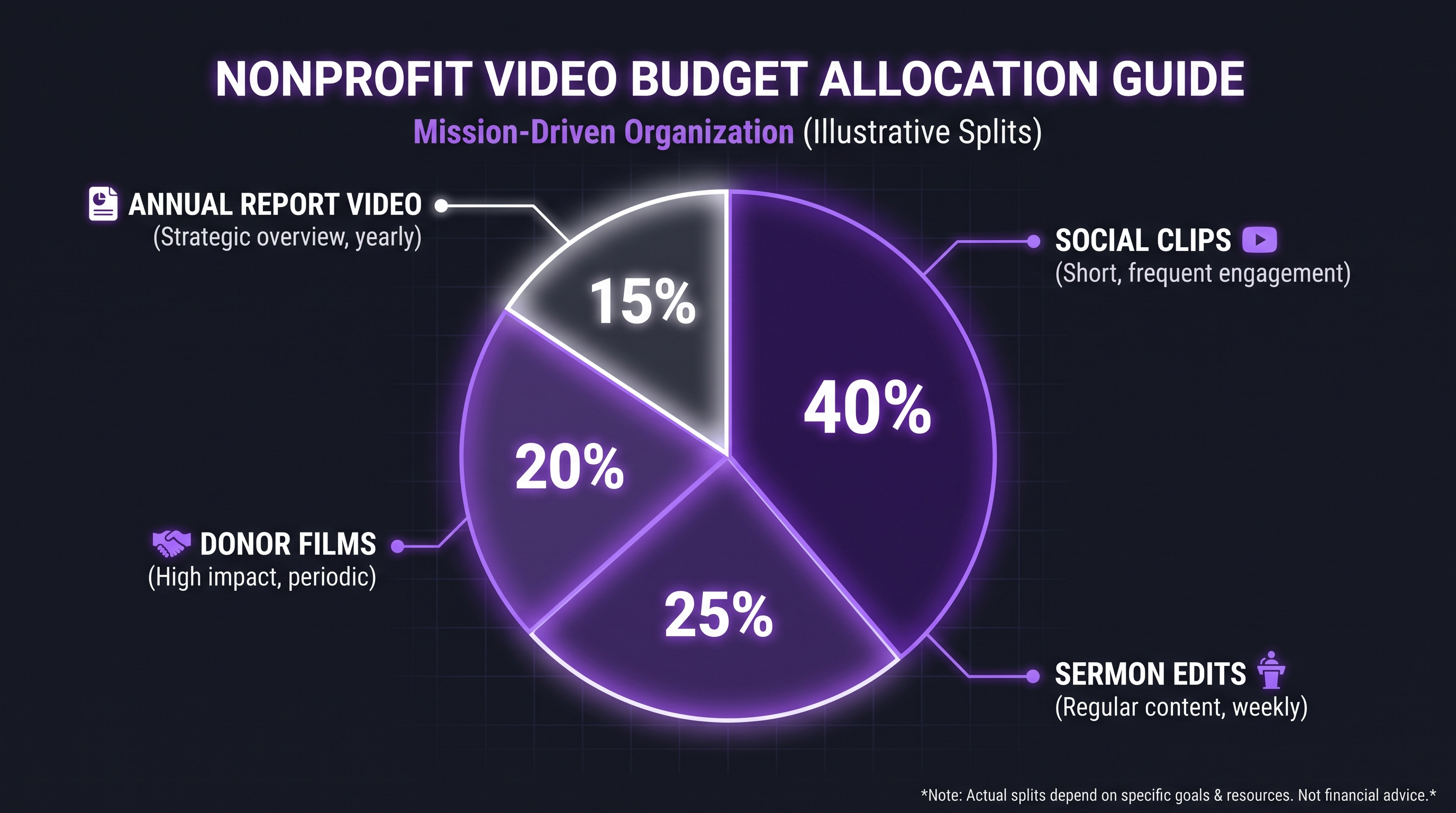
Different video types carry very different editing cost profiles — even when the finished length is similar. Here is a breakdown of the most common asset types and what drives cost in each.
Weekly Sermon Edits
The workhorse of church media. A standard sermon edit — single or multi-camera, lower thirds, light color grade, intro/outro graphics — typically falls in the $100–$400 per edit range depending on length and complexity. Churches running a consistent weekly schedule often find that a monthly retainer covering four sermon edits plus social cuts works out considerably cheaper per deliverable than individual project quotes.
The key cost driver here is your multi-camera setup. A church recording with a single locked-off camera is cheap to edit. A church with four camera angles, a confidence monitor feed, and lower-third graphics triggered by a ProPresenter integration is producing a broadcast-level product that warrants broadcast-level editing.
Event Recap and Highlight Reels
Conference highlights, VBS recaps, gala moments, mission trip documentation — these are typically 2–5 minute emotional storytelling pieces. They require strong music selection, pacing, and a narrative arc built from varied b-roll. Typical editing range: $350–$1,200 depending on footage variety and deliverable polish. Because these often live permanently on the organization’s homepage or donation landing page, the investment justifies higher quality.
Fundraising and Donor Appeal Videos
Donor-facing videos have the highest stakes of any content type because they directly correlate with giving outcomes. A well-edited 3-minute beneficiary story with clear call-to-action, music, and graphics can outperform a poorly edited version by multiples — making edit quality one of the highest-ROI investments in a nonprofit’s content stack.
Professional editing for donor appeal videos typically runs $600–$2,500 for a 3–5 minute piece, depending on the number of interview subjects, b-roll complexity, and any motion graphics or animated data visualization. Organizations running end-of-year giving campaigns often find this is exactly where the budget belongs.
For context, TechSoup’s resources on nonprofit video production consistently highlight donor storytelling as the highest-converting video format for mission-driven organizations — which reinforces why editing quality on this content type earns its cost.
Social Media Clips and Shorts
Repurposing long-form content (sermons, interviews, event footage) into short-form social clips has become one of the most in-demand editing services for churches and nonprofits. A single Sunday sermon can yield 3–8 shareable clips if edited thoughtfully. Per-clip editing typically runs $30–$150 at the freelancer level, or is bundled into a retainer package at significant discount. When you factor in four clips per week at $75 each, you are looking at $1,200/month just in social clips — which is exactly where retainer economics start to make more sense.
Annual Report and Grant Application Videos
Nonprofits often need one or two polished flagship videos per year that represent the organization to major donors, foundation funders, or board audiences. These are not social clips — they are credentialed storytelling assets. Expect to invest $1,500–$4,000 for a 4–8 minute video of this type, with professional motion graphics, narration, and multiple rounds of feedback. The ROI here is measured in grants awarded and major donor relationships secured.
DIY vs. Outsourcing: The Real Trade-Off
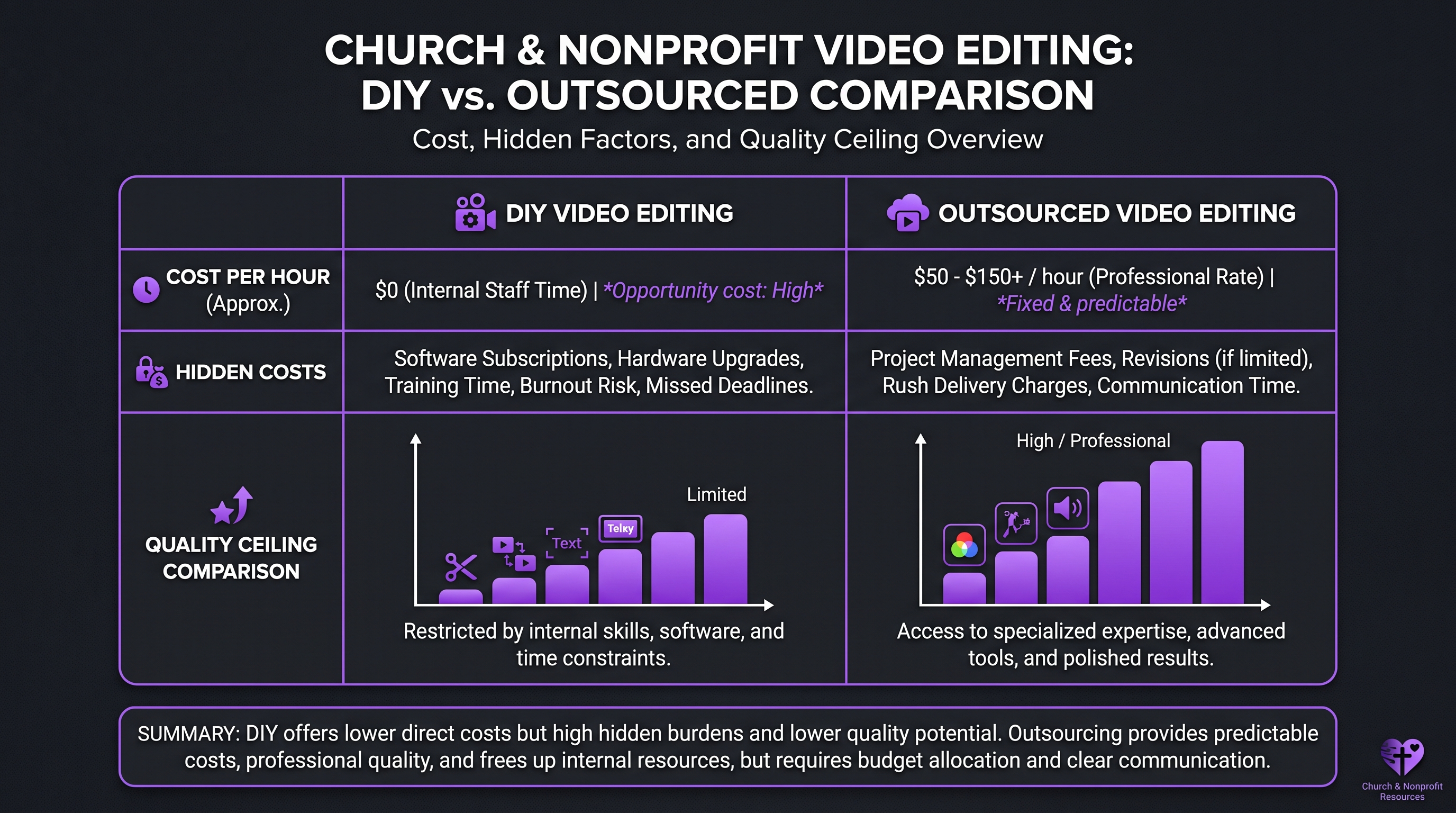
The default assumption in many churches and nonprofits is that DIY editing is the budget-friendly option. That assumption deserves scrutiny — because when you account for the full cost of internal production, the math is frequently more complicated than it appears.
A volunteer or part-time staff member spending 5 hours per week editing a sermon is not free. If that person’s fully-loaded cost (salary, benefits, management time) is equivalent to $25/hour, you are spending $125/week — or roughly $6,500/year — on editing that could be done by a professional faster, at a higher quality, and without pulling your internal team away from their core responsibilities.
The real argument for keeping editing in-house is control and responsiveness: a staff member who can make a fast cut on a Sunday morning clip knows the context and can move at the speed of the ministry calendar. The argument for outsourcing is quality ceiling and opportunity cost: a professional editor produces better work, and your staff member’s 5 hours per week could be redirected to pastoral care, donor relations, or program delivery.
Many growing organizations land on a hybrid: simple, time-sensitive edits handled internally, while complex or high-stakes content — the donor film, the conference recap, the annual impact video — goes to a professional partner. This approach keeps internal skill-building while ensuring flagship content meets the quality bar it deserves.
If you are evaluating whether to build an internal editing capacity or outsource, this breakdown of the agency vs. freelancer decision covers the structural trade-offs in detail and is directly applicable to the church and nonprofit context.
💡 Pro Tip: Before deciding to keep editing in-house, track your team’s actual hours spent on video for one month. Most organizations underestimate this by 40–60% because editing time is spread across multiple people and scattered across the week rather than showing up in a single budget line.
Subscription Services vs. Project-Based Pricing
The past few years have seen an explosion of subscription-based video editing services — flat monthly fees covering a defined volume of videos. These services operate at different quality and price points, and evaluating them against traditional project-based pricing requires understanding what is actually included.
What Subscription Services Typically Offer
Lower-end subscription services (commonly $500–$1,200/month) handle a defined number of videos per month with fixed turnaround times. They typically work well for standardized, templated content — social clips with consistent branding, for example. They struggle with complex multi-cam edits, motion graphics-heavy content, or projects requiring creative direction.
Mid-tier subscription services ($1,500–$3,000/month) often offer dedicated editor relationships, which dramatically improves output quality and consistency. The editor learns your brand style, your approval preferences, and your tolerance for creative risk — which means later edits in a long-term relationship tend to be materially better than early ones.
For high-volume content producers — a megachurch running weekly multi-platform output, or a national nonprofit producing campaign content year-round — premium retainer services ($3,000–$6,000/month and above) offer strategic input, dedicated teams, and enough throughput capacity to handle surges like annual giving campaigns or major conferences.
When Project-Based Pricing Wins
Project pricing works best when your needs are genuinely episodic: you need one excellent donor film produced for a capital campaign, or a conference highlight reel once a year. Trying to force episodic, high-effort projects into a subscription frame often results in rushed turnarounds or editors who are not resourced for the complexity level. Project-based pricing for these assets gives you the freedom to negotiate scope, timeline, and deliverables specifically around what the project actually requires.
Understanding how professional video editing is priced across the full market gives you a useful benchmark for evaluating both project-based and subscription quotes, so you can verify whether a package is good value before committing.
How to Budget Smarter as a Nonprofit
Nonprofit and church communications teams often work with constraints that commercial clients do not. Grant-restricted funding, volunteer labor pools, board approval cycles for larger spend — these factors shape what is actually available for video production. A few specific strategies help mission-driven organizations get meaningfully more from every dollar spent on video.
Plan Content in Seasonal Batches
Many freelancers and agencies offer meaningful discounts for batch commitments — agreeing to six months of weekly edits at a flat rate, for example, rather than negotiating each individually. This also gives editors the runway to build templates, develop brand-matched graphic packs, and learn your workflow — all of which reduce revision cycles and improve quality. Planning your video content calendar three to six months out makes batching possible.
Standardize Your Production Format
Every time your shoot format changes — different cameras, different lighting, different audio setup — your editor pays a tax in the form of re-syncing, color-matching, and troubleshooting. Establishing a consistent recording template for weekly services dramatically reduces editing time and cost. This is one of the highest-leverage operational changes a church media team can make: invest once in a standardized setup, save continuously in post-production.
Use Technology Discounts Available to Nonprofits
Qualified nonprofits have access to meaningful technology discounts that reduce the overall cost of a video production workflow. Google for Nonprofits provides free access to Google Workspace and YouTube channel features. TechSoup offers discounted or donated software licenses for nonprofits, including some post-production tools. Adobe also has a Creative Cloud for Nonprofits program. These do not reduce editing labor cost, but they reduce the technology overhead of your production pipeline, freeing budget for the editing itself.
Prioritize by Impact, Not by Volume
Not every piece of content deserves the same editing budget. A systematic approach — identifying the three to five videos per year that will have the greatest impact on giving, engagement, or community growth, and investing proportionally in those — outperforms spreading a limited budget evenly across everything. The Sunday morning social clip does not need the same treatment as the end-of-year giving appeal.
Build a Long-Term Editor Relationship
Every time you onboard a new editor, you pay a hidden cost in briefing time, re-establishing brand standards, and lower initial output quality. Organizations that build a long-term relationship with one editing partner — whether a dedicated freelancer or an agency team — consistently report lower per-deliverable cost over time, faster turnarounds, fewer revision rounds, and better brand consistency. The relationship investment compounds in ways that one-off hiring never does.
According to research from Candid (formerly GuideStar) on nonprofit communications effectiveness, organizations with consistent, high-quality visual storytelling raise significantly more in online giving than those with inconsistent or low-production content — a compelling case for investing in professional editing capacity rather than treating it as a cost to minimize.
It is also worth knowing that YouTube’s Nonprofit Program offers qualified 501(c)(3) organizations access to the YouTube Giving feature — enabling direct donations through video content — which raises the stakes (and the potential ROI) of professionally edited donor-facing videos substantially.
Frequently Asked Questions
How much does it cost to edit a church sermon video?
Sermon edit pricing commonly falls between $100 and $400 per video for a freelancer handling single or multi-camera footage, lower thirds, basic color grade, and an intro/outro. The wide range reflects camera count, graphics complexity, and the editor’s experience level. Organizations producing weekly sermons typically find retainer pricing more economical over a full year than negotiating individual edits — a bundled monthly plan covering four sermon edits often comes in significantly below the equivalent four one-off quotes.
Do nonprofits get discounts on video editing?
Some freelancers and agencies offer mission-based discounts, though this varies widely and is not standard practice industry-wide. A more reliable path to lower per-video cost is volume: committing to ongoing work rather than one-off projects typically yields meaningfully better rates. Technology discounts for nonprofits (TechSoup, Google for Nonprofits, Adobe for Nonprofits) can reduce software overhead, freeing budget for editing labor. When asking about pricing, be direct about your organization type and ask whether the provider has experience working with faith-based or nonprofit clients — those who do often have more flexible structures.
What is a reasonable video editing budget for a small church?
For a small church producing one sermon video and two to three social clips per week, a reasonable starting budget is $400–$800 per month, depending on your metro area, the complexity of your production setup, and whether you are working with a local freelancer or a remote service. Churches in early growth phases often start lower by hiring one reliable part-time freelancer for sermon edits only, then add social clip repurposing as the content strategy matures. The key is to plan the budget around your current publishing cadence, not your aspirational one.
Is it worth outsourcing video editing for a nonprofit?
For most nonprofits that are actively publishing video — at least bi-weekly — outsourcing editing is worth evaluating seriously. The core question is opportunity cost: what else could your communications staff do with the hours currently spent in a timeline? If the answer is donor cultivation, grant writing, or program storytelling, the case for outsourcing editing is typically strong. For organizations publishing video only a few times a year, a project-by-project freelancer relationship is the more economical fit. The decision is driven by volume, internal capacity, and the relative value of your team’s time on other priorities.
What should I look for in a video editor for faith-based content?
Beyond technical skill, the best editors for church and nonprofit content have direct experience with the format and understand the cultural context. Ask to see examples of sermon edits, event highlights, or donor films they have produced for similar organizations. Assess their communication style and turnaround reliability — both matter enormously for weekly production rhythms. Look for someone who can handle the dynamic range of the work: the emotional storytelling of a beneficiary video alongside the technical precision of a multi-cam worship service edit. If you are evaluating agencies, the Increditors team has direct experience with faith-based and mission-driven clients and can structure a scope around the specific mix of asset types and volume your organization produces.
Verdict
Church and nonprofit video editing cost is not one number — it is a range shaped by your content volume, your asset complexity, your turnaround requirements, and your editing relationship model. Entry-level freelancers can serve smaller organizations with modest output needs. Mid-tier freelancers and subscription services fit growing churches and nonprofits producing weekly content. Agency-grade work and retainer structures deliver the best economics and the highest quality for high-volume, consistent content producers.
The most important insight from organizations that have scaled their video content successfully is not about price per se — it is about the relationship model. A long-term editing partner who knows your brand, your production setup, and your approval process is worth considerably more than a sequence of cheaper one-off editors who require full re-briefing every time. The accumulation of relationship knowledge translates directly into faster turnarounds, fewer revisions, and better content.
If you are spending meaningful energy managing video editing — briefs, revisions, inconsistency, missed deadlines — that energy has a cost, and it is not appearing in your current video budget. Working with a dedicated video editing agency that treats your content output as an ongoing production system rather than a series of one-off transactions changes that equation entirely.
Whether you are a small church trying to get weekly sermon edits out reliably, or a national nonprofit building a video content engine for a capital campaign, the path forward starts with a clear assessment of your volume, your quality requirements, and the true cost of your current approach. From there, the right budget tier becomes obvious rather than arbitrary.
Ready for Video That Actually Converts?
Tell us about your project and we will put together a custom plan.