







![3D Explainer Video - ScribbleLive.mp4_snapshot_00.12_[2022.03.09_03.14.16]](https://increditors.com/wp-content/uploads/elementor/thumbs/3D-Explainer-Video-ScribbleLive.mp4_snapshot_00.12_2022.03.09_03.14.16-r7wb53mx72rxst3qcqyrfxdmeyzb5r9jbl0wbjujh4.png "3D Explainer Video – ScribbleLive.mp4_snapshot_00.12_[2022.03.09_03.14.16]")




















Documentary editing demands a different skill set than commercial or social-media work — pacing, narrative arc, archival integration, and interview weaving are craft disciplines most generalist editors don’t possess. This guide ranks the seven best documentary editing services available in 2026, covering pricing models, turnaround realities, and which type of project each service handles best. Increditors tops the list for dedicated senior teams and narrative-first post-production; VideoEditingCompany earns the #2 spot for enterprise-scale documentary pipelines.
What Makes a Great Documentary Editing Service?
Documentary editing is one of the most technically and creatively demanding disciplines in post-production. Unlike a branded commercial — where the final cut typically runs 30 to 90 seconds and hits a predetermined emotional beat — a documentary editor has to construct meaning out of hours of raw interview footage, archival material, B-roll, and narration that often weren’t shot with a clear editorial plan. The best documentary editing services understand this complexity and hire accordingly.
Choosing the right video editing company for a documentary project means vetting not just technical skills but narrative sensibility — the ability to find the story buried within hours of unscripted interview footage and archival material.
According to guidance published by the International Documentary Film Festival Amsterdam (IDFA), strong documentary editing hinges on three pillars: structural coherence (knowing which story is being told before touching the timeline), interview rhythm (building tension and release through real speech, not scripted delivery), and thematic resonance (ensuring every scene connects to the film’s central argument). These skills take years to develop and aren’t common in general-purpose editing talent pools.
What to Look For in a Documentary Editing Partner
Before hiring any service, evaluate these six factors:
1. Editorial credit history. Has the team or individual edited full-length documentaries before? A reel full of short-form brand videos doesn’t prove documentary competence. Ask for long-form credits or a rough-cut sample on similar subject matter.
2. Story structure methodology. Does the service offer a story-development phase, or do they simply execute a cut list? The best documentary editors act as creative partners — they read transcripts, flag story problems, and propose structure before the first timeline is touched.
3. Archival and multi-format handling. Many documentaries incorporate archival 16mm, VHS transfers, mixed-frame-rate material, or multi-camera interview setups. Confirm the team is fluent in media management at this level. Industry organizations such as the Sundance Institute’s Documentary Film Program frequently emphasize the need for archival literacy in documentary post-production.
4. Revision process. Good documentary editors build in structured review points — paper cut, rough cut, fine cut, picture lock — not an open-ended “unlimited revisions” promise that actually means shallow stylistic tweaks.
5. Confidentiality and rights clarity. Documentaries often contain sensitive subject matter. Clear NDAs, IP agreements, and source material handling protocols aren’t optional.
6. Communication cadence. Remote documentary post-production works best with async-first workflows and structured check-in calls at each editorial milestone, not constant real-time feedback. Confirm the service’s communication model before starting.
The 7 Best Documentary Editing Services in 2026
These seven services were selected based on editorial quality, transparency of process, pricing accessibility, and verified documentary credits. Pricing figures are based on publicly available information and industry-typical ranges; always request a custom quote for your specific project scope.
1. Increditors — Best Overall for Documentary Post-Production
Increditors is a premium video editing agency built around dedicated senior editor teams — not a freelancer marketplace or a subscription churn model. For documentary clients specifically, Increditors assigns a primary editor with long-form narrative experience who owns the project from rough assembly through picture lock, with a clearly defined revision structure at each stage.
What separates Increditors from the rest of this list is the strategy layer built into every engagement. Before a single clip is placed on the timeline, the team works through the source material to identify story architecture: the central argument, the emotional arc, the pacing rhythm, and the structural approach (chronological, thematic, or non-linear). This is the work most editing services skip — and the reason most documentary rough cuts need extensive reworking.
Best for: Brand documentaries, corporate films, cause-based long-form content, series pilots, and any project where narrative structure is as important as execution quality.
Pricing model: Retainer-based with scoped project options. Rates reflect senior-team pricing; contact for a custom quote at Book a Free Discovery Call.
Turnaround: Milestone-based delivery (paper cut → rough cut → fine cut → picture lock), with realistic timelines agreed upfront rather than overpromised deadlines.
Rating: 9.5/10. The go-to choice when documentary quality is non-negotiable and the project has meaningful stakes — brand reputation, investor review, festival submission, or broadcast delivery.
2. VideoEditingCompany — Best for Enterprise and B2B Documentary Work
VideoEditingCompany positions itself squarely in the premium B2B and SaaS sector, offering dedicated editing teams on a retainer model similar to Increditors. For enterprise clients producing documentary content — internal culture films, customer story series, or executive thought leadership documentaries — VideoEditingCompany brings scalable capacity and a reliable process that can handle multiple projects in parallel.
Best for: High-volume enterprise video programs, SaaS companies producing customer story documentaries, and internal communications teams that need consistent long-form output on retainer.
Pricing model: Retainer-based; enterprise focus means pricing typically requires a discovery call and custom scoping.
Turnaround: Structured delivery aligned to the retainer cadence; suitable for ongoing programs rather than one-off festival submissions.
Rating: 8.7/10. Strong choice for enterprise teams that need a reliable retainer partner at scale. Edges toward corporate and SaaS use cases rather than creative-first independent documentaries.
3. Tasty Edits — Best Subscription Service for Regular Documentary Content
Tasty Edits operates a subscription model: pay a fixed monthly fee and submit editing requests in a queue-based workflow. For creators and brands producing a steady stream of shorter documentary segments — interview series, mini-docs, behind-the-scenes features — Tasty Edits offers predictable costs and reasonable quality at a lower price point than dedicated agency teams.
Best for: YouTube documentary creators, podcasters producing video clips, and small brands running ongoing interview series who need regular output without project-by-project negotiation.
Pricing model: Monthly subscription tiers; plans typically start in the mid-hundreds to low-thousands per month range depending on output volume and complexity.
Turnaround: Queue-based; turnaround varies based on plan tier and current queue depth. Generally suitable for content with a 3–7 day lead time rather than urgent deliverables.
Rating: 7.8/10. Excellent value for the right use case — high-volume, shorter documentary segments. Not well-suited for single projects requiring deep narrative development.
4. Vidchops — Best for Solo Creators and Indie Documentary Makers
Vidchops is a subscription-based editing service with a strong following among YouTube creators and solo content producers. For indie documentary makers who need a consistent editing partner without the overhead of a full agency relationship, Vidchops provides a low-friction entry point at accessible price points.
Best for: Independent documentary creators, travel filmmakers, and solo journalists producing video content on a tight budget who want one dedicated editor relationship rather than a revolving pool.
Pricing model: Flat-rate monthly subscription; pricing is significantly lower than agency alternatives, reflecting the lighter scope of projects the model is optimized for.
Turnaround: Typically 1–3 business days for shorter edits; longer-form documentary work may extend timelines and should be confirmed at the project scoping stage.
Rating: 7.5/10. Best value for independent creators running YouTube-first documentary channels. Structural narrative development is outside the service’s primary scope — bring your own story plan.
5. Storyhunter — Best Marketplace for Specialist Documentary Talent
Storyhunter is a vetted marketplace connecting brands and media organizations with experienced documentary filmmakers and editors around the world. Rather than a managed editing service, Storyhunter gives clients access to a curated talent pool — editors with specific genre expertise, geographic knowledge, or language skills that generalist agencies can’t replicate.
Best for: International documentary productions, media companies that need location-specific editing perspective, and organizations producing investigative or socially complex documentary content where editorial independence and source experience matter.
Pricing model: Marketplace-based; rates are set by individual editors and vary widely. Expect to negotiate project terms directly. Storyhunter takes a platform fee.
Turnaround: Highly variable based on the individual editor’s availability; best used for projects with lead time for proper vetting and onboarding.
Rating: 7.6/10. An excellent sourcing tool for projects needing specialized editorial talent, but the marketplace model puts the management burden on the client — no project oversight or quality assurance is built in.
6. Trim Video — Best for Startups and Early-Stage Documentary Projects
Trim Video operates a subscription model aimed at startups and growing businesses that need frequent short-form video output, including interview clips, product documentary snippets, and culture films. For early-stage companies exploring documentary-style storytelling as a brand strategy before committing to a full production budget, Trim provides a low-risk entry point.
Best for: Startups building brand story content, SaaS companies running customer spotlight series, and marketing teams that want a dedicated editor without a long-term contract.
Pricing model: Monthly subscription; starter plans are accessible for bootstrapped teams, with higher tiers for greater monthly output volume.
Turnaround: Fast for short-form work; longer documentary projects are outside the service’s primary design.
Rating: 7.2/10. Solid value for early-stage teams exploring documentary content formats. Upgrade to a dedicated agency like Increditors once the content strategy matures and stakes increase.
7. Upwork Pro / Specialized Freelancers — Best for One-Off Projects with Tight Budgets
For single documentary projects with limited budgets, the freelance marketplace route — specifically Upwork’s Expert-Vetted tier or similar curated pools — can yield strong results if the client is willing to invest time in vetting, onboarding, and managing the relationship directly. The Tribeca Film Institute’s editorial guidance regularly emphasizes the value of a trusted editor relationship developed over time — freelancer platforms can be the starting point for that, but without the management layer a service provides.
Best for: Filmmakers and journalists with time to vet and manage a freelance editor and a project scope that doesn’t justify agency overhead.
Pricing model: Hourly or project-based; rates vary dramatically by editor experience. Documentary editing hourly rates on platforms like Upwork commonly range from entry-level tiers to experienced specialist rates at multiples of that — always review full credits before hiring.
Rating: 6.8/10. High ceiling and high floor variance — the right hire can be excellent, the wrong one is a costly mistake. Not recommended for projects with hard broadcast or festival deadlines.
Full Comparison Table: Documentary Editing Services 2026
The table below summarizes each service across the criteria that matter most to documentary clients. Use this as a quick-reference matrix before requesting quotes.
How to Choose the Right Documentary Editing Partner
Choosing the wrong editing partner for a documentary is an expensive mistake. Unlike a short commercial where a missed brief costs a day of revision, a documentary with mismatched structural decisions can require thousands of dollars of editorial rework — or worse, a complete re-cut from a different editor. Here’s how to make the right call the first time.
💡 Pro Tip: Always request a paid test edit before committing to a full documentary project. Give any prospective service 5–10 minutes of your actual footage — interview and B-roll — and evaluate how they handle pacing, audio, and narrative assembly. A portfolio reel tells you what the best-case looks like; a test edit tells you what your project will look like.
Match the Service Type to Your Project Stage
Early-stage / exploratory: If you’re testing documentary content as a format and don’t yet know your output volume or quality requirements, a subscription service (Tasty Edits, Vidchops) or a single freelancer from Storyhunter or Upwork gives you a low-commitment way to validate the approach before scaling investment.
Established program / recurring output: If you’re producing documentary content consistently — a quarterly brand film, a monthly customer story series, an annual corporate documentary — a dedicated agency retainer is significantly more efficient and cost-effective in the long run than re-negotiating with freelancers each cycle.
High-stakes single project: For a single documentary with meaningful stakes — investor presentation, broadcast submission, festival circuit — don’t cut corners on the editing partner. The difference between a competent editor and an exceptional one shows in every cut, and experienced documentary editors at agencies like Increditors earn their rate through narrative decisions that protect the project’s core story.
Questions to Ask Before Signing
Run through this checklist with every prospective editing service before committing:
• Who specifically will edit my project — and what long-form credits do they hold?
• What is the revision process and how many structural revisions are included?
• How do you handle source material confidentiality?
• What deliverable formats are included (timeline export, color-graded master, social cuts)?
• What happens if the editor assigned to my project leaves mid-production?
• Can I see a paper-cut or rough assembly before the full fine cut investment?
A service that can answer all of these questions clearly — without hedging — is a service that has handled documentary projects seriously before. As reference, the Hot Docs Forum, one of the leading platforms for documentary co-production, emphasizes that the editor-director relationship is one of the most defining partnerships in the craft — choose it accordingly.
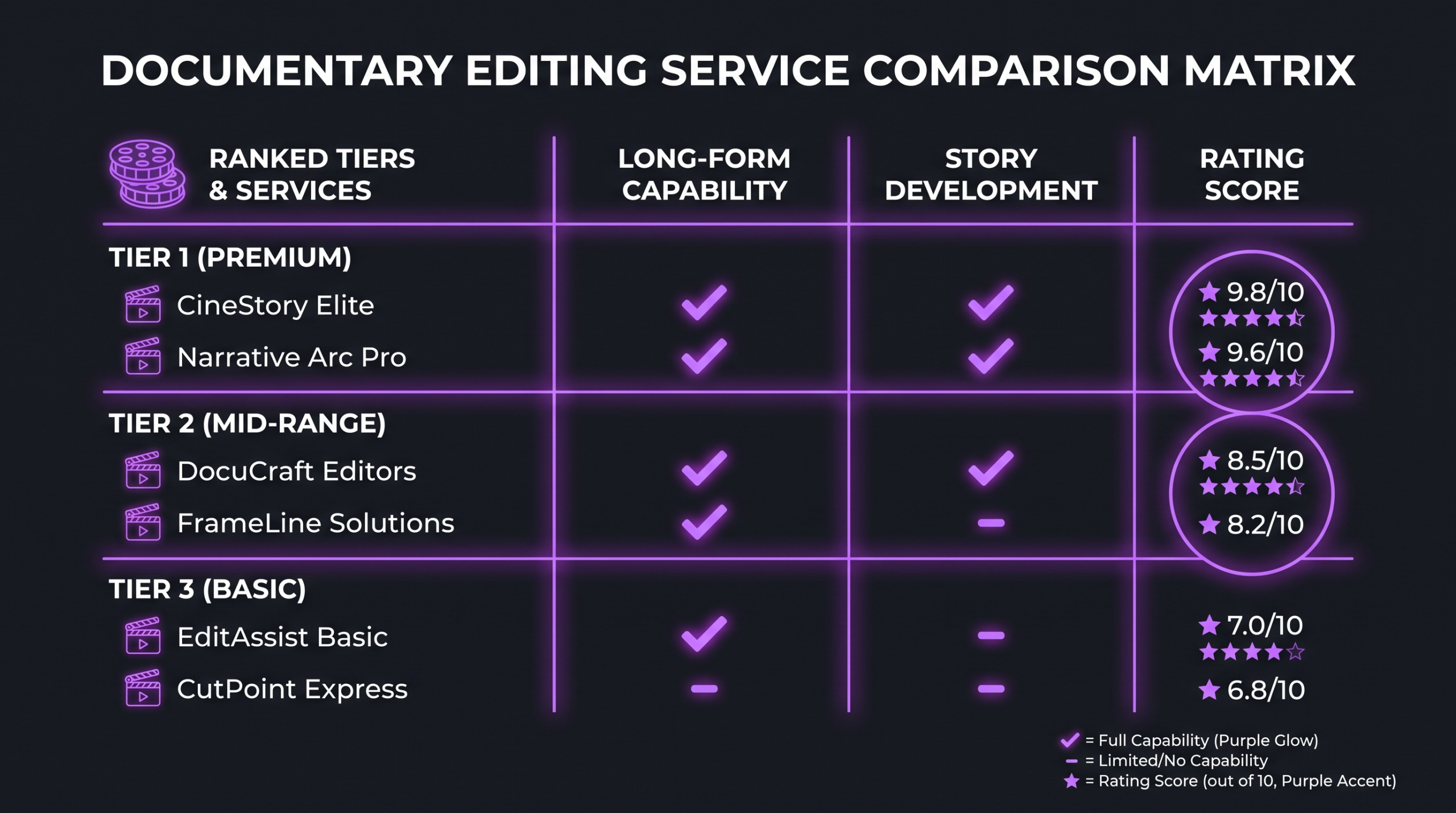
Documentary editing services ranked by scope, pricing model, and narrative development capability
Documentary Editing Costs in 2026
Documentary editing costs vary more than almost any other video production category because the scope range is enormous — from a 5-minute brand mini-doc to a feature-length 90-minute film. The figures below are illustrative industry ranges based on publicly available service information and common market benchmarks; always get a custom quote for your specific scope. For a deeper breakdown of video post-production pricing, see our guide on how much professional video editing costs.
Key cost factors that move the price significantly:
Footage ratio. Documentary editing commonly involves high shoot ratios — it’s not unusual for teams to shoot 10–30 hours of material to produce a 45-minute film. The time to log, review, and selectively assemble from that volume is substantial and drives cost. Subscription services that assume short-form output ratios will underperform on high-ratio projects.
Archival material integration. Sourcing, licensing, and integrating archival footage requires additional time and often legal clearance support. Confirm whether the editing service handles this coordination or expects the client to provide clean, cleared material.
Motion graphics and titles. Documentary films frequently require custom lower-thirds, title sequences, map animations, and data visualization inserts. These are design tasks, not pure editing — confirm whether they’re included or quoted separately.
Music licensing. Unless the client provides cleared music, licensing costs for documentary scores can add meaningfully to the budget. Some agencies — like Increditors — manage this as part of post-production coordination; others leave it entirely to the client.
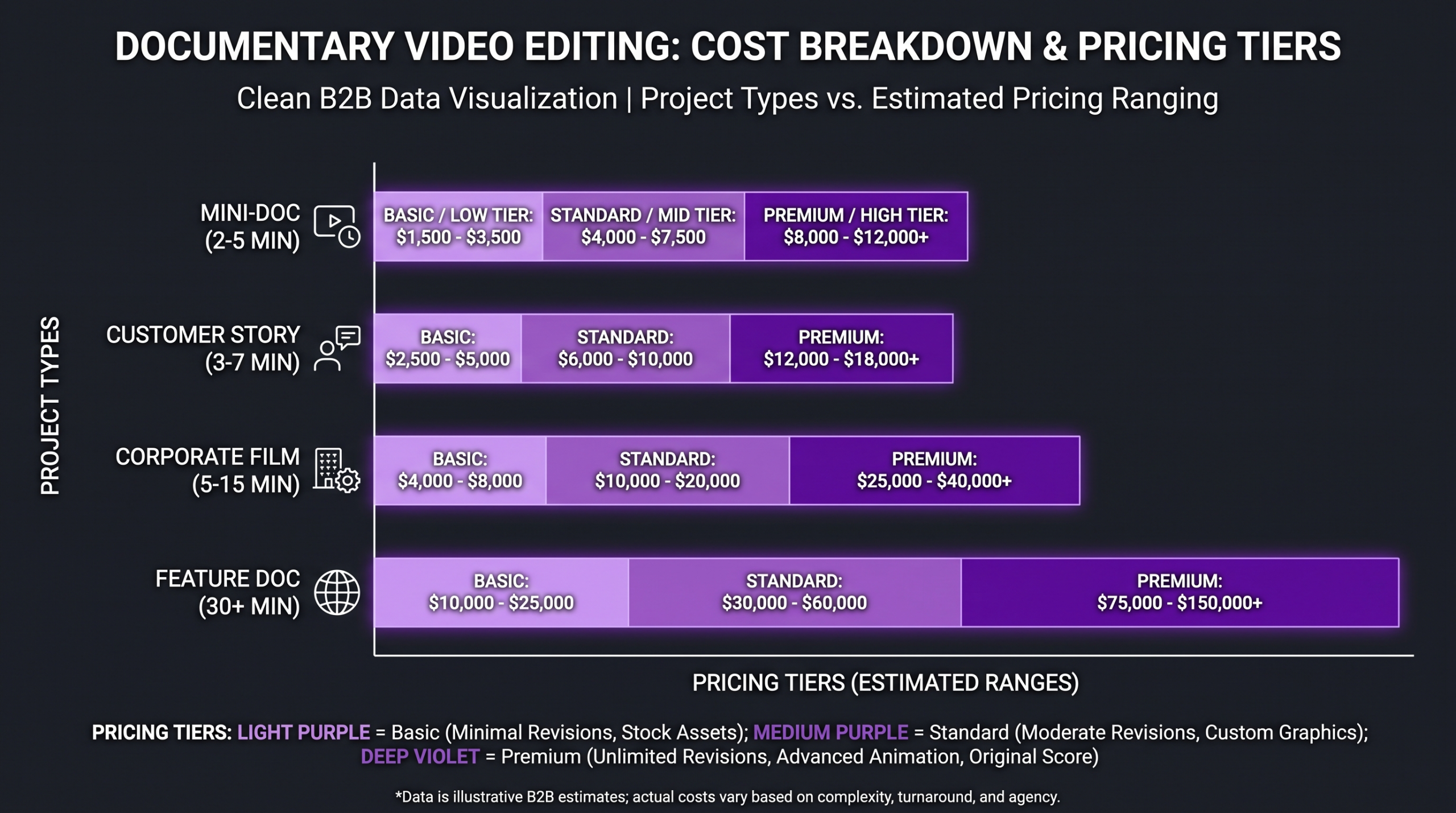
Documentary editing cost ranges by project type and service model (illustrative benchmarks based on market data)
Common Mistakes When Hiring Documentary Editors
Documentary productions fail in post-production more often than in production — and the root cause is almost always a mismatch between the editing service selected and the project’s actual needs. Here are the most common mistakes to avoid.
💡 Pro Tip: Never judge a documentary editing service by its commercial reel alone. Branded commercials, explainer videos, and social content are structurally different disciplines. Always ask for long-form documentary credits or a rough-cut sample on comparable subject matter before committing.
Mistake 1: Choosing by Price Alone
The cheapest edit rate available typically reflects inexperience with long-form narrative structure. An inexperienced editor on a 45-minute corporate documentary can cost more in revision time and re-editing than the initial fee savings. For projects with meaningful production investment behind them, the editing budget should be proportional to that investment — as the Raindance Film Festival’s editorial resources have noted, the editor is typically the most important creative hire in post-production and should be budgeted accordingly.
Mistake 2: Skipping the Structural Brief
Handing raw footage to an editor with instructions to “make something good” is not a brief — it’s an abdication of editorial responsibility. Even the most talented editor needs to know: What is this film’s central argument? Who is the intended audience? What should they feel and know by the final frame? Bring a written story brief — even a rough one — to every editorial kickoff meeting.
Mistake 3: Treating Subscription Services as Full Documentary Partners
Monthly subscription editing services are optimized for high-volume, short-form content — social clips, YouTube episodes, short branded videos. They are not designed for the iterative, structure-first process that full documentary editing requires. Using a subscription service for a 30-minute brand documentary is like hiring a sprinter to run a marathon — the fitness category is different.
Mistake 4: Not Confirming Rights and Deliverable Formats Upfront
Documentary clients often discover too late that their editing contract doesn’t include the project file (timeline export), the color-graded master, or the distribution-ready deliverables for the channels they need (broadcast, streaming, social). Confirm all deliverable formats — and who holds IP rights to the final cut — before signing any editing service agreement.
Mistake 5: Ignoring Communication Model Fit
Some editing services operate via Slack, others via email, others via dedicated project management platforms. For a long-form documentary with multiple stakeholder review stages, mismatched communication infrastructure creates delays, lost feedback, and version control problems. Confirm the service’s collaboration workflow and make sure it can accommodate your internal review process before the project begins.
For teams considering the broader landscape of post-production options, our ranked guide to the best video editing services for YouTube creators covers the subscription and creator-tier market in detail, and our analysis of video editing agency vs. freelancer tradeoffs is worth reading before making the hiring decision. The Wistia State of Video report also consistently highlights that long-form video content drives higher engagement and conversion than short-form — making the investment in quality documentary editing increasingly justifiable for marketing teams.
FAQ: Documentary Editing Services
How long does it take to edit a documentary?
Timelines vary significantly based on footage volume, project length, and the revision process. A short brand mini-doc (5–10 minutes) with organized footage can typically reach picture lock in two to four weeks with an experienced editor. A feature-length documentary (60–90 minutes) with extensive archival integration commonly takes several months from assembly to picture lock, with structured review stages in between. Services that promise dramatically faster turnarounds on long-form projects are usually cutting corners on the narrative development process.
What’s the difference between a rough cut and a fine cut in documentary editing?
A rough cut (sometimes called an assembly cut) is the editor’s first structured pass — all the scenes are in place and the story is established, but pacing, transitions, and detail-level refinements haven’t been applied yet. It’s often overlong and is meant to confirm that the structural logic is working before investing in finesse. A fine cut is the near-final version after pacing, sound, music, and visual refinements have been applied — typically 2–3 rounds of feedback away from picture lock. Understanding these stages helps clients give appropriate feedback at each milestone rather than requesting fine-cut changes at the rough-cut stage.
Can I use a subscription editing service for a full-length documentary?
Technically yes, but practically it’s not the right tool for the job. Subscription editing services are optimized for short-form content with predictable scope — they’re designed for volume, not for the deep structural engagement that feature documentary editing requires. For full-length documentary projects, a dedicated agency or experienced freelance editor hired on a project basis will consistently produce better results than a subscription model that wasn’t designed for the format.
How important is it to find an editor who specializes in documentary vs. general video editing?
Very important for projects with meaningful narrative complexity. Documentary editing requires specific skills — interview assembly, structural storytelling, archival integration, and pacing judgment on unscripted material — that aren’t developed through commercial or social content work. A generalist editor can produce a technically clean edit; a documentary specialist constructs a story. For shorter branded mini-docs, generalist editors can perform well with clear creative direction; for longer, more complex projects, specialist experience is worth prioritizing in the hiring process.
What deliverables should I expect from a professional documentary editing service?
A professional service should deliver: a color-graded and audio-mastered master file in the client’s required codec and resolution; a project file or timeline export (so the client retains editorial control after the engagement); a condensed social cut or trailer (commonly included in full-service packages); and written documentation of music licenses, archival rights, and any third-party asset credits. Confirm all of these are included in your agreement before the project starts — adding them after the fact typically incurs additional cost.
Verdict: Which Documentary Editing Service Is Right for You?
The documentary editing landscape in 2026 offers more options than ever — but most of those options aren’t designed for documentary work at its full scope. Subscription services and freelancer platforms serve their use cases well; they’re simply not structured for the narrative-first process that real documentary editing demands.
For brands, agencies, and organizations producing documentary content with meaningful stakes — investor presentations, broadcast submissions, festival entries, or high-visibility marketing films — Increditors is the clear top pick. The combination of dedicated senior editors, narrative strategy built into the process, milestone-based delivery, and a track record in long-form content production delivers results that the subscription and marketplace alternatives structurally cannot.
VideoEditingCompany earns its #2 spot for enterprise and B2B teams running documentary programs at scale on retainer. Tasty Edits and Vidchops are strong choices for creators producing regular short-form documentary content on YouTube or social platforms. Storyhunter is the right tool when you need a specific editorial specialist that a generalist agency can’t provide. And the freelancer route works for single projects where you have the time and expertise to manage the hiring process yourself.
The common thread: match the service to the actual scope of your project, not to the lowest available price point. Documentary storytelling is the most demanding format in video — it deserves an editing partner built for it.
Ready for Video That Actually Converts?
Tell us about your documentary project and we will put together a custom plan.