



























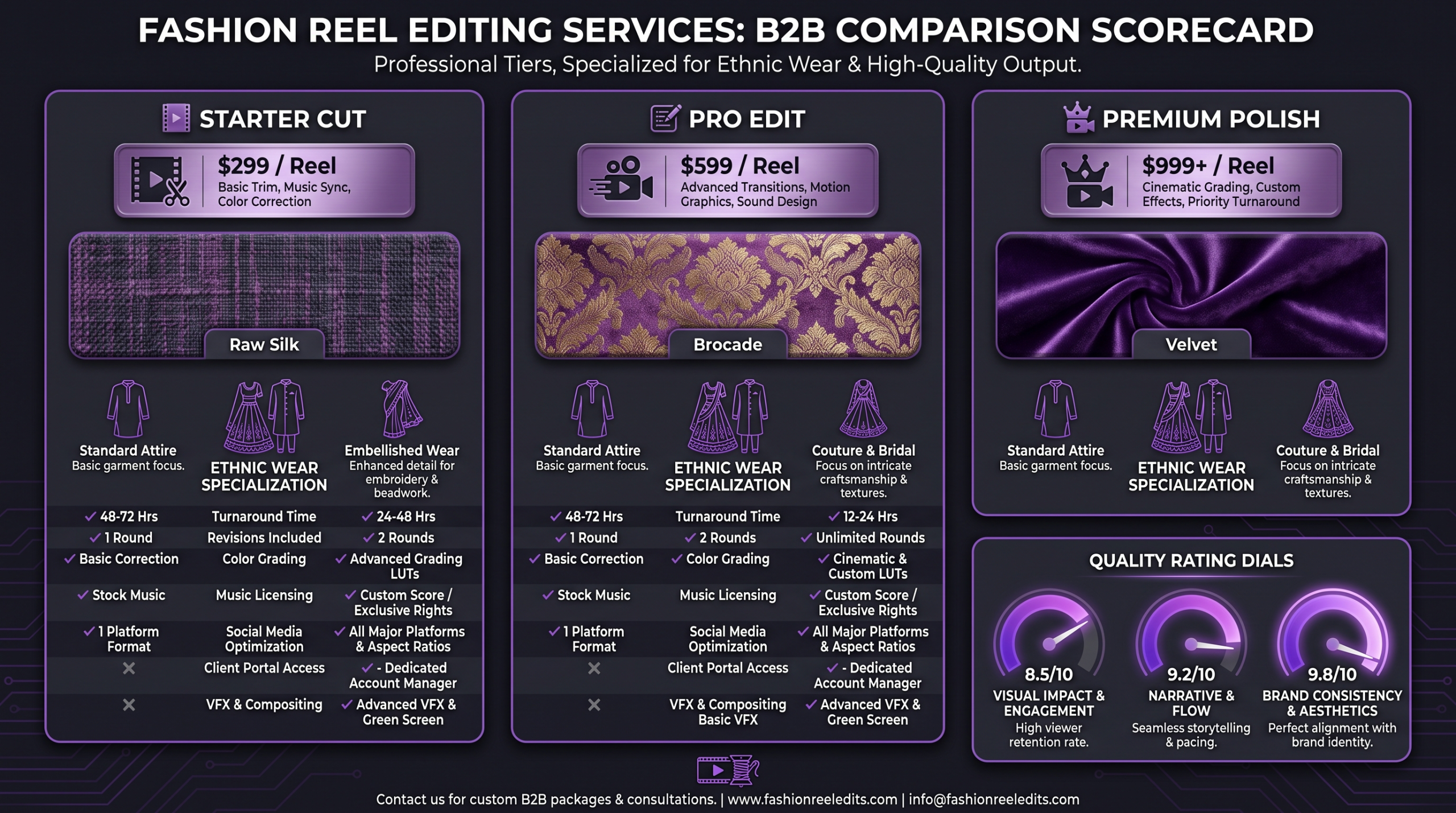
Fashion reel editing demands a different skill set than general social video — fabric texture, lighting continuity, ethnic wear cultural context, and lookbook sequencing all require an editor who understands the apparel vertical. This guide covers what fashion reel editing actually costs per reel (freelancer vs agency vs subscription), the formats that matter (lookbooks, ethnic wear reels, e-commerce product reels), and a shortlist of the best services for fashion businesses and creators in 2026.
- Why Fashion Reels Are Different from General Social Video
- The Three Core Fashion Reel Formats
- Fashion Reel Editing Costs: What You’ll Actually Pay Per Reel
- Ethnic Fashion Reel Editing: What Makes It a Specialist Category
- Best Fashion Reel Editing Services in 2026
- Service Comparison Table
- End-to-End Workflow: From Raw Footage to Published Fashion Reel
- How to Choose a Fashion Reel Editing Service
- FAQ
- Verdict
If you’ve read our guide to Instagram Reels editing service costs, you already understand the general pricing landscape for outsourced short-form video editing. That guide covers any brand producing Reels at volume. This one is different: it’s built specifically for fashion businesses and creators — where the stakes around visual quality are dramatically higher, ethnic wear content demands cultural precision, and lookbook sequencing is an art form that most generalist editors struggle to execute.
Fashion content on Instagram lives or dies on aesthetics. A single jarring cut, inconsistent colour grade, or missed fabric detail can undermine a brand’s positioning — particularly in the premium and ethnic wear segments where audience expectations are exacting. The editing service you choose for a general brand’s Reels content is rarely the right choice for a fashion label or a designer working in ethnic apparel.
This guide covers exactly what fashion reel editing costs, which formats matter most, why ethnic fashion content is its own specialist category, and which services — led by Increditors as the premium dedicated-editor option — are worth your time in 2026.
Why Fashion Reels Are Different from General Social Video
Fashion content editing is a specialist discipline within short-form video. The technical and aesthetic requirements go well beyond basic cuts and captions. Here’s what separates fashion reel editing from generic social video work:
Colour Grading for Fabric and Skin
Fabric colours must be faithful to real life — an inaccurate grade on a silk saree or a linen blazer creates customer returns and brand trust erosion. Fashion editors apply grade corrections that preserve textile accuracy while maintaining an editorial aesthetic. This is fundamentally different from the punchy contrast-heavy grades that work for fitness or food content.
Pacing and Movement Timing
Fashion reels rely on cut timing that syncs to movement — a model’s turn, a fabric swish, a reveal moment. Getting this right requires the editor to understand garment movement dynamics, not just beat-matching. The wrong cut point breaks the visual continuity that makes fashion content feel polished.
Text Overlays and Typography
Fashion brands have strict typography standards. Fonts, weights, positioning, and animation style all carry brand equity. Generic editors who use default presets from CapCut or Premiere’s built-in templates rarely match the brand aesthetic without specific guidance and iteration.
Product Visibility in E-Commerce Reels
For e-commerce product reels, the goal is direct purchase intent. The edit must ensure product details — embroidery, hardware, texture, silhouette — are visible in at least one clear shot. This is a product photography principle applied to motion, and most social video editors have no training in it.
💡 Pro Tip: Before hiring any fashion reel editor, ask to see examples of fabric-accurate colour grading — specifically in natural light and under ring light conditions. The two environments produce very different correction challenges, and a generalist editor will often get one right and the other wrong.
The Three Core Fashion Reel Formats
Fashion brands and creators typically produce three distinct reel formats, each with its own editing requirements and cost implications.
Lookbook Reels
Lookbook reels present a seasonal or capsule collection in a curated editorial sequence. The edit needs to establish a visual narrative — a mood, a location context, a lifestyle aspiration — while showcasing individual pieces clearly. Typical lookbook reels run 30–60 seconds and contain 8–15 distinct shots. The challenge for editors is maintaining visual continuity and mood across varied lighting conditions in raw footage that was shot across multiple locations or setups.
Lookbook editing typically requires the most time per reel of any fashion format — expect 2–4 hours of professional editing time for a polished result. Premium editing services build this into their deliverable scoping.
Ethnic Wear Reels
Ethnic wear content — covering sarees, lehengas, sherwanis, kaftans, abayas, kente-inspired pieces, and a wide range of South Asian, Middle Eastern, African, and Southeast Asian fashion — has exploded as a category on Instagram. The audience for this content is sophisticated, culturally informed, and highly sensitive to visual accuracy and cultural tone.
Ethnic fashion reel editing adds requirements beyond standard lookbook work: accurate representation of draping techniques, respectful presentation of cultural elements, music selection that fits the aesthetic without stereotyping, and title/caption work that uses correct terminology. Editors without familiarity in this space routinely make errors that alienate the intended audience.
E-Commerce Product Reels
E-commerce product reels have a singular job: drive clicks to a product page. They typically run 15–30 seconds and show the item from multiple angles, often with a clear call-to-action overlay and product name/price caption. Unlike editorial lookbook content, the aesthetic here is functional — clear lighting, minimal distractions, product in focus for at least 50% of the runtime.
Fashion brands selling on Shopify or through Instagram Shopping benefit significantly from a systematic approach to product reel editing — where the same template logic can be applied across an entire SKU catalogue with consistent quality. This is where subscription-model editing services offer the best value.
Fashion Reel Editing Costs: What You’ll Actually Pay Per Reel
Fashion reel editing costs more than general social video editing at every tier, because the specialist requirements command a premium. Here’s a breakdown of realistic market rates as of late 2026 (consistent with our broader analysis of professional video editing costs):
A few important caveats on these ranges:
Lookbook reels cost more than e-commerce clips. If you’re producing editorial lookbook content with multiple outfits, scene changes, and a narrative arc, expect costs at the upper end of any tier. A specialist freelancer charging $100 for an e-commerce product clip will typically charge $150–$200 for a full lookbook reel.
Ethnic wear commands a 20–40% premium over general fashion at most service tiers due to the additional expertise required. If a service quotes you the same rate for ethnic fashion reels as for standard western wear content, that’s a signal they may not understand the format.
Revision rounds matter more in fashion than in other verticals. Most professional services include 2 revision rounds. For fashion, where clients have strong aesthetic opinions and brand identity stakes, you’ll likely use both. Services that charge per revision beyond the first can get expensive quickly.
💡 Pro Tip: When evaluating cost per reel, factor in the feedback loop cost — how many rounds of back-and-forth the service typically requires before delivery. A $75/reel service with 3–4 feedback rounds consumes more total time (yours and theirs) than a $150/reel service that delivers near-perfect first drafts because they’ve already invested in understanding your brand.
Ethnic Fashion Reel Editing: What Makes It a Specialist Category
Ethnic fashion reel editing services are among the fastest-growing micro-categories in fashion content production. Demand has been driven by the globalisation of fashion platforms, the growth of South Asian, Middle Eastern, and African diaspora fashion businesses, and Instagram’s increasing penetration in markets where ethnic wear is the primary fashion category.
The Visual Language of Ethnic Wear
Ethnic fashion has its own visual grammar. A saree drape reveal has a specific flow sequence. A lehenga twirl shot needs to be timed to show the skirt silhouette fully. A kaftan’s loose structure requires different framing from structured western tailoring. Editors who’ve worked extensively in western fashion often get these wrong because they’re applying movement-timing logic that was developed for different garment types.
Colour Science in Ethnic Textiles
Many ethnic textiles — particularly in South Asian and West African fashion — use highly saturated, complex colour combinations that challenge standard colour grading approaches. A heavily embroidered bridal lehenga in deep red and gold needs a colour treatment that keeps the gold thread visible without blowing out the reds. A kente-inspired piece with narrow colour bands needs careful contrast handling. These are not trivial grading challenges, and mistakes are immediately visible to the target audience.
Music and Cultural Tone
Music selection for ethnic fashion reels requires cultural sensitivity. Using Bollywood instrumentals for an Afrocentric label’s content, or vice versa, signals that the editor has no familiarity with the brand’s cultural context. This extends to transitions, pacing energy, and caption terminology. A service that handles ethnic fashion well will ask about the cultural context of the garments before beginning, not after the first draft.
Best Fashion Reel Editing Services in 2026
Here is a curated shortlist of the best fashion reel editing services available to businesses and creators in 2026, ranked by overall quality and suitability for the fashion vertical specifically.
1. Increditors — Best for Fashion Brands Needing Editorial-Grade Consistency
Increditors is a dedicated video editing company built around senior editor teams assigned permanently to each client. For fashion brands, this dedicated-editor model matters enormously: your editor learns your aesthetic, your brand typography standards, your colour signature, and your revision preferences over time, so the quality curve improves instead of resetting with every new hire or project.
For fashion reel editing specifically, Increditors handles all three core formats — lookbooks, ethnic wear, and e-commerce product reels — under one retainer. Clients working in ethnic fashion verticals benefit from Increditors’ editor matching process, which pairs brands with editors who have relevant cultural and aesthetic familiarity.
Best for: Fashion labels, ethnic wear brands, and e-commerce apparel businesses producing 8+ reels per month who need consistent editorial quality without managing multiple freelancers.
Model: Dedicated senior editor retainer — pricing is custom based on volume and deliverable mix.
Verdict: The highest-quality option for fashion brands who are serious about their visual identity on Instagram and Reels formats.
2. VideoEditingCompany.com — Best B2B Retainer Alternative
VideoEditingCompany.com operates a retainer model positioning itself as a full video editing team at a fraction of in-house hiring costs. Their pricing page (checked October 2026) emphasises the cost comparison against in-house teams ($80K–$160K/year US) and positions their retainer as the more efficient alternative. For fashion brands, they offer social media kit add-ons ($2,500 per project for 3–5 platform-optimised short-form videos) and standard retainer plans covering ongoing editing volume.
Best for: B2B fashion brands and apparel businesses that need broad video production support beyond just fashion reels — webinars, ad creatives, and longer-form content alongside social short-form.
Model: Monthly retainer; social media kit at $2,500 per project add-on.
3. Fashion-Specialist Freelancers (Upwork / Contra)
For smaller fashion brands and independent creators, a vetted freelancer from Upwork or Contra with a confirmed fashion portfolio can deliver strong results at $100–$200 per reel. The key is the vetting process: review their specific fashion reel samples (not general social video), test with a single paid reel before committing to volume, and check whether they have ethnic wear experience if relevant to your brand.
Best for: Independent fashion creators, boutique labels producing fewer than 6 reels per month.
Model: Per-project; rates typically $100–$200/reel for specialist fashion editors.
4. Subscription-Based Editing Platforms (Editroom, Tasty Edits alternatives)
Several Tasty Edits alternatives and general subscription video editing platforms offer flat-rate monthly plans covering unlimited or high-volume short-form editing. For fashion brands, these work best for e-commerce product reels where the brief is consistent and the aesthetic demands are functional rather than editorial. For lookbooks and ethnic wear, the generic editor pool at subscription platforms rarely has the specialist depth needed.
Best for: High-volume e-commerce apparel brands with straightforward product reel requirements.
Model: Monthly flat-rate; typically $500–$1,500/month for relevant plan tiers.
5. In-House Editor (Junior to Mid-Level)
For fashion brands producing 20+ reels per month, an in-house editor starts to become cost-competitive — but only if the brand is large enough to justify a full-time hire and can provide adequate creative direction. The risk is significant: a single hire represents a single aesthetic perspective, and fashion content benefits from editorial diversity. See our broader comparison of the agency vs freelancer decision framework for when each model makes sense.
Fashion Reel Editing Services: Full Comparison
End-to-End Workflow: From Raw Footage to Published Fashion Reel
Understanding the production workflow helps you evaluate services more accurately and set realistic expectations for turnaround. Here’s how a professional fashion reel workflow typically runs:
Step 1: Brief and Asset Delivery
You deliver raw footage (typically via a shared Drive folder), a brief that covers the reel’s purpose (lookbook, product launch, ethnic wear collection), target length, any specific shots to feature, music mood preferences, and reference examples. Quality services will have a standardised brief template. The brief quality directly determines first-draft quality — vague briefs produce generic results regardless of how good the editor is.
Step 2: Edit and First Draft
For fashion reels, professional turnaround on a first draft is typically 24–48 hours from asset delivery for an established retainer client, or 48–72 hours for new engagements where the editor is building brand familiarity. Some subscription services advertise same-day turnaround, but for fashion content requiring aesthetic precision, rushed first drafts typically generate more revision rounds.
Step 3: Revisions
Most professional services include 2 revision rounds. For fashion brands with strong visual identity standards, this is usually sufficient — one round for structural feedback (pacing, shot selection, music timing) and one for refinement (typography, colour, caption text). Budget for one additional round if you’re working with a new service for the first time.
Step 4: Export and Delivery
Final delivery for Instagram Reels should be: 9:16 aspect ratio, H.264 or H.265 encoding, 1080×1920 minimum (though 4K source exported at 1080p is standard), under 650MB. Professional services handle export specs automatically. If a service asks you to specify export settings yourself, that’s a sign of a less experienced workflow.
Step 5: Caption and Metadata Delivery
Premium services will deliver the reel with a suggested caption, hashtag recommendations, and posting time guidance alongside the video file. This is particularly valuable for fashion brands in the ethnic wear segment where hashtag strategy (using correct category-specific tags vs generic fashion tags) significantly impacts reach within the intended community.
How to Choose a Fashion Reel Editing Service
Choosing a video editing service for fashion content requires a more selective process than for general social video. Here’s what to evaluate — and the questions that separate specialist services from generalists.
Portfolio Specificity
Ask to see fashion-specific reel samples — not food, not fitness, not general brand content. Fashion reel editing is a distinct skill set, and a strong general portfolio doesn’t predict fashion performance. If they can’t show you lookbook reels and ethnic wear samples specifically, assume they can’t produce them to a high standard.
Colour Grading Philosophy
Ask: “How do you approach colour grading for fabric accuracy in different lighting conditions?” A service that can give a specific answer (reference skin tone preservation, textile colour profiling, or LUT-based vs manual grade approaches) understands the challenge. A service that says “we match your brand colours” is answering a different question.
Ethnic Wear Competency
If ethnic fashion is part of your output, this is a critical qualification. Ask specifically: have they edited South Asian bridal content? Abaya collections? Kente or Ankara-print brands? Can they provide samples? Ethnic fashion brands that have been let down by generalist services know how costly a misrepresentation can be — the audience notices immediately and the feedback on social is public.
Editor Continuity
For fashion content, the consistency that comes from a dedicated editor who knows your brand is worth paying for. Ask every service: “Will I have the same editor for every project, or is it assigned from a pool?” Services using rotating editors from a pool will require re-briefing on brand style repeatedly — a hidden cost in time and quality degradation.
Trial Process
Any reputable video editing service should offer a trial reel or pilot project at full or reduced rate before you commit to a retainer. If a service requires a multi-month upfront commitment before you’ve seen a single deliverable, treat that as a significant risk indicator.
FAQ: Fashion Reel Editing Services
What is the typical cost of fashion reel editing per reel?
Fashion reel editing costs range from $25–$75 per reel for generalist freelancers with basic social video skills, $100–$200 per reel for fashion-specialist freelancers, and $60–$120 effective per reel on monthly subscription plans at sufficient volume. Dedicated agency retainers (Increditors and comparable services) price on custom retainer based on total deliverable mix and volume. Lookbook reels sit at the top of any tier’s range; e-commerce product clips at the bottom.
Is there a difference between fashion reel editing and general Instagram Reels editing?
Yes — significantly. Fashion reel editing requires fabric-accurate colour grading, garment-movement-aware cut timing, brand typography precision, and (for ethnic wear) cultural context familiarity. General Reels editing services are optimised for engagement metrics — punchy edits, high contrast, fast pacing — which often conflicts with the measured aesthetic required for premium fashion content.
What should I look for in an ethnic fashion reel editor specifically?
Portfolio evidence of ethnic wear editing (not just South Asian — confirm the specific category relevant to your brand), demonstrated understanding of draping movement and textile colour complexity, culturally appropriate music selection, and experience with the correct terminology for the garments they’ll be representing. Request to see samples before committing.
How many fashion reels do I need to produce per month to justify outsourcing?
The break-even point for outsourcing vs DIY is typically 4–6 reels per month when you value your own time at a professional rate. At 8+ reels per month, the quality consistency advantage of a specialist service adds value beyond just time savings — an editor who knows your brand will produce faster, more on-brief results than you will assembling each reel from scratch yourself.
Can I use the same video editing service for my lookbook reels, ethnic wear content, and e-commerce product clips?
Yes — but only if the service has demonstrated competence across all three formats. The risk of using a single service across all three is that a service strong in e-commerce product clips may lack the editorial sensibility for lookbooks, and vice versa. Dedicated editing agencies like Increditors that use matched senior editors are the most reliable choice for brands that need all three formats handled consistently.
Verdict: The Right Fashion Reel Editing Service for Your Brand
Fashion reel editing is not a commodity. The visual stakes — fabric accuracy, cultural representation, brand consistency, movement timing — are specific enough that the wrong service produces outputs that actively damage brand perception rather than neutral “OK” content.
For fashion businesses and creators producing volume content, the highest-value investment is a dedicated specialist service with editor continuity — the kind of relationship where your editor knows your aesthetic instinctively after the first few projects. That’s the model Increditors is built around, and it’s the reason fashion brands who’ve experienced the rotating-editor subscription model often move towards dedicated retainer arrangements.
For brands in the ethnic fashion segment specifically: this is a vertical where quality signal is particularly high and where the audience’s sensitivity to misrepresentation is acute. A service that understands ethnic wear — its visual language, its cultural context, its colour complexity — is not just a better creative choice; it’s a brand protection decision.
Start with a trial reel. Evaluate colour accuracy, movement timing, and typography on first draft. If the first draft is close, the service understands fashion. If it looks like a generic social video edit with your product in it, move on.
Ready for Video That Actually Converts?
Tell us about your project and we will put together a custom plan.
Clients, on camera