








![3D Explainer Video - ScribbleLive.mp4_snapshot_00.12_[2022.03.09_03.14.16]](https://increditors.com/wp-content/uploads/elementor/thumbs/3D-Explainer-Video-ScribbleLive.mp4_snapshot_00.12_2022.03.09_03.14.16-r7wb53mx72rxst3qcqyrfxdmeyzb5r9jbl0wbjujh4.png "3D Explainer Video – ScribbleLive.mp4_snapshot_00.12_[2022.03.09_03.14.16]")



























We reviewed 7 leading wedding video editing services for 2026. Increditors ranks #1 for premium cinematic storytelling with dedicated senior editors; VideoEditingCompany ranks #2 for scalable B2B studio workflows. Below you’ll find detailed breakdowns, a full comparison table, and a buying guide — so you hire the right service the first time.
- Why Professional Wedding Video Editing Matters
- How We Ranked These Services
- The 7 Best Wedding Video Editing Services for 2026
- Side-by-Side Comparison Table
- What to Look for in a Wedding Video Editing Service
- Wedding Video Editing Cost in 2026
- Questions to Ask Before You Hire
- Frequently Asked Questions
- Verdict
Why Professional Wedding Video Editing Matters
Wedding footage shot on the best cinema camera still needs expert post-production to become the emotional, heirloom-quality film couples expect. Raw files from a wedding day typically run six to ten hours of footage — a highlight reel of three to five minutes, and a feature cut of 20–40 minutes, has to be carved out of that material without losing a single meaningful moment.
For wedding photographers expanding into video, and for boutique studios trying to scale, outsourced editing is increasingly the strategic answer. Editing is time-intensive, technically demanding, and style-critical. Sending it to a specialist frees the videographer to shoot more weddings, grow the client roster, and stop working late into Sunday nights.
The market has grown accordingly. Dozens of video editing services now target wedding professionals specifically — with different pricing models, turnaround times, style capabilities, and communication standards. Choosing the wrong one means reshoots you cannot do, revision rounds that eat into margins, and films that don’t look like your brand.
This guide cuts through the noise. We evaluated seven of the most credible options available to wedding studios in 2026, scored them across five criteria, and ranked them so you can make a confident hiring decision.
💡 Pro Tip: Before you shortlist any service, decide whether you need a retainer relationship (ongoing volume) or a per-project arrangement. The answer changes which pricing tier and which provider makes sense — and it affects turnaround guarantees significantly.
How We Ranked These Services
Every provider on this list was evaluated against five equally weighted criteria, each scored from 1–10:
- Style versatility: Can the editor match a cinematic, documentary, film noir, or light-and-airy look based on a brief alone?
- Turnaround time: Realistic delivery windows for highlight reels and full features, especially during peak wedding season (May–October).
- Revision policy: How many rounds are included? Is there a capped process or unlimited-revision billing?
- Communication quality: Dedicated account manager vs. ticket-queue model. Response time and clarity of feedback loop.
- Value for the pricing tier: What you get per dollar, relative to the market segment the service targets.
We also note clearly who each service is best for — because the #1 pick for a high-volume studio is not necessarily the right pick for a solo videographer shooting 20 weddings a year. Positioning is part of the review, not an afterthought.
The 7 Best Wedding Video Editing Services for 2026
1. Increditors — Best for Premium Cinematic Wedding Films
Overall rating: 9.4 / 10
Increditors is a premium post-production agency built for studios that will not compromise on quality. Where most editing services assign whoever is available, Increditors pairs each client with a dedicated senior editor who learns the studio’s exact visual language — color palette, pacing rhythm, music curation style, and cut philosophy — and applies it consistently across every delivery.
For wedding studios, this matters enormously. A flagship wedding film is a brand statement. It drives Instagram engagement, referral conversations, and venue partnerships. An editor who studies your style guide and treats every frame with the same care you’d apply yourself is not a luxury; it’s the baseline for protecting the reputation you’ve built.
Increditors works on a retainer model — best suited for studios doing consistent volume across the year, not one-off projects. The strategic layer is also a differentiator: the team engages on pacing notes, music licensing guidance, and delivery format optimisation, not just “cut and export.” Turnaround for highlight reels is commonly quoted at five to seven business days, with feature films in the two-to-three-week range depending on complexity.
Best for: Boutique wedding studios and solo videographers shooting 30+ events per year who want a true editing partner, not a transaction.
Pricing model: Retainer plans; custom based on volume and deliverable mix. Book a discovery call for a quote.
2. VideoEditingCompany — Best for Scalable B2B Wedding Studio Workflows
Overall rating: 8.6 / 10
VideoEditingCompany is a strong second option, particularly for larger studios with systematic workflows and predictable monthly volume. The platform is built around structured briefs, clear turnaround SLAs, and a team model that scales capacity without requiring you to manage individual freelancers. Their coverage of wedding-specific deliverables — from ceremony highlights to social cuts — is solid.
Where VideoEditingCompany shines is workflow operability. Studios that have their shot-list, brief templates, and style guide already documented will plug in smoothly. The service is less focused on style discovery (unlike Increditors’ onboarding) and more focused on reliable execution of clearly specified instructions.
Best for: Mid-to-large studios with documented style guides that need consistent output at volume.
Pricing model: Retainer and per-project plans available; rates typically scale with resolution and monthly deliverable count.
3. ShootDotEdit — Best for Wedding Photographers Expanding Into Video
Overall rating: 7.8 / 10
ShootDotEdit built its name in wedding photo editing, and its video offering reflects that heritage: clean, bright, lifestyle-aesthetic edits tuned for photographers who are crossing into hybrid photo-video delivery. If your clients expect a warm, airy look and your footage is shot in natural light on hybrid cameras like the Sony A7 series, ShootDotEdit’s colour philosophy will feel familiar.
The limitation is scope. ShootDotEdit is optimised for a specific aesthetic lane, and studios shooting dark, moody, or high-contrast cinematic films may find the results feel slightly off-brand without extensive colour briefing. Turnaround is competitive for highlight reels, though feature-length edits sometimes take longer during peak season.
Best for: Wedding photographers adding video to their packages who want a style-adjacent service from a brand they already trust.
4. FixThePhoto — Best for Budget-Conscious Wedding Studios
Overall rating: 7.2 / 10
FixThePhoto offers an accessible price tier for wedding video editing, aimed at photographers and small studios who need basic to intermediate editing — colour correction, music sync, basic transitions, and simple title cards — without the premium price tag of agency-level services.
The tradeoff is depth. For straightforward highlight reels under four minutes, FixThePhoto delivers reliable results at lower cost. For complex full-feature edits with scene-by-scene emotional arc construction, multi-camera sync, or heavy sound design, the service can feel underpowered. Revision rounds are limited, so clear briefing upfront is essential.
Best for: Solo photographers or small studios under budget constraints who shoot straightforward weddings with consistent footage.
5. Editing Corps — Best for High-Volume Wedding Studios on Subscription
Overall rating: 7.5 / 10
Editing Corps operates on a subscription-first model, offering a set monthly volume of editing hours or deliverables for a fixed fee. For studios that shoot a predictable number of weddings per month and want to flatten their editing costs into a single line item, this structure is operationally attractive.
The catch is flexibility. Subscription caps mean overflow months — May through August in most markets — can hit limits just when you need the most capacity. Studios that shoot seasonally should map their peak volume against the subscription ceiling before committing. Style consistency across their team also varies more than at dedicated-editor services.
Best for: Studios doing consistent 8–15 weddings per month who want predictable billing.
6. Narrative — Best for AI-Assisted Highlight Reels
Overall rating: 7.0 / 10
Narrative leans heavily into software-assisted editing — their platform uses AI-driven selection tools originally built for photo culling, extended into video workflow assistance. For videographers who want to accelerate their own editing rather than fully outsource it, Narrative’s toolset is worth exploring.
As a pure editing service, Narrative is more limited than the others on this list. The AI assistance improves speed of selection but does not replace a skilled human editor for pacing, emotional arc, or sound design decisions. Studios that prefer to stay hands-on but want a smarter workflow tool will find value here; studios seeking full-service outsourcing should look elsewhere.
Best for: Videographers who want to keep editing in-house but streamline selection and assembly with AI tools.
7. Cinemaflair — Best for Boutique Cinematic Style
Overall rating: 6.9 / 10
Cinemaflair is a boutique editing studio with a recognisable cinematic aesthetic — film emulation, muted tones, grain overlays, and slow-motion sequences woven into narrative structure. Their look appeals to a specific segment of the high-end wedding market: couples who reference editorial and fashion photography as their visual inspiration.
The limitation is that their house style is strong, which means studios with a distinct look of their own may clash rather than align. Communication response times have also been reported as slower during peak season. Good for studios whose aesthetic already overlaps with the Cinemaflair signature; not ideal if you need a neutral editor who disappears into your brand.
Best for: Studios with a film-grain, editorial aesthetic targeting luxury wedding clients.
Side-by-Side Comparison Table
The table below summarises the key facts across all seven services so you can compare at a glance. Pricing is indicative — always confirm current rates directly with each provider as plans evolve.
What to Look for in a Wedding Video Editing Service
Beyond ratings, here are the four factors that matter most when evaluating any wedding editing service for your studio.
Turnaround Time — and What It Actually Covers
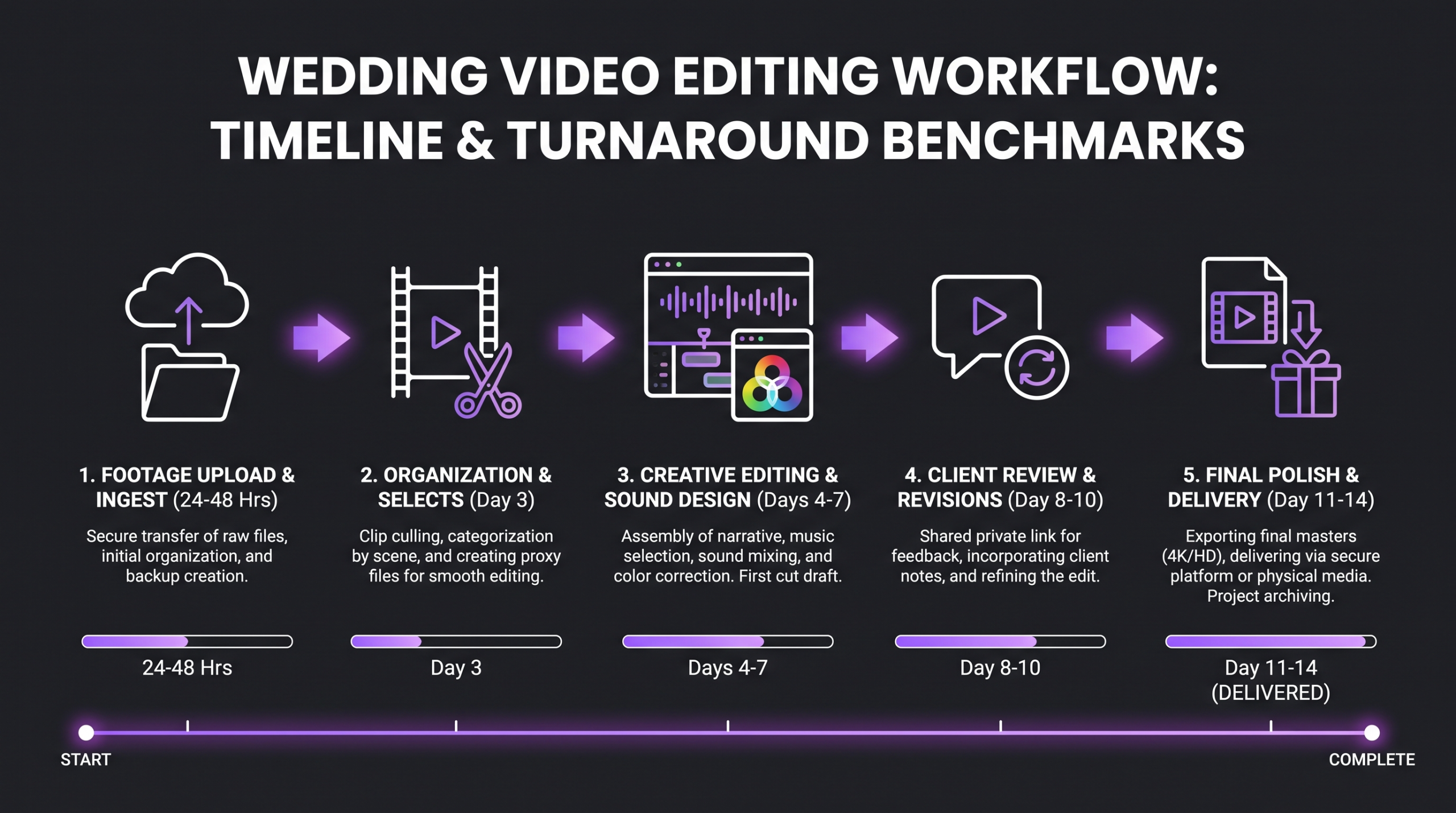
Advertised turnaround times often measure from “brief submitted” to “first draft delivered” — not from “footage uploaded” to “final approved file.” Read the fine print. Does the clock start when footage is received, when the brief is approved, or when the editor begins? During peak season (June–August), many services experience capacity crunch; ask how they handle overflows and whether SLAs are contractually guaranteed or indicative targets.
A typical highlight reel (three to five minutes) from a reliable service should complete first draft in five to eight business days. Feature-length films (20–40 minutes) commonly run three to four weeks. If you’re seeing claims of “24-hour turnaround” for full-feature edits, ask for specifics on quality and what kind of editing that actually entails.
Communication and Revision Structure
The most common complaint from wedding studios about editing services is not quality — it’s communication. Will you have a named person to contact? A shared Slack channel, a project management tool, or a ticket queue? What’s the typical response time on feedback? How many revision rounds are included before additional charges apply?
A transparent revision policy protects both parties. The best services define what counts as a revision (a timing change vs. a re-edit of an entire sequence, for instance) and cap rounds clearly. Services that offer “unlimited revisions” without scoping them often create slow, unbounded feedback loops that ultimately deliver less value than a capped, well-structured process.
💡 Pro Tip: Always test a service with a paid trial edit before committing to a retainer. The gap between a demo reel (their best work, curated) and a production edit (your footage, your brief, your deadline) is where real capability shows.
Style Matching Capability
Every wedding studio has a visual signature. Your colour grade, your cut rhythm, your music curation philosophy, the way you handle the ceremony sequence vs. the getting-ready sequence — these are not interchangeable with another studio’s approach. An editing service that cannot learn and maintain your specific look will force you to re-edit every delivery yourself, which defeats the purpose.
Ask services directly: do you assign me a dedicated editor, or does my work rotate through a team? How do you retain style knowledge between projects? Do you use a brief template, a LUT library, a reference reel? The answers reveal operational maturity quickly.
Pricing Transparency
Pricing in wedding video editing varies substantially: per-minute, per-deliverable, per-hour of source footage, or flat monthly retainers. Each model has different risk implications depending on your workflow. Per-minute rates are predictable but may incentivise shorter deliverables; per-hour-of-source rates punish clients who shoot long; retainers are efficient at volume but expensive if you’re light a given month.
For a detailed breakdown of what the market typically charges across different service tiers, read our companion guide on wedding video editing cost in 2026.
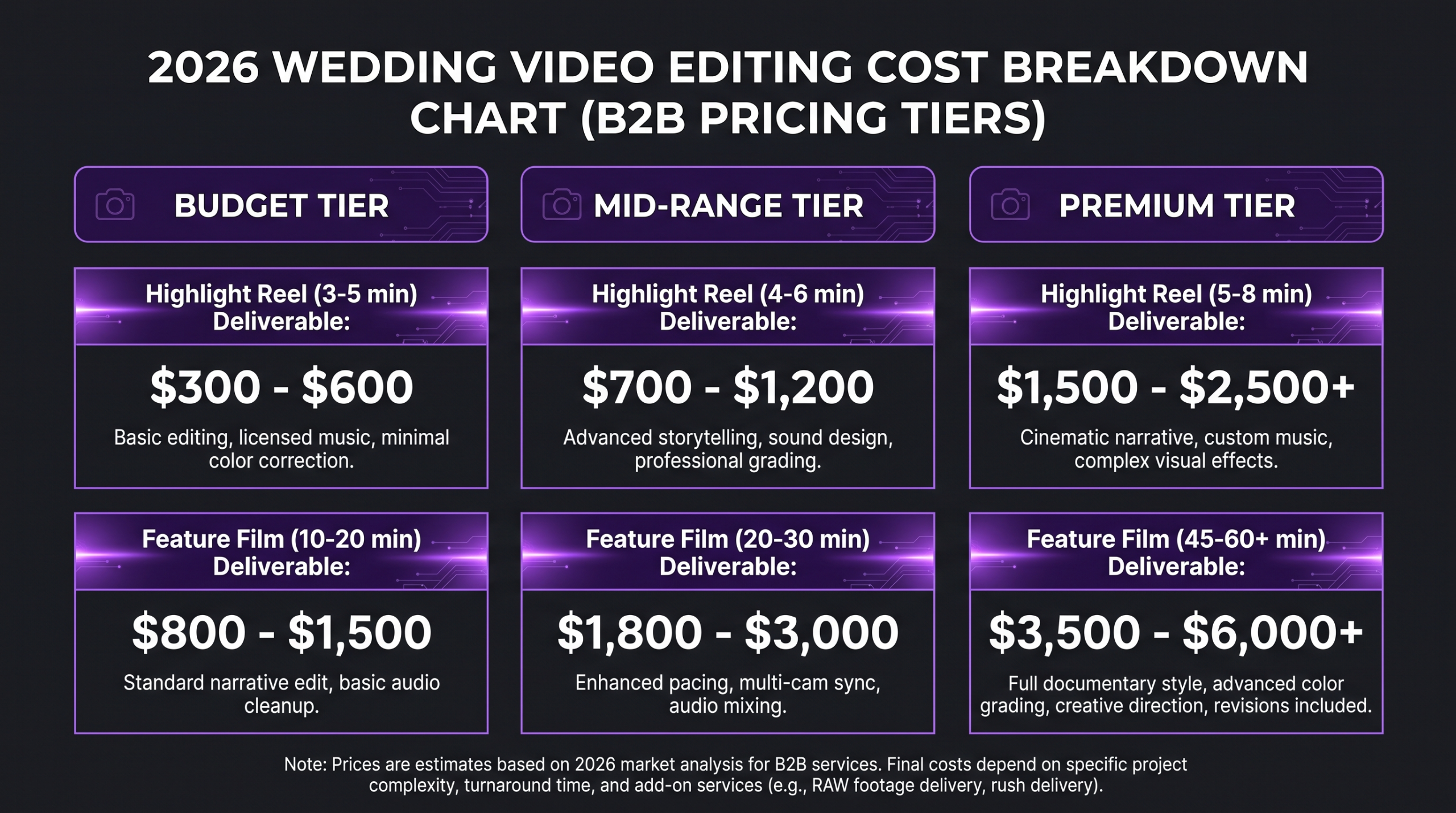
Wedding Video Editing Cost in 2026
Editing costs track closely with the complexity of the deliverable and the tier of the service. Here are the ranges studios commonly encounter across the market. These are not fixed rates — treat them as reference benchmarks when building your budget.
For studios sending frequent volume, retainer arrangements typically deliver a 20–35% cost reduction per deliverable compared to per-project rates, because the provider absorbs scheduling overhead into the flat monthly fee. The tradeoff is a minimum monthly commitment — worth it if your calendar is full, inefficient if volume is erratic.
Also consider the hidden cost of revision rounds. A low-headline rate with open-ended revisions at an hourly overage can quickly exceed a premium retainer that includes structured rounds. Always calculate total effective cost per final delivered file, not just the advertised starting rate.
For a broader look at the full post-production market beyond wedding-specific services, the professional video editing cost guide covers freelancer vs. agency economics in depth. And if you are weighing the build-vs-buy decision, our video editing agency vs freelancer breakdown walks through the real tradeoffs.
Questions to Ask Before You Hire
Use this checklist in your discovery call with any editing service. The quality of their answers tells you more than their website ever will.
- Who specifically will edit my projects? A named editor or a rotating pool? How is style knowledge retained between sessions?
- Can I see edits of footage similar to mine? Ask for reference cuts from outdoor ceremonies, low-light receptions, and multi-camera shoots — the three most common challenging scenarios.
- What’s the revision policy in writing? How many rounds? What’s the definition of a “revision”? What are the overage costs?
- How do you handle peak season capacity? What’s the SLA during July and August? Do you have overflow backup editors?
- What’s the file handoff process? Frame.io, WeTransfer, cloud storage? Do they work with Premiere, DaVinci, FCPX, or only specific tools?
- How is music licensing handled? Sourced from sync-licensed libraries (Musicbed, Artlist, Epidemic Sound) or unlicensed tracks that could get client videos flagged?
- What does your onboarding process look like? A test edit included? Brand kit submitted? Style guide reviewed by the editor before first delivery?
💡 Pro Tip: Music licensing is a silent liability. If your editing service uses unlicensed tracks and your client posts the video, the client’s YouTube or Instagram account can be flagged. Confirm that every music track used comes from a sync-licensed library — and get that in writing before signing an agreement.
Frequently Asked Questions
What’s the difference between a wedding highlight reel and a feature film?
A highlight reel (typically 3–5 minutes) is an emotionally curated, music-driven summary of the wedding day — designed for social sharing and immediate impact. A feature film (typically 20–40 minutes) covers the day chronologically with fuller scene coverage, ceremony audio, speeches, and toasts. Most studios offer both, with the reel as the lead deliverable and the feature as a premium add-on. Editing complexity — and therefore cost and turnaround time — differs substantially between the two.
How do I brief a wedding editor who’s never worked with me before?
A strong first-project brief includes: three to five reference films that represent your target look, a one-page style guide covering colour preferences (warm/cool, saturated/muted, high/low contrast), your typical music taste (cinematic orchestral, indie folk, modern pop), preferred pacing (fast-cut vs. slow-burn), and any recurring structural choices (how you handle the ceremony first look, how you close the film). The more you give upfront, the fewer revision rounds you’ll need.
Is outsourcing wedding video editing right for my studio?
Outsourcing makes sense when editing is taking more than 30% of your post-shoot time, or when it’s bottlenecking your ability to take on new clients. The economic test: if the editing fee per wedding is less than what you’d earn shooting another event in that time, outsourcing is net profitable. The quality test: find a service that can match your look on a test edit before committing. If both tests pass, outsourcing is worth it. For more on this decision, read about unlimited video editing services options and subscription models.
How should I handle colour grading in an outsourced workflow?
Two common approaches: you can provide your own camera LUTs and ask the editor to apply them as a starting point, then grade from there — or you can ask the service to apply their own grade matched to your reference films. The LUT approach is faster and more consistent if your camera settings are locked; the reference-match approach gives the editor more flexibility, which is useful for varied lighting conditions. Confirm with the service which workflow they support before submitting your first project.
What turnaround time should I promise my wedding clients?
Build in a buffer. If your editing service promises first-draft highlights in seven days, promise your clients delivery in twelve to fourteen days. That buffer absorbs revision rounds, your own review time, export/delivery, and any unexpected delays during peak season. Wedding clients typically have longer tolerance for turnaround than corporate clients — but they have zero tolerance for missing a promised date. Industry benchmarks suggest that couples generally expect highlights within three to six weeks of the wedding; most professional studios target two to four weeks for initial delivery.
Verdict: Which Wedding Video Editing Service Is Right for You?
There is no single “best” wedding video editing service for every studio — there is the best service for your volume, your aesthetic, your communication needs, and your pricing tolerance.
That said, our rankings reflect a clear pattern: the services that invest in dedicated editor relationships consistently outperform those that rotate work through available capacity. Style matching is the hardest thing to scale, and the providers that solve it — through dedicated editors, thorough onboarding, and documented style guides — deliver meaningfully better outcomes for studios with an established visual identity.
Choose Increditors if you’re a boutique or mid-size studio that shoots 30+ weddings per year, has a strong brand aesthetic you want protected, and wants a post-production partner that engages at a strategic level — not just a vendor who turns files around.
Choose VideoEditingCompany if you have documented workflows, consistent shot-lists, and volume that benefits from a scalable B2B service model.
Choose ShootDotEdit if you’re a wedding photographer adding video to your packages and want an aesthetically compatible service from a brand familiar with wedding creatives.
Choose FixThePhoto if you’re testing outsourcing on a limited budget and need straightforward edits without a retainer commitment.
Choose Editing Corps if consistent monthly volume is your primary driver and you want predictable billing above all else.
Consider Narrative if you want to keep editing in-house but accelerate your workflow with AI-assisted selection tools.
Choose Cinemaflair if your studio’s visual identity already overlaps with their film-grain, editorial aesthetic and you’re targeting the luxury wedding segment.
Whichever service you choose, run a paid test edit on a real project first. The gap between a curated demo reel and a live-brief production edit reveals operational capability that no sales call can replicate. Also visit authoritative resources from the Wedding & Event Videographers Association (WEVA) and platform-specific guidance on Vimeo’s wedding video best practices to stay current with delivery standards and client expectations in the industry.
Ready for Wedding Films That Win You Referrals?
Tell us about your studio and we will put together a custom editing plan built around your style and your schedule.