








![3D Explainer Video - ScribbleLive.mp4_snapshot_00.12_[2022.03.09_03.14.16]](https://increditors.com/wp-content/uploads/elementor/thumbs/3D-Explainer-Video-ScribbleLive.mp4_snapshot_00.12_2022.03.09_03.14.16-r7wb53mx72rxst3qcqyrfxdmeyzb5r9jbl0wbjujh4.png "3D Explainer Video – ScribbleLive.mp4_snapshot_00.12_[2022.03.09_03.14.16]")


























Event video editing costs range widely based on event type, deliverable count, and who handles post-production. A freelancer might charge $30–$80/hr; a specialist agency typically starts around $800–$1,500 for a highlight reel. Conferences, trade shows, and galas each carry distinct cost drivers. This guide breaks down every variable so you can budget accurately and avoid the surprises that blindside most event planners.
- What Drives Event Video Editing Costs
- Cost by Event Type: Conferences, Galas, Trade Shows & More
- Cost Breakdown by Deliverable
- Freelancer vs Agency vs In-House: Real Cost Comparison
- Hidden Costs That Blow Event Video Budgets
- How to Build a Smart Event Video Budget
- When to Hire a Specialist vs a Generalist
- FAQ: Event Video Editing Costs
- Verdict
What Drives Event Video Editing Costs
Event video editing cost is not one number — it is a sum of distinct variables that interact. The more clearly you understand those variables before you book anything, the better your negotiating position and budget precision. Misquoting an event scope is the most common reason organizations end up paying 40–60% more than they expected.
The five primary cost levers are raw footage volume, deliverable count and complexity, turnaround timeline, editor expertise, and licensing for music and motion graphics. Each one can move a quote dramatically, which is why the range from one organization’s event to another can span from a few hundred dollars to tens of thousands.
Raw Footage Volume
A single-camera half-day shoot produces 2–4 hours of raw footage. A two-day conference with five camera angles generates 50–80+ hours. Editing ratios for event work typically run 10:1 to 25:1 — meaning every finished minute represents 10–25 minutes of review, selection, and assembly. At scale, this ratio is the single largest time cost and the biggest driver of freelancer invoice surprises when scope is underestimated.
Deliverable Count and Format
A single 4-minute highlight reel is one deliverable. A full conference package typically includes: a 3–5 min sizzle reel, individual session recordings cleaned for speaker audio, 10–20 social clips (30–90 seconds each), b-roll montages, a sponsor recognition sequence, and sometimes a recap documentary. Each deliverable multiplies editing hours. Agencies price by deliverable far more reliably than by hour because deliverables are fixed in scope — hourly estimates for event work almost always undercount the actual time.
Turnaround Timeline
Standard event turnaround for a highlight reel is 5–10 business days post-footage receipt. Rush edits (24–72 hours) commonly carry a 30–100% premium depending on the editor’s existing workload. Trade shows and conferences with live social content requirements — where 30-second clips need to be live before the closing keynote — almost always require a premium editor on-site or on standby, pushing costs significantly higher than standard post-production.
Editor Expertise and Specialization
A generalist video editor who primarily works on social content will struggle with multi-camera conference footage — sync issues, audio mixing across lapel and room mics, slide-screen integration, and keynote pacing are all specialized skills. Event video editing requires experience in multicam editing, venue-quality audio correction, lower-third graphics production, and often color correction under unpredictable venue lighting. Editors without this background often produce technically correct but emotionally flat results that fail to capture the energy of the event. Specialist experience commands a premium — and usually justifies it.
Music and Motion Graphics Licensing
Music licensing for event videos distributed publicly can add $50–$500+ per track depending on library and usage rights. Custom motion graphics for lower thirds, animated logos, and branded title cards — often mandatory for corporate events — typically add $200–$800 to a project cost. Many budget quotes omit these line items entirely, then present them as add-ons at invoice time. Verify what is included before signing.
💡 Pro Tip: Always ask for a deliverable list — not just an hourly rate. Deliverable-based pricing gives you far better budget predictability for events where footage volume is hard to estimate in advance.
Cost by Event Type: Conferences, Galas, Trade Shows & More
Different event types have fundamentally different post-production profiles. A conference generates mostly talking-head content with multi-camera coverage; a gala is highly visual with performance footage and emotional moments; a trade show requires fast social turnaround and product-focused edits. Below is a realistic cost landscape for each, based on typical market ranges teams commonly report for professional post-production in 2025–2026.
Conference and Summit Video Editing
Conferences are the most footage-intensive event type. A one-day conference with 6–8 sessions and a single main stage typically produces 8–15 hours of usable footage across all cameras. The standard deliverable set — highlight reel, cleaned individual session recordings, and a social clips package — commonly ranges from $1,500 to $4,500 depending on editor tier and deliverable count.
Multi-day conferences with multiple tracks, keynote speakers, and breakout sessions multiply costs significantly. A two-day, 200-attendee summit with 5+ sessions and a comprehensive post-production package (sizzle reel + all sessions + 15 social clips + sponsor segments) typically falls in the $4,000–$9,000 range at the agency tier. Add a live social cut team on-site and that figure can push toward $12,000–$18,000 for large events.
Gala and Charity Event Video Editing
Galas are emotionally driven — the post-production job is to capture the atmosphere, the keynote moments, and the cause. They typically require more cinematic color grading, music-driven pacing, and highlight montages built around emotional beats rather than informational content. A single gala highlight reel (3–6 minutes, distributed to donors and on social) commonly runs $900–$2,500 depending on editor experience and footage volume.
Nonprofits frequently request additional deliverables: a thank-you video for sponsors, individual honoree spotlight clips, and a recap for the organization’s annual report. Full gala packages (reel + sponsor content + 5–8 social clips) typically range from $2,000–$5,000 at a professional agency tier. Budget-conscious organizations report finding freelancers in the $600–$1,500 range, though audio quality and multi-camera sync are frequent weak points at that price point.
Trade Show and Exhibition Video Editing
Trade show video editing is defined by speed and product focus. The goal is typically a floor recap for social, product demo clips for follow-up sales outreach, and a brand sizzle reel for next year’s event marketing. Turnaround expectations are aggressive — social content often needs to go live during the show, and the recap video needs to be sent to prospects within 48–72 hours of the event.
A trade show recap package (floor sizzle + 5–8 product clips + social cuts) without rush requirements commonly ranges from $800–$2,200. Add a real-time social editing requirement and that typically jumps 50–80%. Large industry expos with multiple booth locations, product launch footage, and executive interviews commonly run $3,000–$7,000 for a full post-production package at professional quality.
Corporate Awards and Internal Events
Internal corporate events — all-hands meetings, awards ceremonies, town halls — are often underbudgeted because they are seen as internal, but they typically need broadcast-quality production when distributed to remote teams or posted on an intranet with thousands of viewers. A polished awards ceremony edit with graphics, title cards, and a highlight recap typically ranges from $700–$2,000 at the freelancer tier and $1,500–$3,500 at an agency with structured workflow.
Cost Breakdown by Deliverable
Deliverable-level pricing is the clearest way to understand event video editing costs, because it isolates what each output actually requires in time and skill. Below are market-typical price ranges for individual deliverables at the professional freelancer and agency tiers — useful as a benchmarking tool when reviewing vendor quotes.
For deeper context on how these ranges compare to broader professional video editing cost benchmarks, that guide covers production type breakdowns across YouTube, corporate, commercial, and more.
Note that these are per-deliverable benchmarks. When bundled into a package, most agencies offer 15–25% below the sum of individual rates, especially for repeat event clients. Negotiating a multi-deliverable package up front is almost always more cost-effective than ordering individual deliverables after the fact.
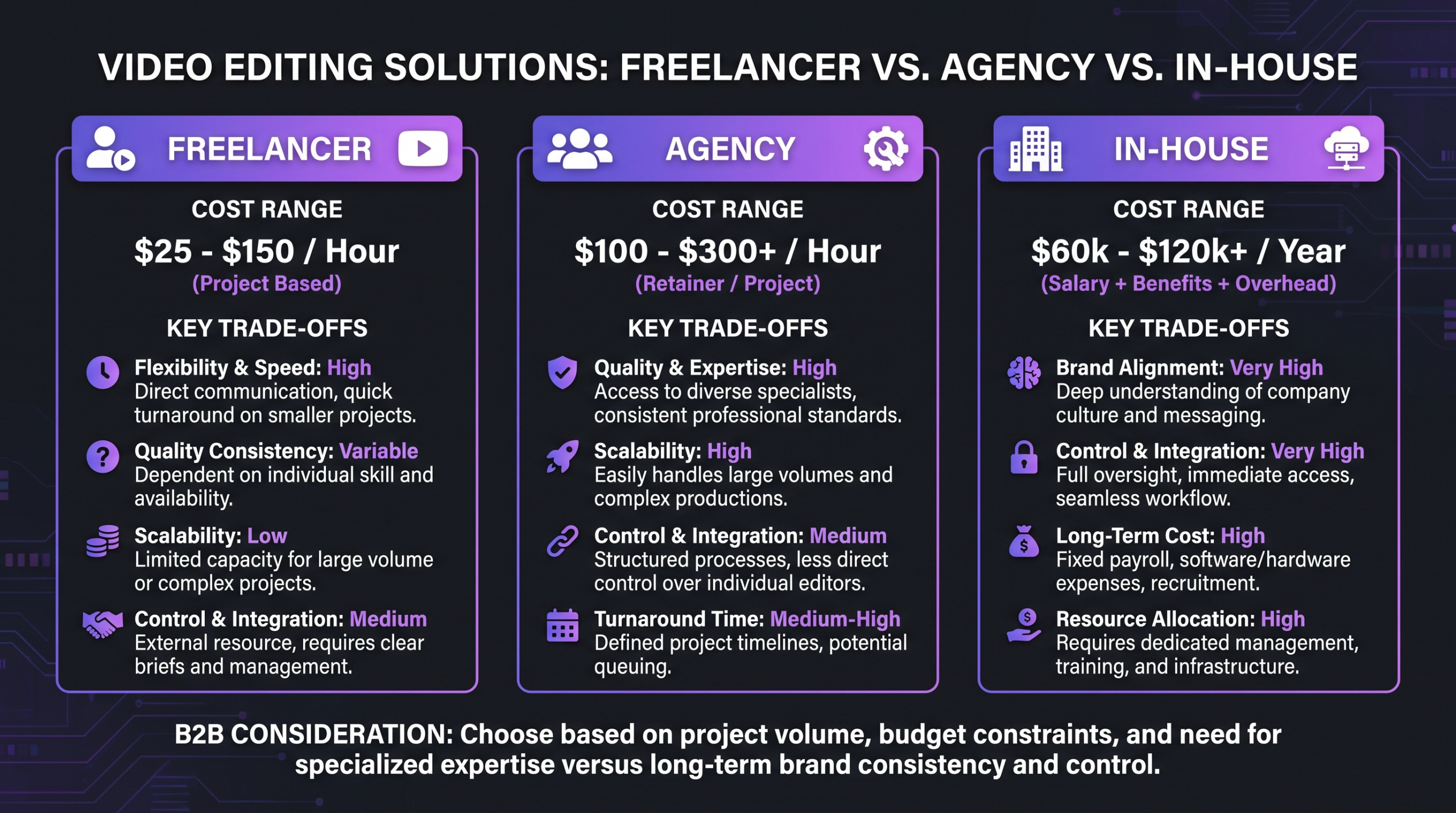
Freelancer vs Agency vs In-House: Real Cost Comparison
Choosing between a freelancer, a video editing company, or building in-house capacity is not just a cost question — it is a risk and capacity question. Each path has a genuine sweet spot, and choosing wrong is a predictable way to overspend or under-deliver on your event video investment.
Freelancers
Freelancers typically charge $30–$100/hr depending on experience and specialization, with flat project rates ranging widely by deliverable. They are the most cost-efficient option for simple, lower-stakes events with limited deliverables — a single nonprofit gala reel, a one-room corporate event, or a straightforward company all-hands recording.
The risk at the freelancer tier is capacity and consistency. A freelancer taking a 60-hour conference project while managing other clients frequently misses turnaround windows. Backup coverage for technical failures is also rare. For events where the video is a central marketing or fundraising asset, the risk profile of depending on a single person is worth factoring into the cost comparison.
Specialist Video Editing Agencies
Agencies bring structured workflow, dedicated editor teams, consistent brand adherence, and built-in review cycles. For organizations running annual events where the video output is used in donor campaigns, sales outreach, or public relations, the consistency and reliability of an agency often offsets the higher per-project cost. Project management, revision rounds, and delivery on deadline are included in the scope rather than negotiated ad hoc.
Teams like Increditors specialize in B2B event and corporate video post-production, with dedicated senior editor assignments and structured revision protocols — the kind of process that matters most when event footage goes directly to executive stakeholders or donor audiences. For organizations with recurring event video needs, the agency vs. freelancer trade-off almost always shifts in favor of the agency at the third event or beyond, where consistency of output becomes a competitive differentiator.
In-House Editors
Hiring a full-time video editor for event coverage only makes financial sense for organizations producing 8–12+ major events per year. A mid-level in-house editor costs $55,000–$90,000/year in the US (salary alone), plus software licenses ($600–$2,000/year), hardware, and benefits. For most organizations, that cost amortizes poorly against event frequency — the per-event cost of in-house production often exceeds the agency rate once overhead is included.
Hidden Costs That Blow Event Video Budgets
Most event video budget overruns are predictable — they come from the same sources repeatedly. Understanding these hidden cost categories before you finalize a quote can prevent the most common surprises in post-production billing.
Revision Rounds
Most project quotes include 1–2 revision rounds. Additional rounds at the freelancer tier commonly run $50–$200 each; at an agency, revision rounds beyond the contracted number are often billed at project rate multiples. Organizations with multiple internal stakeholders reviewing event videos frequently blow their revision budget simply because approval processes are not defined before post-production begins. Define a single decision-maker and a clear review timeline before the editor starts cutting.
Audio Cleanup and Sync
Poor event audio — common in large venues, outdoor spaces, or any setting with ambient noise — can triple the audio post-production time. Professional audio cleanup (noise reduction, EQ, level matching across multiple sources, lip sync correction for multi-camera shoots) is often quoted as an add-on when the editor encounters footage that requires it. Budget for audio cleanup specifically if your event used a venue PA system, outdoor microphones, or a mix of lavalier and room mics.
Stock Music Licensing
Budget music licensing from platforms like Musicbed or Artlist typically runs $15–$75/track for standard commercial licenses. Enterprise or broadcast licenses can run $200–$800+ per track. Some freelancers use unlicensed music — verify this before distribution, particularly for any video posted publicly. A copyright claim on a major platform can result in demonetization or removal, which effectively destroys the ROI of the entire post-production investment.
Motion Graphics and Lower Thirds
Custom lower thirds (name/title graphics), animated logos, chapter titles, and branded end cards are often not included in base editing quotes. A full lower-thirds package for a conference with 8 speakers commonly adds $150–$500 to a project depending on design complexity. If your organization has existing brand templates in After Effects or Motion, sharing them with the editor can significantly reduce this cost.
💡 Pro Tip: Ask your editor for a written scope document that explicitly lists what is NOT included in the quote — revision rounds, music licensing, lower thirds, color grading. The absence of those line items from the contract is where budget surprises hide.
Footage Transfer and Storage
Large event footage (especially 4K or multi-camera) requires significant storage and bandwidth for transfer. A single day of 4K multi-camera conference shooting can produce 200–400GB of footage. Transfer via physical drive adds $30–$80 in shipping; cloud transfer platforms like Frame.io or Wipster speed up review workflows but may carry subscription costs not always passed through in quotes. Some agencies include a review platform in their workflow; others do not.
How to Build a Smart Event Video Budget
Building an accurate event video budget starts before you hire anyone — it starts with a clear deliverable list and a defined decision process. Here is a practical framework that event teams use to arrive at defensible budget numbers rather than guesses.
Step 1: Define Deliverables Before Getting Quotes
List every piece of video content the event needs to produce: the highlight reel, all session recordings, social clips, teaser for next year, sponsor thank-you video, internal recap. Assign each a target length and format. Only after this list is complete should you approach vendors — otherwise you are comparing quotes that have incompatible scopes.
Step 2: Add a 15–20% Contingency for Scope Growth
Event scopes almost always expand. A keynote speaker adds an unplanned Q&A. The event runs 45 minutes long. A sponsor requests an additional clip. Budget 15–20% above your base quote specifically for scope changes — not as a “nice to have” but as a planned line item. Teams that build this in from the start rarely exceed budget; teams that treat the quote as the ceiling regularly do.
Step 3: Prioritize Deliverables by Business Value
If the budget is constrained, rank deliverables by their downstream business impact. For a conference, the highlight sizzle reel and the speaker clip library typically generate the most reusable marketing value. For a gala, the 3-minute emotional highlight reel is the single highest-leverage asset for donor communication. Identify your top two deliverables and protect their budget before allocating to secondary outputs.
Step 4: Factor in Turnaround Requirements
If you need social clips live during the event, or a recap video within 48 hours, that is a rush requirement — build the rush premium into your base budget, not as an afterthought. Rush turnarounds at the agency tier commonly add 25–50% to project cost. Plan for it or plan the timeline to avoid it.
For organizations comparing their event video costs to broader unlimited video editing services, the per-event project model versus a subscription retainer is worth evaluating if you produce three or more events annually. At that frequency, the economics of a retainer often favor predictability and lower per-deliverable cost over individual project pricing.
When to Hire a Specialist vs a Generalist
Event video editing is a specialty. Not every video editor who can cut a YouTube video or a corporate talking head can handle the multi-camera audio complexity, the pacing demands, and the brand sensitivity of a high-stakes conference or charity gala. Knowing when you are in specialist territory prevents the most expensive mistake in event video production: hiring the wrong person for the wrong scope.
When a Generalist Is Fine
A generalist editor is a reasonable choice for simple, single-camera events with one or two deliverables, low distribution volume (internal only or small social following), and no brand-critical output. A company all-hands meeting recorded on a single camera, edited for internal viewing, does not require event video specialization.
When You Need a Specialist
You need an event specialist when: (1) footage comes from multiple cameras that need frame-accurate sync, (2) the audio environment was complex (venue PA, multiple mics, live music), (3) the deliverables include anything distributed to external audiences — press, donors, customers, or social media, (4) the event has brand partners or sponsors whose coverage must be handled correctly, or (5) the turnaround requires someone who has done this at scale before and won’t be slowed down by the workflow.
The gap in output quality between a generalist and a specialist on complex multi-camera event footage is significant. Event video content that underperforms expectations — flat pacing, poor audio, generic cuts — often does more damage to event brand perception than no video at all. The cost of a specialist is usually recouped in the quality of the asset’s downstream performance.
💡 Pro Tip: Ask any editor you are considering to share examples specifically from multi-camera event footage — not their best branded commercial or music video. Event-specific editing skills are demonstrated by event-specific work. A beautiful reel of unrelated content does not tell you whether they can handle 60 hours of conference footage.
According to Bizzabo’s event marketing research, organizations that invest in professional post-production for their events report higher perceived event quality among attendees and significantly greater reuse of event content in their year-round marketing — both indicators that the post-production investment compounds over time rather than being a one-time sunk cost.
FAQ: Event Video Editing Costs
How much does it cost to edit a conference highlight reel?
A professional conference highlight reel (3–5 minutes) from a single-day event typically costs $800–$2,000 at the agency tier and $350–$900 from an experienced freelancer. Factors that push cost higher include multi-camera footage, large raw footage volume, branded motion graphics, and rush turnaround requirements. Packages that include the reel plus social clips and session recordings commonly range from $1,500–$4,500.
Is it cheaper to hire a freelancer for gala video editing?
Freelancers are typically 40–60% less expensive per project than agencies. For a gala that is a lower-stakes or internal distribution event, a freelancer in the $600–$1,500 range can be a sensible choice. For high-visibility gala videos distributed to donors, board members, or on public channels, the accountability structure and quality control process of an agency tend to justify the higher rate — particularly when the video is part of a fundraising campaign where poor quality can actively undermine the ask.
What is the typical turnaround time for event video editing?
Standard turnaround for a highlight reel is 5–10 business days after footage is received and organized. Full packages with multiple deliverables commonly take 10–20 business days. Rush turnaround (48–72 hours for a reel) is available from most agencies but typically carries a 25–75% premium. Live social content edited during the event requires dedicated on-site or real-time editing staff, which is quoted as a separate service.
Does event video editing cost more for longer events?
Yes, primarily because footage volume drives editing time. A two-day conference generates roughly 3–5x the raw footage of a one-day event, and the editing time scales proportionally. Multi-track events with parallel sessions compound this further. Most agencies price large events with a flat package rate that acknowledges the volume, which is typically more cost-effective than pure hourly billing when footage volume is very high.
What should I send to an event video editor for an accurate quote?
Send: (1) the complete deliverable list with target lengths and formats, (2) estimated total raw footage hours, (3) camera count, (4) audio setup description (lavalier, boom, PA, etc.), (5) any specific brand guidelines or template assets, (6) your delivery deadline, and (7) distribution channels (internal only vs. public platforms vs. press). The more complete this brief, the more accurate and comparable the quotes you receive will be. Editors who quote accurately from incomplete briefs are usually padding the number to cover unknowns.
Verdict: What Does Event Video Editing Really Cost?
Event video editing cost is not a single number — it is a range defined by your event type, deliverable list, editor tier, turnaround requirements, and the hidden extras most quotes omit. The ranges in this guide reflect real market conditions as of 2025–2026, framed as benchmarks rather than precise quotes because your specific project will vary based on scope.
The most consistent pattern across event types: organizations that define their deliverables first and get multiple quotes against a consistent scope almost always spend less and get better output than those who hire first and define scope after. Second most consistent: the cost of poor event video — lost fundraising impact, weak sales follow-up, tepid sponsor relationships — almost always exceeds the cost of doing it right.
If you are running three or more events per year with meaningful business objectives attached to the video output, the investment in a specialist video editing company with a structured workflow and dedicated senior editors is almost always the highest-ROI path — not because freelancers lack talent, but because events are high-stakes, deadline-bound, and unforgiving of scope uncertainty. The right team treats your event footage with the strategic weight it deserves.
For more on how event video fits into your broader video production strategy, the complete guide to video editing for B2B companies covers workflow, ROI measurement, and how to build a sustainable video content operation around recurring event content.
Ready for Event Video That Actually Converts?
Tell us about your next conference, gala, or trade show and we will put together a custom post-production plan built around your deliverables and timeline.