








![3D Explainer Video - ScribbleLive.mp4_snapshot_00.12_[2022.03.09_03.14.16]](https://increditors.com/wp-content/uploads/elementor/thumbs/3D-Explainer-Video-ScribbleLive.mp4_snapshot_00.12_2022.03.09_03.14.16-r7wb53mx72rxst3qcqyrfxdmeyzb5r9jbl0wbjujh4.png "3D Explainer Video – ScribbleLive.mp4_snapshot_00.12_[2022.03.09_03.14.16]")

























A video editing company takes your raw footage and turns it into publish-ready assets — handling cutting, color grading, motion graphics, audio mixing, captions, and multi-format delivery through a coordinated specialist team. Unlike a freelancer or in-house hire, you get a repeatable workflow, dedicated roles for each discipline, and no single point of failure. This guide explains exactly what you receive, who does the work, when it makes financial sense, and the eight questions you must ask before signing.
- The 30-Second Answer: What a Video Editing Company Actually Does
- The Deliverables Map: What You Actually Get Back
- Inside the Team: Who Works on Your Video Project
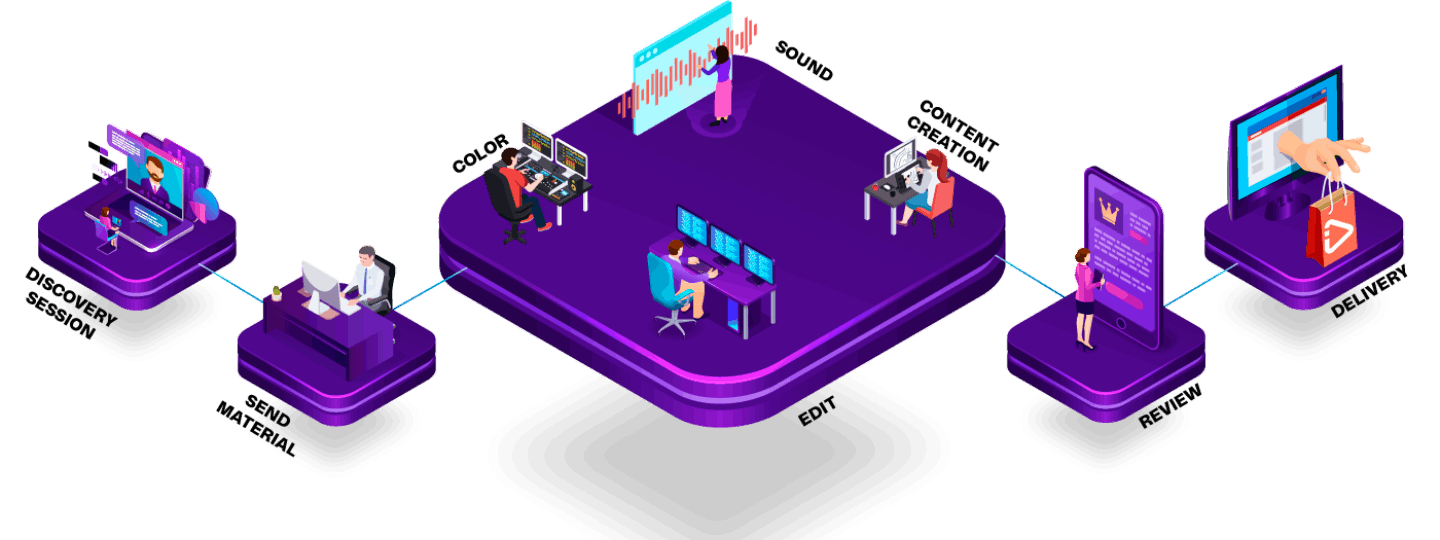
- From Footage Handoff to Finished Asset: The Client Journey
- Video Editing Company, Freelancer, or In-House: A Decision Framework
- Eight Questions to Ask Before You Hire
- Red Flags That Separate Good Partners From Average Ones
- Frequently Asked Questions
- Verdict: Is a Video Editing Company Right for You?
The 30-Second Answer: What a Video Editing Company Actually Does
A video editing company is a specialist post-production business that transforms raw, unedited footage into polished, publish-ready video content. It does not shoot video. It does not own cameras or lighting rigs. Its entire value is in what happens after the camera stops recording: the cutting, shaping, color treatment, audio refinement, graphic layering, and platform packaging that turn hours of raw material into something audiences actually watch.
That distinction matters enormously for buyers. If you already have footage — from your own shoots, screen recordings, user-generated content, or a production company — a video editing company is exactly the partner you need. If you need someone to plan and film the footage in the first place, that is a different service category entirely (a video production company), and confusing the two leads to misaligned expectations and budget waste on both sides.
The defining characteristic of a video editing company — compared to a freelance editor or an in-house team — is the combination of specialised roles, a structured workflow, and consistent capacity. One freelancer juggles cutting, color, audio, and graphics by themselves. A video editing company assigns each discipline to a specialist, coordinates their work through a project manager, and delivers an output that reflects the sum of those focused skills.
Post-Production vs Full Production: The Boundary You Need to Understand
Post-production is everything that happens after filming ends. A video editing company operates exclusively in this space. This is not a limitation — for most B2B and content-driven brands, post-production is the stage where the bulk of the value is created and where most of the budget is best spent. Shooting is increasingly commoditised. Editing, pacing, narrative structure, and visual polish are where the meaningful creative decisions live.
If you want to understand how a video editing company compares specifically to a production company in terms of scope, pricing, and use case, see our detailed breakdown: Video Editing Company vs Production Company. And if you are evaluating post-production agencies specifically — organisations that blur the line between editing companies and broader creative studios — our guide on what a post-production agency does covers that category directly.
The Deliverables Map: What You Actually Get Back
Most buyers understand that a video editing company “edits video,” but underestimate the breadth of what that phrase actually covers. A mature video editing operation does not hand you back a single cut. It returns a suite of finished assets, each optimised for its intended platform and audience context. Here is the full deliverables map of what a professional video editing company typically produces.
Primary Deliverables
Edited video cut. The core deliverable — raw footage assembled into a coherent, timed narrative with pacing, transitions, and structural decisions made by an experienced editor. This includes selecting the best takes, trimming dead air, building story arcs within individual pieces, and applying b-roll to support the primary footage.
Color grading and correction. A separate specialist pass that ensures consistent color temperature, skin tone accuracy, and a visual look appropriate for the brand. Color correction fixes technical problems (exposure, white balance). Color grading adds the intentional aesthetic — the warmth, the contrast, the filmic treatment — that makes content feel considered rather than raw.
Audio mixing and sound design. Dialogue cleanup, music bed selection and levelling, sound effect placement, and mastering to loudness standards appropriate for the delivery platform (broadcast, streaming, social). Poor audio is the fastest way to lose an audience; this discipline is often what separates professional output from amateur footage with a good camera.
Motion graphics and titles. Animated lower-thirds, intro sequences, branded end cards, kinetic text overlays, and data visualisation animations. These elements carry brand identity into the video layer and improve information retention. For B2B content especially, well-executed motion graphics can significantly improve a video’s perceived credibility and production value.
Captions and subtitles. Burned-in or delivered as SRT/VTT files, captions have become a non-negotiable deliverable for social video. Industry research cited by platforms like LinkedIn Marketing Solutions consistently shows that the majority of social video is watched without sound in public or workplace environments — captioned video performs materially better in these contexts.
Extended Deliverables: The Repurposing Layer
Beyond the primary finished cut, a full-service video editing company will typically also deliver platform-adapted formats (16:9 for YouTube, 9:16 for Reels/TikTok/Stories, 1:1 for LinkedIn feed), short-form clips cut from long-form content, thumbnail design for YouTube and article pages, and transcript documents. These extended outputs are where volume-focused brands extract the most leverage from a single shoot.
Inside the Team: Who Works on Your Video Project
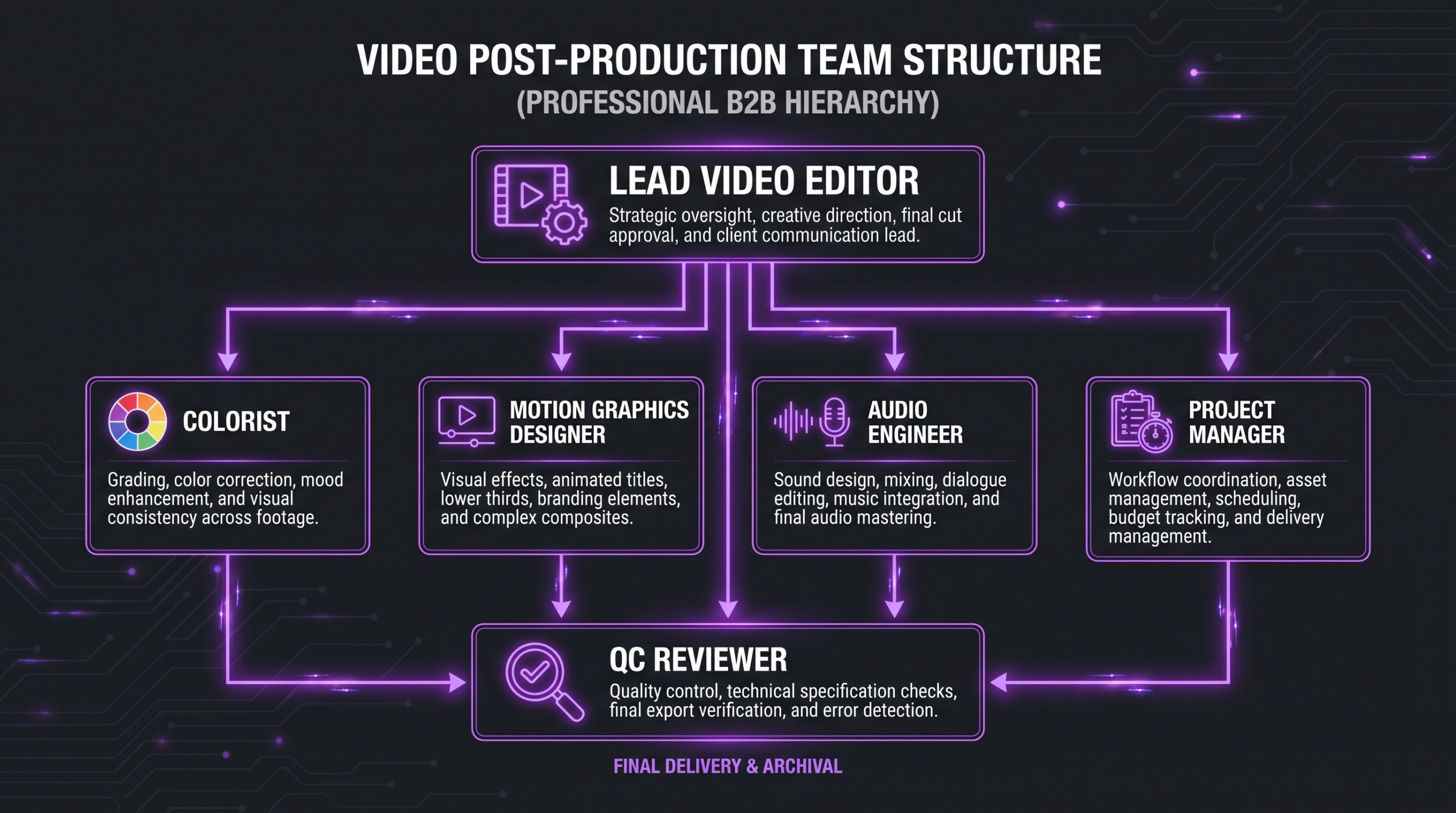
The most significant operational difference between a video editing company and a freelancer is invisible on the surface but fundamental to output quality: behind your finished video are multiple human specialists, not a single generalist doing everything. Understanding who those people are helps you evaluate companies more accurately and brief them more effectively.
The Core Specialist Roles
Lead Video Editor. The primary creative driving each project — responsible for structural decisions, pacing, narrative assembly, and overall storytelling. The lead editor reviews the brief, selects the best takes from the provided footage, and builds the first cut. All other specialist work flows from and supports this initial editorial foundation. A strong lead editor brings a sense of rhythm and story that is the hardest single skill to find and the most valuable per hour.
Colorist. A specialist working exclusively in color science — using tools like DaVinci Resolve to ensure that every shot in the piece matches in exposure and tone, skin tones look natural and flattering, and the overall grade expresses the intended mood. Color work is a full discipline; a generalist editor doing their own color typically produces technically adequate but not professionally graded output.
Motion Graphics Designer. Creates and animates visual elements — lower-thirds, title cards, branded intros, kinetic text overlays, icon animations, and data charts. This role requires both design sensibility and technical proficiency in After Effects or similar tools. Many clients underestimate how much motion graphics affect the perceived production value of a video and the brand signals it sends to an audience.
Audio Engineer. Cleans and mixes the audio track — reducing background noise, equalising dialogue, levelling music and effects relative to speech, and mastering to platform loudness standards (typically -14 LUFS for YouTube and streaming, -16 LUFS for broadcast). A well-mixed audio track is often the single biggest factor in whether a viewer continues watching past the first 30 seconds.
Project Manager / Account Lead. The client-facing coordinator who owns communication, schedules, and deliverable tracking. This role is what makes a company feel like a company rather than a group of freelancers. A good project manager translates client briefs into actionable creative direction, manages revision rounds efficiently, and ensures the right specialist is working on the right element at the right time.
QC Reviewer. An independent pair of eyes that checks every deliverable before it leaves — verifying cut points, color consistency, audio levels, caption accuracy, aspect ratio compliance, and file technical specs. Without a QC step, errors that slipped past an editor focused on the creative often reach the client. Professional video editing companies build this into their workflow as standard.
💡 Pro Tip: When evaluating a video editing company, ask specifically who handles color and audio — and whether those are dedicated specialists or tasks your assigned editor handles themselves. The answer tells you quickly whether you are dealing with a genuine company or a freelancer operating under a brand name.
From Footage Handoff to Finished Asset: The Client Journey
Understanding the workflow from a client’s perspective — not the internal operations perspective — removes a lot of the anxiety that first-time buyers feel when handing off valuable footage. Here is what the process actually looks like from the moment you share your files.
Phase 1: Brief and Intake
Every project starts with a brief — a structured document or conversation capturing the deliverable type, intended platform, target audience, desired tone, specific instructions (which takes to use, what to cut), and any brand guidelines (fonts, colours, intro/outro templates). The better your brief, the fewer revision rounds you will need. Professional companies provide a brief template or intake form to guide this step. Your raw footage is transferred via a shared drive or secure upload link — frame.io, Google Drive, Dropbox, and Wetransfer are all common options.
Phase 2: Assembly and First Cut
The lead editor reviews all provided material, selects the best usable takes, and assembles a rough cut — a structural draft of the video without final colour, audio polish, or graphics. This is shared with you for structural feedback before specialist work begins. Getting your structural sign-off at this stage is efficient: it means colour, audio, and graphics work happens on a version of the video you have already approved architecturally. Changing the structure after colour and audio passes costs significantly more time.
Phase 3: Specialist Passes
Once the cut is locked, specialist work runs in parallel or in sequence depending on the company’s workflow. The colorist works through the graded version. The audio engineer cleans, levels, and mixes the sound track. The motion graphics designer builds and places graphic elements. Each specialist works from the same locked timeline, meaning their work integrates without requiring the main editor to rebuild anything. This parallel structure is one of the key efficiency advantages a company has over a solo freelancer.
Phase 4: Revision Rounds
Revisions are managed through a structured feedback tool — typically Frame.io, Vimeo Review, or a branded client portal — where you can leave timestamped comments directly on the video. Most companies include two revision rounds in their standard retainer or project pricing. Understanding the revision policy upfront avoids friction: know what counts as a revision (structural changes vs minor tweaks) and what triggers additional cost.
Phase 5: Final Delivery and Format Packaging
After revisions are incorporated and QC reviewed, the project manager packages the final deliverables — the main cut, all format variants, caption files, thumbnails, and any supplementary assets — and delivers them via the same shared storage setup used for intake. A well-organised delivery folder is itself a sign of a professional operation. You should receive files organised by deliverable type, properly named, and in the exact specification agreed in the brief.
Video Editing Company, Freelancer, or In-House: A Decision Framework
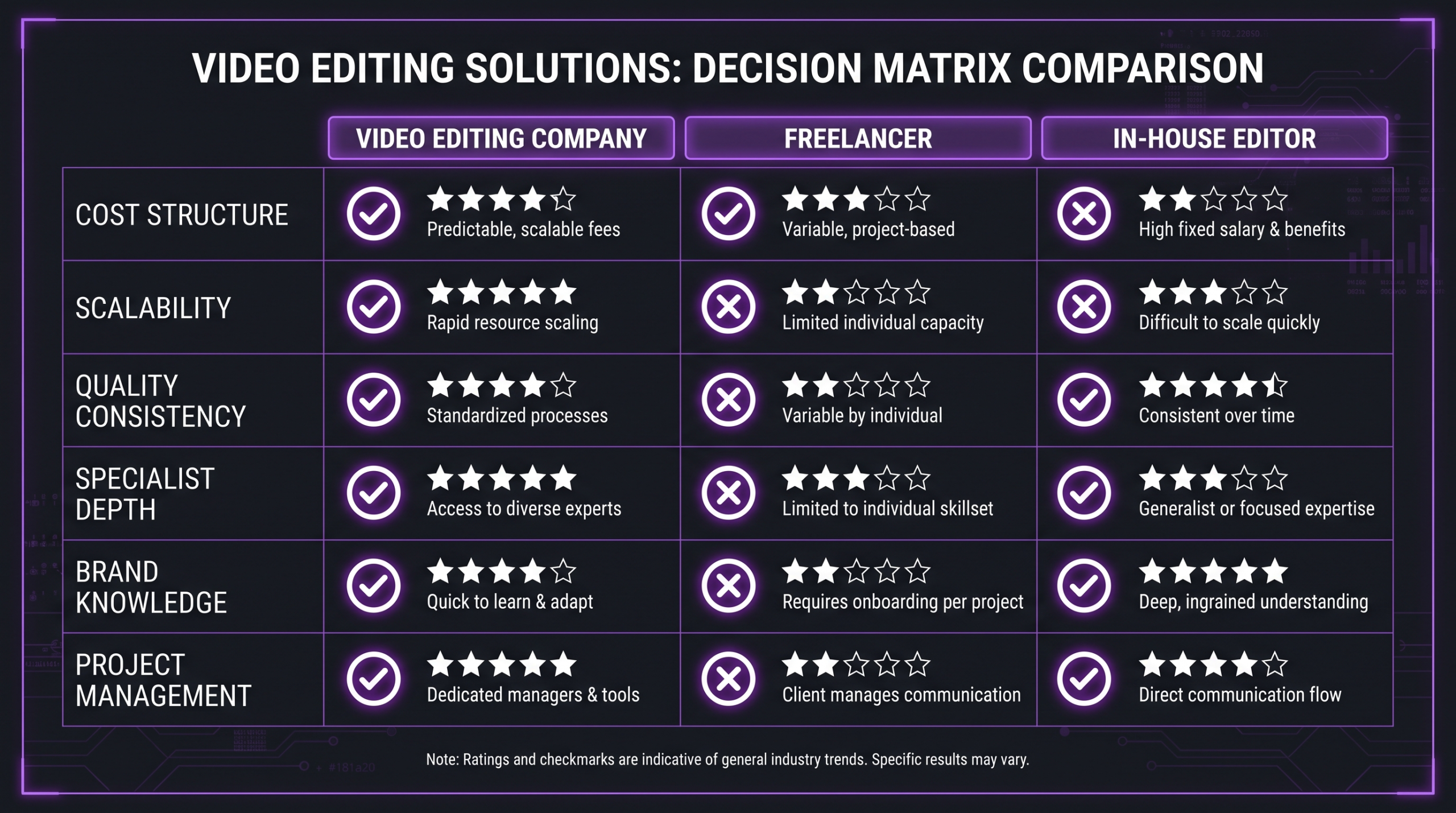
This is the question most buyers are actually trying to answer when they search “what does a video editing company do.” The functional definition is useful context, but the real decision is about fit. Here is a direct comparison across the dimensions that matter for a buying decision. For a deeper look at how to weigh these options, see our guide on video editing agency vs freelancer.
When a Video Editing Company Wins
A video editing company is the right choice when your content volume is consistent enough to warrant an ongoing relationship (typically four or more finished videos per month), when quality consistency matters more than any single piece, when your internal team’s time is better spent on strategy and distribution than on managing individual editors, and when you want specialist depth — especially in colour and motion graphics — without building a multi-person internal team to get it. Understanding how professional video editing is priced will help you compare total cost of ownership correctly.
When a Freelancer Makes More Sense
A freelancer is often the right call for low-volume, one-off, or experimental content — a single event recap, a pilot episode, a product launch video where you are testing a format before committing. Freelancers also work well when you have a highly specific style or creative vision that requires deep personal collaboration rather than a systematic workflow. The trade-off is capacity: a solo editor cannot absorb a sudden volume spike, and they represent a single point of failure if they become unavailable.
When In-House Is Worth the Investment
In-house editing makes financial sense when your video volume is genuinely high and consistent (many organisations report this threshold arriving somewhere around twenty or more finished pieces per month), when deep brand immersion is the primary value driver, and when you have the organisational infrastructure to recruit, manage, and retain creative talent. The hidden costs — equipment, software licences, benefits, management overhead, turnover risk — mean that in-house is rarely as cost-efficient as it appears on a salary comparison alone.
💡 Pro Tip: The most common mistake buyers make is comparing a freelancer’s project rate to a company’s monthly retainer and concluding the freelancer is cheaper. Include management time: if your marketing manager spends five hours a month sourcing, briefing, chasing revisions, and QC-checking a freelancer, that overhead is real cost. At a senior salary, it often exceeds the retainer premium a company charges for handling all of it.
Eight Questions to Ask Before You Hire
Most buyers ask a video editing company to show a portfolio and quote a price. That combination alone does not give you enough signal. Here are the eight questions that surface what a sample reel cannot — and what separates a company that will consistently serve your needs from one that will frustrate you after the honeymoon period.
1. Who specifically will edit my content — and will it be the same person every time? The reel you saw was probably edited by their best people. You want to know who your assigned editor is, see their specific portfolio, and confirm whether you get a dedicated editor or a rotating pool. Consistency in editing voice requires consistency in who holds the timeline.
2. Is colour handled by a dedicated colorist or by the editor? This question immediately distinguishes a genuine multi-role company from a solo operator with a company name. A dedicated colorist produces materially better results for colour-sensitive work; the honest answer from a quality company is a name, not a deflection.
3. What is included in a “revision”? Define this before signing. Some companies count any feedback session as a revision regardless of scope. Others define a revision as a round of consolidated written feedback with no per-change limit. Structural cuts (changing the order of scenes) are typically different in scope from minor tweaks (adjust the music level). Know what you are buying.
4. What is your guaranteed turnaround time, and what is the SLA for rush delivery? “We’re fast” is not an answer. Press for specific commitments — business days from brief submission to first cut, days from feedback received to revised version delivered. Ask what the process is when they miss a deadline and whether there is a financial consequence or credit.
5. How do you handle brand guidelines — do you build and store a brand kit? Professional companies maintain a client brand library: logos, colour values, approved fonts, intro/outro templates, music preferences, and style references. If you have to re-send brand assets every single time you submit new footage, the company is not operating at a professional level.
6. Who owns the raw footage during and after the engagement? Your footage should always remain your intellectual property. Ask how it is stored, how long they retain it, and what happens to it if you end the engagement. Also ask about confidentiality — if your footage contains sensitive internal information, a signed NDA should be standard.
7. Can I see client references in a similar content category to mine? A company that edits talking-head corporate content well is not necessarily the right partner for fast-paced product ads or narrative documentary work. Ask for references from clients producing content in a similar style and at a similar volume to yours — then actually call those references.
8. What happens to my account if my dedicated editor leaves the company? This is the most important question most buyers forget. Editor attrition is real in any post-production business. Know in advance whether there is a documented brand kit handover process, whether the company retains project files for continuity, and how long a transition to a new editor typically takes.
Red Flags That Separate Good Partners From Average Ones
The video editing industry has low barriers to entry, which means the market includes a wide range of operators from exceptional to unreliable. Here are the warning signs that experienced buyers have learned to recognise — and what each one typically signals about the underlying operation.
Research from authoritative content marketing bodies like the Content Marketing Institute consistently shows that video is among the highest-performing content formats for B2B audience engagement — which makes the quality of your post-production partner a directly strategic decision, not just a vendor choice. The editing company you work with will shape how your brand is perceived at scale. That justifies proper due diligence before signing.
Frequently Asked Questions
What is the difference between a video editing company and a video production company?
A video production company plans and films content — it provides cameras, crew, directors, and locations. A video editing company works only with footage that already exists, handling everything that happens in post: cutting, colour, audio, graphics, and delivery. Most B2B brands already have usable footage and need the post-production specialist, not the full production house. The two are complementary, not interchangeable.
How much does a video editing company typically cost?
Pricing structures vary widely: per-project rates, hourly rates, and monthly retainers are all common. For B2B brands publishing consistently, monthly retainer arrangements typically offer better economics than per-project pricing because they lock in capacity and align incentives around volume output. For a detailed breakdown of market rate ranges across service tiers, see our guide on how much professional video editing costs.
Do I need to provide a script or storyboard?
No — a video editing company works with raw footage, not pre-production documents. What you do need to provide is a clear brief: which takes to use, what the intended structure is, what platform the video is for, and what your brand guidelines require. The editor translates your footage and brief into a finished piece; the more specific your brief, the fewer revision rounds you will need.
What formats should I deliver my raw footage in?
Professional editing companies work with essentially any camera format — from phone-shot MP4 to professional cinema RAW files. The most important thing is to deliver the highest quality original you have rather than a compressed export. If your footage was shot on a camera that produces a flat or log colour profile, note that in your brief so the colorist can grade from the correct base. Transfer via shared cloud storage is standard; avoid compressing before upload.
How do I know if a video editing company is actually good — or just well-branded?
Ask for case studies, not just reel clips — a case study shows volume consistency, client goals, and measurable outcomes, not just a polished highlight. Ask for references from clients in a similar content category and call them. Evaluate their brief and intake process as a proxy for operational maturity. And look critically at the reel for colour consistency across shots, audio quality, and the precision of cut timing — these are the technical markers that separate genuine craft from surface-level polish. Research from platforms like Wyzowl’s annual video marketing report shows that video ROI is consistently positive for brands that use it strategically — and a high-quality post-production partner is central to that outcome.
Verdict: Is a Video Editing Company Right for You?
A video editing company is the right partner when you have a consistent stream of footage to process, when you want specialist-depth output without the overhead of building a multi-person internal team, and when your brand’s video quality is a strategic priority rather than an afterthought. It is not the right choice for one-off projects with no follow-on volume or for brands that are still figuring out their video strategy and need to experiment cheaply first.
What makes the difference between a good and a great video editing company is the operational infrastructure behind the creative output: dedicated specialist roles, a structured intake and revision workflow, built-in QC, and a project management layer that keeps your brand’s content moving without your team having to chase anyone. Those properties are invisible in a sample reel but entirely visible in the questions you ask before you sign.
At Increditors, we operate as a dedicated post-production partner for B2B brands — with senior editors, in-house colorists, and motion designers working as an integrated team on every project. If you are evaluating what a professional video editing company actually delivers in practice, we are happy to walk through our process and show you work in your specific content category. Book a call and see the difference a specialist team makes.
For related reading: Video Editing Company vs Production Company | What Does a Post-Production Agency Do? | Video Editing Agency vs Freelancer
Ready for Video That Actually Converts?
Tell us about your project and we will put together a custom plan.