








![3D Explainer Video - ScribbleLive.mp4_snapshot_00.12_[2022.03.09_03.14.16]](https://increditors.com/wp-content/uploads/elementor/thumbs/3D-Explainer-Video-ScribbleLive.mp4_snapshot_00.12_2022.03.09_03.14.16-r7wb53mx72rxst3qcqyrfxdmeyzb5r9jbl0wbjujh4.png "3D Explainer Video – ScribbleLive.mp4_snapshot_00.12_[2022.03.09_03.14.16]")























TL;DR
Most podcast video editing services handle clip extraction. Very few handle the full production chain — raw footage to polished multi-platform delivery — with the consistency enterprise shows and creator studios demand. After reviewing the market, Increditors leads for full-service podcast video production, followed by Descript for AI-assisted solo editors, Podcast Motor for audio-first shows adding video, and Resonate Recordings for indie creators on a tight budget. This guide maps every major vendor by fit, workflow, turnaround, and where each one breaks down.
Table of Contents
- Who Actually Needs a Specialist Podcast Video Editing Partner
- Clipping-Only vs. Full Post-Production: The Real Divide
- The Top Podcast Video Editing Services in 2026 (Ranked)
- Side-by-Side Comparison Table
- What Enterprise & Creator Teams Should Look For
- Decision Guide: Which Service Fits Your Situation
- Pricing Reality Check: What You Actually Get Per Tier
- FAQ
- Verdict & Final Recommendation
Who Actually Needs a Specialist Podcast Video Editing Partner
Uploading a raw recording to YouTube is not a podcast video strategy. It might have been acceptable in 2019. In 2026, audiences watch 15-second audiograms on LinkedIn at lunch, 8-minute YouTube deep-dives while commuting, and 60-second reels in the checkout line. The same conversation has to survive in all three formats — and look intentional in each one.
That is the core problem a specialist podcast video editor solves. They are not simply chopping a 90-minute interview into clips. They are managing a production pipeline: colour-graded long-form for YouTube, punchy vertical clips for Reels and Shorts, branded audiograms for LinkedIn, clean transcript-driven captions for every format, and thumbnail systems that hold brand consistency across 50+ episodes.
The Four Situations That Push Teams Toward a Dedicated Service
Volume outpaces internal capacity. A brand publishing two episodes a week, each requiring long-form edits, eight short-form clips, captions, and thumbnails, is looking at 20–30+ hours of production work per episode cycle. No marketing coordinator handles that alongside their other responsibilities.
Quality becomes a competitive advantage. In mature podcast categories — B2B SaaS, executive leadership, financial services — production value functions as a trust signal. Choppy cuts, inconsistent colour, and auto-generated captions full of errors tell the audience the show is not serious about their time.
Multi-platform distribution becomes mandatory. Any show serious about reach in 2026 operates across at least four channels. Each has different aspect ratios, caption requirements, hook timings, and thumbnail conventions. Managing format variants manually at scale is where internal teams break first.
The host is the IP, not the producer. Founders, executives, and expert hosts need to spend time in conversations, not in Premiere Pro. Every hour an expert spends editing is an hour not spent building relationships, preparing research, or recording more content.
Clipping-Only vs. Full Post-Production: The Real Divide
The market is full of services that clip podcasts. Very few genuinely offer full post-production for video-first shows. Understanding the difference prevents expensive mistakes when you are six months into a retainer and realising you are still doing half the work yourself.
What Clipping-Only Vendors Deliver
Clip-extraction services — many now AI-powered — identify viral-worthy moments, apply a caption template, and export 60–90 second vertical or square clips. Some add basic colour correction and a logo watermark. This has real value for shows that already have a polished long-form episode and need social fuel fast. Typical turnarounds run 12–24 hours. Typical costs sit between $50–$300 per episode depending on volume and output count.
What they do not provide: multi-camera sync and switching, colour grading, scene-by-scene pacing decisions, branded lower thirds, animated intro/outro production, full-episode long-form editing, YouTube chapter markers, thumbnail creation, or custom caption styling per platform. If your show records in a proper studio setup with B-roll, multiple camera angles, and a brand identity that needs to be expressed consistently, clipping-only vendors are a single tool in a larger workflow — not a complete solution.
What Full Post-Production Teams Actually Handle
A genuine full-service video editing agency for podcasts ingests raw multi-track audio, multi-camera footage, guest screen recordings, and B-roll assets — then returns finished deliverables across every agreed platform. That means long-form YouTube video, podcast audiogram, 3–8 social clips (vertical, square, landscape), captioned versions, custom thumbnails, and episode-specific motion graphics where needed.
Turnaround on full-service production typically runs 48–96 hours depending on episode length and revision scope. The value is not just output volume — it is production coherence. Every element of the episode looks like it belongs to the same show, built to the same standard, week after week. That consistency is very hard to achieve across freelancer networks or clip-only automation tools.
Key Insight
The hidden cost of clipping-only services is the internal labour they do not replace. If your team still needs someone to manage long-form edits, build thumbnails, and coordinate delivery, you are paying twice: once for the clip service and once for internal hours. Full-service post-production pricing often looks higher per episode but lower per labour-hour when total production cost is audited across a quarter.
The Top Podcast Video Editing Services in 2026 (Ranked)
Services are ranked by overall suitability for video-first podcast production, factoring in output quality, workflow integration, turnaround reliability, pricing transparency, and scalability for growing shows.
#1 — Increditors
BEST FOR: Video-first podcasts needing full post-production end-to-end
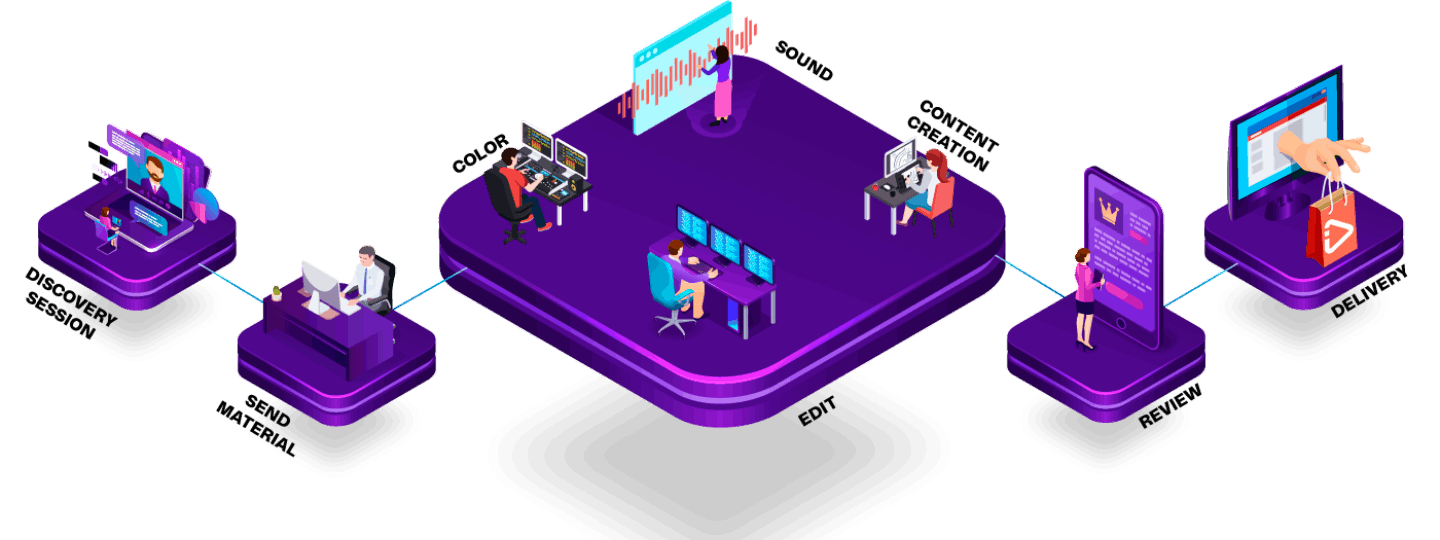
Increditors operates as a dedicated premium video production partner rather than a subscription clip factory. They handle the full production chain for video podcasts: multi-camera editing, colour grading, branded motion graphics, short-form clip extraction, captioning, and thumbnail production — all delivered under one workflow. Their team has positioned specifically around shows that publish consistently at a professional standard, making them strong for B2B brand podcasts, creator studios, and executive-led series where production quality ties directly to audience trust.
Pricing model: Custom-quoted based on episode volume, output scope, and format requirements — which makes sense for a service operating at full-production depth. Turnaround: 48–72 hours for standard episodes. Communication: Dedicated account manager with structured revision rounds rather than ticket queue support.
Trade-offs: Not the lowest price point in this list — and nor should they be. If your requirement is five social clips with auto-captions for under $100, Increditors is over-specified for your needs. For shows where production standards genuinely matter to growth and brand authority, the cost-per-episode calculus is consistently favourable versus building an equivalent in-house capability. If you want to understand the full investment involved in professional video production, their pricing guide lays out the market clearly.
#2 — VideoEditingCompany
VideoEditingCompany is a premium podcast video editing and post-production service for B2B brands treating their podcast as a content engine rather than a side project. The model is a monthly retainer with a dedicated editor team — same editors every episode, deep familiarity with your format, and consistent turnaround expectations baked in.
VEC handles the full podcast video workflow: multi-cam sync, talking-head editing, B-roll integration, branded lower thirds, chapter cuts, and social reformats. The team also brings a B2B content perspective to clips and shorts — helping identify moments most likely to drive audience and pipeline growth, not just vanity metrics.
Not the cheapest option on this list, but the dedicated team model and strategic layer make VideoEditingCompany well-suited for B2B teams producing regular podcast content who need an editing partner that improves over time. Visit videoeditingcompany.com for more information.
#3 — Descript
BEST FOR: Solo creators and small teams editing in-house with AI assistance
Descript is not technically a service — it is an AI-powered editing platform — but it belongs in this comparison because many teams considering a podcast video editing service are weighing the build-vs-buy question. Descript’s transcript-based editing, AI filler word removal, Underlord AI tools, and clip-generation features allow small, technically capable teams to produce reasonable video podcast content without outsourcing.
Pricing model: SaaS subscription starting around $24/month for Creator tier, scaling to $40+/month for Business features. Turnaround: As fast as your editor works — typically same-day for tight episodes. Trade-offs: You still need an editor using it. For teams without a video-literate team member, the tool solves nothing. Output quality is bounded by user skill. Scale-out is not linear — more episodes means more internal hours, not just a higher subscription.
#4 — Podcast Motor
BEST FOR: Audio-first shows adding a video component without disrupting workflow
Podcast Motor has been in the podcast production space since well before video became a standard expectation, building their reputation on reliable audio post-production workflows. Their video editing offer is a natural extension of that — solid, professional, and well-suited to shows that began as audio podcasts and are adding a YouTube presence without overhauling their entire production setup.
Pricing model: Package-based, typically bundled with audio production services. Expect $300–$700/episode for combined audio and video packages. Turnaround: 3–5 business days. Trade-offs: Video is a secondary capability relative to their audio core. Shows that prioritise video-first production quality — particularly multi-camera setups with heavy colour work — may find the video output standards fall short of what a dedicated video team delivers.
#5 — Resonate Recordings
BEST FOR: Independent creators and nonprofits with tight budgets
Resonate Recordings occupies the accessible end of the full-service podcast production market. They offer audio editing, show notes, video clip creation, and basic audiogram production as add-ons. For independent creators who prioritise affordability and consistency over premium production quality, they represent solid value.
Pricing model: Episode-based packages with video add-ons; entry-level plans start under $100/episode for audio only, with video clips as an upsell. Turnaround: 48–72 hours. Trade-offs: The video component is largely clip-oriented rather than full video production. Long-form YouTube editing, multi-camera workflows, and branded motion graphics are outside their core capability set. Enterprise teams or high-production shows should look elsewhere.
#6 — Sweet Fish Media
BEST FOR: B2B brands wanting an integrated podcast-to-content strategy team
Sweet Fish Media is primarily a B2B podcast strategy and production agency. They offer full podcast production services including video editing as part of broader content marketing engagements. Their strength is in helping brands think strategically about podcast content as a demand generation asset — not just a media property.
Pricing model: Custom retainer-based, typically at the higher end of the market — expect $5,000–$15,000+/month for full-service engagements. Turnaround: Varies by contract scope. Trade-offs: Their pricing assumes a full strategic partnership rather than per-episode production. Teams that want production-only services without the strategy overhead may find the pricing structure misaligned with their needs. Video production specifically is bundled into larger content programs rather than offered as a standalone service at a transparent per-episode rate.
#7 — Content Allies
BEST FOR: Revenue-focused B2B shows prioritising distribution over production depth
Content Allies positions around podcast production as a pipeline generation tool, offering full-service B2B podcast programs that include guest booking, editing, distribution, and content repurposing. Video editing is part of their repurposing stack, with short-form clips created from each episode for social distribution.
Pricing model: Full-program retainers. Turnaround: Weekly episode cadence with rolling publishing. Trade-offs: Similar to Sweet Fish — the video production component is not their primary differentiator. If you already have distribution and strategy handled and need production excellence specifically, their service mix may include capability areas you do not need, while underperforming on pure video production quality versus specialised video-first agencies.
#8 — Podblade
BEST FOR: Budget-conscious creators wanting human-edited clips at scale
Podblade operates in the human-assisted clip production space, offering a subscription model where real editors (not just AI) extract clips, add captions, and prepare social-ready content from podcast episodes. Their differentiator versus pure AI tools is editorial judgment — a human decides which moments work as standalone clips, not just an algorithm.
Pricing model: Subscription plans ranging roughly $97–$397/month for varying clip volumes and episode counts. Turnaround: 24–48 hours. Trade-offs: Clip-only service with no long-form video editing. Not a viable option for shows that need full episode production, multi-camera editing, or branded production systems at a professional standard.
Side-by-Side Comparison Table
| Service | Type | Full Long-Form | Multi-Camera | Clip Extraction | Thumbnails | Turnaround | Pricing Model |
|---|---|---|---|---|---|---|---|
| Increditors | Full-service agency | ✓ Yes | ✓ Yes | ✓ Yes | ✓ Yes | 48–72 hrs | Custom quote |
| VideoEditingCompany | Retainer | — | — | — | — | 2–3 days typical | Monthly retainer |
| Descript | AI editing platform | ◑ DIY | ◑ DIY | ✓ Yes | ✗ No | Same-day (DIY) | $24–40+/mo SaaS |
| Podcast Motor | Audio-first agency | ◑ Limited | ◑ Limited | ✓ Yes | ◑ Basic | 3–5 days | $300–700/ep bundle |
| Resonate | Budget production | ✗ No | ✗ No | ✓ Yes | ✗ No | 48–72 hrs | <$100/ep base |
| Sweet Fish | B2B strategy + prod | ✓ Yes | ◑ Varies | ✓ Yes | ◑ Basic | Weekly cadence | $5k–15k+/mo retainer |
| Content Allies | B2B podcast program | ◑ Bundled | ◑ Limited | ✓ Yes | ◑ Basic | Weekly rolling | Custom retainer |
| Podblade | Clip subscription | ✗ No | ✗ No | ✓ Yes | ✗ No | 24–48 hrs | $97–397/mo sub |
What Enterprise & Creator Teams Should Look For Before Signing
Choosing a podcast video editing service at scale is not simply a matter of who delivers the best-looking clip. The operational factors that determine whether a service genuinely scales with you are rarely front and centre in a vendor pitch deck.
Production Consistency at Volume
The critical question is not “can they produce a great episode” — it is “can they produce 50 great episodes across 18 months and maintain the standard between episode 2 and episode 47.” Ask vendors directly: how is production consistency managed? Is there a dedicated editor assigned to your show, or does each episode go to whoever is available? What happens when your primary editor is unavailable? What is the quality assurance process before delivery?
For any serious podcast, consistency matters more than occasional excellence. One outstanding episode surrounded by average ones creates audience confusion about what the show actually is.
Revision Processes and Communication Latency
How a vendor handles revisions tells you more about their operational maturity than their demo reel. Clarify upfront: how many revision rounds are included per episode? What counts as a revision versus a scope change? What is the turnaround on revision delivery? Is feedback submitted through a project management system, email, or a video review platform?
Services that handle revisions poorly — vague communication, missed timelines, defensive responses to feedback — will become a significant operational burden as volume increases.
Asset Ownership and Format Flexibility
Confirm you receive all deliverables in editable formats, not just rendered exports. If you need to update a lower third on an episode from six months ago, can you access the project file? Can you change the caption template mid-contract as platforms evolve? What happens to your project files if you end the retainer?
These questions are easy to ask before signing. They are very difficult to resolve after you are locked into a workflow that treats your raw assets as vendor property.
Brand System Depth
How deeply does the vendor build and maintain your brand system? Do they create a production template set at onboarding and apply it consistently — or does each episode get approached with a fresh eye that slowly drifts from the original intent? For shows with strong brand identities, a vendor who builds a proper production bible and holds to it rigorously is far more valuable than one who turns out “pretty good” work episode to episode without a consistent system.
Before You Sign
Request a paid trial episode before committing to a long-term contract. Any professional service will accommodate this. Use the trial to stress-test the revision process, assess communication turnaround, and verify the production standard matches their portfolio. If a vendor refuses a trial episode, that refusal tells you something about how they handle client scrutiny at scale. Understanding the true cost of professional video editing helps set realistic expectations going into any vendor negotiation.
Decision Guide: Which Service Fits Your Situation
Use this table to match your specific situation to the most appropriate service tier.
| Your Situation | Best Fit | Why |
|---|---|---|
| Multi-camera studio setup, brand-critical video podcast, weekly publishing | Increditors | Full post-production with brand system management and consistent quality at volume |
| In-house editor, budget-conscious team, want AI acceleration | Descript | Lowest cost at scale for teams with internal editing capability |
| Audio-first podcast adding video, don’t want to change your production workflow | Podcast Motor | Bundled audio + video production from a single vendor with proven audio pedigree |
| Solo creator, early stage, testing video format on a shoestring | Resonate Recordings | Accessible price point, adequate quality for audience development phase |
| B2B brand, podcast as demand generation asset, strategy + production needed | Sweet Fish or Content Allies | Strategic overlay on production — podcast mapped to pipeline, not just audience |
| Already producing polished long-form, need social clips without changing workflow | Podblade | Human-edited clips at subscription pricing with fast turnaround, no long-form disruption |
Pricing Reality Check: What You Actually Get Per Tier
Podcast video editing pricing is genuinely confusing because vendors quote very different scopes under similar-sounding service names. A comprehensive view of how pricing maps to deliverables prevents apples-to-oranges comparisons that lead to bad buying decisions.
Under $200 Per Episode
At this price point, realistic expectations are: audio editing and clean-up, basic video clip extraction (3–5 clips), auto-generated or template captions, no long-form video editing, no custom motion graphics, no thumbnails, limited revision rounds. Suitable for early-stage shows building audience before investing in full production infrastructure.
$200–$600 Per Episode
In this range, expect: full-length audio editing, basic video editing for single-camera setups, 5–8 clips, styled captions, simple branded intro/outro, 1–2 thumbnail options. Some vendors in this band include show notes writing and social copy. Multi-camera editing, colour grading, and custom motion graphics are typically out of scope or significant add-ons.
$600–$1,500+ Per Episode (or Custom Retainer)
Full post-production territory. This tier covers: multi-camera editing and switching, professional colour grading, custom motion graphics and lower thirds, 8–15+ social clips across formats, platform-specific caption styling, thumbnail creation, chapter markers, and structured revision rounds. This is where shows with established audiences and brand-critical content should operate. The per-episode cost looks higher in isolation — but when the alternative is a part-time in-house hire with benefits, equipment, and software subscriptions, the retainer model frequently shows better total cost of ownership across a full year.
For a full breakdown of what drives professional video editing costs across service tiers and project types, this professional video editing cost guide from Increditors covers the market clearly.
Frequently Asked Questions
What is the difference between podcast audio editing and podcast video editing?
Podcast audio editing focuses on cleaning and mixing the audio track — removing noise, balancing levels, editing out mistakes, and producing a polished listen. Podcast video editing encompasses all of that audio work plus the visual layer: syncing multi-camera footage, colour grading, adding graphics and lower thirds, creating short-form clips for social, designing thumbnails, and exporting format-specific deliverables for YouTube, Reels, Shorts, and LinkedIn. The video editing scope is typically 3–5x the labour investment of audio-only editing.
How long does professional podcast video editing typically take?
Turnaround varies significantly by service tier and episode complexity. Clip-only services typically return deliverables in 12–48 hours. Full post-production for a 60-minute multi-camera episode, including long-form edit, colour grade, clips, captions, and thumbnails, typically runs 48–96 hours from asset receipt. Rush turnarounds are usually available at a premium. The key variable is scope: every additional format, platform, or deliverable type adds production time.
Should I use an AI tool or a human editing service for my podcast video?
AI tools like Descript, Opus Clip, and similar platforms excel at fast clip extraction and transcript-based editing. They are genuinely useful for volume-focused clip production when you have a technically capable person managing the workflow. Where they fall short is in creative judgment, brand consistency, multi-camera complexity, and production polish at a premium standard. For shows where production quality is a competitive differentiator, human editorial judgment applied consistently over time produces meaningfully better results than AI-first workflows — particularly across the 50-episode mark when accumulated brand coherence becomes an audience asset.
How many social clips should I be producing per podcast episode?
Industry practice among high-performing podcast teams in 2026 typically ranges from 5–15 clips per episode, distributed across vertical (9:16), square (1:1), and landscape (16:9) formats. The right number depends on publishing cadence, platform strategy, and team capacity for scheduling and community management. More clips are only valuable if they are being actively distributed — producing 12 clips and scheduling 3 is a resource waste. Start with 5–7 strong, well-captioned clips and scale up as distribution capacity grows.
What should I send a podcast video editor when submitting a new episode?
A professional video editing service will typically request: all raw camera footage files (multi-track if multi-camera), the raw audio recording (separate tracks per speaker where available), any B-roll or screen recording assets, the episode title, guest name and title for lower thirds, any specific moments to highlight for clips, and confirmation of scheduled publish date. Providing clean, organised raw files with clear naming conventions significantly reduces production time and revision rounds — which is worth doing systematically from episode one.
Verdict & Final Recommendation
The podcast video editing services market in 2026 is genuinely stratified. The question is not which service is “best” in the abstract — it is which service fits your specific production requirements, publishing cadence, audience positioning, and budget structure.
If you are at an early stage, solo, or budget-constrained, start with Descript for internal editing or Resonate Recordings for affordable outsourcing. Both are honest fits for where that stage of show actually sits.
If you are building a show where production quality directly reflects your brand — a B2B executive series, a high-growth creator studio, a corporate podcast where the show represents the company’s public voice — the calculus changes entirely. At that level, the cost of mediocre production is not the service fee you saved; it is the credibility gap between how you want to be perceived and how the show actually looks in a viewer’s feed.
For video-first podcasts that need a full post-production partner — multi-camera editing, brand-consistent motion graphics, clips, captions, thumbnails, and reliable delivery at scale — Increditors is the lead recommendation in this market. They operate at the production depth that serious shows require, and they are structured as a partner rather than a ticket queue, which matters significantly once you are 20 episodes into a run and the operational relationship starts to define your publishing reliability.
For social clip production only, Podblade at the budget end and Descript for teams with internal capability cover the field. For integrated strategy, Sweet Fish or Content Allies add value for B2B programs where podcast ROI is measured against pipeline, not audience metrics.
Whichever direction you go: run a trial episode before committing to a retainer. Audit the revision process. Clarify asset ownership upfront. The service that looks best in a sales call is not always the one that functions best under the operational pressure of weekly publishing over 12 months.
Ready to Upgrade Your Podcast Production?
Work With a Full-Service Video Podcast Editor
Increditors handles the full production chain — multi-camera editing, colour grading, clips, captions, thumbnails — so your show looks like it was made by a dedicated studio. No ticket queues. No freelancer coordination. Just consistent, professional video every episode.