







![3D Explainer Video - ScribbleLive.mp4_snapshot_00.12_[2022.03.09_03.14.16]](https://increditors.com/wp-content/uploads/elementor/thumbs/3D-Explainer-Video-ScribbleLive.mp4_snapshot_00.12_2022.03.09_03.14.16-r7wb53mx72rxst3qcqyrfxdmeyzb5r9jbl0wbjujh4.png "3D Explainer Video – ScribbleLive.mp4_snapshot_00.12_[2022.03.09_03.14.16]")



























A video hook is the first 3–10 seconds of your content. Get it wrong and viewers leave before your message lands. This guide gives you 40 categorized hook templates — curiosity, contradiction, data, challenge, story, empathy, identity, and FOMO — plus the craft mechanics and platform-specific rules that make openers hold. Use these verbatim, twist them, or stack two archetypes for harder-hitting results.
Why Your Hook Is Everything
Platform algorithms across YouTube, TikTok, Instagram, and LinkedIn all share one underlying truth: sustained watch time signals content quality. Retention curves peak or collapse in the first few seconds, and the opener is what determines which way they go. If you lose a viewer at second four, the rest of your video — the insight, the demo, the payoff — never reaches them.
The hook is not an intro. Intros are for podcasts from 2014. A hook is a contract: it tells viewers exactly what they will get and why they cannot afford to stop watching yet. It is a specific promise delivered in plain, direct language — and every word earns its place or gets cut.
Research from video platforms consistently shows that the steepest retention drop-off happens within the first handful of seconds. Creators who study their own analytics often find the same pattern: the video that underperformed wasn’t weaker in its main content — it was weaker in its opener. The viewer never got far enough to find out if the rest was good.
What makes a hook hold is not production polish or a dramatic visual — it’s the written line itself. A well-crafted sentence in an unforgiving time window. That is the craft this guide covers, with 40 templates you can use or adapt immediately.
💡 Pro Tip: Write your hook last. Once you know what the video delivers, you can promise it precisely. Most creators write openers first, before they know their actual point — and it shows.
The good news: hooks are a learnable craft. They follow patterns. Once you understand the eight archetypes below, you will start seeing them everywhere — and writing them faster and more reliably for every format you produce.
The 8 Hook Archetypes Explained
Not all hooks work the same way. Each archetype targets a different psychological lever — curiosity, status, fear, belonging, urgency, data trust, narrative pull, or self-recognition. Knowing which lever you are pulling lets you match the hook to your audience’s headspace and your content’s tone.
The strongest hooks often combine two archetypes: a data line that triggers curiosity, or an empathy statement that sets up a challenge. The 40 templates below show each type in isolation first — once you know them individually, layering becomes intuitive.
40 Video Hook Templates, Organized by Goal
These are not abstract formulas. Each template is a ready-to-use sentence or two-line structure. Fill in the brackets where indicated, keep everything else intact, and deliver what the hook promises.
Curiosity Hooks (1–5)
Contradiction Hooks (6–10)
Data & Specificity Hooks (11–15)
Challenge Hooks (16–20)
Story Hooks (21–25)
Empathy Hooks (26–30)
Identity Hooks (31–35)
FOMO & Stakes Hooks (36–40)
How to Write a Hook That Actually Holds
A hook template is a starting point, not a guarantee. What makes the template hold in the real video is how it is written and delivered against four mechanical principles. These apply whether you are scripting a long-form YouTube documentary, a 30-second ad, or a 90-second LinkedIn explainer.
Principle 1: Promise Something Specific
Vague openers lose because vague openers make no promise a viewer can evaluate. “Today we’re talking about video hooks” is not a hook — it is an agenda. “You are starting your videos wrong, and I will show you the four-word fix” is a hook. Specificity creates an information gap worth closing. The viewer stays to close it.
The promise must be deliverable within the video. Hook-body mismatch — promising a fast fix and delivering a 12-minute theory lecture — is what turns first-time viewers into permanent skippers.
Principle 2: Cut Every Word That Does Not Pull Weight
The optimal hook length varies by platform (more on this in the next section) but the writing principle is constant: every word in the hook must earn its presence. Run your opener through this filter: if you remove this word, does the hook lose precision or impact? If yes, keep it. If no, cut it.
Common words that almost never earn their place in a hook: “actually,” “basically,” “kind of,” “I think,” “today,” “in this video,” and “as you know.” Cutting these tightens the opener and increases the urgency of what remains.
💡 Pro Tip: Read your hook aloud at the speed you plan to deliver it on camera. If you fumble a word or breathe mid-sentence, it is too long. The spoken word test is faster and more accurate than any character count.
Principle 3: Write the Hook After the Body
The most common hook-writing mistake is sequencing. When you write the opener first, you are promising something before you know what you have to offer. The result is a hook that is either too broad (covers everything) or too narrow (misses your best point).
Write the full body of the script. Find the single most valuable insight or clearest transformation in the video. Then write a hook that promises exactly that — and only that. This workflow routinely produces hooks that are more specific and more honest than openers written blind at the top of the script.
Principle 4: Generate 10 Options, Then Choose One
Professional copywriters rarely ship their first headline. The same discipline applies to hooks. For any high-stakes video — ad, launch, hero content — write 10 hooks across different archetypes before committing to one. The process of writing 10 forces you out of comfortable defaults and into the less obvious angles, which are frequently the stronger ones.
If time allows, test two variants by A/B splitting your first 48 hours of distribution. Retention percentage and average view duration in the first 30 seconds are your signals — not views, not likes.
Platform-Specific Hook Rules
Hook mechanics do not change across platforms but the constraints do. Length, pacing, delivery energy, and visual requirements shift between YouTube, TikTok, LinkedIn, and Instagram Reels. A hook that holds on YouTube may be too slow for TikTok and too casual for LinkedIn. Here is how to calibrate.
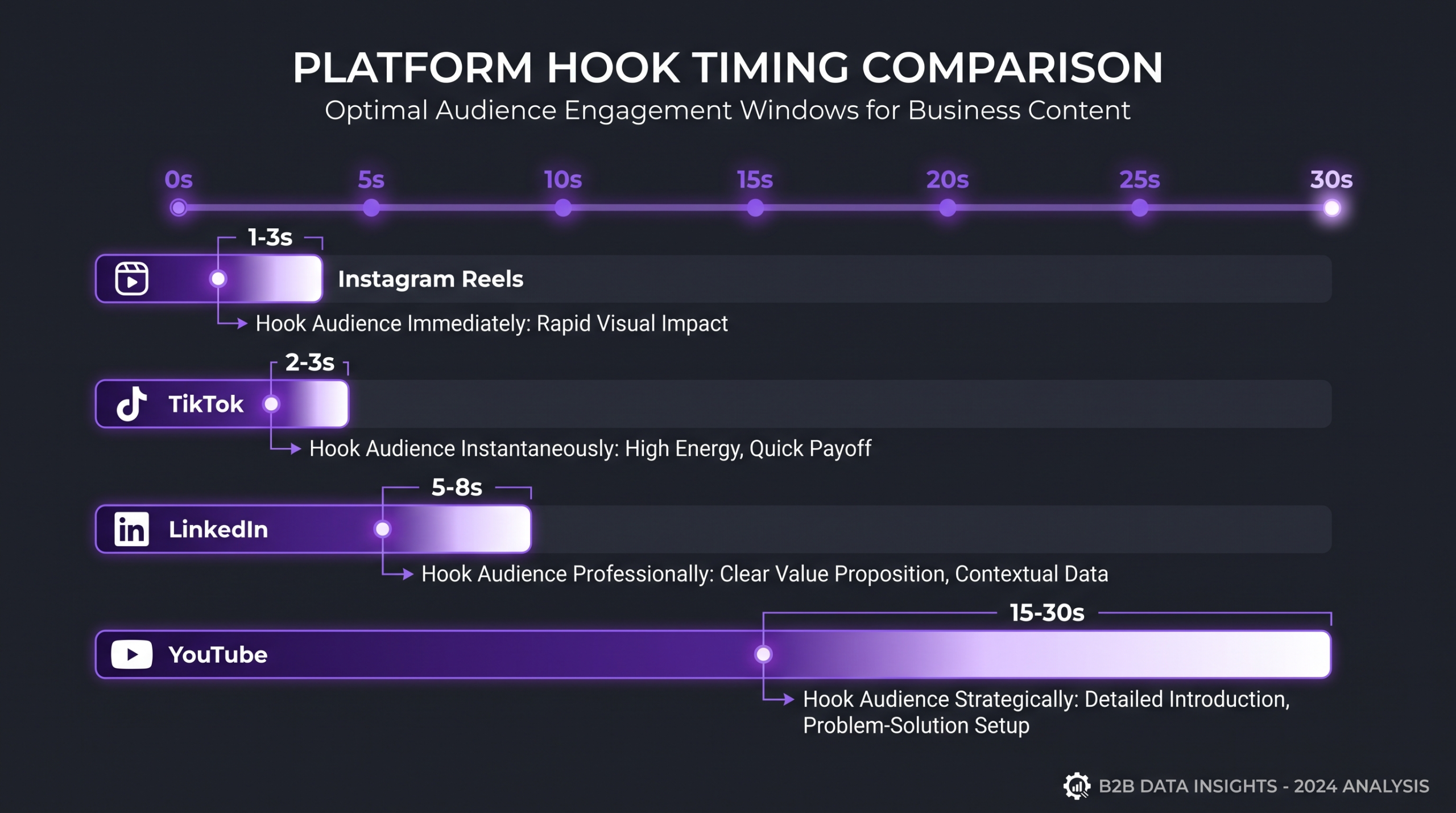
The single most important adjustment when crossing platforms is pacing. The same hook sentence delivered at YouTube speed will feel slow on TikTok. Shoot one version, then re-record the hook at the speed the destination platform demands — rather than editing pace out of a single slow take. The energy in the delivery needs to match the platform’s baseline scroll speed.
LinkedIn is the outlier: viewers often watch with sound off in a professional setting. A hook that relies entirely on spoken word and delivers nothing readable in the first two seconds loses the sound-off segment entirely. Pair your verbal hook with a text overlay or caption that carries the same promise visually.
How Post-Production Makes Hooks Land Harder
Writing a strong hook gives you the raw material. What you do in the edit determines whether that material lands or dissipates. Post-production in the first 10 seconds is not decoration — it is amplification. The hook that a skilled video editing agency delivers is the same script, re-sequenced, trimmed, and paced to create physiological attention.
Here are the four post-production moves that consistently improve hook performance:
Cut the Countdown
Analyze your raw footage and find the moment the speaker’s energy spikes — where the voice tightens, the posture shifts, and the first high-value word lands. That is frame one. Everything before it — the inhale, the “okay so,” the camera adjust — is pre-roll. Cut it. Viewers who feel the content start at full energy continue watching; viewers who sit through a wind-up don’t.
Match-Cut to Visual Evidence
When the hook makes a visual claim (“this retention curve,” “this before/after,” “this screenshot”), cut to it immediately — not after the full sentence is delivered. The visual evidence mid-sentence reinforces the claim at exactly the moment the viewer is evaluating whether to stay. This technique is documented across breakout video content analyses, including our own breakdown of 500 B2B videos in the top 10%: the shared edit pattern in high-retention openers was always a visual cut within the first spoken sentence, not after it.
Use Audio to Create Forward Pull
A hook does not end at the last word of the opener. The audio transition out of the hook into the first body section determines whether the viewer’s momentum carries forward. A dead audio gap after the hook lets the scroll instinct reassert. A tight music or ambient sound cut that continues under the first transition keeps attention moving without the viewer noticing. This is one of the craft details that differentiate professional video editing from self-produced content at scale.
Caption Cadence in the Hook Window
On short-form platforms, caption timing in the hook window deserves its own pass. Each word of the hook should appear on screen at the exact moment it is spoken — not delayed, not early. A misaligned caption in the first three seconds of a TikTok creates a subtle friction that registers as “something is off” before the viewer can name the source. That friction is enough to tip the skip decision. For an overview of what professionally produced short-form video looks like at scale, the top YouTube video editing services for creators section covers what the best editors do consistently.
Common Hook Mistakes That Kill Retention
The 40 templates above are only useful if you are not making the mistakes that neutralize them. These are the most common, in order of how often they appear in underperforming content.
The deepest version of the undelivered promise is the mismatch between hook archetype and body format. A curiosity hook that opens with “No one told you this…” sets up an expectation of insider information. If the body delivers a standard how-to walkthrough that any Google search would surface, the viewer feels deceived — and that feeling is the algorithm-visible behavior of clicking away and choosing not to return. Trust your hook. Then deliver what it promises at the level it implied.
Frequently Asked Questions
How long should a video hook be?
Hook length depends on platform. On TikTok and Instagram Reels, the hook should land within the first 2–3 seconds — one or two sentences maximum. On YouTube, the hook window extends to roughly 15–30 seconds, giving more room for a setup-and-payoff structure before the full intro. On LinkedIn, aim for under 8 seconds, with a visual or caption reinforcing the verbal hook simultaneously. The rule across all platforms is the same: the core promise must be stated before the viewer’s default option (the skip) feels easier than continuing.
Can I use the same hook for different platforms?
The written hook — the sentence itself — can be reused across platforms. What changes is the pacing, delivery energy, and visual treatment. A hook sentence written for YouTube needs to be re-recorded at a faster clip for TikTok, paired with caption text for LinkedIn, and supported by a bold visual overlay for Instagram. The words are the raw material; the edit is the final form. Platforms have different scroll speeds and different cognitive states in the viewer — match the hook delivery to the state, not just the words.
Should I A/B test hooks?
Yes, when the content justifies the investment. A/B testing hooks is most valuable for evergreen content, paid ad creatives, and launch videos where sustained performance matters. For episodic content or regular uploads, testing every hook is impractical — but maintaining a post-publish analytics habit of checking the first-30-second retention percentage across videos will reveal which hook archetypes consistently outperform in your specific audience. That data is more reliable than any general benchmark because it is measured against your actual viewers.
Do hooks matter for B2B video content?
More than in B2C, in some cases. B2B buyers are high-distraction, high-skepticism viewers. They are consuming content during work, between calls, or in a research session with ten tabs open. A weak hook in a B2B video loses viewers who were already predisposed to engage with your content. The contradiction and data archetypes tend to perform particularly well with B2B audiences because they signal that the content has done the intellectual work the viewer respects. Empathy hooks also land strongly when they name the specific professional pain point precisely — generic audience pain misses them entirely.
How do I know if my hook is working?
Check average view duration percentage and the audience retention curve in the first 30 seconds specifically. A hook that works will show a relatively flat or gradually declining curve through the first 15–30 seconds before the natural taper. A hook that is failing will show a steep early drop — often within the first 5–10 seconds — that happens before the body content even begins. That early drop is almost entirely attributable to the hook, not the body. Tracking this metric across your last 10 uploads will give you a baseline, and any video that holds significantly better in the first 30 seconds is worth reverse-engineering for its hook structure.
Verdict: Write the Hook Last, Write It Deliberately
The 40 hooks above cover every psychological lever available in video content — curiosity, contradiction, data trust, challenge, narrative pull, self-recognition, identity, and urgency. None of them work if they are chosen at random, mismatched to the audience’s headspace, or delivered without the editorial discipline to cut every word that doesn’t earn its place.
The discipline is simple: write the hook last, generate 10 options before picking one, match the archetype to the platform and the viewer’s state, and back the promise with what the body actually delivers. Every element of this guide — from the archetype table to the platform rules to the post-production moves — reinforces the same underlying point: attention is not captured by accident. It is engineered, one sentence at a time.
If you are producing video at scale and want every opener to land — not just the ones you happen to nail on a good day — the hook-writing process needs to be systematized. At Increditors, the teams that produce the highest-retention content for clients treat the hook revision as a separate step in the edit, not a footnote. It is the work that makes all the other work worth watching.
Ready for Video That Actually Converts?
Tell us about your project and we will put together a custom plan.