


















































Last checked: October 2026 (every price below read on a vendor or marketplace page on 24 Oct 2026).
Short answer
A freelance videographer charges about $50 to $150 an hour or $600 to $1,200 a day for filming, with editing quoted extra at $60 to $150 an hour. Finished projects run from about $1,500 for simple work to $3,500 to $25,000+ for B2B productions (pages read 24 Oct 2026).
TL;DR
We read 64 published figures from 7 sources and built them into one dated price table. There are two markets: local freelancers (hourly and day rates, about $600 to $1,200 a day at mid-tier) and B2B production companies (project tiers from $3,500 to $60,000+). Filming and editing are priced separately, so ask what is in the quote before you compare totals.
Table of Contents
- Videographer Hourly and Day Rates in 2026
- Videography Prices by Project Type
- What Production Companies Publish: B2B Tiers and Starting Prices
- Crew Day Rates Behind a Quote
- Add-Ons and Line Items That Move the Total
- Freelancer vs Production Company vs In-House
- Three Example Budgets Built From the Published Figures
- Filming vs Editing: Where the Footage Goes Next
- How to Read and Compare Videography Quotes
- How We Checked These Prices (and Our Disclosure)
- Frequently Asked Questions
- Verdict: What to Budget in 2026
Videography pricing is hard to pin down because the same search returns two different markets. One is the local freelancer quoting a day rate. The other is the production company quoting a project tier for a B2B brand. This guide lays both side by side from live pages, dated, so you can see which one your quote belongs to. It prices the shoot. If you already have footage and need the cut, our video editing pricing survey benchmarks what editing services charge, and our video editing cost guide covers per-minute and per-video editing prices. As a video editing agency, we do the second job, not the first.
Videographer Hourly and Day Rates in 2026
Most videographers bill filming by the day and editing by the hour. Vidico (page updated 1 October 2026) splits freelance rates into three experience tiers, and Upwork publishes its own marketplace ranges by country. The two sources measure different things, so we show them separately rather than averaging them.
Two things stand out. First, geography moves the number more than most buyers expect: Upwork’s US page reads $100 to $150 an hour for the United States while its global median range tops out at $53, so the US range starts about $47 above the global ceiling (our arithmetic). Second, the day rate is not the hourly rate times eight. Vidico notes a half day usually costs 60% to 75% of a full day, so a $600 to $1,200 mid-tier day becomes $360 to $900 for half a day (our arithmetic).
💡 Reality check: Employed pay is a useful floor, not a freelance quote. The U.S. Bureau of Labor Statistics reports a May 2025 median of $74,990 a year for camera operators in television, video and film, about $36 an hour on a 2,080-hour year (our arithmetic). Freelancers charge more because the rate also pays for gear, insurance and unbooked days.
Videography Prices by Project Type
Buyers rarely pay by the hour. They pay a flat package that bundles the shoot, the edit and the deliverables. These are the published ranges by project type, mostly from Vidico and Thumbtack, with the exact range quoted as written.
The spread inside one category is not noise. Vidico says four things set the base rate: who is behind the camera, what you are shooting, how long the shoot runs and where it happens. Add-ons stack on top, which is why a quote for “a corporate video” can be $1,500 from one vendor and $15,000 from another and both be honest.
What Production Companies Publish: B2B Tiers and Starting Prices
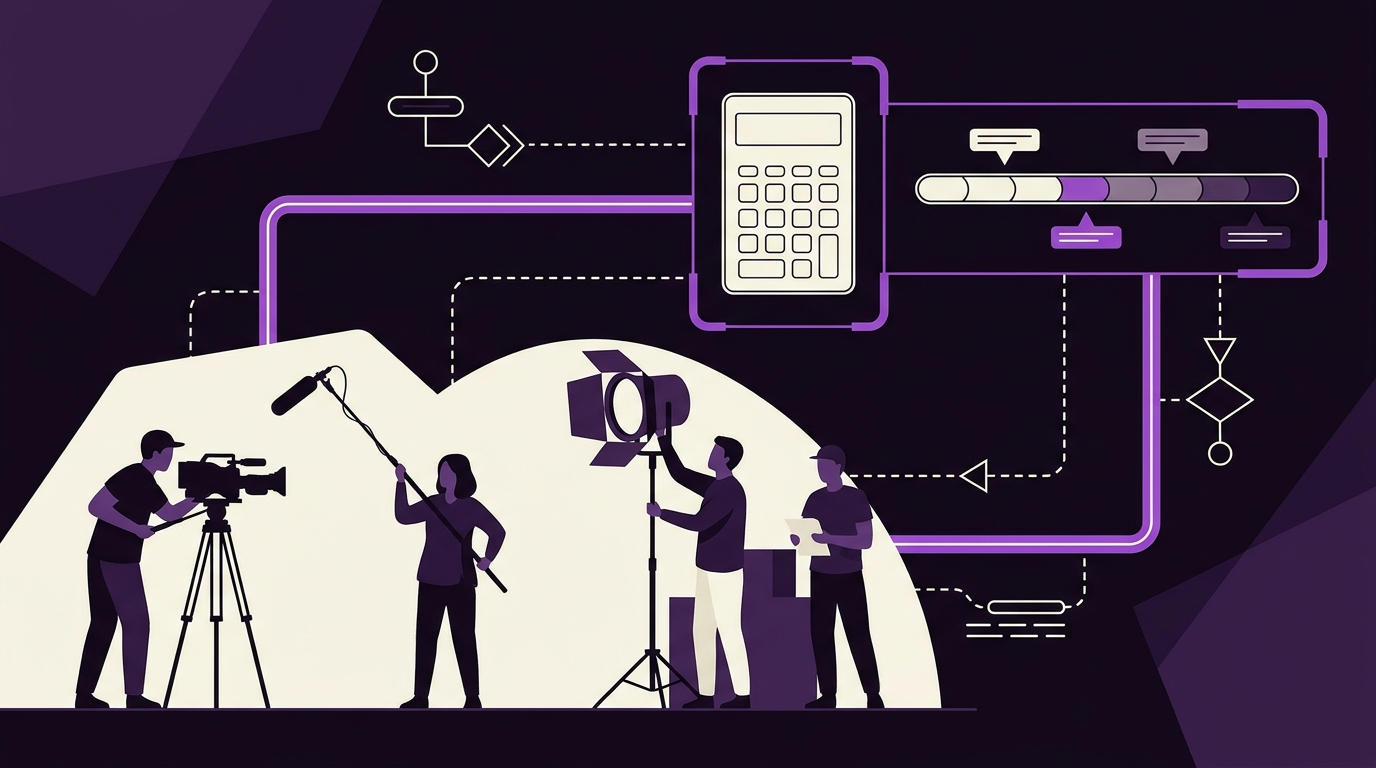
Marketing teams usually buy from a production company, not a gig-marketplace freelancer. Levitate Media (page dated 19 March 2026) points out that the national average of about $961 that shows up for “videographer cost” fits a wedding or a small event, not a multi-camera B2B shoot, and publishes tiers for four project types. Basic means a minimal crew and one location, standard means a professional crew on a full day rate, and premium means a multi-day shoot with a large crew.
Source: Levitate Media videography pricing guide, dated 19 March 2026, read 24 Oct 2026. Levitate is a production company; its ranges describe its own market and are not a quote.
Production companies that publish a price list start lower than those tiers for simpler formats. Lemonlight lists starting prices by video style on its product-video page (read 24 Oct 2026):
💡 Pro Tip: “From” prices are floors. Ask any vendor what the floor excludes: crew days, talent, music licensing, extra cuts and travel are the usual gaps between the starting price and the invoice.
Crew Day Rates Behind a Quote
A production quote is mostly a stack of crew day rates. NeedaCrew publishes non-union 10 to 12 hour day rates as of May 2026 for a typical mid-sized US market, using Los Angeles as the 1.0x city baseline. It adds that union rates typically run 15% to 40% higher.
A four-person crew of a director of photography, a sound mixer, a gaffer and a production assistant adds up to $2,150 to $5,800 for one day before kit fees, talent, locations and post-production (our arithmetic on the ranges above). That is why a solo freelancer at $600 to $1,200 and a crewed production at several thousand dollars are not competing quotes; they are different jobs.
Add-Ons and Line Items That Move the Total
Beyond the base rate, Vidico lists the extras that most often change an invoice:
Travel, overnight lodging, rush delivery, extra edited versions and stock or music licensing are usually billed on top as well, according to Vidico, and none of them has a standard published price. Put each one in writing before the shoot.
Freelancer vs Production Company vs In-House
Who you hire changes the cost as much as what you shoot. Vidico describes three models, and we added the editing-only route for teams that already film their own footage.
💡 Pro Tip: If you publish video every month, price the whole chain, not just the shoot day. A cheap shoot that lands as 4 hours of raw footage still needs, by Vidico’s guide, five to ten editing hours per finished hour, or roughly $300 to $1,500 at $60 to $150 an hour (our arithmetic).
Three Example Budgets Built From the Published Figures
These scenarios are our arithmetic using only the ranges in the tables above. They are not quotes, and each excludes talent, location, travel, music licensing and your own time.
The first two sit in the freelancer market and overlap the $1,500 to $4,000 Vidico range for corporate and live event coverage. The third lands in the low thousands before gear and is the point where production companies start publishing tiers.
Filming vs Editing: Where the Footage Goes Next
Filming is one bill and editing is another, and they are often quoted by different people. If your videographer hands over raw footage, or you shoot in-house, the cut is a separate job with its own price and its own turnaround. We are a video editing agency focused on that second job: editing footage that already exists, at volume, for B2B marketing teams and founders. We have delivered 1,700+ videos for 340+ clients and hold a Clutch 5.0 rating from 12 reviews.
- Increditors – video editing agency for marketing teams that already have footage; named clients include Emerj/The Trajectory, TuMeke, Riley Coleman and Trade with Pat. We do not publish prices on this page.
- Video Editing Company – premium B2B and SaaS retainer editing with dedicated teams; a division of Increditors according to its own About page, so listed here with disclosure.
For a worked example of editing raw shoot footage into a finished piece, see our TuMeke case study or browse all case studies. For editing price benchmarks, read the video editor hourly rates guide and the video editing retainer cost guide.
How to Read and Compare Videography Quotes
A quote you can compare has the same line items as the one next to it. Ask each vendor to answer the same short list:
- How many shoot days, how many crew and which roles?
- How many finished videos, in which lengths and aspect ratios?
- How many editing hours or revision rounds are included, and what does the next round cost?
- Who owns the raw footage and the project files, and is handover priced?
- Are music licensing, travel, talent, location fees and rush delivery in or out?
- What is the delivery date, and what happens if the shoot runs long?
Vidico also advises being upfront about budget so a videographer can shape coverage hours or editing depth to fit it, shooting locally to avoid travel and keeping weekday, off-peak dates flexible. Limiting scope, for example filming the key moments rather than a full day, is the other lever it names.
💡 Pro Tip: Batch interviews into one day. Crew, lighting and setup are the same whether you film one customer or four, so cost per finished testimonial falls fast when you schedule several back to back.
How We Checked These Prices (and Our Disclosure)
Method. On 24 Oct 2026 we opened each source page, copied every published figure and recorded its page date where one is shown. The dataset has 64 rows from 7 sources (Vidico, Upwork, Thumbtack, Levitate Media, Lemonlight, NeedaCrew and the BLS), each with its source URL, saved in our working files. Nothing is estimated; calculations marked “our arithmetic” use only those rows and a 2,080-hour work year.
What we dropped. Wyzowl’s cost guide covers animated explainers rather than videography, the Wyzowl and Lemonlight pricing URLs we first tried returned errors, and Thumbtack’s videographer page was not retrievable, so the $961 average shown comes from Levitate Media’s citation of Thumbtack and is labelled that way. Clutch, Upwork and BLS return errors to scripts and were read in a browser. Upwork pages are undated and Thumbtack’s page is titled “2026 Average Video Production Cost” without a visible edit date.
Disclosure. This guide is published by Increditors, a video editing agency, and includes our own services. Vidico, Levitate Media and Lemonlight are production companies that sell the services they price, so their ranges describe their own markets. Video Editing Company (videoeditingcompany.com) is a division of Increditors according to its own About page. We do not publish Increditors prices.
Frequently Asked Questions
How much does a videographer cost per hour?
On the pages we read on 24 Oct 2026, a mid-tier professional videographer charges $60 to $100 an hour and the freelance range runs $25 to $400 or more by experience (Vidico, page updated 1 Oct 2026). Upwork’s own pages put US videographers at $100 to $150 an hour and UK ones at $50 to $96. Most professionals bill filming by the day, not the hour.
How much does a videographer cost per day?
A mid-tier videographer’s day rate is $600 to $1,200 for 8 to 10 hours of filming, with beginners at $250 to $500 and specialists at $2,000 to $3,500 or more (Vidico). A half day usually costs 60% to 75% of the full day, which is $360 to $900 on the mid-tier rate by our arithmetic. Editing is usually quoted on top.
How much does a corporate videographer cost?
It depends on who you hire. A freelancer covering a corporate event for four to eight hours with a highlight reel runs $1,500 to $4,000 (Vidico). A production company quoting a B2B corporate event runs $4,500 to $25,000 or more and a testimonial video $3,500 to $20,000 or more (Levitate Media, March 2026). The gap is crew size, shoot days and post-production.
Is editing included in a videographer’s price?
Not always. Vidico says most videographers bill filming by the day and editing separately by the hour, at $60 to $150 an hour, and that editing a finished video often takes several times longer than the shoot. A flat project package usually bundles both, so ask for the number of edit hours, revision rounds and finished cuts in writing.
Why do videography quotes vary so much?
Because quotes bundle different things. Thumbtack’s video producers average $600 to $870 a project, while production companies publish starting prices of $1,500 to $10,000 (Lemonlight) and B2B tiers from $3,500 to $60,000 or more (Levitate Media). Crew size, number of shoot days, gear, talent, location and post-production depth explain most of the spread.
Is it cheaper to hire a freelancer or a production company?
A freelancer is usually cheaper for a single local shoot, and a production company costs more but adds a full crew, backup equipment, project management and insurance (Vidico). For steady monthly volume, the cost of an in-house team is high: U.S. median wages are $74,990 for camera operators and $75,420 for editors (BLS, May 2025), before gear.
Verdict: What to Budget in 2026
For a single local shoot, plan on $600 to $1,200 a day for a mid-tier freelance videographer, plus editing at $60 to $150 an hour unless the package says otherwise. For B2B marketing video bought from a production company, budget from $1,500 for the simplest formats and $3,500 to $25,000+ for testimonials, corporate events and brand work, with brand film premium tiers reaching $60,000+. Treat anything outside those bands as a different scope, not a bargain or a rip-off.
Whichever route you take, split the budget into shoot and edit, ask each vendor the same six questions, and re-check the date on every price you rely on. If the shoot is covered and you need the footage cut at volume, you can book a call with our video editing agency.
Changelog: 24 Oct 2026 – first published; 64 figures from 7 sources read on live pages.
About the author
Increditors Team
The Increditors editorial team is made up of working video editors and producers at a video editing agency that has delivered 1,700+ videos for 340+ clients. We publish buyer guides from live vendor pages and say clearly when our own services are included.
Footage Shot and Ready to Edit?
Tell us about your volume and formats and we will put together a custom plan.
Clients, on camera