










![3D Explainer Video - ScribbleLive.mp4_snapshot_00.12_[2022.03.09_03.14.16]](https://increditors.com/wp-content/uploads/elementor/thumbs/3D-Explainer-Video-ScribbleLive.mp4_snapshot_00.12_2022.03.09_03.14.16-r7wb53mx72rxst3qcqyrfxdmeyzb5r9jbl0wbjujh4.png "3D Explainer Video – ScribbleLive.mp4_snapshot_00.12_[2022.03.09_03.14.16]")






























A creative director in video is the person accountable for the overall creative vision — what the video means, how it feels, and whether it connects with the right audience. Unlike a director who executes a single shoot, a creative director shapes the brief, guides every department head, and protects the strategy from the first concept call through to final delivery. Most brands don’t realize they need one until the footage looks polished but says absolutely nothing.
- What Is a Creative Director in Video Production?
- Core Responsibilities: What a Creative Director Actually Does
- Creative Director vs. Director vs. Producer: Key Differences
- How a Creative Director Works With Your Production Team
- The Creative Director’s Role Across Different Video Formats
- Signs Your Brand Needs a Creative Director
- How to Hire or Brief a Creative Director for Video
- Frequently Asked Questions
- Verdict
What Is a Creative Director in Video Production?
A creative director in video production is the senior creative authority on a project — the person who defines what the video needs to communicate, how it should feel to the viewer, and whether every creative decision along the way serves that goal. They sit above the execution layer and operate at the intersection of brand strategy and storytelling craft.
The title borrows from advertising and design, where the creative director role has existed for decades. In a traditional agency, the creative director oversees campaigns across all media. In video specifically, the role has expanded as brands produce more content in-house and commission more complex projects from production partners — explainer series, brand films, product launches, event recaps, social content at scale. Someone needs to hold the vision together across all of it.
That someone is the creative director.
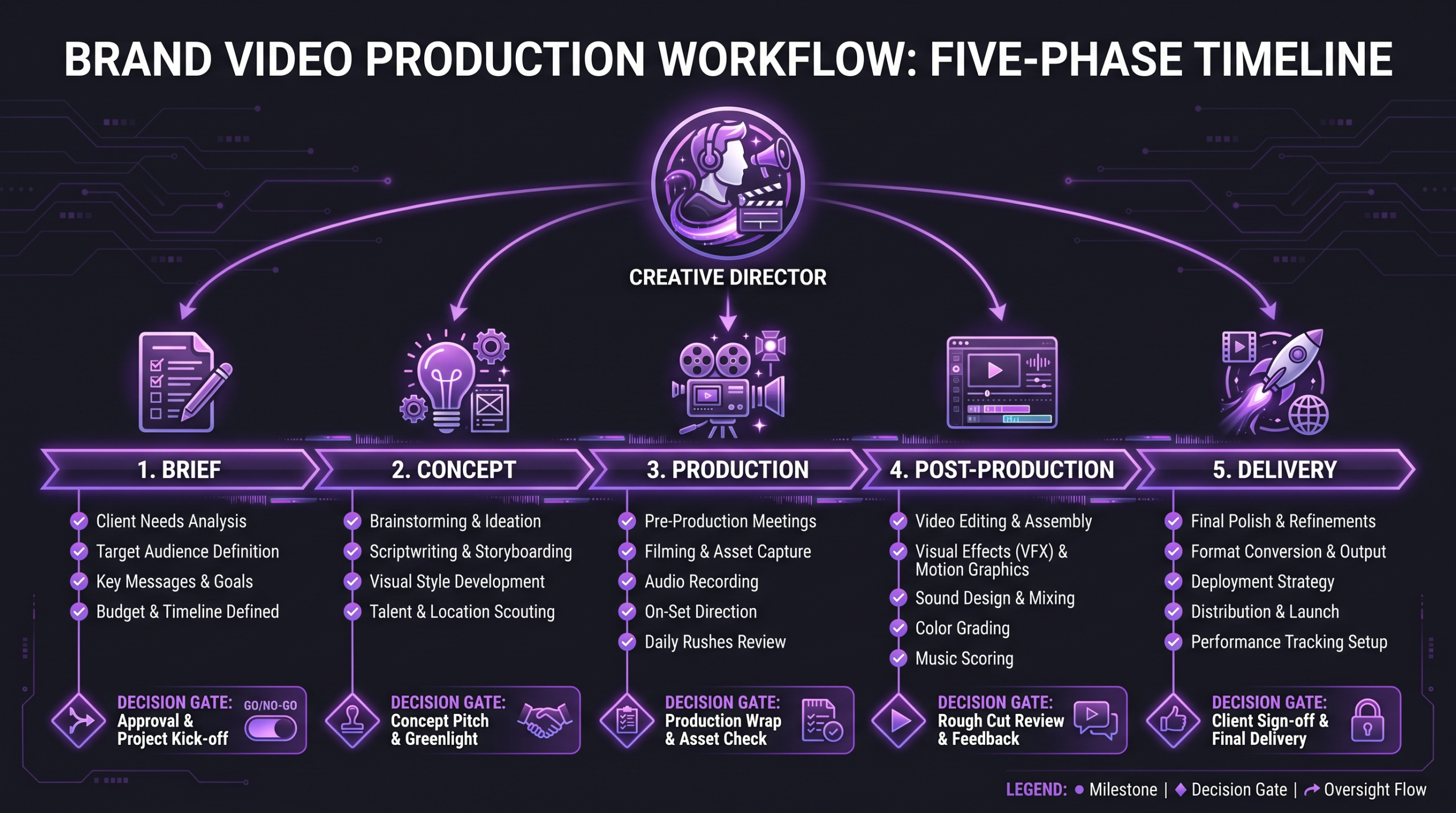
What makes this role distinct is its vertical span. A creative director works before production begins — developing the concept, interrogating the brief, and ensuring the strategy is sound. They work during production — guiding tone, reviewing footage against the vision, and catching drift. And they work in post-production — approving the edit, the music choices, the color grade, the pacing, and whether the final version would actually move an audience to act. This end-to-end accountability is what separates a creative director from any other role on the team.
Where the Role Comes From
The creative director title in video grew out of two traditions. The first is the advertising creative director — the person at an agency who oversees a team of copywriters and art directors and is accountable for the quality and effectiveness of the ideas, not just their execution. The second is the film director — someone with a clear artistic vision who guides every technical department toward a unified result.
In branded video, these two traditions converge. A creative director for video needs the brand-strategic thinking of the advertising tradition — understanding audiences, positioning, messaging hierarchy — combined with the production fluency of the film tradition: knowing how a script translates to camera, how editing rhythm affects emotion, and how sound design shapes perception. This combination is rarer than either skill alone, which is why strong creative directors are genuinely hard to find.
In-House vs. Agency Creative Directors
Larger brands — tech companies, consumer brands with substantial marketing budgets, media companies — often have a creative director on staff whose primary scope is video content. They know the brand deeply, manage internal production resources, and brief external vendors when needed.
Smaller brands and growing companies more commonly access creative direction through a production agency or editing partner. In this model, the senior strategist or lead editor at the agency fills the creative director role — bringing vision and accountability to a project that the brand’s internal team doesn’t have the experience or headcount to lead themselves.
Understanding which model you’re working in matters, because it changes who is accountable for what and where creative decisions get made.
Core Responsibilities: What a Creative Director Actually Does
The creative director’s work falls into five broad areas, each spanning the full production lifecycle. None of them involve picking up a camera or running an edit timeline — the creative director directs the people who do those things, and is accountable for whether the output achieves its goals.
1. Interpreting and Shaping the Brief
Every project starts with a brief — a document or conversation that describes what the client wants, who the audience is, what the video should achieve, and what it should feel like. A creative director’s first job is to read this brief critically and push back on anything that doesn’t hold up.
Briefs written by marketing teams often describe the video they imagine seeing, not the outcome they actually need. “We want a two-minute brand film that shows our culture and makes people want to work here” is a brief about format and subject. A creative director interrogates it: What does your culture actually mean to candidates? What does your current recruiting problem look like — too few applicants, or wrong fit? Who specifically is the target hire, and what do they already believe about companies like yours? The answers to those questions change the creative strategy entirely.
This brief interrogation is one of the highest-value things a creative director does — and one of the first to be skipped when teams rush to production.
2. Developing the Creative Concept
Once the brief is solid, the creative director develops and presents the concept — the core idea that will guide every creative decision. This is not a mood board (though mood boards may come later). The concept is the strategic creative idea: the angle, the emotional promise, the single organizing thought the video will execute around.
In practice, this means writing or commissioning a treatment — a written document that describes how the video will work, what it will feel like, why those choices serve the audience and the goal. A good treatment answers the question: if someone reads this before watching, will they understand why the video works the way it does?
The creative director presents multiple concepts when needed, advocates for the strongest one, and leads the client through the decision with reasoning — not just aesthetics.
3. Guiding Every Production Department
Once a concept is approved, the creative director’s job becomes translating it into decisions across every department: cinematography, set design, wardrobe, casting, music, motion graphics, color grade, and edit structure. Each department head brings their craft — the creative director ensures all of those crafts serve the same vision rather than pulling in different aesthetic directions.
This is particularly critical in post-production, where the edit, the sound design, the grade, and the visual effects are often handled by different specialists. Without a creative director holding the vision, a technically polished edit can still feel like a collection of parts rather than a cohesive piece.
4. Managing the Client Relationship on Creative
The creative director is the primary creative voice in client-facing conversations. They present work, explain rationale, filter feedback, and protect the concept from revisions that would undermine it. This is a delicate balance: good creative directors are deeply receptive to meaningful client feedback while being able to distinguish between feedback that improves the work and feedback that just reflects personal preference.
Without a creative director in this role, client feedback often goes directly to the editor or producer, who may implement it literally without considering whether it serves the concept. The result is a video that reflects the latest round of comments rather than the original strategy.
5. Final Approval Authority
On well-run projects, the creative director holds final approval over creative deliverables before they go to the client. This is a quality gate, not a bureaucratic step. The creative director watches the final cut against the brief and the approved concept and asks: does this do what we said it would do? If not, it goes back to the editor. This accountability is the difference between a production team that ships volume and one that consistently ships work that performs.
💡 Pro Tip: The most common failure mode in branded video isn’t poor execution — it’s a solid execution of the wrong concept. A creative director exists to catch that mismatch before it costs you a full production budget.
Creative Director vs. Director vs. Producer: Key Differences
These three roles are frequently confused — sometimes because job titles vary by company, sometimes because smaller productions combine roles. Understanding the distinction helps you know who to bring in and what authority each role carries.
The clearest way to think about it: the producer answers “how do we make this happen?” The director answers “how do we capture this on camera?” The creative director answers “what are we actually trying to say and does everything we’re doing serve that?”
When One Person Holds Multiple Roles
On smaller productions, a single person often carries two or even all three of these roles simultaneously. A director-producer is common in commercial production; a creative director who also directs is common in agency environments. This isn’t a problem as long as the responsibilities are clearly understood and the scope doesn’t create quality blind spots.
The risk comes when the creative director role isn’t held at all — when a project has a producer coordinating logistics and an editor executing cuts but no one accountable for whether the output actually works strategically. That gap is where branded video most often disappoints.
The Creative Director’s Relationship With the Editor
Post-production is where the creative director’s influence is often most consequential and least understood by clients. The edit is not just assembly — it’s the final creative act, where pacing, structure, and tone are built from raw material. A creative director works closely with the lead editor in post, not to micromanage the timeline, but to ensure the structural choices serve the story: which interview moments carry the most weight, where the emotional peak should land, which footage should be cut entirely even if it was expensive to capture.
Editors working without creative direction commonly over-include footage (because cutting footage feels wasteful) and under-structure the narrative (because structure requires a point of view about what the video is for). Creative directors provide both — the permission to cut and the point of view that guides the cut.
At Increditors, a video editing agency working with B2B brands and content creators, the senior editorial team plays this creative direction role on every project — reviewing cuts not just for technical quality but for strategic alignment with the original brief.
How a Creative Director Works With Your Production Team
A creative director’s effectiveness depends on how they’re integrated into the production structure. This varies significantly between in-house, agency, and hybrid setups — and getting it right is worth more than most people expect.
The Brief-to-Concept Handoff
The first formal touchpoint in any project is the creative brief review. The creative director should be in the room (or on the call) when the brief is first presented by the client. Not because they’ll have all the answers immediately, but because hearing the client’s own language, hesitations, and unspoken priorities is essential context that gets lost when briefs are relayed secondhand.
After that conversation, the creative director takes a defined period — typically a few days for complex projects — to develop the creative response: concepts, treatments, reference references, creative rationale. This is not a brainstorm; it’s a considered creative proposal backed by strategic reasoning.
During Pre-Production
Once the concept is approved, the creative director briefs every department head: the director of photography on the visual language, the casting team on who fits the concept, the production designer on the environment and props, and the editor on the post-production strategy (especially important when the edit structure needs to be planned before footage is captured).
The creative director also contributes to script review (for scripted content) or interview question development (for documentary-style pieces), ensuring the questions will surface the moments that the edit needs.
On Set (When Relevant)
For high-stakes productions, the creative director attends the shoot. They’re not there to direct — that’s the director’s domain — but to watch. They observe whether performances feel genuine, whether the footage will cut together the way the concept requires, and whether unexpected opportunities arise that should be captured. The creative director can redirect a shoot when something isn’t working at the conceptual level, a call the director may not have authority or perspective to make.
For productions handled remotely — which describes a large share of branded video today, especially content for digital channels — the creative director reviews dailies (raw footage) rather than attending in person, and gives structured feedback that shapes how the footage is used in post.
Through Post-Production
Post-production is where most of the creative director’s decisions happen in branded video — because most branded video is more edit-driven than shoot-driven. The creative director reviews each significant version of the cut: rough assembly, first cut, fine cut, and picture lock. At each stage, feedback is given in terms of the concept, not just the mechanics: “This interview section needs to come before the B-roll montage — we need to establish the problem before we show the solution” rather than “move the clip at 1:24 to earlier.”
The creative director also approves or directs the music brief, the color grade direction, and the motion graphics style — each of which carries significant tonal weight in a finished video.
💡 Pro Tip: Give your creative director genuine authority to protect the concept from scope creep in feedback rounds. A creative director who can only say “here’s what the client asked for” but can’t push back is functioning as a project manager, not a creative lead — and that’s a costly role for the wrong job.
The Creative Director’s Role Across Different Video Formats
The creative director’s involvement changes in character — though not in importance — depending on what kind of video is being made. Here’s how the role adapts across the most common branded video formats.
A Note on Social and Short-Form Video
Short-form video — Reels, TikTok, YouTube Shorts — might seem like it needs less creative direction, since the format is short and the production is lightweight. The opposite is often true. The creative challenge is harder: you have less time to earn attention, and the content landscape is noisier. A creative director working on short-form content focuses intensely on the hook (the first two seconds), the format convention (what the platform audience expects vs. what will surprise them in a useful way), and the repeatable series logic that drives consistent performance over time.
Research from platforms including Think with Google consistently shows that creative quality — the idea behind the video, not just the production value — is the primary driver of video ad performance. Creative direction is where that quality lives.
Signs Your Brand Needs a Creative Director
Most brands don’t start a project by asking “do we have creative direction?” They start by asking “who’s making the video?” The absence of creative direction often goes unnoticed until the final cut comes back — and something feels wrong that nobody can quite name.
Here are the signals that creative direction is missing:
Your Videos Look Fine but Don’t Land
Production quality is high — good camera, clean audio, competent editing — but the videos don’t drive action, engagement, or brand recall. This is almost always a creative strategy problem. The execution is solid; the idea underneath it is weak or absent. A creative director works at the idea level, not the execution level.
Feedback Rounds Go in Circles
When a video goes through four or five rounds of revisions and still doesn’t feel right, it usually means the creative concept was never fully resolved — and the edit is trying to compensate for it by moving clips around. A creative director resolves concept questions before the edit starts, so revision rounds are specific and finite rather than open-ended.
Your Content Has No Consistent Visual Identity
Each video looks like it was made by a different team — because it was, or because there was no creative oversight to establish and maintain consistent visual language across pieces. Creative directors define the rules: color palette, typography in motion, lighting treatment, editing rhythm, music character — and enforce them across a content program.
You’re Spending More on Production Than You Need To
Budgets get inflated when strategy is unclear. If no one has defined what the video needs to do, teams compensate by adding more production: more shoot days, more locations, more motion graphics. A creative director can often reduce production cost by identifying the simplest version of the concept that achieves the goal — which is almost always better than the most expensive version.
For a detailed view of what video production costs at different levels, the guide to professional video editing costs breaks down where budget goes and how creative decisions affect it.
You’re Scaling a Content Program
Once a brand moves from occasional video to a consistent content program — weekly social content, a multi-episode series, a full-funnel video library — the need for creative direction becomes structural. Without it, the program loses coherence as different editors, writers, and contractors contribute. A creative director provides the system: the creative standards, the format rules, the approval gates that keep a high-volume program consistent.
According to Wyzowl’s annual video marketing report, a growing share of marketing teams now produce video on a weekly or near-daily basis. At that cadence, ad-hoc creative decision-making doesn’t scale — structured creative direction does.
How to Hire or Brief a Creative Director for Video
Whether you’re hiring an in-house creative director or engaging one through a production partner, the evaluation criteria and the briefing process matter more than the job title.
What to Look for in a Creative Director’s Portfolio
A strong creative director’s portfolio doesn’t just show beautiful videos — it shows a variety of problem-solving. When reviewing work, ask: does this person’s work have a consistent point of view, or does each piece look like a different director? Can they explain why each creative choice was made in terms of the audience and the goal, not just the aesthetic? Have they done work comparable in context to yours — same industry, similar budget range, similar audience sophistication?
The ability to explain the concept behind a piece of work is as important as the work itself. A creative director who can only say “it looked good” is relying on taste, not strategy — and taste doesn’t scale or repeat.
Resources like MasterClass’s guide to the creative director role offer useful framing on what separates strong creative direction from pure craft — worth reading before any interview process.
Key Interview Questions
When evaluating a creative director for video, the most revealing questions are situational:
Tell me about a time a client’s brief was wrong — and how you handled it. This surfaces their confidence in strategic thinking and their ability to have difficult creative conversations.
Walk me through your revision process for a project where the first cut wasn’t right. This shows how they diagnose creative problems vs. just escalating feedback.
How do you know when a video is done? Strong creative directors answer this by referencing the brief and the audience, not the client’s approval. The benchmark is whether the video does its job, not whether everyone signed off.
Briefing a Creative Director Effectively
A creative director can only be as good as the brief they’re given. The most effective briefs for creative directors include five things: (1) the specific audience, described in terms of what they already believe; (2) the single job the video needs to do; (3) the context in which it will be watched; (4) what “success” looks like in measurable terms; and (5) what the brand genuinely can’t or won’t do (brand guardrails).
What a brief should not include: the solution. Describing the video you imagine watching removes the creative director’s ability to find a better answer. Brief on the problem, then trust the creative director to solve it.
For B2B brands producing video content at scale — SaaS companies, professional services firms, enterprise brands — the discipline of creative direction becomes even more critical. The guide to video editing for SaaS companies explores how this plays out specifically in product-led growth contexts.
Creative Direction as a Service
For brands that don’t produce enough volume to justify a full-time creative director, the most practical option is to embed creative direction into your production partnership. When you work with a senior-led editing and production team, creative direction is part of the engagement — the senior editor or account lead isn’t just executing your brief, they’re challenging it, shaping it, and protecting it through delivery.
This is the model that makes the most economic sense for most growing brands: access to strategic creative thinking without the overhead of a full-time hire. HubSpot’s video marketing research consistently finds that brands which invest in creative quality — not just production volume — see stronger ROI from video as a channel. Creative direction is the mechanism through which that quality is built.
Frequently Asked Questions
What is the difference between a creative director and a video director?
A video director is responsible for what happens on set — performances, camera angles, shot coverage, and real-time decisions during the shoot. A creative director is responsible for the overall vision: what the video is for, what it says, and whether it achieves its strategic goal. The director executes within the creative director’s approved concept. On smaller productions, one person may hold both roles, but the responsibilities remain distinct.
Does every video project need a creative director?
Not formally — but the function needs to exist in some form on any project where the outcome matters. A one-person video creator who writes, shoots, and edits their own content is acting as their own creative director. The role becomes critical when multiple people are involved, when the budget is significant, or when the video is part of a broader brand or marketing strategy. Without it, decisions made in isolation by different specialists rarely add up to a coherent whole.
Can a project manager or producer fill the creative director role?
Generally no — not because producers aren’t talented, but because the role requires a specific kind of strategic creative judgment that most producers aren’t hired or structured to provide. Producers are accountable for delivering the project on time and on budget; creative directors are accountable for whether the delivered project achieves its creative and strategic goals. These accountabilities can conflict, which is another reason the roles are usually separated.
How much does a creative director for video cost?
This varies widely based on market, experience, and engagement model. Freelance creative directors working on individual projects typically charge day rates that vary significantly by market and specialization — project rates are also common. Full-time in-house creative directors at mid-market brands tend to sit in the senior management compensation band. When creative direction is embedded in a production agency retainer, it’s included in the overall engagement cost rather than billed separately. For a broader view of video budget allocation, see the breakdown of professional video editing costs.
How do I know if a creative director is right for my brand’s video needs?
The clearest signal is whether your current video output reflects a consistent strategic point of view, or whether it looks like a collection of individual deliverables. If you find yourself constantly explaining your brand identity to new vendors, struggling to maintain visual consistency across content, or shipping videos that perform below expectation despite solid production value — those are signs the creative direction layer is missing. Engaging a senior creative partner or building the function internally is the appropriate response, depending on your scale and production volume. Platforms like Indeed’s career resource on creative directors provide useful benchmark context on what the role typically encompasses.
Verdict: The Role That Makes Video Work
A creative director in video is not a luxury for large productions or high-budget campaigns. It is the function that makes video strategic rather than merely decorative — the role that connects what a brand needs to say with how a video makes someone feel, and holds that connection intact across every production decision from brief to delivery.
The failure to account for creative direction is one of the most consistent and avoidable reasons branded video underperforms. Brands invest in cameras, editors, animators, and distribution — but skip the strategic creative layer that gives all of those investments a coherent purpose. The result is technically competent work that doesn’t move anyone.
If you’re building a video content program of any meaningful scale, the question isn’t whether you need creative direction — it’s how you’re going to get it. In-house hire, embedded agency relationship, or fractional engagement: each can work. What doesn’t work is assuming that creative direction will happen by itself when smart people are in the room.
It doesn’t. Someone has to own it.
Ready for Video That Actually Converts?
Tell us about your project and we will put together a custom plan.