






![3D Explainer Video - ScribbleLive.mp4_snapshot_00.12_[2022.03.09_03.14.16]](https://increditors.com/wp-content/uploads/elementor/thumbs/3D-Explainer-Video-ScribbleLive.mp4_snapshot_00.12_2022.03.09_03.14.16-r7wb53mx72rxst3qcqyrfxdmeyzb5r9jbl0wbjujh4.png "3D Explainer Video – ScribbleLive.mp4_snapshot_00.12_[2022.03.09_03.14.16]")




















Most DTC brands get raw creator clips — and most of those clips never reach their ad potential because the editing is wrong. This guide ranks the best UGC editing services for direct-to-consumer brands in 2026, compares what each costs and who they are for, and shows you how to brief an editing team so your UGC actually converts on Meta and TikTok.
- What UGC Editing Means for DTC Performance Marketing
- 7 Criteria for Choosing a UGC Editing Service
- Best UGC Editing Services for DTC Brands (Ranked 2026)
- UGC Editing Pricing: What DTC Brands Actually Pay
- How to Brief Your UGC Editor for Better Ad ROAS
- 5 UGC Editing Mistakes That Kill DTC Ad Performance
- Frequently Asked Questions
- Verdict: Which UGC Editing Service Is Right for You?
What UGC Editing Means for DTC Performance Marketing
User-generated content for DTC brands is not the same as organic social UGC for brand awareness. In a direct-to-consumer performance marketing context, UGC means raw clips from paid creators, micro-influencers, or actual customers — footage shot on a phone in someone’s kitchen or while unboxing a package on their couch. The job of a UGC editing service is to take that raw, authentic footage and engineer it into a high-converting paid ad without killing the authenticity that made it worth shooting in the first place.
Partnering with an experienced video editing company that specializes in performance-driven UGC means the difference between raw creator clips that blend into the feed and polished ads that stop the scroll and drive real ROAS.
That is a fundamentally different skill set from traditional video editing. It requires editors who understand hook structure, caption psychology, platform-native pacing, and the creative metrics that matter to a media buyer — hook rate, two-second view rate, and click-through rate. Most general editors are trained to tell visual stories. UGC editors for DTC brands are trained to stop thumbs and drive conversions.
The Raw-to-Ad Gap: Why Unedited UGC Underperforms
Raw UGC footage commonly arrives with a 30–90 second introduction before the creator says anything useful, shaky camera work in the first five seconds, no captions, incorrect aspect ratios, and no clear call to action. Publishing this footage without editing is not “authentic” — it is just unfinished. Good UGC editing preserves the creator’s voice and on-camera personality while adding the structural elements that turn a clip into a performing ad unit.
A well-edited UGC ad for a DTC brand typically includes: a hook cut in the first two seconds that leads with the benefit or a pattern-interrupt, dynamic captions synced to speech, b-roll inserts showing the product in use, a sound bed or trending audio layer where platform rules allow, and a branded end card with a clear CTA. None of this is complex — but it requires an editor who knows DTC ad structure and can execute at the pace a growth-stage brand demands.
Why DTC Brands Need a Dedicated UGC Editing Workflow
A DTC brand scaling on Meta and TikTok is typically testing dozens of creative variants per month. According to Meta for Business creative guidance, creative fatigue sets in fast in performance campaigns — brands running volume tests commonly cycle through multiple hooks, multiple formats, and multiple audience angles for each core product claim. That volume makes a general videographer relationship economically inefficient. A UGC editing service designed for DTC brands operates more like a production line than a boutique studio — delivering consistent quality at the creative volume a performance-media budget requires.
This post is specifically about UGC editing — post-production of existing creator footage. The distinction from full creative production is worth stating clearly. We have covered full-service video ad production agencies in our guide to the best video ad creative agencies. UGC editing services occupy a different slot in the workflow: they receive footage already shot by creators and turn it into ad-ready deliverables. That makes them faster and cheaper than a full creative production engagement — but they are only as good as the UGC footage they receive.
7 Criteria for Choosing a UGC Editing Service
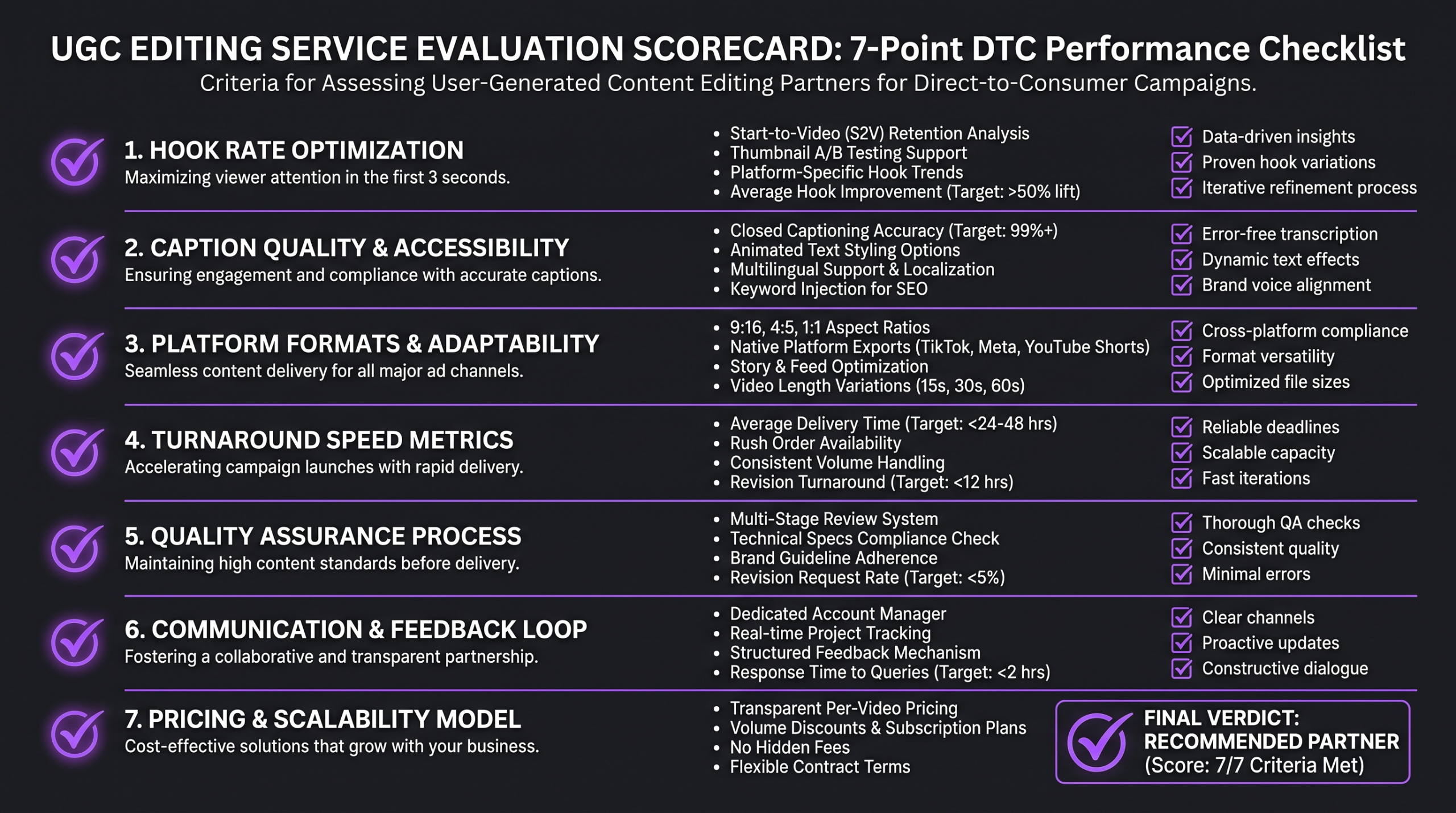
Not every video editing subscription or agency can handle DTC UGC editing at a performance-marketing standard. Before evaluating specific services, align your team on these seven criteria — they are what separate a general editing vendor from a UGC partner that moves your ROAS.
1. Platform-Native Deliverable Formats
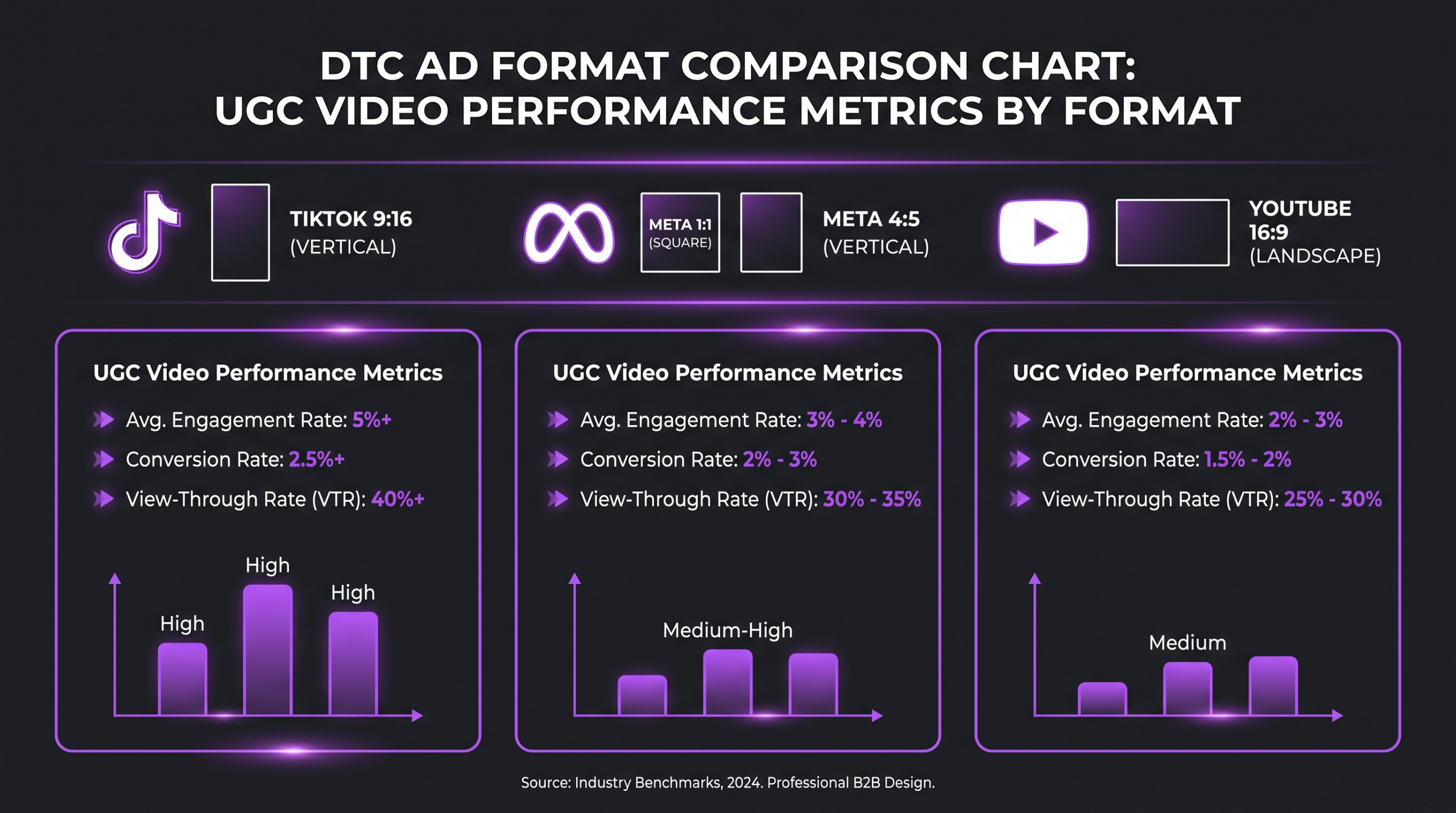
A UGC editing service should deliver 9:16 vertical for TikTok and Reels, 1:1 square and 4:5 portrait for Meta feed, and 16:9 for YouTube pre-roll — without you having to re-specify this for every job. Ask prospective partners whether format variants are included in the base deliverable or priced separately. Services that charge per format discourage the creative testing that DTC brands depend on.
2. Hook-First Editing Knowledge
The first two seconds of a UGC ad on TikTok for Business or Meta determines whether the rest of the video gets viewed. Your UGC editor needs to instinctively re-cut footage to lead with the hook — the benefit statement, the surprising moment, or the visual pattern-interrupt — not the creator’s intro. Ask for examples of how they approach hook selection when the raw footage starts slow (and most does).
3. Caption and Subtitle Quality
Sound-off viewing is the norm on mobile. Data from social media analytics platforms consistently shows that captions improve completion rates across short-form video. For DTC UGC ads, captions are not optional — they are the difference between a clip being understood and a scroll. Look for services that include animated or auto-synced captions natively, not ones that treat it as a billable add-on.
4. Turnaround Speed and Revision Policy
DTC media buyers do not wait two weeks for a creative. Standard turnaround expectations for UGC editing services in 2026 run 24–72 hours for standard deliverables. Ask about revision rounds included in base pricing and whether rush delivery is available for live campaign needs. Unlimited revision models sound appealing but often create bottlenecks — a defined two-round revision cycle with clear scope is typically more predictable than open-ended revisions.
5. Ad-Specific Sound Design
Sound design for DTC UGC ads spans background music beds, product sound design, voiceover layering, and trending audio matching where platform licensing allows. A service that delivers video-only exports without consideration for the audio layer is delivering half a product. Check whether music licensing for ad use is included in their pricing or whether tracks must be separately cleared — this is a hidden cost that catches many DTC brands off-guard.
6. Creative Variant Volume
DTC performance marketing teams typically need multiple hook variants from the same core clip — same creator footage, three different openings — to A/B test on Meta. A UGC editing service that only delivers one cut per clip significantly limits your testing capacity. Ask specifically: “From one creator clip, how many variants can you deliver, and what does that cost?” A service that charges per variant at full price disincentivizes the testing cadence that performance creative demands.
7. DTC and E-Commerce Context Awareness
An editor who has worked in DTC e-commerce understands product benefit hierarchy, objection handling in creative, and how to frame a purchase CTA without sounding pushy. This is different from editing brand-awareness or entertainment content. Ask for examples from DTC brands specifically — skincare, supplements, home goods, fashion — not just generic corporate video or social media content.
Best UGC Editing Services for DTC Brands (Ranked 2026)
We evaluated services based on editorial quality for performance ads, platform-native deliverable options, turnaround, revision policy, and fit for DTC e-commerce brands at different growth stages. Pricing references use publicly available information or hedged industry benchmarks where exact pricing is not published.
#1 Increditors — Best UGC Editing for DTC Performance Ads
Increditors is a specialist video editing agency built around performance creative — the kind of post-production that directly supports paid media results. What distinguishes Increditors in a UGC editing context is the editorial team’s depth of experience with DTC ad formats: they understand hook rate as a KPI, not just a buzzword, and they structure every edit to maximize the first-two-second retention window that determines ad performance on Meta and TikTok.
Their UGC editing workflow treats each creator clip as a raw asset to be engineered into multiple creative variants — different hooks, different pacing, different CTA approaches — rather than delivering a single edited version and calling it done. For DTC brands in growth mode, that variant-first thinking is what keeps creative testing pipelines full without burning out the production team. Increditors also brings a strategic layer to the editing relationship — advising on which hook structures to test based on what is working in the category, not just executing whatever the brief says.
Best for: DTC brands spending $30K+ per month on paid social who need consistent creative volume and performance-oriented editing strategy, not just output.
Turnaround: typically 24–48 hours for standard UGC edits
Model: custom retainer (engagement starts with a discovery call)
Pros: senior editorial team, variant-first workflow, DTC ad strategy layer included, dedicated account management
Cons: not the right fit for brands testing paid social for the first time with minimal creative budgets
Rating: 9.4/10
#2 VideoEditingCompany — Best for B2B and SaaS Retainer Teams
VideoEditingCompany operates as a premium B2B/SaaS-focused video editing retainer service with dedicated editorial teams and structured monthly workflows. Their strength is in enterprise-grade reliability and consistent output quality under a retainer model — making them a strong option for companies with steady, predictable video editing volume across corporate, SaaS product, and brand content.
For DTC brands specifically, VideoEditingCompany is best suited to those that have an established creative direction and need a retainer partner to execute reliably at volume rather than advise on direct-response strategy. Their editorial process is structured and professional, though their primary positioning leans more toward business video content than performance-first UGC ad creative. DTC brands with complex brand standards and structured editorial needs will find the retainer model fits their workflow well.
Best for: B2B/SaaS companies and enterprise DTC brands with structured retainer needs and established creative direction
Pricing: retainer plans typically start around $1,500/month (estimated, confirm directly)
Pros: dedicated editor teams, reliable retainer output, strong client onboarding process
Cons: less specialized in performance-first DTC UGC ad creative; better positioned for brand video than direct-response
Rating: 8.5/10
#3 Vidchops — Best Subscription Option for High-Volume Social Clips
Vidchops is a subscription-based video editing service known for fast turnaround and content-creator-friendly pricing. They serve YouTube creators, social media managers, and smaller DTC brands who need reliable editing at a monthly price point that works for lean teams. Their workflow is straightforward: upload footage, receive an edited video, request revisions.
For DTC UGC specifically, Vidchops works well for brands whose creative strategy is already defined and who need execution support at volume. The trade-off is that their editorial teams are generalists — they edit competently, but do not bring DTC performance marketing knowledge to the table. You will need to brief hooks, captions, and platform specs explicitly rather than rely on an editor who thinks in ad structure by default. This is not a criticism — it is a scope reality that affects how you manage the relationship.
Best for: content creators and small DTC brands needing affordable high-volume editing
Pricing: subscription plans typically start around $495/month (estimated)
Pros: fast turnaround, affordable entry, predictable monthly cost
Cons: generalist editors not specialized in DTC ad creative; creative strategy input is not part of the service
Rating: 7.2/10
#4 QuickFrame — Best Marketplace for On-Demand Creative Production
QuickFrame (acquired by MNTN) operates as a managed video production marketplace connecting brands with a network of vetted filmmakers and editors. Their platform is oriented toward enterprises that need on-demand creative production rather than ongoing editing retainers. For UGC editing specifically, they can match brands with editors who specialize in social and ad creative from their network.
The marketplace model introduces more production overhead — briefing, matching, and revision cycles take longer than a dedicated retainer relationship. QuickFrame is better suited to brands with occasional high-quality creative needs rather than DTC brands running ongoing creative testing pipelines. That said, their quality ceiling is high and their network is large, which makes them useful for one-off campaigns or seasonal creative bursts.
Best for: enterprise brands with project-based UGC and ad creative needs
Pricing: per-project pricing, typically starting around $500 and scaling with scope (estimated)
Pros: large vetted editor network, high quality ceiling, enterprise account management
Cons: longer turnaround than retainer services; marketplace overhead; not suited for ongoing DTC creative testing pipelines
Rating: 7.5/10
#5 Vidsy — Best UGC Platform for Creator-Integrated Brands
Vidsy is a UK-based platform that combines UGC creator sourcing with editing and creative strategy under one roof. They serve global brands who want the UGC creation and editing workflow managed in a single platform rather than coordinating separate creator and editing relationships. Their platform is particularly useful for brands running multi-market UGC campaigns across TikTok, Meta, and YouTube Shorts who need both creator and post-production in one engagement.
For DTC brands, Vidsy is best when the bottleneck is both creator sourcing AND editing — not editing alone. Their deliverables are solid with platform-native formats and performance ad awareness. The trade-off is campaign-based pricing, which can make ongoing creative testing more expensive than a dedicated editing retainer when volume is high.
Best for: global DTC brands who need integrated UGC creation and editing in one relationship
Pricing: campaign-based, typically starting around $2,000 per campaign (estimated)
Pros: creator plus editing in one platform, strong global creator network, platform-native creative focus
Cons: campaign pricing not ideal for high-frequency testing; less agile than a dedicated editing retainer at volume
Rating: 7.8/10
#6 Billo — Best for Bootstrapped DTC Brands Needing Creator Plus Light Editing
Billo is a UGC creation platform that connects DTC brands with micro-creators for product review content, with light editing and delivery included. It is oriented toward early-stage DTC brands who need authentic creator content at low cost rather than performance-grade post-production. The editing layer in Billo is intentionally light — the platform assumes you want raw, authentic footage with minimal polish, which is philosophically correct for organic social but limiting for paid ad performance.
For brands in early product testing phases where real creator reviews matter more than polished ad creative, Billo provides strong value. For brands actively scaling paid social and testing creative performance, the editing depth is insufficient — you will typically need to supplement Billo’s output with a dedicated editing service to transform those clips into high-performing ad units.
Best for: bootstrapped DTC brands needing affordable UGC for organic use and light paid testing
Pricing: per-video pricing, typically starting around $59 per video (estimated)
Pros: affordable, fast creator sourcing, authentic feel, low barrier to entry
Cons: editing is light and not optimized for direct-response paid ads; requires supplemental editing for scaling campaigns
Rating: 7.0/10
💡 Pro Tip: When evaluating UGC editing services, ask to see their reel filtered to DTC e-commerce specifically — not just “social media” or “branded content.” The editing approach for a lifestyle brand’s Instagram and a DTC brand’s Meta paid campaign are fundamentally different. The reel will reveal whether they understand the distinction before you sign anything.
UGC Editing Pricing: What DTC Brands Actually Pay
Pricing for UGC editing varies significantly by model, volume, and service depth. The table below reflects hedged industry benchmarks — specific service pricing should always be confirmed directly with the vendor. For TikTok-specific creative cost context, see our 2026 TikTok ad creative cost benchmarks. For a broader video editing pricing breakdown, see our professional video editing cost guide.
The most common budget anchor we hear from growth-stage DTC marketing directors: “We spend more on a single day of paid social than we spend on a month of editing.” That math is worth taking seriously. If well-edited UGC creative meaningfully improves CTR and lowers CPM, the return on a performance-grade editing retainer can often be recovered within a few weeks of testing, not quarters. The risk is not overpaying for editing — it is underpaying and letting a flat or declining ROAS persist without investigating the creative layer.
According to Shopify’s e-commerce research, creative quality consistently ranks among the top controllable levers for DTC brand growth at scale — above targeting and above bid strategy for brands with sufficient data. The editing layer is where most brands leave the most performance uncaptured because it is easy to underinvest in post-production when the media spend itself feels like the “real” cost.
How to Brief Your UGC Editor for Better Ad ROAS
The quality of your UGC editing output is directly proportional to the quality of your brief. A senior DTC editor with a vague brief will produce a good video. The same editor with a well-structured brief will produce a high-performing ad. These are different outcomes. Here is how to brief specifically for DTC performance results.
The Hook-First Brief
Every UGC editing brief should start with the hook. Before you describe the product or the creator, answer: “What should the viewer see, hear, or read in the first two seconds?” Specify whether you want a benefit statement hook (“My skin cleared up in three weeks”), a question hook (“Is your sunscreen actually working?”), a visual pattern-interrupt such as a before-and-after cut, or a social proof hook like a highlighted testimonial line. When you define the hook type, the editor knows how to restructure the raw footage — and if the footage does not contain that hook moment, they can flag it before editing rather than delivering a version you will reject in revision.
The Platform Spec Sheet
Your brief should include a deliverable spec sheet covering: platform (TikTok, Meta feed, Meta Stories, YouTube Shorts), aspect ratio, maximum video duration per platform, caption style preference (kinetic, static, auto-generated sync), music bed requirements and any licensing constraints, brand end card (included asset or editor-created), and the number of hook variants required from each clip. Later’s social media resource hub provides regularly updated platform specs if your team needs a current technical reference. Ambiguity in a spec sheet creates revision cycles; a one-page spec eliminates most of them.
Reference Ads and Performance Benchmarks
Include two to three reference ads in your brief — ads from your own past performance or from Meta’s Ad Library that reflect the creative direction you are testing. Describe specifically what you want from each reference: the caption rhythm from this one, the pacing from that one, the hook structure from the third. Specific direction produces specific output. “Make it feel like this” produces guesswork.
💡 Pro Tip: Before sending raw footage to your editor, watch through it once and timestamp the best moments — the clearest benefit statement, the most authentic reaction, the most compelling product moment. Editors can find these moments themselves, but a timestamp guide cuts editing time significantly and improves hook selection accuracy on the first pass.
5 UGC Editing Mistakes That Kill DTC Ad Performance
These five editing mistakes account for most of the avoidable performance losses we observe in DTC creative programs. None require advanced editing skill to fix — they require awareness of what paid social actually demands from a UGC edit.
Mistake 1: Keeping the Creator’s Intro
Creators naturally introduce themselves when they start recording. “Hey guys, it’s me, I’m back with another video — today I’m going to be talking about…” is the single most reliable hook-killer in DTC UGC. Viewers on paid platforms did not choose to watch your ad — they are scrolling. The first recognizable “intro cadence” signals “this is an ad I can skip” and triggers the scroll reflex. Every UGC edit for a paid placement should cut into the moment the creator says something genuinely interesting about the product — not before.
Mistake 2: Wrong Aspect Ratio for the Platform
Cropping a 16:9 horizontal video for TikTok and calling it a vertical ad is one of the most visible signals that a brand is not native to the platform. TikTok viewers recognize black bars immediately as out-of-platform content. Always deliver 9:16 for TikTok and Reels, 1:1 for Meta feed. If UGC footage was shot horizontally, a DTC-experienced editor knows how to reframe it using tracking and crop — but they need the platform destination specified in the brief from the start, not after delivery.
Mistake 3: Skipping Captions
Social platforms consistently report higher video completion rates for captioned content than for non-captioned equivalents on mobile. For performance ads where a spoken claim is the primary selling point — “this foundation covered my redness after one application” — a viewer watching on mute cannot receive the message at all without captions. Captions are not an accessibility add-on in performance marketing; they are a conversion lever. Any UGC editing service that treats them as optional is not calibrated for DTC paid social.
Mistake 4: Over-Polishing the UGC
The value of UGC in DTC advertising is authenticity — a real person, in a real setting, genuinely talking about a product. When editors over-polish UGC — heavy color grading, corporate logo overlays, over-produced motion graphics that belong in a brand video — they strip out the authenticity that made the content worth creating. The benchmark for UGC editing polish is: viewers should feel like they are watching a real person’s content, not a brand production. Editing serves the content; it does not replace it.
Mistake 5: Delivering One Version Per Clip
Creative testing on Meta and TikTok requires creative variants to generate meaningful performance data. Delivering one edited version of each creator clip and expecting it to perform across all audience segments and placements wastes the testing opportunity entirely. Best-practice DTC creative teams extract at least two to three hook variants per creator clip — same footage, different opening cuts — to understand which hook structure resonates with which audience. Ask your editing service whether multi-variant delivery is part of their standard workflow. For additional context on structuring high-volume video editing workflows across platforms, see our guide to video editing services for YouTube creators.
Frequently Asked Questions
What is UGC editing for DTC brands?
UGC editing for DTC brands is the post-production process of taking raw footage from creators, micro-influencers, or customers and turning it into performance-ready ad creative for paid social platforms like Meta and TikTok. This includes structuring hooks in the first two seconds, adding captions, selecting and inserting b-roll, layering audio, formatting for platform-specific aspect ratios, and delivering creative variants for A/B testing. It is distinct from general video editing in that every decision is optimized for direct-response advertising outcomes — hook rate, watch time, and click-through rate — rather than storytelling or brand awareness.
How long does UGC editing take?
Standard turnaround at dedicated DTC-focused UGC editing services is typically 24–48 hours from footage submission to first draft delivery. Subscription services commonly operate on a 1–2 day cycle, while campaign-based platforms and marketplaces may take 3–10 days depending on briefing and matching workflows. Rush delivery is available from most services for an additional fee, though building 48-hour standard turnaround into your creative pipeline eliminates most urgency pressures before they start.
How much does UGC editing cost for a DTC brand?
UGC editing pricing typically ranges from around $15–$80 per video for freelancers, $495–$1,500 per month for subscription services, and $2,500–$8,000+ per month for dedicated performance agency retainers. The right budget depends on your creative volume and ad spend: brands spending under $10K per month on paid social commonly start with a subscription service, while brands spending $30K+ per month often find a dedicated retainer pays for itself through creative performance improvements.
Can I use the same UGC video for TikTok and Meta?
You can, but you should not use an identical single export without platform optimization. TikTok performs best with 9:16 vertical video and platform-native caption styling; Meta feed rewards 1:1 square format with early-caption hooks. A well-structured UGC editing workflow produces platform-specific exports from the same core footage rather than one file deployed everywhere. Most professional UGC editing services include format variants in their deliverable set — confirm this before signing a contract, since some charge per format at full price.
What is the difference between a UGC platform and a UGC editing service?
A UGC platform (like Billo or Vidsy) combines creator sourcing with editing — they help you find creators to shoot content and then edit the resulting footage into deliverables. A UGC editing service focuses purely on post-production: you supply the footage, they produce ad-ready output. For DTC brands that already have creator relationships or an in-house creator program, a dedicated UGC editing service is typically faster and more cost-efficient. For brands building their UGC program from scratch, a platform that includes creator sourcing reduces coordination overhead.
Verdict: Which UGC Editing Service Is Right for You?
The right UGC editing service depends entirely on where your DTC brand is in its paid social journey and what your creative pipeline actually needs.
If you are spending $30K+ per month on Meta or TikTok and need performance-grade creative at volume — Increditors is the right partner. Their senior editorial team, DTC performance focus, and variant-first workflow are built for exactly that growth stage. The strategy layer they bring to UGC editing is what separates them from execution-only services.
If you are a B2B or SaaS company with structured retainer needs — VideoEditingCompany is built for reliable, high-quality output at scale. For enterprise DTC brands with well-defined creative standards and predictable volume, their retainer model fits the workflow.
If you are a small DTC brand or content creator testing paid social — Vidchops gives you the volume and speed of a subscription service at a price point that works for lean teams. Come with a clear brief and you will get solid output.
If you need integrated creator sourcing and editing — Vidsy suits larger campaign budgets requiring global creator networks; Billo suits bootstrapped brands at lower per-video cost with lighter editing depth.
The signal that it is time to upgrade your UGC editing investment is straightforward: if your media spend is growing faster than your creative performance is improving, the bottleneck is almost certainly editing quality and creative variant volume — not your media buying. The editing layer is where most DTC brands leave the most performance uncaptured, and it is the easiest layer to improve with the right partner.
Ready for UGC Editing That Actually Converts?
Tell us about your DTC creative pipeline and we will put together a custom UGC editing plan for your brand.