







![3D Explainer Video - ScribbleLive.mp4_snapshot_00.12_[2022.03.09_03.14.16]](https://increditors.com/wp-content/uploads/elementor/thumbs/3D-Explainer-Video-ScribbleLive.mp4_snapshot_00.12_2022.03.09_03.14.16-r7wb53mx72rxst3qcqyrfxdmeyzb5r9jbl0wbjujh4.png "3D Explainer Video – ScribbleLive.mp4_snapshot_00.12_[2022.03.09_03.14.16]")

















Finding the right event video editing company comes down to three things: turnaround speed, multi-camera experience, and whether the team understands the storytelling logic of live events. This guide ranks the six strongest options in 2026, with Increditors at #1 for B2B and corporate work, and VideoEditingCompany in a firm #2 spot for teams that need a dedicated retainer relationship. Use the comparison table and FAQ to match your event type to the right partner.
Why Event Video Editing Needs Specialist Hands
Event footage is fundamentally different from scripted or studio content — and most general video editors find that out the hard way on their first conference or product launch project. You are not working with clean, controlled shots and a pre-planned edit. You are working with hours of multi-camera footage from a live environment: handheld close-ups of a presenter, wide shots of a crowded auditorium, B-roll of networking breaks, and audience reaction cuts that have to align with a keynote that ran five minutes over schedule.
The editing skills that make someone excellent at narrative short film or YouTube long-form do not automatically translate. Event editors need to understand pacing that respects spoken rhythm rather than scripted rhythm, multi-camera sync across cameras with different codecs and frame rates, and — critically — the ability to compress a two-hour conference into a three-minute highlight reel that still communicates the energy of the room. These are specialized editorial instincts.
Add to this the time pressure. Corporate clients routinely need same-day highlights published to LinkedIn or company intranets before attendees have even landed back at their home airports. Trade show teams want floor footage edited and up by end-of-day at the show. That delivery window is closer to broadcast news than to traditional video post-production. Working with a video editing agency that has genuine event post-production experience is not a premium add-on — it is a prerequisite for making the investment in event coverage pay off.
This guide focuses specifically on corporate events, conferences, product launches, trade shows, and brand activations — not sports coverage or live stream clipping, which have their own dedicated post-production workflows. If you are looking for sports event editing, see our ranked comparison of video editing services for content creators. Here we are looking at the six companies best equipped to handle the B2B and corporate event market in 2026.
What to Look for in an Event Video Editing Company
Before comparing specific vendors, it helps to know the five criteria that consistently separate good event post-production partners from average ones. These criteria come from the types of briefs corporate marketing teams and event producers send to post-production companies most often.
Multi-Camera Sync Experience
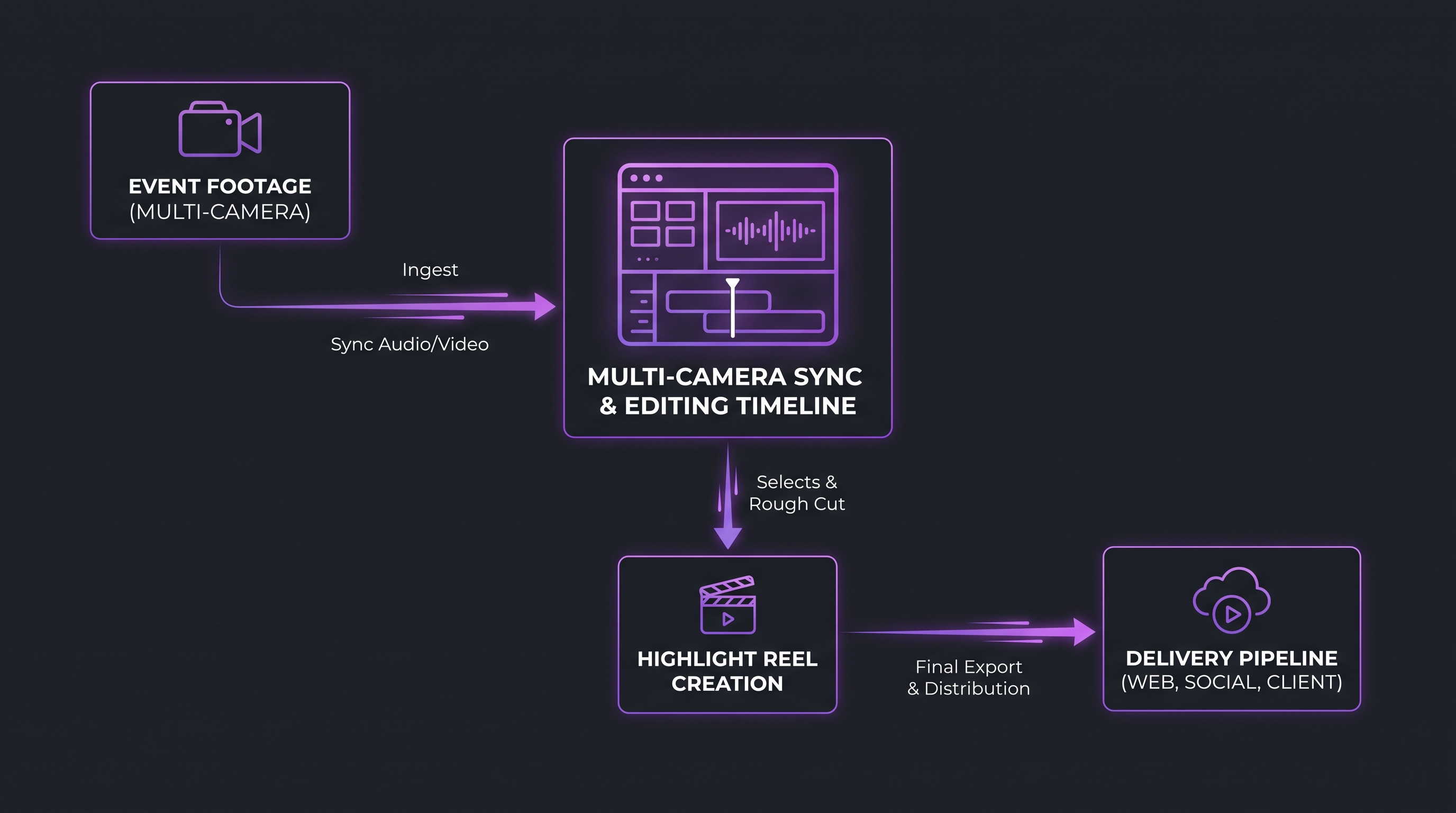
A single-camera team can shoot a keynote. But most professional event coverage uses three to six cameras simultaneously — a dedicated presenter cam, a wide audience shot, a close-up roving camera, and often a screen-capture feed from presentation slides. Syncing all of these in a multi-cam timeline, managing different focal points, and then making clean cuts that feel live without feeling choppy requires editors who have done it dozens of times. Ask any prospective partner how they handle multi-cam rushes at scale.
Turnaround and Same-Day Delivery Capability
If you need a highlight reel posted while the event is still trending on LinkedIn, turnaround is everything. Some services are built around week-long queues; others are structured for rapid event delivery. Be explicit with any vendor about your fastest-possible delivery need. Same-day capability typically requires either on-site editing support or a team specifically configured for relay editing where one editor hands off to another across time zones.
Brand Consistency Across Deliverables
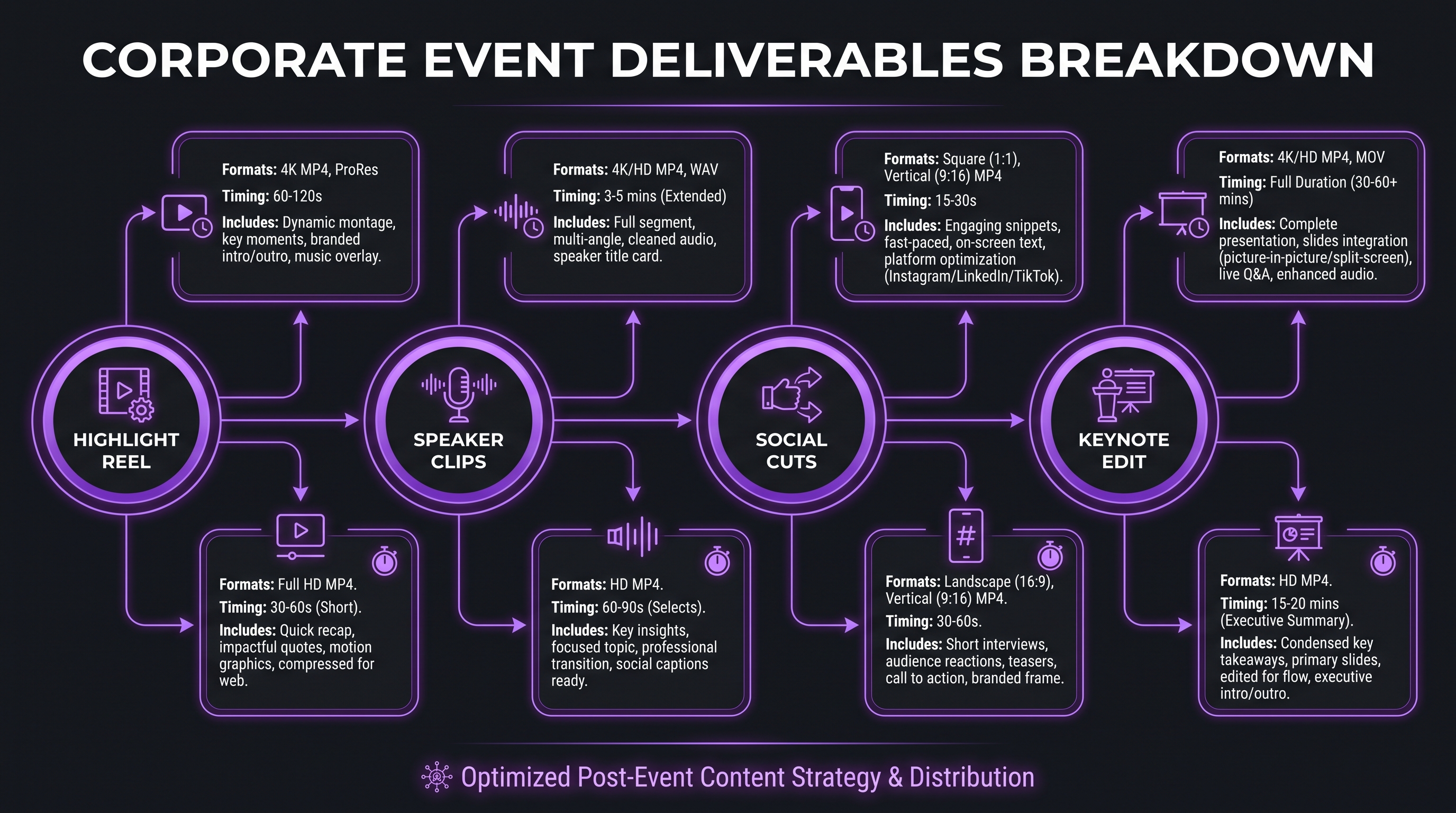
A single event commonly produces seven to fifteen distinct deliverables: the full keynote cut, a 3-minute highlight reel, speaker teaser clips for LinkedIn, a 60-second social version, a recap video for the website, and sometimes vertical cuts for Instagram Stories. Each format has different pacing and framing needs, but they all need to feel like they came from the same brand. Companies that treat each deliverable as a separate job — rather than a versioning problem to solve once — cost more time and generate more revision cycles.
Understanding of Corporate Event Storytelling
Events communicate a narrative: a company’s direction, a product’s promise, the energy of a community gathering. Good event editors understand how to select the ten seconds of audience applause that communicates the room better than two minutes of raw footage. They know to cut on the speaker’s pause, not on a gesture. And they understand that the goal of a B2B conference recap is not to document everything — it is to make a viewer who was not there wish they had been.
Scalability for Recurring Events
Companies that run quarterly all-hands sessions, annual conferences, or regular product launches need a partner who can handle recurring volume without recreating the brief from scratch each time. Retainer and subscription structures that let a dedicated editor stay assigned to your account are worth paying a premium for — institutional knowledge of your brand, speakers, and style guide pays dividends over time. Review our breakdown of unlimited video editing services if you are comparing retainer structures specifically.
💡 Pro Tip: When evaluating event video editing companies, ask specifically for examples of conference highlight reels, not just brand videos. The editing rhythm and pacing required for live events is a genuinely different skill — great brand video editors do not automatically translate to great event editors.
The 6 Best Event Video Editing Companies in 2026
The following six companies are ranked by their suitability for corporate and B2B event video post-production. Rankings reflect service model fit, editorial quality, turnaround capability, and scalability for recurring event programs — not price alone. All pricing references use hedged language because packages vary significantly by project scope and are subject to change.
1. Increditors — Best Overall for Corporate Event Video
Increditors takes the top spot in 2026 because it is built specifically for the kind of polished, high-stakes video output that corporate events demand. The agency operates on a dedicated senior editor model — your account gets consistent editorial ownership rather than a queue-based assignment system that sends your footage to a different editor each time. For B2B brands running annual conferences, investor summits, or product launch events where the output will be shared with board members and senior stakeholders, that consistency matters enormously.
What distinguishes Increditors from production studios is the strategic layer alongside the craft. The team does not just cut footage — they work with clients to plan the deliverable architecture from the brief stage, so that a single event shoot produces a coordinated set of outputs across formats and aspect ratios without redundant rounds of revision. This is particularly valuable for companies that routinely produce seven or more distinct assets from a single event: keynote cuts, highlight reels, speaker clips, social versions, and website recaps.
Pricing works on a retainer model well-suited to teams with recurring event programs. Companies managing multiple events per year find the economics shift substantially in their favor over time, as the assigned editor builds an internal brand style guide that eliminates briefing overhead. For one-off event editing projects, Increditors handles these as project-based engagements — reach out through the discovery call to discuss scope and timeline.
Best for: Corporate conferences, investor events, product launches, annual summits, and any brand program where event video will be used as a marketing asset or stakeholder communication tool.
Pros: Dedicated senior editors, strategic deliverable planning, consistent brand voice across formats, strong B2B positioning.
Cons: Retainer model may not fit single one-off event budgets. Fastest delivery depends on footage transfer speed from your production team.
Rating: 9.5/10
2. VideoEditingCompany — Best for Dedicated Team Retainer
VideoEditingCompany takes a strong #2 position for corporate event post-production teams looking for a dedicated retainer relationship. The service model is similar to Increditors in philosophy — dedicated editor assignment rather than a pooled queue — making it one of the few retainer-based editing services positioned specifically for B2B and SaaS marketing teams.
For event video specifically, the dedicated team model means your editor will already understand your motion graphics templates, color grading preferences, and brand guidelines before your next event footage arrives. That institutional familiarity reduces turnaround times on the second and third project significantly compared to working with a marketplace or production company that onboards fresh each time.
VideoEditingCompany is positioned at the premium B2B tier, meaning it is not the lowest-cost option in this list but offers reliable output quality that suits corporate use cases. Teams evaluating between VideoEditingCompany and Increditors will typically differentiate on the basis of the strategic advisory layer — Increditors offers more content strategy input, while VideoEditingCompany leans toward pure post-production execution at consistent quality.
Best for: SaaS companies, tech brands, and corporate marketing teams running recurring event programs who want a dedicated post-production partner without the overhead of managing a full in-house editor.
Pros: Dedicated editor model, B2B-aligned positioning, reliable quality consistency across events.
Cons: Less content strategy input than Increditors. Pricing sits at the premium tier — verify current rates on their site.
Rating: 8.5/10
3. Lemonlight — Best for Polished Brand Storytelling
Lemonlight has built a strong reputation in the US market for brand video production and editing — and that craft extends meaningfully into event coverage. Where many event post-production services focus on efficient assembly, Lemonlight brings a storytelling sensibility that results in event recaps that feel cinematic rather than documentary.
For brands where the event recap video is intended to function as premium content — something that will run as a paid campaign asset or anchor a website feature — Lemonlight’s production values are a fit. The team understands color, music selection, and pacing at a level that goes beyond functional assembly. Their work tends to feel like a brand film rather than a conference documentary.
The trade-off is speed and cost. Lemonlight’s project timelines typically reflect a production-focused workflow, meaning same-day delivery for social highlights is less their model and more their exception. For brands that can plan ahead and want the highest-quality single deliverable from an event, it is worth evaluating. Pricing for event projects typically varies with scope — check their website for current package structures.
Best for: Brand activations, premium product launch events, executive keynote videos intended for campaign use.
Pros: High production values, strong brand storytelling craft, polished color and sound design.
Cons: Not optimized for high-volume or same-day delivery. Project timelines longer than retainer-model services.
Rating: 8/10
4. Video Caddy — Best for Volume Event Editing
Video Caddy positions itself as a managed video editing service with a subscription model aimed at businesses that need consistent editing throughput at competitive price points. For event teams that need a steady flow of footage processed — think trade show teams producing daily social content across a three-day exhibition, or event agencies that produce ten or more events per year — Video Caddy’s volume-friendly structure can make sense.
The service works on a managed editing model where clients submit footage, briefs, and style guidelines through a portal, and the team returns edited cuts within an agreed turnaround window. This makes it efficient for repetitive event editing tasks — cutting speaker clips to a consistent template, creating same-format social versions across multiple sessions, or processing B-roll selects.
The trade-off relative to dedicated-editor services is creative depth. Video Caddy’s model is optimized for consistent template-based execution, not for the kind of narrative judgment calls that make a highlight reel feel genuinely compelling. For high-stakes flagship event videos, you will likely want a more senior editorial relationship. For production efficiency at volume, it performs well.
Best for: Event agencies and internal teams needing efficient throughput for multiple events per month. Social content factories and trade show programs.
Pros: Volume-friendly subscription pricing, reliable turnaround, good for template-based deliverables.
Cons: Less suited to narrative-heavy or flagship event videos. Editor continuity can vary by plan tier.
Rating: 7.5/10
5. Shootsta — Best for Rapid-Turnaround Event Content
Shootsta has carved out a specific niche in the corporate video market by combining a structured filming methodology with fast-turnaround editing — making it one of the more interesting options for event teams that need content moving quickly. The Shootsta model involves sending clients a kit for self-capture or coordinating with their production partners, then running footage through an editing pipeline designed to deliver consistent outputs rapidly.
For event use cases where the priority is speed and consistency over cinematic polish — internal town halls, company all-hands sessions, employee-facing conference recaps — Shootsta’s structure fits well. The platform is built for corporate communication video rather than premium external marketing content, so the editorial approach reflects that: clean, professional, and fast rather than cinematic.
The platform also offers a subscription structure that suits companies producing a steady cadence of internal events throughout the year. If your primary use case is internal stakeholder communications from events — leadership briefings, all-hands recaps, internal product reveals — Shootsta is worth a demo. If your event content is going to external audiences and will be used as marketing material, you will likely want a service with more editorial craft.
Best for: Internal corporate communications, town halls, company all-hands, and internal stakeholder event coverage.
Pros: Fast turnaround, structured methodology, subscription model, good for internal comms at scale.
Cons: Less suitable for premium external-facing marketing event content. Cinematic depth is not the focus.
Rating: 7.5/10
6. Wienot Films — Best for Creative Event Storytelling
Wienot Films brings a creative-first editorial sensibility to event video. Based in Austin, Texas, the team is known for finding the human story inside corporate events — the unrehearsed attendee reaction, the speaker moment that the script did not capture, the venue detail that sets the atmosphere. This makes their work stand out among event highlight reels that typically feel like slideshow montages set to generic music.
Wienot Films works as a production and post-production company, meaning they often handle both filming and editing for event clients — which simplifies the workflow considerably. For events where you are also sourcing production services, their end-to-end offering removes the handoff friction that can cost time and quality when production and post are handled by separate vendors.
The limitation is scale. Wienot Films operates as a boutique production company, which means they are a strong fit for individual high-quality projects but are less suited to ongoing volume programs or clients managing multiple events per quarter. If you are running a single flagship annual conference and want genuinely creative event storytelling, they are worth a serious look.
Best for: Annual flagship events, company culture storytelling, brand activation coverage where creative quality is the primary KPI.
Pros: Strong creative storytelling, end-to-end production + editing capability, genuine editorial craft.
Cons: Boutique capacity — not suited to high-volume ongoing programs. US-centric availability for on-site production needs.
Rating: 8/10
Full Comparison Table
Use this table to compare the six companies across the criteria that matter most for corporate event video post-production decisions.
Event Video Types and What Each Format Needs
One of the most common mistakes in event video post-production is treating all event footage the same. The editing approach for a same-day social highlight reel is completely different from the approach for a full keynote edit or an awards gala recap. Understanding the distinct requirements of each format helps you brief your post-production partner more precisely — and avoid wasting budget on the wrong deliverable hierarchy.
Conference and Keynote Edits
A keynote edit preserves the full speaker presentation, usually with cuts between the presenter, their slides, and audience reaction. The primary editing task is quality cleanup: stabilizing shaky cuts, matching audio levels across camera sources, and making sure slide transitions are synced. The running time is typically 30 to 90 minutes. Distribution is usually gated — posted to a conference platform, company intranet, or YouTube with restricted access.
What matters most here is audio quality and technical sync. A poorly mixed keynote edit — where the presenter sounds different when cut from Camera A to Camera B — destroys credibility. Make sure any post-production partner you hire understands dialogue editing and dialogue-specific audio cleanup, not just music and sound effects work.
Highlight Reels
The highlight reel is typically the flagship deliverable — the 2-to-4-minute distillation of the event’s energy and key moments that goes out publicly on LinkedIn, YouTube, and the company website. This is where editorial judgment matters most. The editor has to sift through hours of footage and select the moments that communicate the story of the event: the crowd reaction that shows enthusiasm, the speaker quote that crystallizes the theme, the networking moment that communicates community.
Music selection, pacing, and color grading are all critical for the highlight reel. This is also the deliverable that gets amplified by speakers and attendees — which means it represents your brand in shared contexts. Investing in editorial quality for the highlight reel pays disproportionate dividends. Understanding what professional video editing costs at different quality tiers helps set realistic expectations before briefing this deliverable.
Speaker Clips and Social Cuts
Speaker clips are 30-to-90-second extracts from keynotes or panel discussions — individual quotes that work as standalone social content. They are typically cut in multiple aspect ratios (16:9 for YouTube, 1:1 for LinkedIn, 9:16 for Stories) and require on-screen captions because most social platforms play with audio off. This is a volume deliverable — a single conference might produce twelve to twenty speaker clips — so the editing workflow needs to be template-driven and efficient.
The challenge for post-production companies is maintaining energy and context in a very short format. A clip that starts mid-sentence or loses the audience’s context in the first five seconds will not perform well organically. Good event editors know how to identify clip entry and exit points that preserve the impact of the moment.
Awards and Gala Recaps
Awards events and gala dinners have a different editorial rhythm from content-driven conferences. The audience is smaller in number but often higher in seniority, and the recap video is typically shared with award recipients and sponsors — so it needs to feel prestigious. Pacing is slower and more deliberate than a conference highlight reel. Color grading tends toward warm, elegant tones. Music choices lean cinematic rather than energetic.
This format also typically includes ceremony footage — award presentations, acceptance speeches, trophy handoffs — which requires clean multi-angle coverage and careful audio editing of the PA system sound.
How to Match Your Budget to the Right Partner
Event video post-production costs vary enormously based on the deliverable set, turnaround speed, and the editorial model of the company you work with. Rather than quoting specific numbers that become outdated quickly, here is a framework for understanding which tier of service fits which budget level.
High-Volume Event Programs (Multiple Events Per Quarter)
If your organization runs a consistent cadence of events — quarterly all-hands, monthly webinars, trade shows, recurring conference appearances — a retainer or subscription model will almost always be more cost-effective than project-based pricing. The economies of scale are significant: when your editor already knows your brand, your templates are already set up, and your revision cycle is predictable, you are paying for execution rather than onboarding every time.
For this use case, Increditors and VideoEditingCompany are the strongest structural fits. Subscription services like Video Caddy work for teams with lower production quality expectations and very high volume. Lemonlight and Wienot Films are not optimized for this model.
Annual Flagship Events (Single High-Stakes Project)
Companies that have one major annual event — a conference, summit, awards ceremony — and want to invest properly in its video output should prioritize editorial quality over cost efficiency. The return on a well-produced event highlight reel that gets thousands of views from exactly the right audience can outperform entire marketing campaigns. Project-based pricing from Lemonlight or Wienot Films may be appropriate here, or a short-term engagement with Increditors for the event itself.
Internal Communications Events (Town Halls, All-Hands)
Internal event content typically has less demanding production quality requirements — the audience is forgiving of imperfect lighting because they know the context, and the content does not need to compete for attention in a public feed. For internal comms specifically, Shootsta’s platform model makes sense, and subscription-tier options from Video Caddy are also worth evaluating. Spending premium rates on internal content that will only be viewed by employees once is often not the highest-value use of a post-production budget.
💡 Pro Tip: Before finalizing your post-production budget for any event, create a deliverable list first — every format you need, every platform it will go to, and every aspect ratio required. Most event video budgets underestimate the number of distinct deliverables by a factor of two or three. A good post-production partner will help you scope this realistically before agreeing on pricing.
Frequently Asked Questions
How long does event video editing typically take?
Turnaround time varies significantly by deliverable type and the service model of your post-production partner. Highlight reels and social clips from retainer-based services typically deliver within 24 to 72 hours of footage receipt. Full keynote edits and longer-form event films commonly take three to seven business days depending on runtime and complexity. Same-day delivery is possible with the right partner and a clear brief submitted before the event, but should be confirmed explicitly in your scope agreement — most services do not offer it as a standard feature. Building sufficient lead time into your post-event communications calendar prevents the pressure that degrades quality.
What footage do I need to provide for event video editing?
Most event video editing companies need the raw camera files from all recording angles, any separate audio tracks recorded to a mixer or recorder (rather than the camera’s built-in mic), any screen capture or presentation recordings, and a basic brief covering the deliverable list, key moments to include, brand guidelines, and the intended use and platform for each output. Providing a shot list or event runsheet from your production team helps the editor navigate the footage more quickly and reduces unnecessary revision cycles.
Can I get same-day event highlights?
Same-day highlight delivery is achievable but requires preparation before the event, not just fast editing after it. The most reliable approach involves briefing your editor in advance with your brand guidelines, a template for the highlight reel, pre-approved music, and a clear list of the key moments to look for. Some companies structure same-day delivery through relay editing — footage is ingested and passed to a team across time zones as the event progresses. If same-day delivery is a requirement, confirm this capability explicitly with any vendor before booking, and plan for fast footage transfer to their team immediately after the event concludes.
What is the difference between event video editing and event video production?
Event video production refers to the on-site work: camera operators, directors, sound engineers, and equipment management on the day of the event. Event video editing — post-production — is what happens after the event: organizing the footage, syncing multi-camera timelines, cutting the deliverables, color grading, mixing audio, adding graphics and captions, and exporting final files. Some companies handle both; others specialize in one or the other. If you already have a production company managing your event filming, you may only need a post-production partner for the editing stage. The two services are sometimes bundled at a discount, but it is worth evaluating vendors for each independently before assuming bundling is the better deal.
How do I brief an event video editor effectively?
An effective brief for event video editing covers: the full list of deliverables and their formats, the purpose and intended audience for each deliverable, the event runsheet or program so the editor can identify key moments without watching everything, any specific moments or quotes that must be included, brand guidelines including colors, fonts, and any motion graphics templates, music direction or specific approved tracks, and the review and approval process including who signs off and how many revision rounds are included. A brief that takes thirty minutes to write can save several hours of back-and-forth revision. If you are working with a new post-production partner, including a reference video — something that shows the tone and pacing you are aiming for — is one of the most efficient briefing tools available.
Verdict: Which Event Video Editing Company Is Right for You?
The right event video editing company depends almost entirely on how you answer two questions: how often do you run events, and what will the output be used for?
If you run events regularly and the output is going to external audiences — LinkedIn, your website, media, or prospects — Increditors is the clear choice. The dedicated senior editor model, strategic layer, and retainer structure are purpose-built for this exact use case. Your editor builds institutional knowledge of your brand, your deliverable set gets produced consistently at premium quality, and the economics improve as you scale.
If you want the same dedicated-team model from a slightly different positioning — more pure execution, less strategic advisory — VideoEditingCompany is a strong alternative at #2. It is a premium service built for the same B2B buyer profile.
Lemonlight and Wienot Films are the right calls for single flagship events where creative quality is the primary KPI and you have time to work through a standard production timeline. Video Caddy and Shootsta work best for internal comms, high-volume social content factories, and programs where turnaround speed and cost efficiency matter more than editorial craft.
Whatever partner you choose, brief them thoroughly before the event, align on the deliverable list before filming begins, and give your editor a reference video that shows the tone you are after. The difference between a good event recap and a forgettable one is almost always made in those pre-editing decisions — not in the edit suite itself.
Ready for Event Video That Actually Converts?
Tell us about your next event and we will put together a custom post-production plan — highlight reel, speaker clips, social cuts, and everything in between.